Crypto | Crypto
"Crypto" in Crypto feed
-
Cointelegraph.com - 15:51 Oct 09, 2026
 Wealthy investors are embracing crypto faster than their advisers, while OKX attracts new funding and Strategy shifts more capital toward preferred stock buybacks. Affluent investors appear increasingly comfortable with crypto, even if their financial advisers aren’t keeping pace. A new CoinShares survey found that a majority of wealthy investors across seven major economies already own digital assets, with many planning to increase their exposure this year. The findings come as capital continues to move into crypto in other ways, even against a tougher market backdrop. Bitcoin is trying to build on its best quarter since 2017 while Treasury yields remain above 5%, and OKX has raised additional funding at a $25 billion valuation. Meanwhile, Strategy is putting more capital into its preferred stock. The company spent more than six times as much buying back STRC shares last week as it did buying Bitcoin. Read more
-
Cointelegraph.com - 05:34 Oct 09, 2026
 Anthropic’s new opt-in service promises vulnerability reports from its strongest AI models, including Claude Mythos. Ethereum client developer Nethermind and Bitcoin and Lightning wallet ZEUS are among several crypto companies to apply for a newly launched Anthropic program that gives open-source projects access to security reports from its most powerful AI models. The projects submitted enrollment requests on Friday for OSS Scanner, which Anthropic launched on Thursday with the aim of helping open-source developers find and fix vulnerabilities before attackers exploit them. “These reports will be generated by our strongest models (including Claude Mythos) to give open-source projects the largest defensive advantage,” Anthropic said in its announcement. Read more
-
Cointelegraph.com - 13:30 Oct 08, 2026
 Crypto lending has risen by 55% since July, but now has to deal with the dangers of AI assisted hacks, and risks cascading through interlinked protocols. Here’s how to stay safe. As the charts flip from red to green, crypto lending has seen a resurgence of interest after a particularly dismal second quarter. Figures from Galaxy show that $11.33 billion left the sector in Q2 — partly due to the crisis of confidence in lenders caused by the Kelp DAO hack in April that left users of the most trusted protocol, Aave, unable to access their ETH. Since the beginning of July, however, total lending value locked has gained more than 55% to sit around $56 billion today. Read more
-
Cointelegraph.com - 05:06 Oct 08, 2026
 Former New York Governor Andrew Cuomo urged the crypto industry to balance its support for Democrats and Republicans if they want federal crypto legislation passed. The crypto industry’s heavy backing of US Republicans has alienated Democrats whose support is needed to pass federal crypto legislation, says former New York Governor Andrew Cuomo. Speaking in a panel with OKX CEO Star Xu at Token2049 on Tuesday, Cuomo said the industry “believed in investing heavily in the Republican Party” as a way to get the CLARITY Act passed. Crypto-focused political action committees tracked by Tech Influence Watch have spent $54.3 million supporting Republicans in the 2026 election cycle, compared with $26.2 million supporting Democrats. Another $23.2 million has been spent opposing Democrats, according to the tracker’s latest figures checked on Thursday. Read more
-
Cointelegraph.com - 04:28 Oct 08, 2026
 Canton CEO Yuval Rooz compared blockchain adoption to Uber and Airbnb, arguing that widespread adoption could help insulate it from potential policy reversals. Digital Asset co-founder and CEO Yuval Rooz said the crypto industry should use the current regulatory environment to accelerate institutional adoption, arguing that widespread use of blockchain could make it harder for future administrations to reverse the industry’s progress. Speaking at Token2049 in Singapore, Rooz said the industry should make blockchain so widely used that whatever happens in 2028, “there is no going back.” The next US presidential election, which could bring a change in administration and regulatory priorities, is scheduled for Nov. 7, 2028. He compared the opportunity to Uber and Airbnb, where he argued both services became entrenched before policymakers could effectively restrict them. “By the time people got their act together and decided, OK, we wanna legislate against those companies, it was too late,” Rooz said. Read more
-
Cointelegraph.com - 11:37 Oct 07, 2026
 Crypto card demand can be stronger where access is harder, Tangem says, as the company expands its self-custodial payment offering through Visa. More than 40% of Tangem Pay payments come from Latin America and over 30% from the US, while physical card availability remains restricted in some markets, the Swiss crypto wallet provider told Cointelegraph. “It is not simply a question of where people want crypto cards,” Andrey Ilinskiy, head of Tangem Pay, told Cointelegraph, adding: “It is where demand, regulation, banking infrastructure and card-issuing requirements happen to line up — and today, those maps do not always overlap.” On Wednesday, Tangem announced its first physical Visa card for in-store and online purchases and ATM withdrawals, with an initial release limited to 5,000 cards. Read more
-
Cointelegraph.com - 09:45 Oct 07, 2026
 Bitcoin fell 2.3% in two hours amid suspicion over the appearance of leveraged BTC short positions on Hyperliquid. Bitcoin (BTC) dipped below $84,000 on Wednesday as flash downside liquidated over $500 million in crypto long positions. Key points: Read more
-
Cointelegraph.com - 21:42 Oct 05, 2026
 Fairshake said it would financially back 32 House candidates who all voted in favor of the CLARITY market structure bill in 2025, as the legislation remains in limbo in the Senate. Fairshake, the political action committee (PAC) backed by contributions from Coinbase, Ripple Labs and Andreessen Horowitz, announced that it would initially spend a combined $6 million on six House of Representatives candidates out of 32 people the group planned to back ahead of the 2026 US midterm elections. On Monday, Fairshake said that it would support 19 Republican and 13 Democratic incumbents in US House races for 2026. The PAC is expected to spend more than $100 million on ads supporting House and Senate candidates in 2026, including at least $30 million in Ohio’s Senate race to back Republican Jon Husted over Democrat Sherrod Brown. “Fairshake has always been and always will be an issue-focused organization,” said Fairshake spokesperson Geoff Vetter. “We back pro-crypto candidates who support American innovation in both p...
-
CoinDesk - 14:00 Oct 04, 2026
Crypto firms have spent years building financial products on blockchains. Getting people to use them — and keep using them — is becoming the next challenge. -
CryptoSlate - 19:10 Oct 02, 2026
A third-party lending adapter built on Aave was exploited to steal about 114 ETH, worth over $300,000, while the protocol itself remained unaffected. On Oct. 2, blockchain security firm SlowMist said the attacker compromised two Safe multisig wallets through a flaw in the FlashLoopAdapter used with Aave v3 positions. The exploit allowed the attacker to […] The post Crypto hackers exploit third-party Aave tool to steal 114 ETH appeared first on CryptoSlate. -
Cointelegraph.com - 15:32 Oct 02, 2026
 Kalshi seeks a $40 billion valuation, while Blockchain.com targets an IPO and crypto treasury companies struggle to maintain their once-high valuations. Crypto companies are raising billions again, but investors are no longer handing out premiums indiscriminately. Kalshi is reportedly seeking $1 billion at a $40 billion valuation, nearly twice what it was worth in May. Meanwhile, Blockchain.com is preparing for an initial public offering (IPO) at a potential $6 billion valuation, well below the $14 billion it commanded during the last crypto boom. The divide is even sharper among digital asset treasury companies, where just four of the 20 largest still trade above the value of their crypto holdings. This week’s Crypto Biz looks at where investors are still willing to pay up, where the old crypto premium has disappeared and how Bitget is dealing with the fallout from a $388 million security breach. Read more
-
CryptoSlate - 00:20 Oct 02, 2026
Crypto firms and users have lost nearly $2.7 billion to security incidents this year, with North Korea-linked thefts exceeding $1 billion. Blockchain security firm CertiK recorded 658 incidents through September, with about $420.4 million of stolen assets frozen or returned. That leaves adjusted losses of roughly $2.26 billion and an average loss of $4.1 million […] The post Crypto hackers have taken $2.7 billion in 2026 and the losses are alarmingly concentrated appeared first on CryptoSlate. -
Cointelegraph.com - 04:44 Oct 01, 2026
 The $388 million Bitget breach and $320 million Liquid Network exploit accounted for most of September’s losses, though more than $270 million from the latter was later returned. Crypto suffered its worst month of the year for hacks and exploits in September, with two blockchain security firms estimating losses at more than $766 million. PeckShield counted 55 major incidents resulting in $766.5 million in stolen funds, while CertiK recorded 97 incidents and estimated losses at $768.4 million. Both firms showed the losses were a significant increase from August. The month included the $388 million Bitget hack and a $320 million hack of the Liquid Network. More than $270 million was later returned, according to reports. The incidents rank among the largest crypto thefts of the year. Read more
-
Cointelegraph.com - 19:11 Sep 30, 2026
 The organization’s endorsements in the House and Senate came as many polls showed Democrats favored to regain control of both chambers in 2027. Update (Sept. 30, 10:55 pm UTC): This article has been updated to include a response from Stand With Crypto. Stand With Crypto, the industry-aligned organization Coinbase launched in 2023 to promote what it called “clear, common-sense regulations for the crypto industry,” has announced several picks for the next session of the US Congress. On Wednesday, Bloomberg first reported that Stand With Crypto said it would be supporting candidates running for Senate seats in 2026, including Republican Jon Husted in Ohio, Republican Ashley Hinson in Iowa and Democrat Chris Pappas in New Hampshire. Husted is defending his Senate seat against Democrat Sherrod Brown, who lost to Republican Bernie Moreno in 2024 after outside groups spent more than $300 million in Ohio. Read more
-
Cointelegraph.com - 10:11 Sep 30, 2026
 From touchscreen and QR-code devices to NFC cards and Bitcoin-only models, this guide compares hardware wallets by security, connectivity, usability and recovery options to help users choose the right fit. A hardware wallet is a device designed to protect the private keys used to approve cryptocurrency transactions. In plain terms, your crypto remains on the blockchain, while a hardware wallet holds the keys that let you access it. The main differences between wallets are which coins they support, how they connect to your phone or computer, and how you check and approve a transaction. This guide explains those differences and what they mean when choosing a wallet. Cointelegraph tested Trezor Safe 7, Ledger Stax, Flex, Nano Gen5, Nano X, Nano S Plus and Coinkite’s Opendime. Testing used smartphones and computers running both Linux and macOS operating systems, with both third-party and official software. The Opendime was used as cold storage; the others were used to test both simple transactions and decentraliz...
-
Cointelegraph.com - 03:40 Sep 30, 2026
 In February, ai.com drew enough traffic to crash its website after a $15 million Super Bowl ad, but months later, users are still wondering what’s happened to their promised AI agent. Crypto.com says its personal AI agent venture, pitched to perform a broad set of tasks from trading stocks to updating online dating profiles, is still under construction, months after a Super Bowl debut that got so much attention it crashed the website. Ai.com, a business line of Crypto.com, promoted the launch of its AI platform in a $15 million ad during the fourth quarter of the Super Bowl in February. The website crashed within minutes as curious users flocked to reserve a handle for their own personal AI agent. However, nearly eight months later, the website continues to display a message that AI agent generation is queued due to high demand. Read more
-
Cointelegraph.com - 19:59 Sep 29, 2026
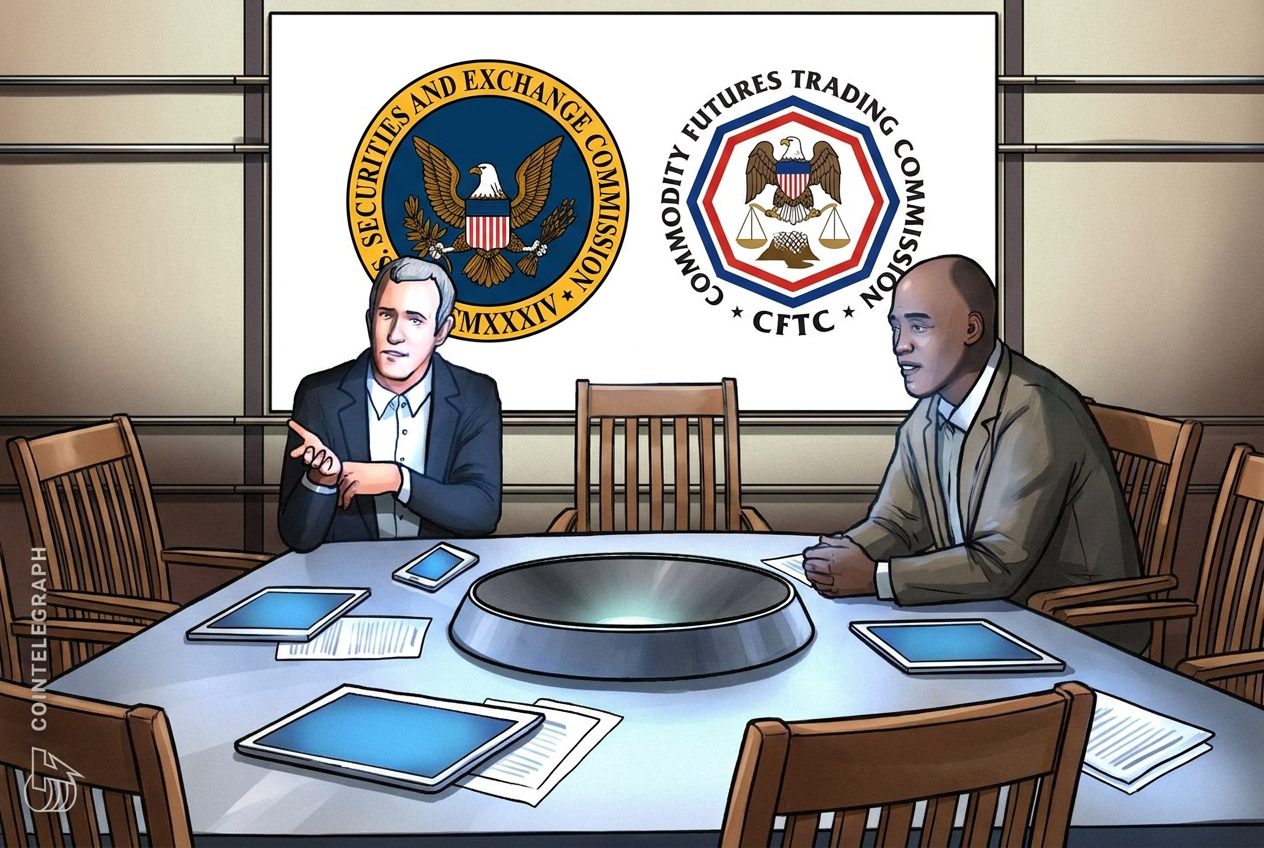 Seven commissioner seats at the SEC and CFTC will be empty after Friday, leaving only a few leaders at financial regulators to oversee aspects of the $3 trillion crypto industry. Update (Sept. 29, 8:45 pm UTC): This article has been updated to include a response from the CFTC. Two of the United States’ financial agencies tasked with overseeing and enforcing digital asset regulation will be down to just three commissioners after Friday, following the departure of a Republican member. On Friday, Hester Peirce, who served as a commissioner with the US Securities and Exchange Commission (SEC) for eight years, will leave the agency about two months before the end of the 18-month extension for her second term. The departure of Peirce, whom many in the industry knew as “Crypto Mom” for her views on digital assets, will mark only the second time in US history the agency has operated with two commissioners. Read more
-
Cointelegraph.com - 16:48 Sep 28, 2026
 Fairshake pledged an initial $30 million on media opposing the Democratic candidate in Ohio’s Senate race in what some see as a repeat of spending by the crypto industry in 2024. A political action committee (PAC) aligned with and largely funded by the cryptocurrency industry reported spending more than $11 million on ads supporting Republican Jon Husted and opposing Democrat Sherrod Brown in a race for one of Ohio’s seats in the US Senate. In a Thursday filing with the Federal Election Commission (FEC), the Defend American Jobs PAC, affiliated with the Coinbase- and Ripple Labs-backed group Fairshake, reported spending $11.4 million on media supporting Husted and opposing Brown’s potential return to the Senate. The ad buys appeared to be part of Fairshake’s pledge to initially spend $30 million in the Ohio race in an attempt to block Brown, who was previously chair of the Senate Banking Committee and one of the more outspoken voices in Congress against pro-crypto legislation and policies. Sept. 24 filing fro...
-
CryptoSlate - 09:10 Sep 28, 2026
Scammers built a counterfeit version of Upbit-backed GIWA blockchain and lured 1,333 wallets into depositing 767 ETH, worth about $2 million, before draining almost all of it. The fake network appeared to be GIWA’s anticipated Ethereum Layer 2 mainnet, complete with an RPC endpoint, cross-chain bridge, and Chain ID 9134, the identifier associated with the […] The post Crypto scammers built an entire fake blockchain to steal over $2 million appeared first on CryptoSlate. -
Cointelegraph.com - 15:49 Sep 25, 2026
 Stablecoins and tokenized assets are pushing banks, exchanges and crypto companies into the same markets, from payments to stocks and ETFs. The line between crypto companies and traditional finance is blurring. Binance is buying a $100 million stake in Circle, Canada’s six largest banks are exploring tokenized deposits and the New York Stock Exchange is working with Blockchain.com to bring US stocks and ETFs onchain. Crypto companies want a bigger role in payments and traditional assets, while banks and exchanges are bringing those markets onchain without giving up their place at the center of the financial system. This week’s Crypto Biz highlights how stablecoins and tokenized assets put crypto companies and traditional finance on increasingly overlapping turf, with both sides vying for control over how money and assets move. Read more