Publisher items dated Wednesday, 4 February 2026, grouped by their original publication date in UTC. Open the source for the full report and its later updates.
Base’s Jesse Pollak says L2s can’t be “Ethereum but cheaper” as builders respond to Vitalik Buterin’s call for specialization. Several layer-2 builders responded after Ethereum co-founder Vitalik Buterin said the original vision of L2s as the primary scaling engine “no longer makes sense,” calling for a shift toward specialization. In a Wednesday post, Buterin argued that many L2s have failed to fully inherit Ethereum’s security due to continued reliance on multisig bridges, while the base layer is increasingly capable of handling more throughput via gas-limit increases and future native rollups. The comments prompted responses from Ethereum layer 2s, who broadly agreed that rollups must evolve beyond being cheaper versions of Ethereum but diverged on whether scaling should remain central…
Tether CEO Paolo Ardoino scaled back the company's $20 billion funding plan, calling the target a "misconception," while maintaining a $500 billion valuation. Update (Feb. 4, 3:20 pm UTC): This article was updated to include a statement from Tether CEO Paolo Ardoino, and the headline has been revised to reflect the changes. Tether, issuer of USDt — the largest stablecoin by market capitalization — denied it had ever planned to raise up to $20 billion, contrary to reports that circulated last fall. “There has been a misconception around the capital raise, amplified by unnecessary noise and speculation rather than by anything that has materially changed,” Tether CEO Paolo Ardoino told Cointelegraph on Wednesday.
Base is rolling out month-long infrastructure upgrades aimed at preventing future transaction delays and improving overall network reliability. Coinbase’s Ethereum layer-2 network Base said recent slow or missing transactions were caused by a configuration error that has been fixed. Over the weekend, Base users experienced elevated transaction drops and delays in getting transactions included onchain. Despite the slowdown, blocks continued to be produced and the network remained operational, suggesting that the incident didn’t cause a full outage. In a Wednesday post on X, Base explained that a change to transaction propagation led the block builder to repeatedly fetch transactions that could not be executed as base fees climbed quickly.
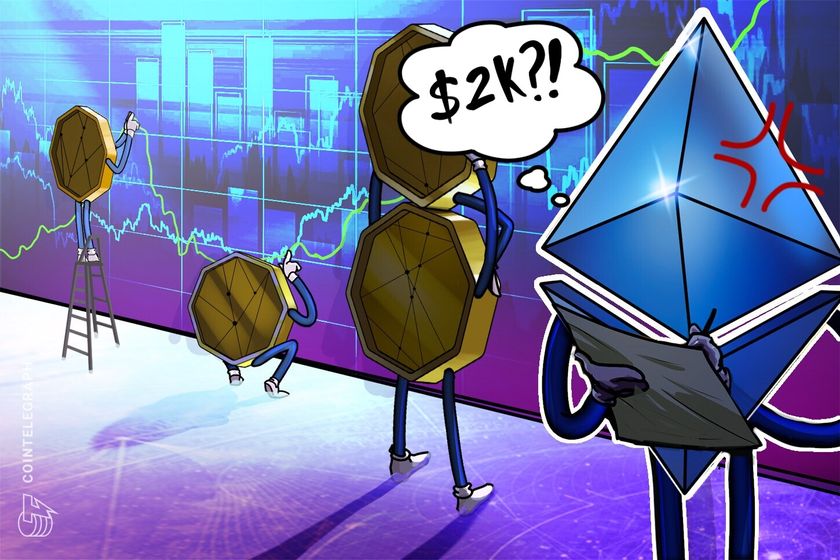
Ether risks declining toward the $1,665-$1,725 range in February, according to a confluence of bearish technical and on-chain indicators. The price of Ethereum’s native token, Ether (ETH), risks sliding below $2,000 in February as a classic bearish setup plays out. Key takeaways: ETH breakdown keeps $1,665 downside target in focus.
The firm addressed speculation that a multibillion-dollar client trade was motivated by concerns over Bitcoin’s resistance to future quantum computing advances. Galaxy Digital denied that a $9 billion Bitcoin sale by one of its clients was linked to quantum computing risks, countering speculation after its earnings call. Following the company’s earnings call, crypto community members pointed to a $9 billion Bitcoin (BTC) sale by one of Galaxy’s wealthy customers who was ”fairly concerned about BTC quantum resistance.” Alex Thorn, Galaxy's head of research, said in a Tuesday X post that the $9 billion trade executed on behalf of its client was not due to Bitcoin-related quantum computing concerns.
US spot Bitcoin exchange-traded funds recorded $561.8 million in net inflows on Feb. 2, ending a four-day streak of nearly $1.5 billion in outflows. Investors could interpret the number as a return of conviction after punishing outflows, but Jamie Coutts, chief crypto analyst at Real Vision, offered a different read. According to him: “Aggregate ETF …
Aave's strategic consolidation under a single brand reflects a broader industry shift toward specialized financial products over general-purpose crypto wallets following months of governance disputes and regulatory clarity.
Spot Bitcoin ETF AUM fell below $100 billion after $272 million in outflows, pushing year-to-date losses close to $1.3 billion. Assets in spot Bitcoin (BTC) ETFs slipped below $100 billion on Tuesday following a fresh $272 million in outflows. According to data from SoSoValue, the move marked the first time spot Bitcoin ETF assets under management have fallen below that level since April 2025, after peaking at about $168 billion in October. The drop came amid a broader crypto market sell-off, with Bitcoin sliding below $74,000 on Tuesday. The global cryptocurrency market capitalization fell from $3.11 trillion to $2.64 trillion over the past week, according to CoinGecko.