
Saylor’s Strategy Strengthens Liquidity Position but Long-Term Bitcoin Plan Still Faces Scrutiny
Strategy introduced its Digital Credit Capital Framework, boosting its U.S. dollar reserve target to roughly $3 billion.
Publisher items dated Sunday, 19 July 2026, grouped by their original publication date in UTC. Open the source for the full report and its later updates.
Strategy introduced its Digital Credit Capital Framework, boosting its U.S. dollar reserve target to roughly $3 billion.
Monday was extremely painful for the BTC funds, but the rest of the week managed to offset the losses.
The offence took effect July 17 without naming crypto, forcing UK-linked firms to reconstruct what they knew and when.
The stablecoin-focused GENIUS Act became a law a year ago.
Proposed trust changes would require no-less-than-quarterly cash distributions, creating a common cadence without fixing payout amounts or yield.
Thursday was the funds' best day since late June. However, one thing has to be addressed.
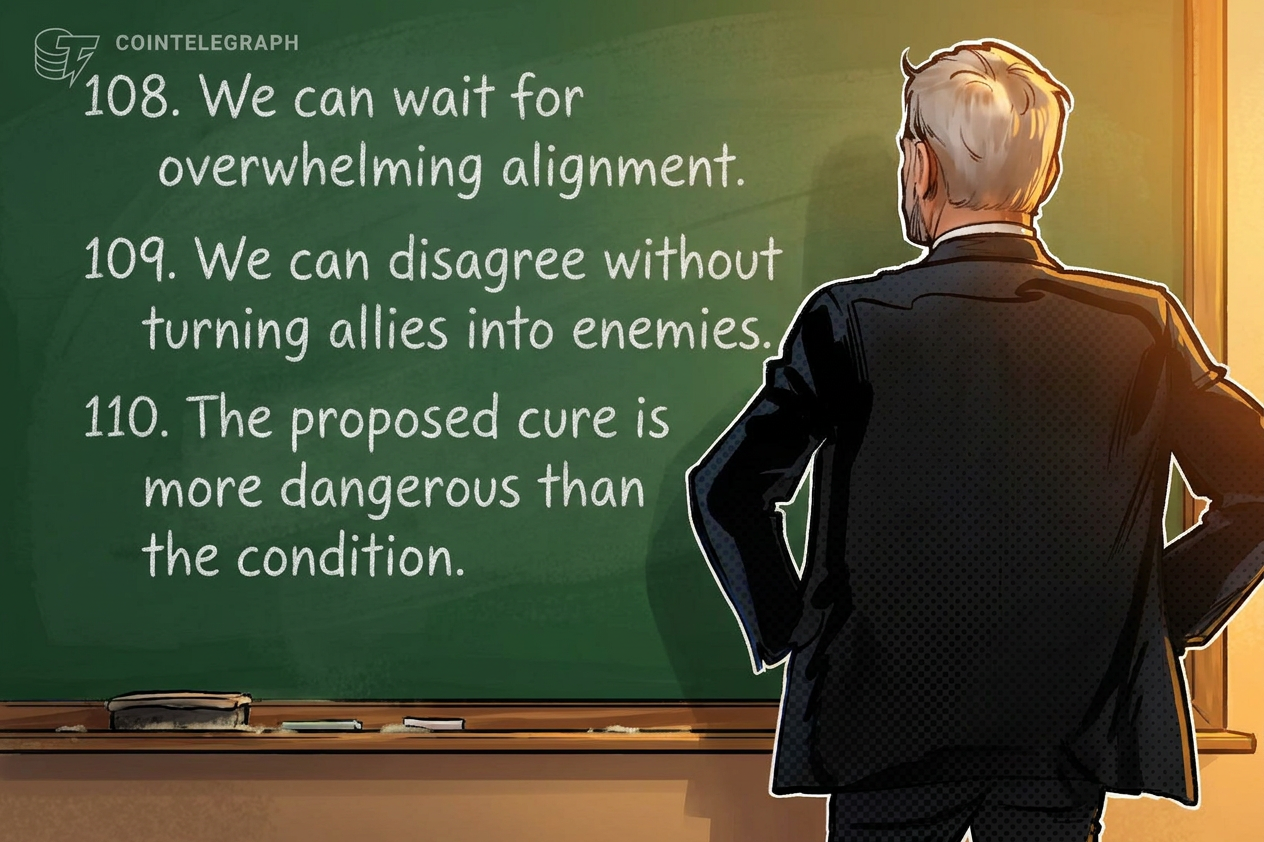
The man in control of the biggest Bitcoin corporate treasury said he shares the objectives but disagrees about the remedy detailed in the proposed temporary fork. Strategy executive chairman Michael Saylor took to social media on Sunday to detail his “110 reasons” why a proposed temporary fork to limit non-monetary transactions on the Bitcoin network, or BIP-110, is a bad idea. Bitcoin Improvement Proposal-110 was introduced in December 2025 to stop nonfungible token-like Ordinals inscriptions and other arbitrary data from spamming the network and to preserve BTC’s main use as a peer-to-peer cash system. In a roughly 3,700 word post on X.com, the man in control of the largest Bitcoin (BTC) corporate treasury made a case for what he said are “neutral rules, hard consensus, open markets, and…
Consensys found no compromised assets or data, no malicious code deployment and no user impact, but contractor access controls face scrutiny.
Michael Saylor argues that a new proposal, BIP-110, to temporarily block "spam" data from the Bitcoin blockchain would undermine the network's neutrality and create a dangerous precedent for censorship.
For two decades, the American investor essentially got a free insurance policy. When equities fell, Treasuries rallied, and the loss on one side of the portfolio was partly covered by the gain on the other. That relationship became so reliable that an entire industry built products on it, and an entire generation of allocators started …
The community wonders what is behind this sudden Sunday price pump.
Grok AI predicts intriguing XRP price movements with five key factors supporting a potential rise by mid-August.
The rise of autonomous AI agents necessitates the utilization of zero-knowledge proofs, argues Brian Trunzo, chief growth officer at Succinct Labs.
The entire perception around his Sunday posts on X has shifted.
Bitcoin continues to recover from its June capitulation but remains trapped beneath a major resistance cluster. Although buyers have managed to defend higher lows on the lower timeframe, the market is still approaching a critical confluence that could determine whether the recovery extends or transitions into another rejection. BTC Price Analysis: The Daily Chart On …
Investigators reportedly followed Bitcoin-funded gift cards to Uber Eats deliveries, showing both sides of software-mediated wallet risk.
The Wyoming-based firm launched USD-settled bitcoin and ether options, saying product design, not demand, has held back adoption.
The GENIUS Act has hit its first anniversary without U.S. regulators yet meeting deadlines to write regulations, though rules will be in full effect by July 2028.
US regulators failed to finalize implementing regulations by the GENIUS Act’s one-year deadline, issuing 10 proposed rules instead. US regulatory agencies missed Saturday’s rulemaking deadline under the Guiding and Establishing National Innovation for US Stablecoins (GENIUS) Act, one year after the law was signed. While several regulatory agencies published proposed rules and collected public feedback during the past year, no final regulations were issued before the deadline. Those agencies include the Department of the Treasury, the Office of the Comptroller of the Currency (OCC), the Federal Deposit Insurance Corporation (FDIC) and the Federal Reserve Board, according to rulemaking trackers by law firm Chapman and crypto investment company Paradigm.

Cooling holder losses support a higher low, but weak spot demand leaves Bitcoin below its first major recovery test near $69,000.


