Iran | News
-
The Express Tribune - 14:32 Jul 30, 2026
US Senate blocked a bid to curb military action on Iran, leaving the president's authority unchanged -
The Express Tribune - 09:28 Jul 30, 2026
Iran set to receive up to 400 Chinese-made air-defence missile systems within weeks amid efforts to rebuild forces -
Dawn - 08:23 Jul 30, 2026
The Foreign Office (FO) said on Thursday that Pakistan was doing its “utmost” to bring the United States and Iran back to the negotiating table under the Islamabad memorandum of understanding (MoU) signed last month. Addressing a weekly press briefing, FO spokesperson Tahir Andrabi said Pakistan noted with concern that the security situation in the Middle East “remains precarious despite the relative calm of the past few days, which had rekindled hopes that this positive development, this calm, would consolidate into a durable and fully respected ceasefire and pave the way for dialogue”. Andrabi reiterated Pakistan’s support for dialogue and diplomacy, maintaining that it remained the “only viable path forward”. “We welcome all efforts aimed at sustaining cessation of hostilities and resumption of dialogue between Iran and the US,” he said, adding that Pakistan remained engaged and will continue to do so. “Let me add that the negotiations between parties are ongoing to normalise the situation, particularly th... -
Dawn - 05:51 Jul 30, 2026
The US military completed a “heavy wave of strikes” against Iran on Thursday in retaliation for Tehran targeting American bases in Jordan, as fighting intensified in the Middle East war after a nearly week-long pause. The reignited hostilities appear to have dashed hopes of a quick return to negotiations between the foes. US President Donald Trump had vowed to hit Iran “hard” after Tehran launched missiles at Jordan, its first regional strike in days. American forces “successfully completed a heavy wave of strikes against Iran”, and struck dozens of Islamic Revolutionary Guard targets including military command centres, US Central Command (Centocom) said. “The strikes aimed to further diminish threats posed by Iran and its proxies to American forces, commercial shipping, and neighboring Gulf countries,” it said. Iran’s state news agency IRNA reported hits on several cities in the southwestern Khuzestan province, as well as on Qeshm island in the Gulf. Areas around the cities of Abadan, Shadegan, Arvandkenar a... -
ukrinform.net - 01:39 Jul 30, 2026
The commander of the U.S. Central Command (CENTCOM), Admiral Brad Cooper, has warned American service members that videos posted online from their mobile phones could be used by Iran to help adjust strikes against U.S. military bases. -
NU.nl - 18:51 Jul 29, 2026
Een Noorse tiener is woensdag schuldig bevonden aan samenzwering tot moord. Hij reisde naar Engeland om daar iemand te vermoorden in opdracht van een internationale criminele organisatie die banden heeft met Iran. Hij zou daar een flinke som voor krijgen. -
NU.nl - 17:31 Jul 29, 2026
Met nieuwe aanvallen tussen de Verenigde Staten en Iran is een gevechtspauze alweer ten einde. De opties van de Amerikaanse president Donald Trump raken op: hij kan een deal sluiten die slecht uitpakt voor de VS óf een grondoorlog starten waar niemand op zit te wachten. -
Cointelegraph.com - 17:06 Jul 29, 2026
 Bitcoin traders weathered an oil-price surge and ongoing Asia chip-stock sell-off into the Federal Reserve interest-rate decision. Bitcoin (BTC) whipsawed around $64,000 on Wednesday as geopolitical and macroeconomic tensions pressured US stocks. Key points: Data from TradingView showed BTC/USD halting a local rebound at the Wall Street open, having hit 11-day lows of $62,700 the day prior. Read more
 -
Haaretz - 15:43 Jul 29, 2026
The senior official added that Netanyahu did not announce Israel's preferred outcome, and that ultimately the final decision whether to continue the offensive against Iran rests with Trump, unless Tehran attacks first -
Haaretz - 09:24 Jul 29, 2026
Iran's Revolutionary Guards said they fired several ballistic missiles at U.S. facilities in Jordan. It is the first Iranian strike on a U.S. base since Friday, when Trump abruptly called off a 13-day bombing campaign and Iran appeared to follow suit -
NU.nl - 05:36 Jul 29, 2026
Iran heeft een dagenlange gevechtspauze in de nacht van dinsdag op woensdag beëindigd met aanvallen op Amerikaanse bases in het Midden-Oosten en olietankers. Saoedi-Arabië voerde in samenwerking met Amerikaanse strijdkrachten "gerichte aanvallen" uit op door Iran gesteunde milities in Irak. -
Adevarul Romania - 02:40 Jul 29, 2026
Temerile că războiul Rusiei împotriva Ucrainei și conflictul din Iran ar putea converge într-un singur front s-au intensificat după ce un atac ucrainean asupra unei nave iraniene a alimentat tensiunile dintre cele două regiuni. -
Dawn - 17:40 Jul 28, 2026
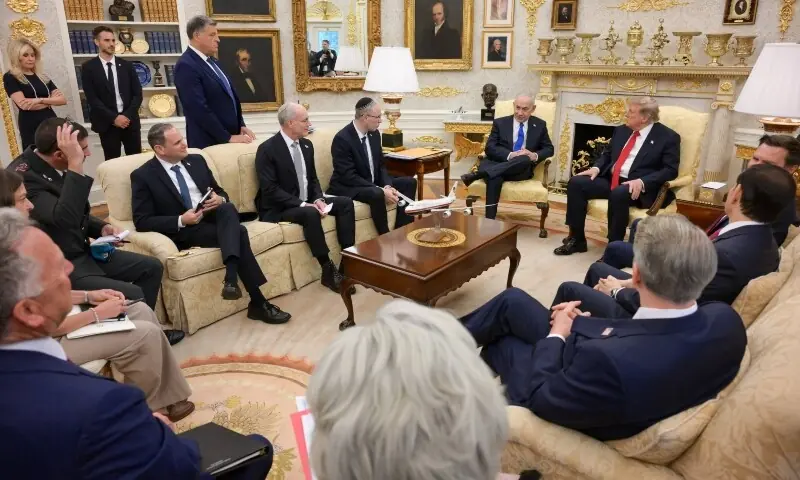 Israeli Prime Minister Benjamin Netanyahu visited the White House on Tuesday for his first in-person talks with President Donald Trump since the Iran war began, as the leaders sought to patch over public disagreements on the conflict. The meeting, which took place behind closed doors, was expected to be dominated by the war, which began with US and Israeli strikes on Iran in late February but has seen a recent pause in the fighting as Washington says it wants to give negotiations a chance. Israel has not taken part in the latest round of hostilities between the United States and Iran, which flared earlier this month as an April ceasefire collapsed. The talks — which the White House described as “positive and productive” — lasted for about an hour and a half. The meeting is the eighth between the leaders since Trump’s return to office in early 2025 and comes ahead of key electoral tests later this year for both Netanyahu and the US president: national elections in Israel and midterm polls in the United States....
 -
Haaretz - 15:19 Jul 28, 2026
Iran wants to manage the strait alongside Oman, which controls the opposite shore, while Washington wants to return to the status quo before the war, when ships were able to pass freely with no payments, claiming that charging mandatory fees would be illegal -
ukrinform.net - 14:19 Jul 28, 2026
A bipartisan group of U.S. senators announced on Tuesday that they had reached an agreement on long-awaited legislation that would authorize President Donald Trump to impose additional restrictions on major purchasers of Russian energy, as well as expand sanctions on Iran. -
The Express Tribune - 10:12 Jul 28, 2026
Iran has yet to respond to Oman proposals aimed at ending Strait trade disruption from US-Israeli war -
Dawn - 03:26 Jul 28, 2026
AT least 624 US military service members have been wounded since President Donald Trump ordered strikes against Iran in February, according to the Pentagon’s most recent update on 25 July, BBC News reported. Among those wounded, 417 are attributed to Operation Epic Fury, while 207 are attributed to “Overseas Operations”. The US and Iran agreed to a ceasefire in April and signed a Memorandum of Understanding in June, but attacks by both sides have continued throughout. Revised casualty figures, unexplained changes to official records draw criticism over transparency Last week, the Pentagon revised its figures on those injured and killed in the war, removing the names of four personnel who died in Operation Epic Fury and adding them to the death toll for Overseas Operations. On the Pentagon’s Defence Analysis Casualty System, the death toll for Operation Epic Fury — the name given to the initial attack — was listed at 18 as late as Tuesday, along with 482 wounded, according to BBC News. At some point, four of ... -
The Express Tribune - 01:47 Jul 28, 2026
Relations with Zelenskiy warm while White House frustration mounts over stalled progress in Iran conflict -
Haaretz - 20:34 Jul 27, 2026
Trump says Turkey is a 'good ally' and that no one would tell the U.S. what to sell after saying he would consider F-35 sales to Ankara. A White House source told Haaretz that Trump will discuss Iran, Lebanon and the Abraham Accords with Netanyahu -
Dawn - 15:19 Jul 27, 2026
Oil prices hovered around a one-week low on Monday after the US and Iran paused strikes over the weekend following two weeks of attacks, raising hopes of a diplomatic solution that would de-escalate the conflict and allow shipping to resume in the Strait of Hormuz. Brent crude futures fell $5.85, or around 6 per cent, to $90.93 a barrel by 1:09pm GMT (6:09pm PKT). They fell as low as 9.5pc earlier in the session to $87.55 a barrel. US West Texas Intermediate crude was at $84.33 a barrel, down $4.98, or around 5.6pc and going as low as 8pc earlier in the day to $82.12 a barrel. Both contracts were trading at their lowest levels since July 20 earlier in the session. Brent had reached $100 per barrel as the conflict, which reduced oil shipments via the Strait of Hormuz, spilled over to the Red Sea, hindering exports from the world’s top exporter, Saudi Arabia, via the Bab el-Mandeb strait to Asia. The US ambassador to the United Nations, Mike Waltz, told Fox News on Sunday and other US media that President Donal...