Iran | News
-
Dawn - 06:01 Mar 20, 2026
WASHINGTON: Japanese Prime Minister Sanae Takaichi sailed smoothly past a potential clash with Donald Trump on Iran on Thursday — although the US president whipped up a bit of a storm about Pearl Harbor. Days after lashing out at US allies including Japan for failing to heed his calls to help reopen the Strait of Hormuz, Trump praised Tokyo’s efforts related to the Middle East war in vague terms. “I believe that, based on statements (which) were given to us yesterday, the day before yesterday, having to do with Japan, they are really stepping up to the plate,” Trump told reporters as he hosted Takaichi in the Oval Office. After a long pause Trump then added “unlike Nato,” repeating his criticisms of the US-led military alliance with mainly European countries. Trump gave few details about what help Japan might provide in securing the crucial waterway, through which one-fifth of the world’s oil normally passes. But his tone towards Takaichi was far more friendly than the tongue-lashings he has given to allies, ... -
The Nation - National - 05:33 Mar 20, 2026
The Islamic Revolutionary Guard Corps (IRGC) has claimed it struck and “seriously damaged” a F-35 Lightning II over central Iran, amid rising regional tensions. -
Haaretz - 04:00 Mar 20, 2026
It's unclear whether U.S. President Donald Trump is trying to calm things down or whether he wants to spark an energy war, but Iran is willing to hold out. Either way, it suits Netanyahu -
Dawn - 02:45 Mar 20, 2026
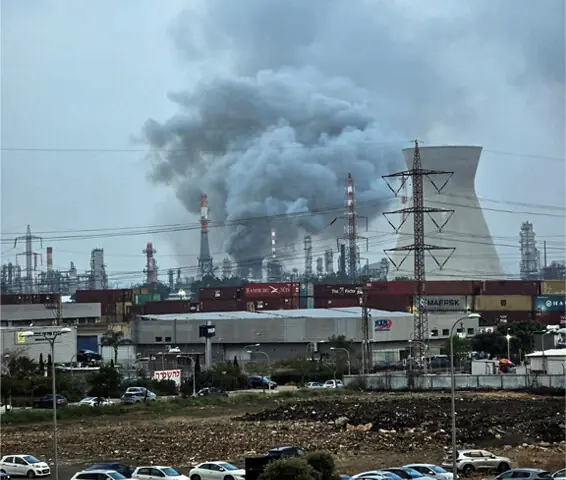 SMOKE rises after an Iranian retaliatory salvo damaged an Israeli oil refinery in Haifa.—Reuters • Tehran strikes Qatari LNG plant, Saudi and Kuwaiti refineries • Trump warns of ‘furious response’ if attacks on Qatar continue • Rules out troop deployment, but officials say reinforcements under review • Hegseth sets no timeline for war; White House to seek $200bn more from Congress • Global energy markets shaken; Brent jumps to $119, gas prices up 35pc • Riyadh asserts it reserves right to retaliate after refinery drone strike • Netanyahu says Israel ‘acted alone’ in striking Iran gas field • Claims Tehran no longer able to enrich uranium or build missiles DOHA: As Washington rushed to arm its Gulf allies with a $16.46 billion military package, Iran issued its starkest warning yet, vowing “zero restraint” if its energy infrastructure is targeted again, pushing the Middle East closer to a regional war. The developments came after Iranian attacks on the world’s largest LNG plant in Qatar and refineries in Saudi ...
 -
The Express Tribune - 22:49 Mar 19, 2026
Rejects US assertions about major losses to Iran’s air defences and navy -
Dawn - 22:03 Mar 19, 2026
Iran’s Islamic Revolutionary Guard Corps (IRGC) claimed on Thursday that it had struck and “seriously damaged” a US F-35 fighter jet over central Iran. In a statement, the IRGC said the aircraft was hit by its air defence systems at around 2:50am (local time) on Thursday (2320GMT Wednesday night), adding that “a US F-35 fighter jet was struck and seriously damaged” over central Iran. It added that “the fate of the aircraft remains unknown and is under investigation,” noting there is a “high possibility” that the jet may have crashed. The IRGC also said the operation came “following the successful interception of more than 125 US-Israeli drones,” adding that the incident “reflects significant and targeted improvements in the country’s integrated air defence systems.” The US military, meanwhile, said in a statement that a US F-35 aircraft conducted an emergency landing after flying a combat mission over Iran. The military said the pilot was in stable condition. A US official, speaking on the condition of anonym... -
Haaretz - 21:58 Mar 19, 2026
Iran no longer has the capacity to enrich uranium or manufacture ballistic missiles after 20 days of war, Netanyahu told foreign media, while declining to detail the exact objectives of the war -
Haaretz - 18:05 Mar 19, 2026
Speaking from the Oval Office, Trump said the war with Iran is 'going to be over with pretty soon,' with 'the only thing left' being opening the Strait of Hormuz -
Dawn - 16:59 Mar 19, 2026
United Nations Secretary General Antonio Guterres on Thursday called on the US and Isreal to end the war on Iran while urging Tehran to stop “attacking your neighbours”. “Let me start by two clear messages. First, to the United States and to Israel: It’s high time to end this war that is risking to get completely out of control, causing immense suffering on civilians and with propagation around the global economy, that is really dramatic with potential tragic consequences, especially for the least developed countries,” Guterres told reporters in Brussels after he met with European Union leaders. Then, turning his attention to Iran, he said: “Stop attacking your neighbours; they were never parties to the conflict.” Guterres’s remarks come as the US-Israel war on Iran rages on. It began was Washington and Tel Aviv launching strikes on Iran on February 28, which also resulted in the assassination of supreme leader Ayatollah Khamenei. The war has expanded since, with Iran targeting US assets and bases in Gulf cou... -
Dawn - 15:57 Mar 19, 2026
On what should be a time of celebration, families across Pakistan will instead be marking Eid in mourning, after their loved ones working in the Gulf were killed in the Iran conflict. At least 23 workers from countries including Pakistan, India and Bangladesh were killed or reported missing since the US and Israel launched strikes on Iran, according to an Anadolu tally. Muzaffar Ali, a 28-year-old from Sindh province, was among those killed when shrapnel from a missile struck his car in Dubai. He left behind three young children, the eldest just 7 years old. “He went to Dubai four years ago in search of a better life,” his uncle Abdul Hakim told Anadolu by phone. “He was paying off the loans he had taken from relatives for the move. The last time we spoke, he told me he had nearly paid off everything he owed. Now he could finally settle down.” “Shrapnel wounded his face. He died at the hospital,” Hakim said. “I don’t know who will feed his family. He was the breadwinner.” Ali was among three Pakistanis confir... -
Haaretz - 15:28 Mar 19, 2026
Sen. Bernie Sanders seeks to block $660 million in U.S. arms sales to Israel over 'illegal' Iran war
While Democrats have largely opposed the war in Iran in votes in Congress, this would mark the first formal occasion on which they will vote on U.S.-Israel military aid since the war began. 'The last thing in the world that we need to do is provide 22,000 new bombs to the Netanyahu government,' Sanders said -
JPost.com - Antisemitism - 13:38 Mar 19, 2026
IMPACT-se says Iran’s Khomeinist ideology is deeply embedded in schools, with textbooks reflecting the regime’s political values, narratives, and agendas.
-
Dawn - 13:13 Mar 19, 2026
Preparations for the end of Ramadan were in full swing at a beauty salon in the Punjab, with customers getting haircuts, eyebrow-threading and henna tattoos. In Multan’s markets, crowds of women young and old shopped for colourful bangles, shoes, new clothes, make-up and sweet treats. But in Multan and elsewhere in Pakistan, the ripple effects of the US-Israeli war against Iran were being felt. “It feels very different because inflation has risen so much due to the ongoing war. Every poor person is distressed. It is affecting them deeply,” said make-up artist Rozina Amjad. Chaand Raat — the eve of Eidul Fitr — used to be “lively”, Amjad told AFP, adding: “Now that charm is gone. It’s not like it used to be.” Pakistan is reliant on oil and gas from the Gulf but since war broke out last month, fuel supply pressures have seen prices rise at the pump and government austerity measures. Rising oil prices have pushed up costs across the board, affecting purchasing power before the most important festival in the Musl... -
Dawn - 11:07 Mar 19, 2026
 As Eidul Fitr approaches, marking the end of Ramazan, delivery riders on Karachi’s streets say they’re working longer hours, but earning less, with little left for the new clothes and treats that usually mark the festival. A few weeks ago, 23-year-old Mohammad Mohsin could make around Rs1,500 a day. Now, with the US-Israeli war on Iran choking oil supplies, petrol prices have surged above Rs320 per litre and Mohsin’s earnings have shrunk to around Rs1,100. This July 8, 2020 picture shows Foodpanda riders getting ready for deliveries outside a restaurant during Covid-19 pandemic in Kuala Lumpur. —Reuters/File “Before it was all mine,” he said. “Now, a huge sum goes into petrol.” The rising cost of fuel is hitting some of Pakistan’s lowest-paid urban workers hardest, and many riders are making barely enough to cover the essentials, let alone the Eid celebrations. Reuters spoke to more than half a dozen riders in Karachi, all of whom said the fuel price surge had squeezed earnings ahead of Eid, a time when they ...
 -
Dawn - 10:59 Mar 19, 2026
A ministerial meeting, hosted by Saudi Arabia, called on Iran to “immediately and unconditionally” halt attacks against Gulf countries in the ongoing conflict in the Middle East, the Saudi Arabian Foreign Ministry said on Thursday. The conflict began with US-Israeli strikes on Iran on February 28. In retaliatory strikes, Iran has targeted US assets and bases in Gulf countries. A day earlier, Deputy Prime Minister and Foreign Minister Ishaq Dar travelled to the Saudi Arabian capital Riyadh for the ministerial meeting. In a statement on X, the ministry said that the consultative meeting was attended by Azerbaijan, Jordan, the United Arab Emirates, Bahrain, Pakistan, Turkiye, Syria, Qatar, Kuwait, Lebanon and Egypt, where they condemned Iranian “missile and drone attacks” and held Iran “fully responsible”. They called on the country to “immediately and unconditionally cease its aggression and to comply with UN Security Council resolutions”. The ministers maintained that Iran’s actions amount to “violation of sov... -
Haaretz - 07:57 Mar 19, 2026
Prices for basic food items are surging, and hospitals report shortages of medical supplies. The Rafah crossing reopened Thursday for the first time since the Iran war began, allowing patients in Gaza to leave for urgent treatment -
Haaretz - 04:00 Mar 19, 2026
While Trump acts as if time is on his side, the war in Iran needs to end before Israelis and Gulf states run out of patience – and interceptor stockpiles -
AD.nl - 18:30 Mar 18, 2026
De situatie in Iran drukt Europa met de neus op de feiten. Het moet loskomen van onbetrouwbare energieleveranciers, de economie moet sterker worden én de EU moet sneller beslissingen nemen. Kolossale uitdagingen, die allemaal samenkomen bij de Europese top van donderdag. -
Haaretz - 18:25 Mar 18, 2026
Concerned over U.S. President Donald Trump's decision to remove sanctions on Russian oil and not being wholly dependent on oil coming from the Strait of Hormuz, European members of NATO do not have faith in Trump's plans for Iran -
ukrinform.net - 15:44 Mar 18, 2026
Iran stated that the U.S. and Israel struck the South Pars gas field and related facilities in Asaluyeh.