Pakistan | News
-
Dawn - 17:31 Oct 28, 2025
Indian Prime Minister Narendra Modi skipped out on attending an Asean summit in Malaysia to avoid broaching the issue of Pakistan in a possible meeting with United States President Donald Trump, Bloomberg reported on Tuesday. Modi had backtracked from his proposed visit to Malaysia over the weekend to attend an Asean summit and opted to join the discussions “virtually” instead. The opposition Congress party had blamed the change of plan on Modi’s fear of meeting Trump. The annual summit of the Association of Southeast Asian Nations, a 10-nation grouping, as well as associated meetings, was held from Oct 26 to 28 in Kuala Lumpur. “Indian Prime Minister Narendra Modi stayed away from a regional leaders summit in Malaysia this week to avoid meeting US President Donald Trump and having a possible discussion about Pakistan,” people familiar with the matter said. “Officials in the government were apprehensive that Trump would repeat his claim that he mediated a ceasefire between India and Pakistan after a four-day ... -
The Nation - National - 17:17 Oct 28, 2025
Pakistan’s Ministry of Information and Broadcasting on Tuesday strongly rejected Indian media reports alleging that Pakistani officials held secret meetings with the United States’ Central Intelligence Agency (CIA) and Israel’s Mossad to discuss sending troops to Gaza as part of a peacekeeping force. -
Dawn - 13:47 Oct 28, 2025
 Pakistan has tested multiple missile types over the last few years to increase its defence capabilities and also to ensure credible deterrence. The missiles range from ground-launched cruise missiles to medium-range ballistic missiles. Fatah 4 cruise missile On September 30, the Pakistan Army successfully conducted a training launch of a newly inducted, indigenously-produced Fatah-4 cruise missile at a range of 750 kilometres, the military’s media wing said. “Equipped with advanced avionics and state-of-the-art navigational aids, this weapon system is capable of evading [the] enemy’s missile defence system due to terrain-hugging features and engaging targets with high precision,” the Inter-Services Public Relations (ISPR) said in a statement. An image of the newly inducted cruise missile Fatah-4. — Screengrab via X/@PTVNewsOfficial Fatah surface-to-surface missile On May 5, Pakistan conducted a successful training launch of a Fatah series surface-to-surface guided missile with a range of 120 kilometres, as pa...
 -
Dawn - 13:46 Oct 28, 2025
 Pakistan and Saudi Arabia on Tuesday launched the Economic Cooperation Framework, which is based on their shared economic interests and reaffirms their desire to strengthen trade and investment relations. The decision to launch the framework was taken during a Monday meeting between Prime Minister Shehbaz Sharif and Saudi Crown Prince Mohammed bin Salman on the sidelines of the Ninth Edition of the Future Investment Initiative (FII9) in Riyadh, according to a statement from the Foreign Office (FO). The FII9 convened global leaders, investors, policymakers, and innovators to explore the theme, ‘The Key to Prosperity: Unlocking New Frontiers of Growth’ and discuss key topics such as innovation, sustainability, economic inclusion, and geopolitical shifts. “As part of the framework, several strategic and high-impact projects will be discussed in the economic, trade, investment and development fields that will contribute to strengthening cooperation between the two governments, enhancing the pivotal role of the pr...
 -
The Nation - National - 10:49 Oct 28, 2025
Pakistan on Tuesday expressed solidarity with the people of Turkiye as 6. -
Cointelegraph.com - 10:42 Oct 28, 2025
 Fintech startup ZAR aims to use Pakistan’s corner stores and kiosks to make stablecoins accessible to millions of unbanked citizens. Venture capital giant Andreessen Horowitz (a16z) is leading a $12.9 million funding round for ZAR, a one-year-old fintech startup aiming to make dollar-backed stablecoins accessible to everyday consumers in Pakistan and other emerging markets. The round drew participation from Dragonfly Capital, VanEck Ventures, Coinbase Ventures and Endeavor Catalyst, according to a Tuesday report by Bloomberg. The startup is targeting Pakistan’s 240 million people, where the World Bank estimates over 100 million adults remain unbanked. Unlike many crypto companies focused on apps or global exchanges, ZAR plans to distribute stablecoins through local stores, phone kiosks and money agents, the same network used for mobile top-ups and remittances. Read more
 -
Dawn - 10:02 Oct 28, 2025
Pakistan’s economy has expanded by three per cent in fiscal year 2025 (FY25), the World Bank said in a report on Tuesday, but cautioned that growth is likely to remain the same in the next fiscal year due to the impacts of the recent floods. Earlier this month, the WB had cut its growth forecast for Pakistan by half a per cent to 2.6pc for the current fiscal year due to the recent floods, which are also expected to push up inflation to 7.2pc. It had said that for FY 2025/26, real gross domestic product (GDP) growth was projected to remain around 2.6pc, as ongoing catastrophic floods had damped the forecast. It projected a 3.1pc growth rate for the country in its previous biannual outlook in April 2025. Pakistan has set 4.2pc growth target and has since been looking at 3.5pc as part of its engagements with the International Monetary Fund (IMF). In the report released today, titled — Staying the Course for Growth and Jobs — WB predicted that the economy’s “growth is projected to remain at three per cent for the... -
The Nation - National - 09:39 Oct 28, 2025
The World Bank, in its Pakistan Development Report 2025, has cautioned that inflation in Pakistan is likely to rise following the recent floods that caused extensive damage to the country’s economy. -
Dawn - 17:23 Oct 27, 2025
Pakistan’s build-up towards next year’s T20 World Cup will continue on Tuesday when they take on South Africa in the opener of the three-match series at the Rawalpindi Cricket Stadium. The national side goes into the series after faring decently in their biggest test at the Asia Cup last month — beating all sides they came up against except world number one and archrivals India, who handed them defeats in all three encounters including the final. South Africa, in contrast, arrive as a depleted outfit on paper — the presence of star batter Quinton de Kock, featuring in a Twenty20 International for the first time since June 2024, standing out in a largely second-string squad led by Donovan Ferreira, who has just nine T20Is to his name. Hence, Pakistan can be safely called favourites to take the series trophy, which would help restore their damaged confidence following the triple-drubbing from India. The hosts too haven’t shied away from striking a balance between experimentation and experience. Former skipper B... -
Dawn - 14:46 Oct 27, 2025
The roof of a sprawling rice mill in the eastern district of commercial capital Karachi is covered with sky blue solar panels soaking rays under the broiling midday sun. The mill is one of thousands of industrial units across Pakistan that have shifted to solar energy to counter rising electricity tariffs and frequent power outages in recent years. The South Asian country of around 255 million people has witnessed a solar uptake, particularly over the past two years, after an International Monetary Fund (IMF) bailout forced Pakistan to sharply raise power and gas tariffs to support struggling suppliers in the heavily indebted energy sector. From pharmaceuticals to cement manufacturers in Karachi, to textile units in Faisalabad, and from supermarkets to mosques in Lahore, solar panels paired with lithium batteries have been adopted as an alternative to electricity from the national grid. “We were left with no other choice but to go for solar energy, as the power bills had literally become unpayable for industr... -
Dawn - 13:36 Oct 27, 2025
Jordan’s King Abdullah II on Monday lauded the Pakistan military’s contributions towards regional peace and security in a meeting with Chief of the Army Staff (COAS) Field Marshal Asim Munir on Monday, according to the military’s media wing. A statement from the Inter-Services Public Relations (ISPR) said the army chief is currently on an official visit to Jordan and called on the Jordanian king for a meeting, with Crown Prince Hussein bin Abdullah II also present. The ISPR said both dignitaries discussed matters of mutual interest, with a particular focus on enhancing bilateral cooperation in defence and security, and exchanging perspectives on regional developments. “His majesty appreciated the professionalism and contributions of the Pakistan Armed Forces towards regional peace and stability and expressed his desire to further strengthen defence collaboration between the two brotherly countries,” the ISPR said, adding that the army chief conveyed warm regards from Pakistan’s people, government and military... -
The Nation - National - 12:18 Oct 27, 2025
Pakistan has decided to temporarily close portions of its airspace near the Indian border for two consecutive days, according to a notice issued by the Pakistan Airports Authority to all airlines and aviation operators. -
Dawn - 11:42 Oct 27, 2025
American multinational technology company Meta has officially launched Meta AI in Urdu for users in Pakistan, intending to accelerate the process of digital transformation in the country, a press release from the company said on Monday. The announcement was made during an event titled “Future in Focus: AI and Innovation”, held in collaboration with the Ministry of Information Technology and Telecommunication (MoITT), the release said. Meta also announced the start of an experimental programme for AI education and government digital transformation in Pakistan. “These initiatives aim to accelerate the process of digital transformation in the country,” the release said. “Pakistani users will now be able to interact with Meta AI not only in English but also in Urdu.” Speaking at the event, Federal Minister for Information Technology and Telecommunication Shaza Fatima Khawaja said, “Under the Prime Minister’s Digital Nation Vision, Pakistan is moving toward a future where technology empowers every citizen. “Our pa... -
The Nation - National - 10:14 Oct 27, 2025
Pakistan and Bangladesh have reaffirmed their commitment to enhancing bilateral defence and security cooperation, recognizing its importance in promoting regional peace and stability. -
ukrinform.net - 19:59 Oct 26, 2025
U.S. President Donald Trump has stated that he will resolve the military conflict between Afghanistan and Pakistan "very quickly." -
Dawn - 18:56 Oct 26, 2025
After staying out of favour in the Twenty20 International format for Pakistan’s last five assignments, former skipper Babar Azam was picked for the upcoming three-match series against South Africa only after fellow batter Fakhar Zaman decided to skip it, white-ball head coach Mike Hesson said on Sunday. Since Hesson took over the role in June, Babar hasn’t featured for Pakistan in T20Is with the national side playing series against Bangladesh, the West Indies and a tri-nation series followed by the Asia Cup during that period. Hesson had cited the right-hander’s low strike-rate as the reason for his absence. But Babar’s selection for the series, which starts in Rawalpindi on Tuesday raised suggested a change of mind for the coach before the New Zealander clarified it. “I certainly endorse his selection,” Hesson said of Babar while speaking to reporters on the sidelines of Pakistan’s training session at the Rawalpindi Cricket Stadium. “We’ve sent him (Fakhar) back to first-class cricket after a conversation wi... -
Dawn - 13:02 Oct 26, 2025
Secretary of State Marco Rubio has said that the US sees an opportunity to expand its strategic relationship with Pakistan and that the recent strengthening of ties between the two countries does not come at the expense of Washington’s relationship with New Delhi. He made these remarks during a press briefing on Saturday, during which he was asked whether India had raised any concerns about the “stronger relationship” between the US and Pakistan. “They really haven’t — I mean, we know they’re concerned for obvious reasons because of the tensions that have existed between Pakistan and India historically. But, I think they have to understand, we have to have relations with a lot of different countries,” he said, according to a transcript of the briefing on the State Department’s website. He continued, “We see an opportunity to expand our strategic relationship with Pakistan, and I think we’ve made — that’s our job, is to try to figure out how many countries we can find how we can work with on things of common i... -
The Nation - National - 19:00 Oct 25, 2025
ISLAMABAD - Prime Minister Muhammad Shehbaz Sharif Saturday here hosted dinner in honour of cricket teams of South Africa and Pakistan. -
The Nation - National - 19:00 Oct 25, 2025
ISLAMABAD - Pakistan and Poland on Saturday agreed to enhance cooperation in various fields including illegal immigration, border security and mutual legal assistance. -
Dawn - 18:37 Oct 25, 2025
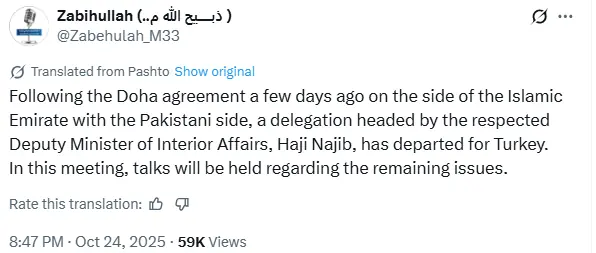 A second round of talks between Pakistan and Afghanistan kicked off in Istanbul on Saturday, with Islamabad eyeing a “concrete” mechanism to monitor Afghan Taliban actions aimed at preventing cross-border terrorist attacks. Today’s meeting follows the first round of Pakistan-Afghanistan talks mediated jointly by Qatar and Turkiye in Doha on October 18-19. The Qatar talks had come after days of fighting along the Pak-Afghan border — where trade is still closed — and strikes by Islamabad on Gul Bahadur group camps in Afghanistan. The agreement reached in Doha extended an initial 48-hour truce and resulted in a permanent ceasefire, as well as a commitment to reconvene in Istanbul to work on mechanisms for lasting peace and stability between the two countries. According to Afghan interim administration spokesman Zabihullah Mujahid, the Afghan delegation was to be led by Mawlawi Rahmatullah Najeeb, deputy minister at Ministry of Interior, Turkish news agency Anadolu reported. Islamabad has not said who it has sent...