September | News
-
ISW Blog - 01:07 Oct 01, 2022
 Kateryna Stepanenko, Katherine Lawlor, Grace Mappes, Riley Bailey, George Barros, and Frederick W. Kagan September 30, 8:30 pm ET Click here to see ISW’s interactive map of the Russian invasion of Ukraine. This map is updated daily alongside the static maps present in this report. Russian President Vladimir Putin did not threaten an immediate nuclear attack to halt the Ukrainian counteroffensives into Russian-occupied Ukraine during his speech announcing Russia’s illegal annexation of Ukrainian territory. ISW analysts broke down Putin’s speech in a separate September 30 Special Report: “Assessing Putin’s Implicit Nuclear Threats after Annexation.” Russian President Vladimir Putin announced the illegal Russian annexation of four Ukrainian territories on September 30 without clearly defining the borders of those claimed territories. Kremlin spokesperson Dmitry Peskov declined to specify the borders of the newly annexed territories in a September 30 conversation with reporters: "[the] Donetsk and Luhansk People'...
 -
ISW Blog - 00:24 Oct 01, 2022
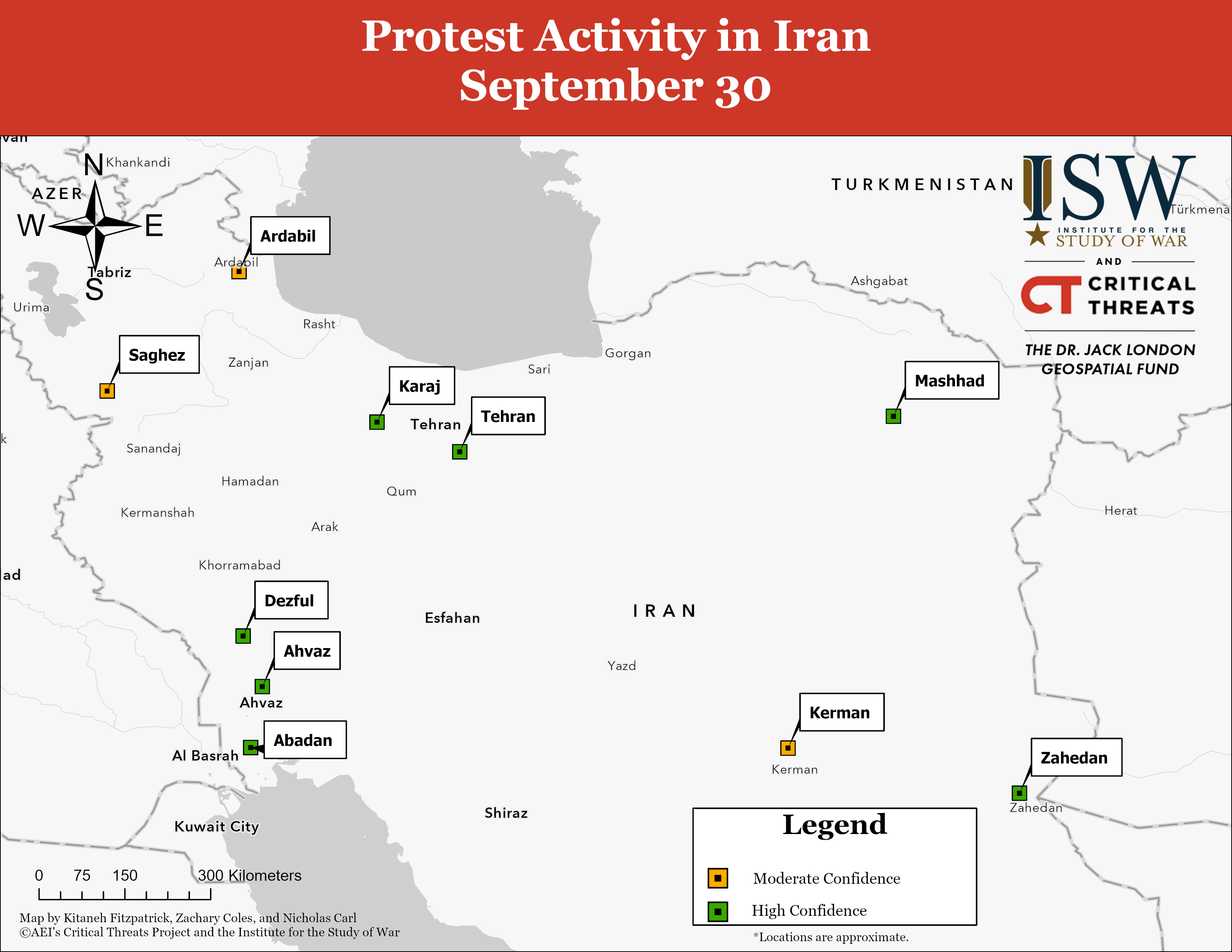 Nicholas Carl, Kitaneh Fitzpatrick, Zachary Coles, and Frederick W. Kagan September 30, 5:00 pm ET The Iran Crisis Updates are produced by the Critical Threats Project (CTP) at the American Enterprise Institute with support from the Institute for the Study of War (ISW). Anti-regime protests are continuing in at least 10 major cities in eight provinces and escalated violently in southeastern Sistan and Baluchistan Province on September 30. Protesters clashed with security forces in Zahedan, Sistan and Baluchistan Province, attacking local police stations and killing the provincial head of Islamic Revolutionary Guards Corps (IRGC) intelligence.[1] Social media users suggested that state security services deployed helicopters to abet their crackdown.[2] These clashes are among the most violent in the ongoing protest wave thus far. The security situation around Zahedan could worsen in the coming days and weeks, straining state security services more than they already are. Anti-regime militancy is common around Za...
 -
AD.nl Noord Holland - 08:19 Sep 30, 2022
September 2022 gaat de boeken in als een zeer natte maand. Gemiddeld viel over het land 130 millimeter neerslag, waar dat normaal gesproken in de maand september 79 millimeter is. Ook was het een zonnige maand, met een gebruikelijke gemiddelde temperatuur van 14,7 graden, meldt Weeronline. -
ISW Blog - 00:34 Sep 30, 2022
Kitaneh Fitzpatrick, Nicholas Carl, Zachary Coles, and Frederick W. Kagan September 29, 3:00 pm ET The Iran Crisis Updates are produced by the Critical Threats Project (CTP) at the American Enterprise Institute with support from the Institute for the Study of War (ISW). The Iranian regime’s extensive internet and telecommunications censorship is severely limiting the open-source information available on ongoing anti-regime protests in Iran. Iranian state media and officials have confirmed that they are blocking domestic access to Western social media applications such as WhatsApp and Instagram to impede protester coordination and organization and limit the free flow of information September 22.[1] Iranian internet users reported restricted access to foreign domains—including Google—and difficulties accessing Google Play and Apple’s App store, preventing users’ efforts to download VPNs.[2] CTP cannot verify most protest footage circulating on social media. Iranian authorities previously blocked internet acces...
-
ISW Blog - 00:33 Sep 30, 2022
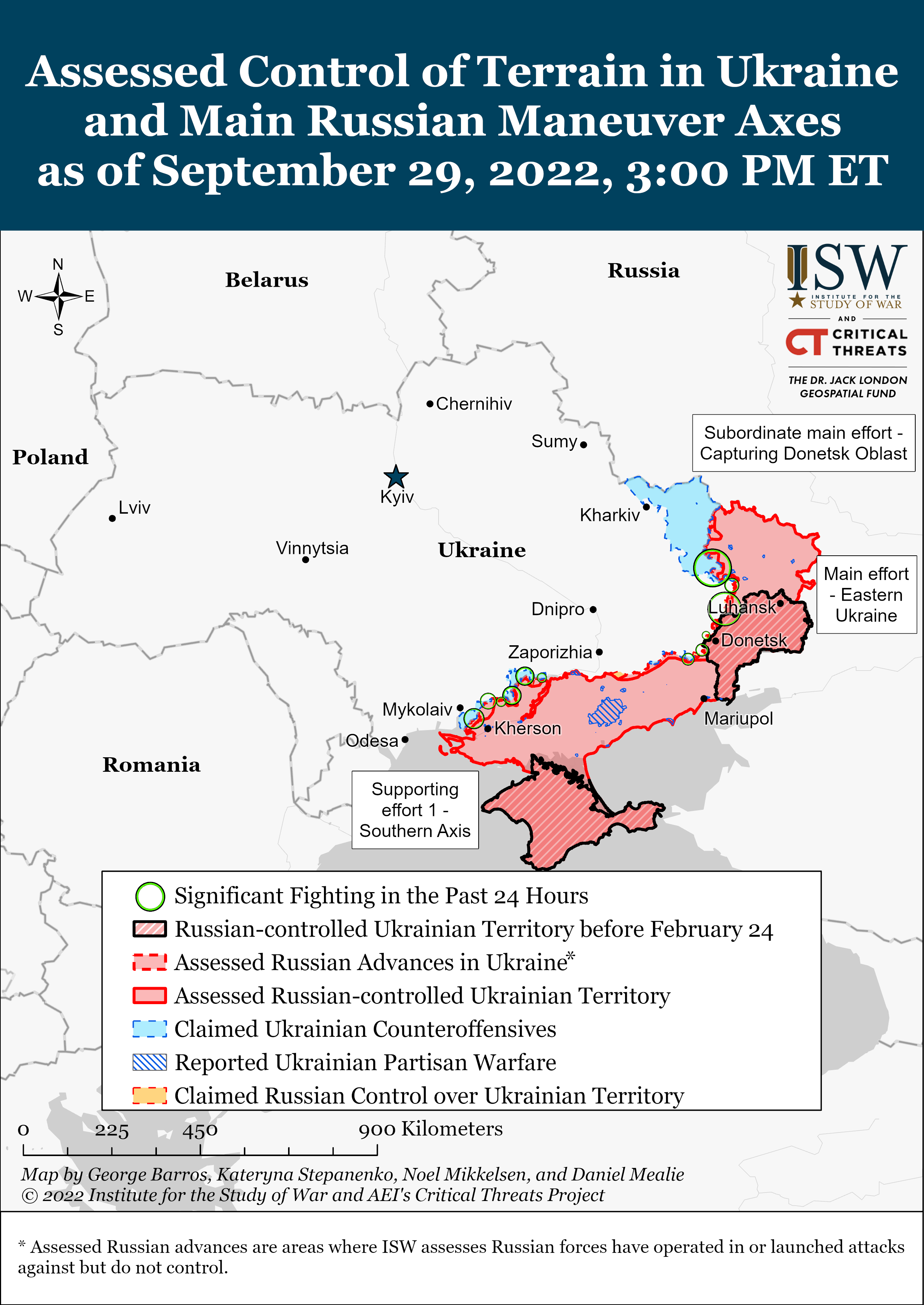 Kateryna Stepanenko, Karolina Hird, George Barros, Riley Bailey, and Frederick W. Kagan September 29, 7:30 pm ET Click here to see ISW’s interactive map of the Russian invasion of Ukraine. This map is updated daily alongside the static maps present in this report. The Kremlin continues to violate its stated “partial mobilization” procedures and contradict its own messaging even while recognizing the systematic failures within the Russian bureaucracy just eight days after the declaration of mobilization. Russian President Vladimir Putin acknowledged and deflected the blame for repeated “mistakes” during the first week of mobilization in his opening remarks at the Russian Security Council meeting on September 29.[1] Putin recounted instances of mobilizing men without prior military experience, assigning servicemen to the wrong specializations, and unfairly mobilizing men with health conditions or large families. ISW has previously reported that Kremlin-state media began exploring similar complaints just days ...
 -
ISW Blog - 03:45 Sep 29, 2022
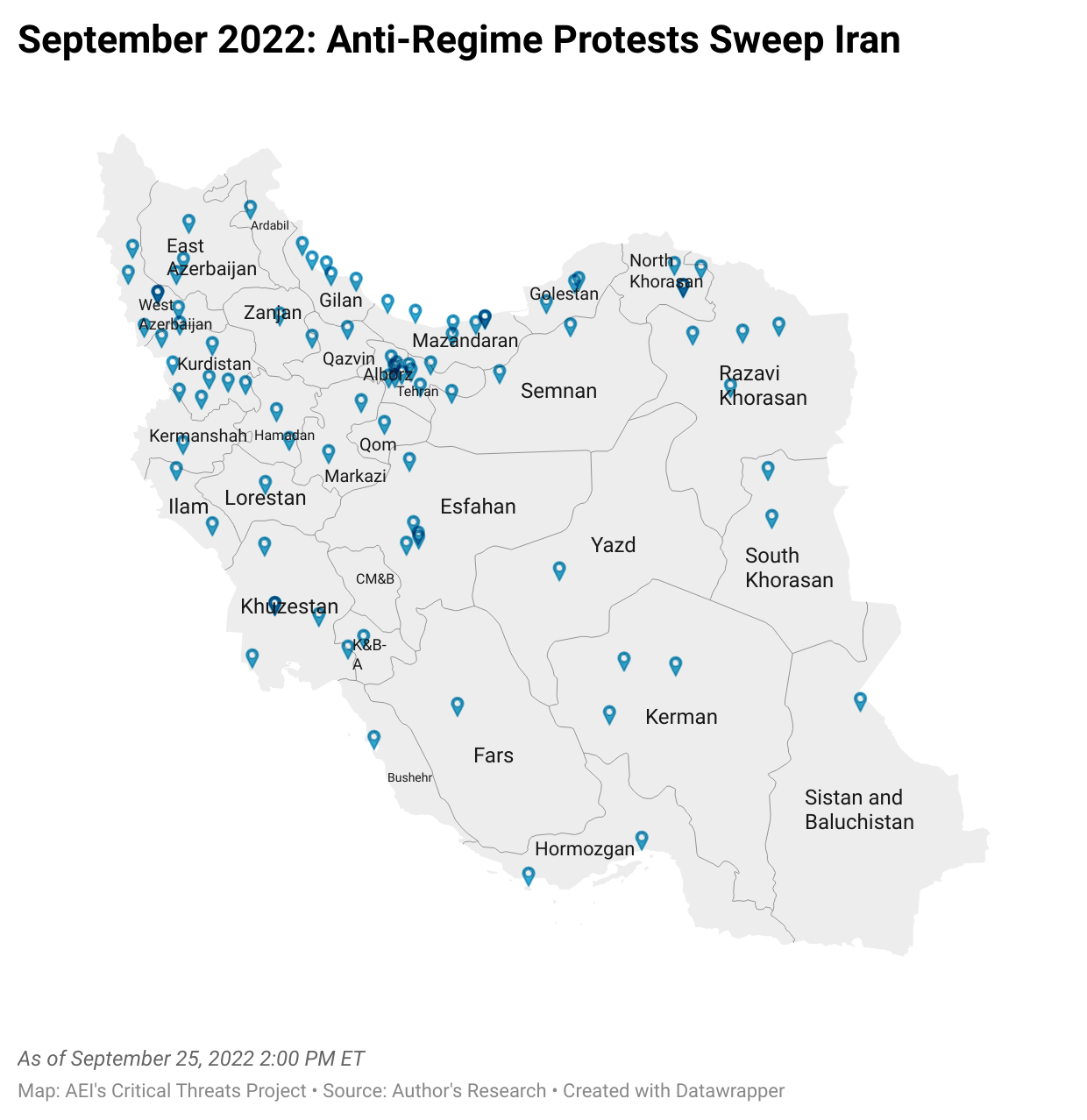 Nicholas Carl, Kitaneh Fitzpatrick, Zachary Coles, and Frederick W. Kagan September 28, 5:00 pm ET The Iran Crisis Updates are produced by the Critical Threats Project (CTP) at the American Enterprise Institute with support from the Institute for the Study of War (ISW). Circumstantial evidence suggests that Supreme Leader Ali Khamenei is at least temporarily unable to perform his normal duties. Khamenei has been unusually absent in recent days amidst countrywide, anti-regime protests, which began on September 16. Rumors have circulated that Khamenei’s health has deteriorated significantly since early September.[1] CTP cannot verify these rumors about Khamenei’s health, and such reports should be treated with skepticism. There are indications that Khamenei is ill or incapacitated, however. Regime power centers are behaving as if succession is either imminent or underway. President Ebrahim Raisi—a prominent frontrunner to succeed Khamenei—is positioning himself to become the next supreme leader with support fro...
 -
ISW Blog - 00:04 Sep 29, 2022
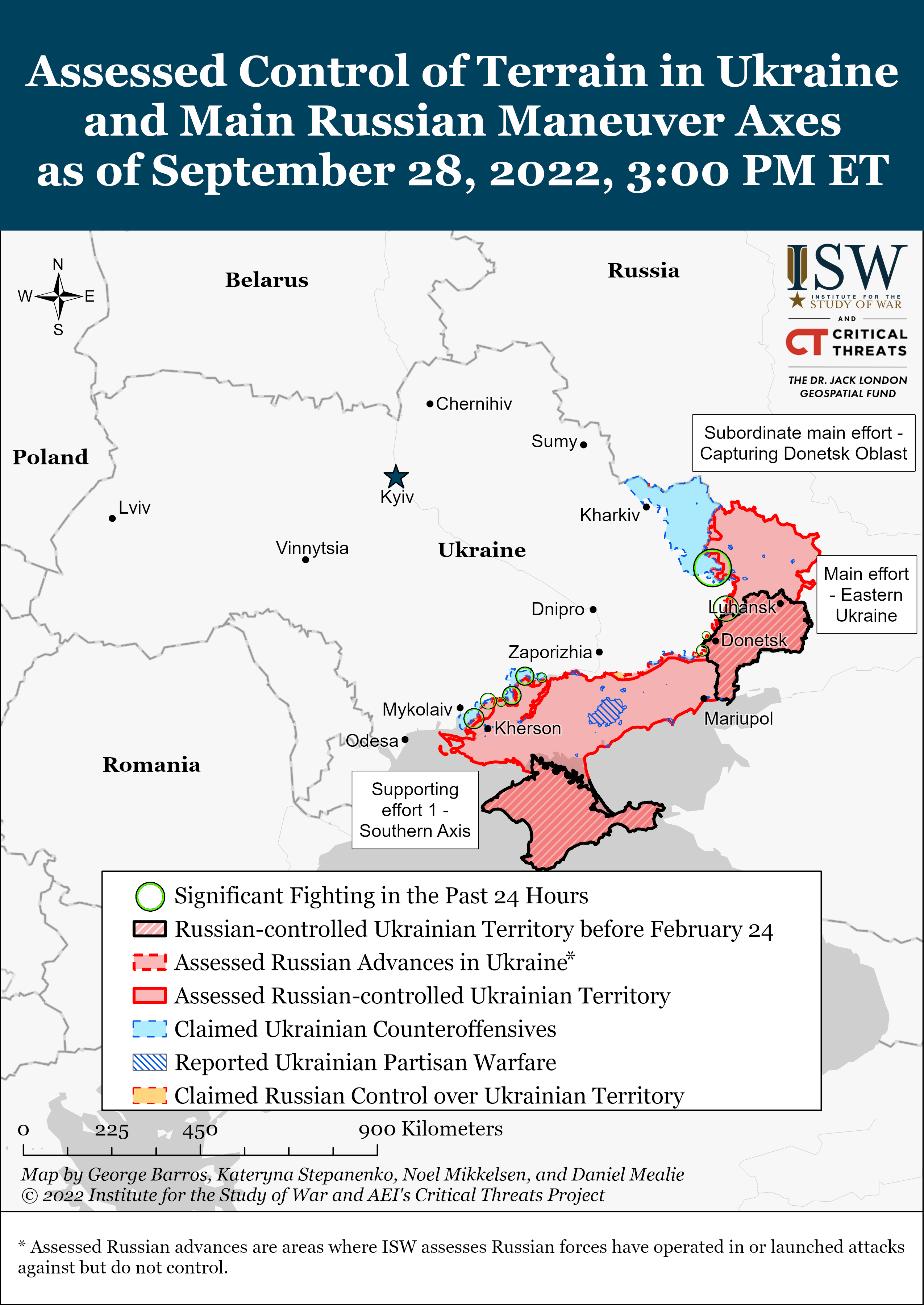 Karolina Hird, Katherine Lawlor, Grace Mappes, Riley Bailey, and Frederick W. Kagan September 28, 7:30pm ET Click here to see ISW’s interactive map of the Russian invasion of Ukraine. This map is updated daily alongside the static maps present in this report. Russian milbloggers discussed Ukrainian gains around Lyman with increased concern on September 28, suggesting that Russian forces in this area may face imminent defeat.[1] Several Russian milbloggers and prominent military correspondents claimed that Ukrainian troops advanced west, north, and northeast of Lyman and are working to complete the envelopment of Russian troops in Lyman and along the northern bank of the Siverskyi Donets River in this area.[2] Russian mibloggers stated that Ukrainian troops are threatening Russian positions and lines of communication that support the Lyman grouping. The collapse of the Lyman pocket will likely be highly consequential to the Russian grouping in northern Donetsk and western Luhansk oblasts and may allow Ukrai...
 -
ISW Blog - 01:28 Sep 28, 2022
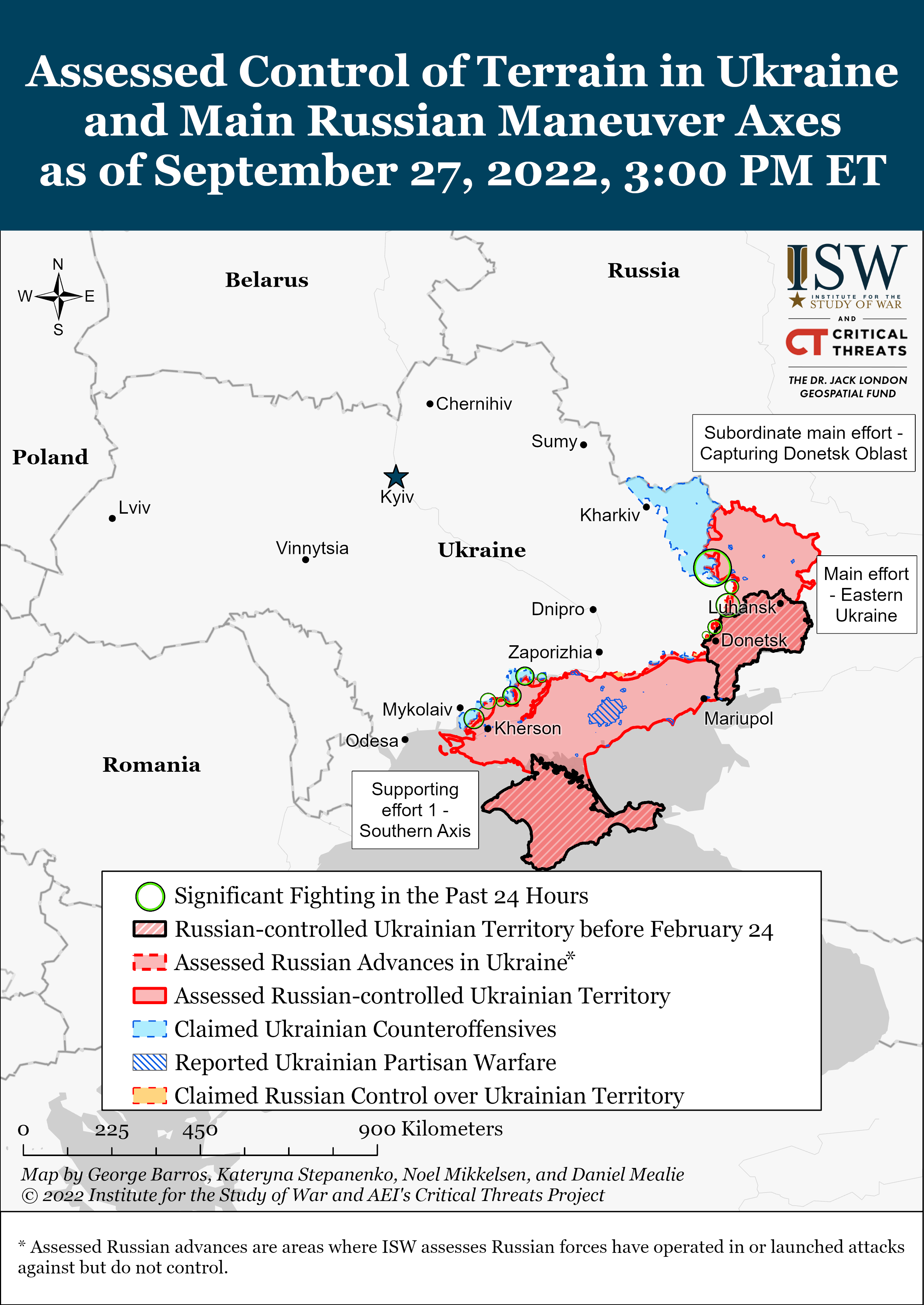 Kateryna Stepanenko, Katherine Lawlor, Grace Mappes, Riley Bailey, and Mason Clark September 27, 8:30pm ET Click here to see ISW’s interactive map of the Russian invasion of Ukraine. This map is updated daily alongside the static maps present in this report. Russian authorities in occupied parts of Ukraine’s Kherson, Zaporizhia, Donetsk, and Luhansk oblasts completed their falsified annexation “referenda” on September 27 and implausibly claimed that each sham referendum received between 87 and 99% approval from Ukrainian residents.[1] Russian officials pre-ordained and falsified the approval ratings and alleged voter participation rates for the sham referenda while coercing Ukrainian civilians in occupied territories to performatively vote for Russian annexation, as ISW has previously reported. Russian President Vladimir Putin will likely announce the Russian annexation of occupied Ukrainian territory on September 30. The completion of the performative referenda marks the last prerequisite for Russian Preside...
 -
ISW Blog - 00:17 Sep 26, 2022
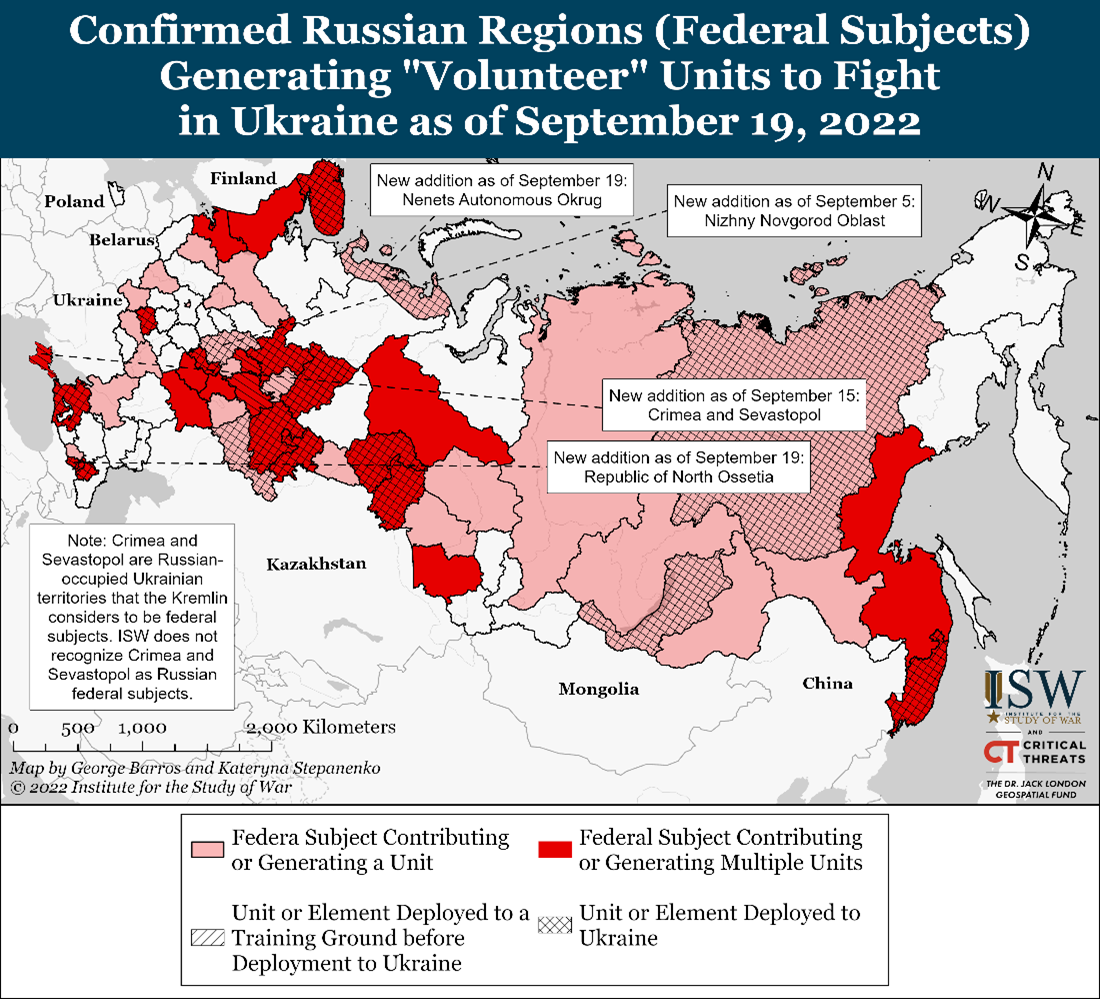 Special Edition on Russian Mobilization Frederick W. Kagan September 25, 6 pm ET Click here to see ISW’s interactive map of the Russian invasion of Ukraine. This map is updated daily alongside the static maps present in this report. This campaign assessment special edition focuses on Russian military mobilization efforts. Significant inflections ISW would normally cover in its regular sections will be summarized briefly today and addressed in more detail tomorrow. Russian President Vladimir Putin is unlikely to overcome fundamental structural challenges in attempting to mobilize large numbers of Russians to continue his war in Ukraine. The “partial mobilization” he ordered on September 21 will generate additional forces but inefficiently and with high domestic social and political costs. The forces generated by this “partial mobilization,” critically, are very unlikely to add substantially to the Russian military’s net combat power in 2022. Putin will have to fix basic flaws in the Russian military personnel ...
 -
ISW Blog - 01:41 Sep 25, 2022
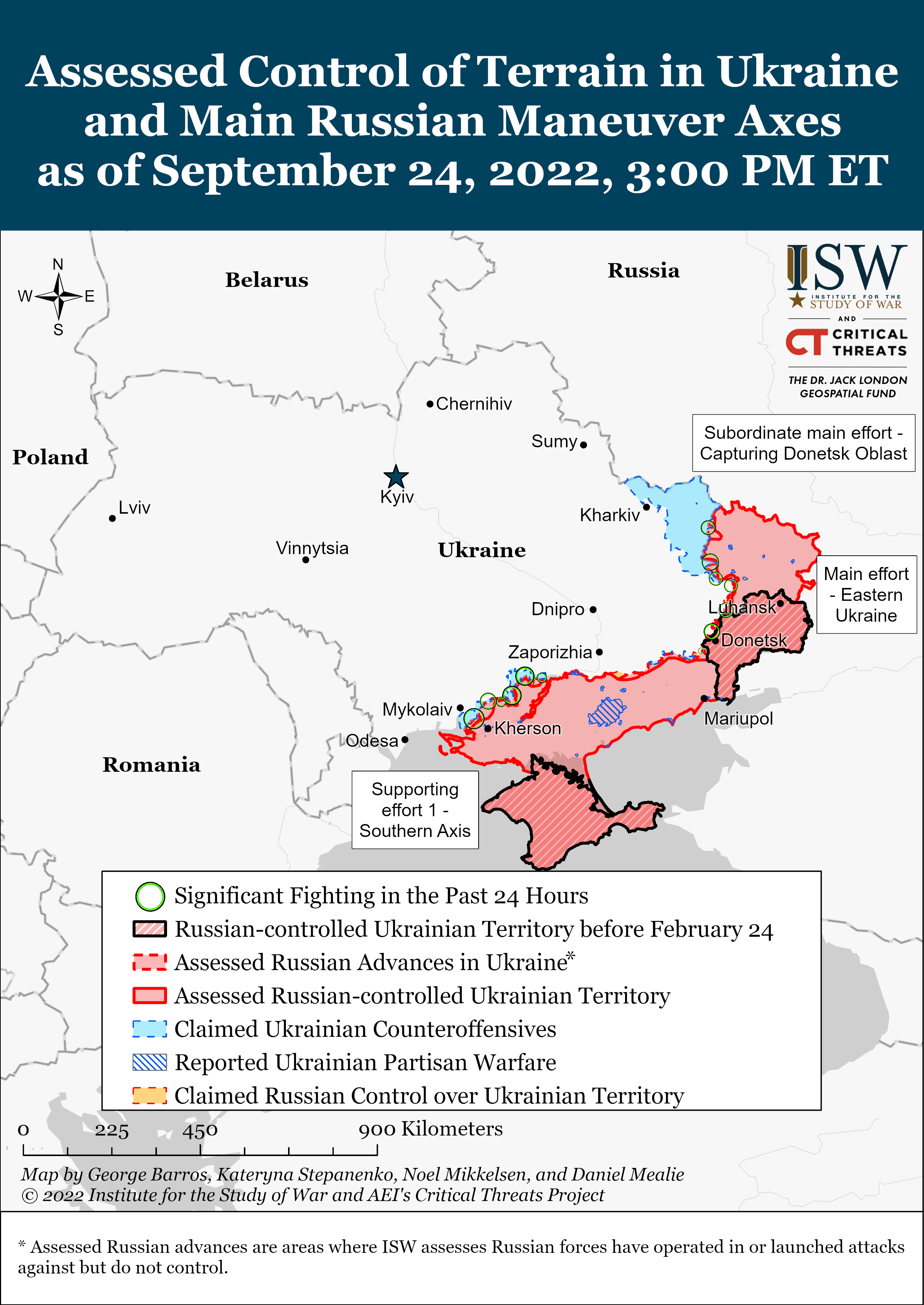 Karolina Hird, George Barros, and Frederick W. Kagan September 24, 9 pm ET Click here to see ISW’s interactive map of the Russian invasion of Ukraine. This map is updated daily alongside the static maps present in this report. Russian Defense Minister Sergei Shoigu’s declarations about which categories of Russian males will be exempted from partial mobilization may not reflect Russian President Vladimir Putin’s intentions or orders. A Russian media insider claimed on September 24 that officials of the Russian Ministry of Defense (MoD) reprimanded military commissars in person for negligence in carrying out mobilization and sending out summonses in “excess,” and contrary to the explicit MoD guidance regarding exemptions for age, disability, or other limiting factors.[1] Another Russian source claimed that certain heads of federal subjects acknowledged that they have mobilized citizens who are technically ineligible.[2] Responsibility for the partial mobilization appears to be divided and complex, possibly co...
 -
ISW Blog - 02:04 Sep 22, 2022
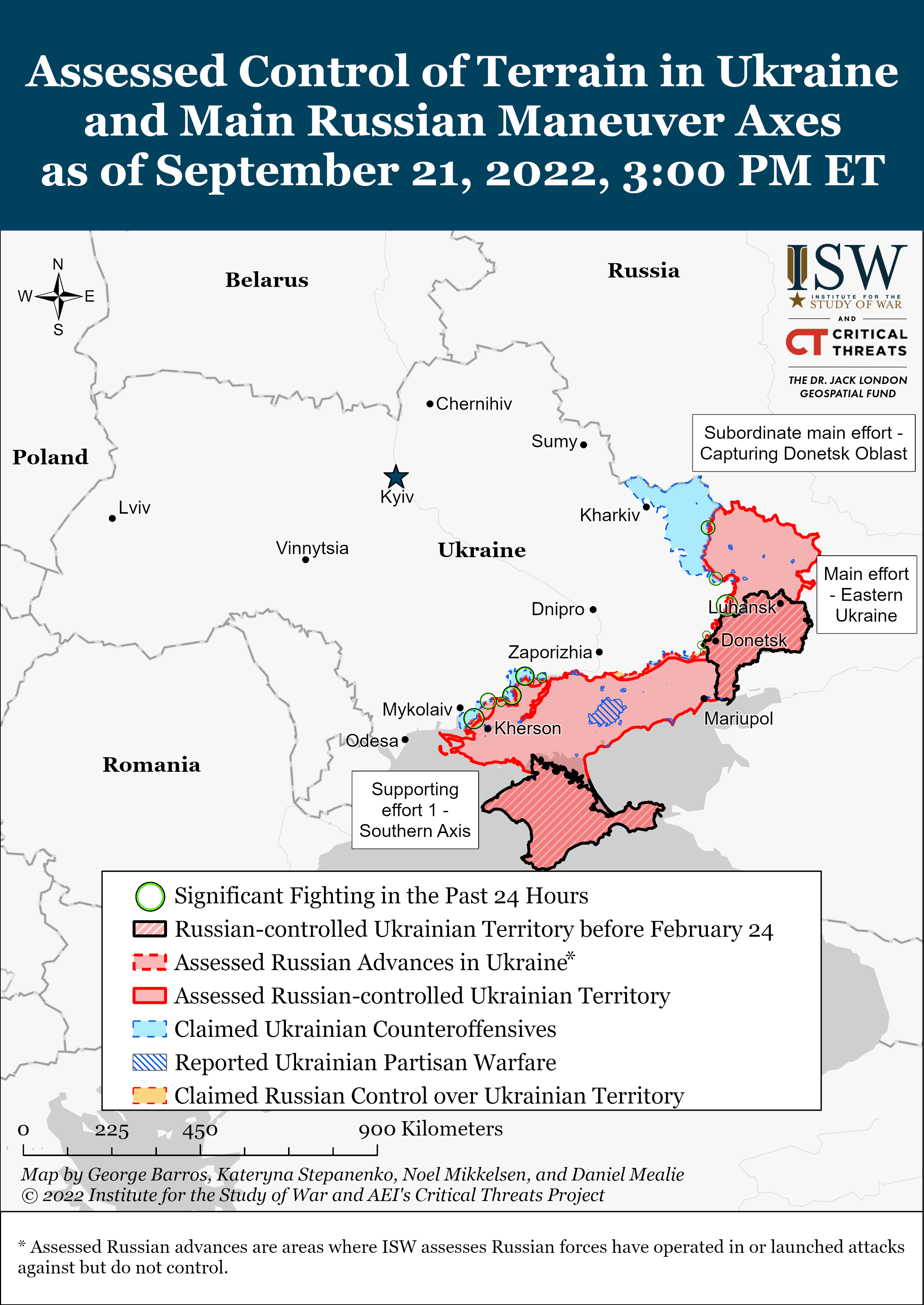 Karolina Hird, Kateryna Stepanenko, Grace Mappes, Mason Clark, Kat Lawlor, and Frederick W. Kagan September 21, 9:30 pm ET Click here to see ISW’s interactive map of the Russian invasion of Ukraine. This map is updated daily alongside the static maps present in this report. Russian President Vladimir Putin’s announcement of “partial mobilization” on September 21 reflected many problems Russia faces in its faltering invasion of Ukraine that Moscow is unlikely to be able to resolve in the coming months.[1] Putin’s order to mobilize part of Russia’s “trained” reserve, that is, individuals who have completed their mandatory conscript service, will not generate significant usable Russian combat power for months. It may suffice to sustain the current levels of Russian military manpower in 2023 by offsetting Russian casualties, although even that is not yet clear. It will occur in deliberate phases, Russian Defense Minister Sergei Shoigu said in an interview on September 21, likely precluding any sudden influx of Ru...
 -
DutchNews Business - 07:24 Sep 21, 2022
 Dutch consumer confidence fell to a new low in September, the fifth month in a row that the index has...
 -
ISW Blog - 02:14 Sep 21, 2022
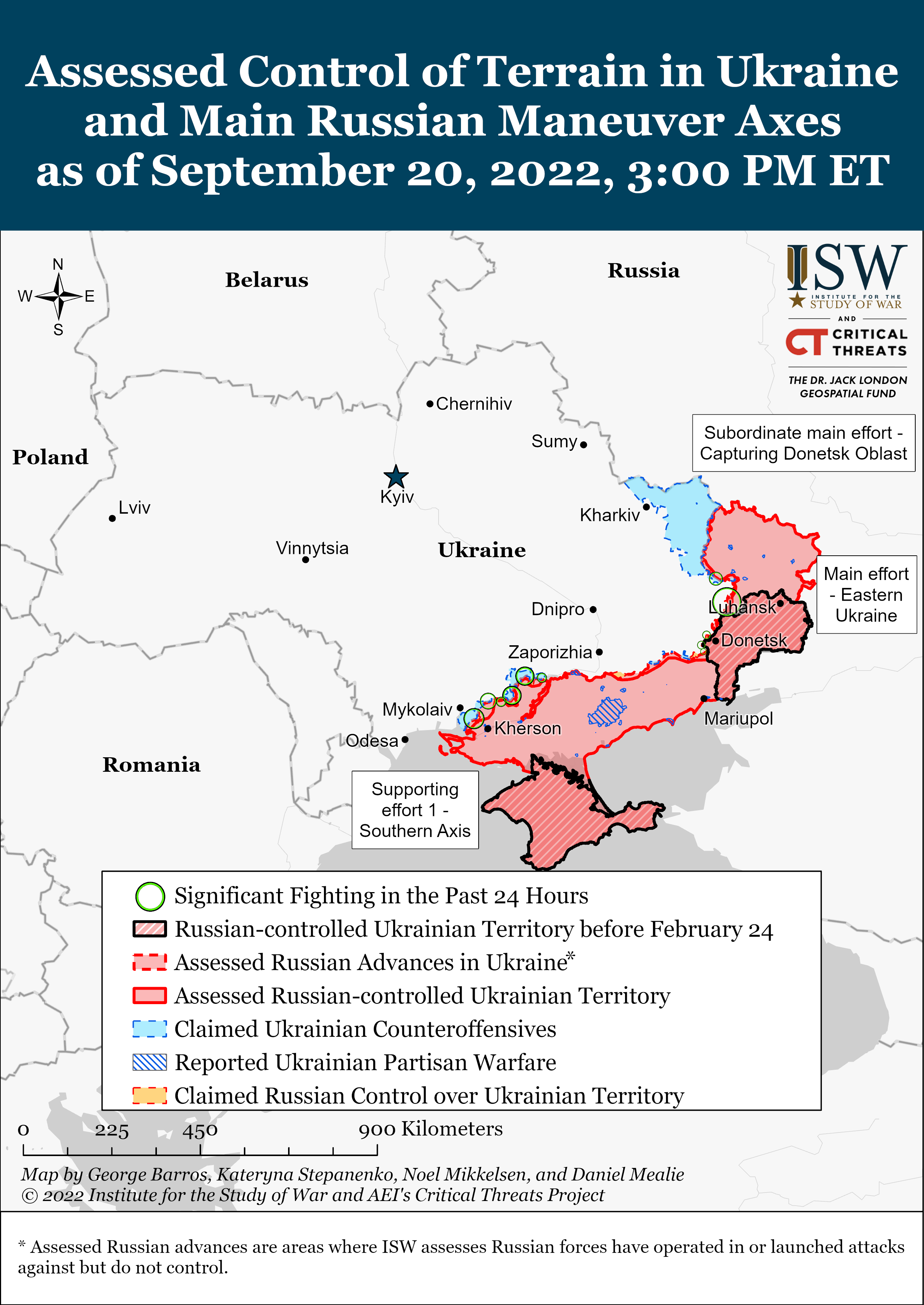 Katherine Lawlor, Karolina Hird, George Barros, and Frederick W. Kagan September 20, 8:45pm ET Click here to see ISW’s interactive map of the Russian invasion of Ukraine. This map is updated daily alongside the static maps present in this report. Russian-appointed occupation officials in Luhansk, Donetsk, Kherson, and Zaporizhia oblasts announced on September 20 that they will hold a “referendum” on acceding to Russia, with a vote taking place from September 23-27.[1] The Kremlin will use the falsified results of these sham referenda to illegally annex all Russian-occupied parts of Ukraine and is likely to declare unoccupied parts of Donetsk, Kherson, and Zaporizhia oblasts to be part of Russia as well. The Kremlin’s annexation plans are primarily targeting a domestic audience; Putin likely hopes to improve Russian force generation capabilities by calling on the Russian people to volunteer for a war to “defend” newly claimed Russian territory. Putin and his advisors have apparently realized that current Russi...
 -
ISW Blog - 02:55 Sep 20, 2022
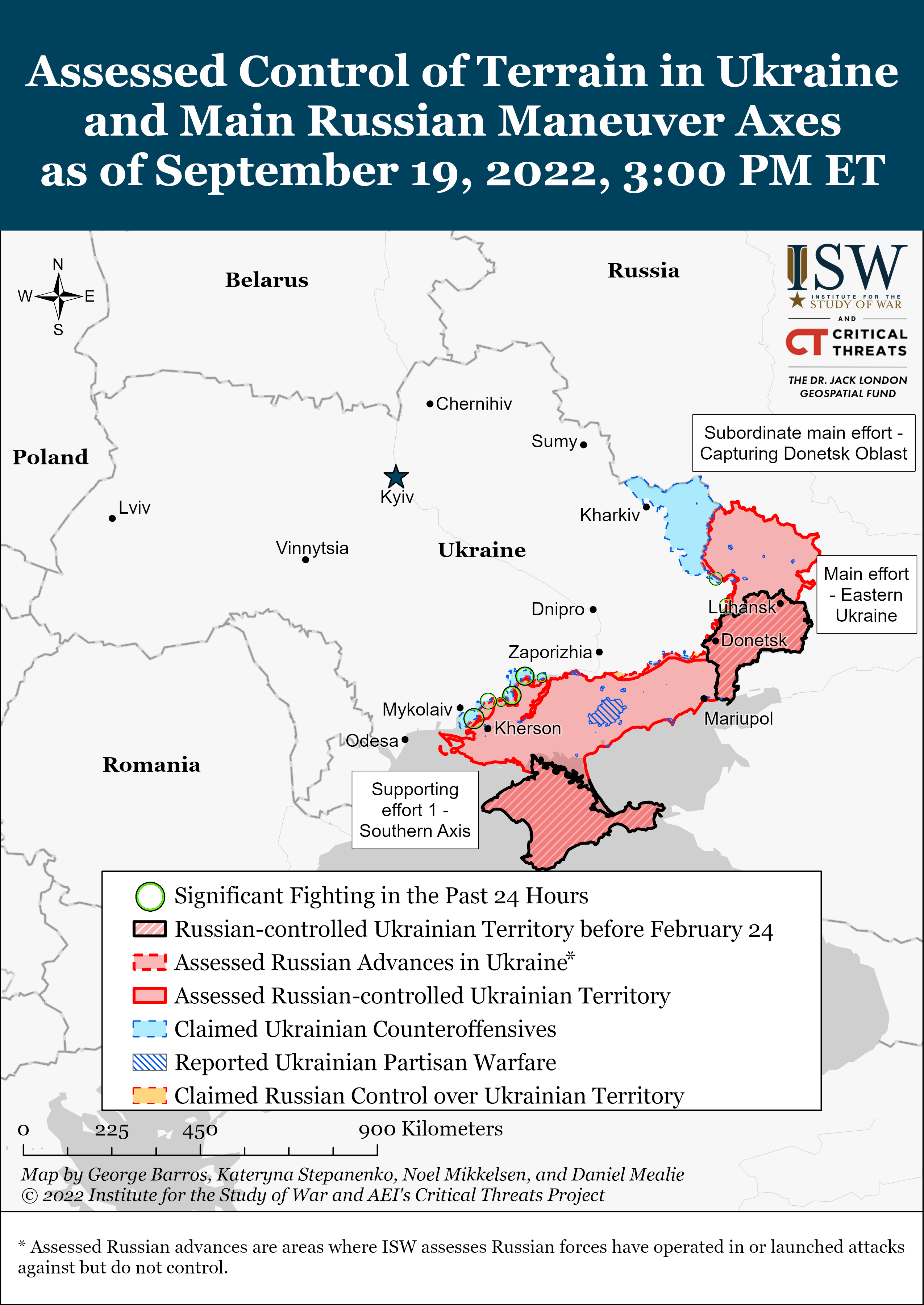 Karolina Hird, Katherine Lawlor, Mason Clark, and Frederick W. Kagan September 19, 9 pm ET Click here to see ISW’s interactive map of the Russian invasion of Ukraine. This map is updated daily alongside the static maps present in this report. Urgent discussion on September 19 among Russia’s proxies of the need for Russia to immediately annex Luhansk and Donetsk oblasts (much of the latter of which is not under Russian control) suggests that Ukraine’s ongoing northern counter-offensive is panicking proxy forces and some Kremlin decision-makers. The legislatures of Russia’s proxies in occupied Ukraine, the Donetsk and Luhansk People’s Republics (DNR and LNR), each called on their leadership to “immediately” hold a referendum on recognizing the DNR and LNR as Russian subjects.[1] Russian propagandist and RT Editor-in-Chief Margarita Simonyan spoke glowingly of the call, referring to it as the “Crimean scenario.” She wrote that by recognizing occupied Ukrainian land as Russian territory, Russia could more easily ...
 -
Odessa Journal - 09:02 Sep 18, 2022
In the first half of September, Ukraine exported products worth $1.818 billion and imported $1.929 billion. The deficit is only ..... -
ISW Blog - 00:45 Sep 17, 2022
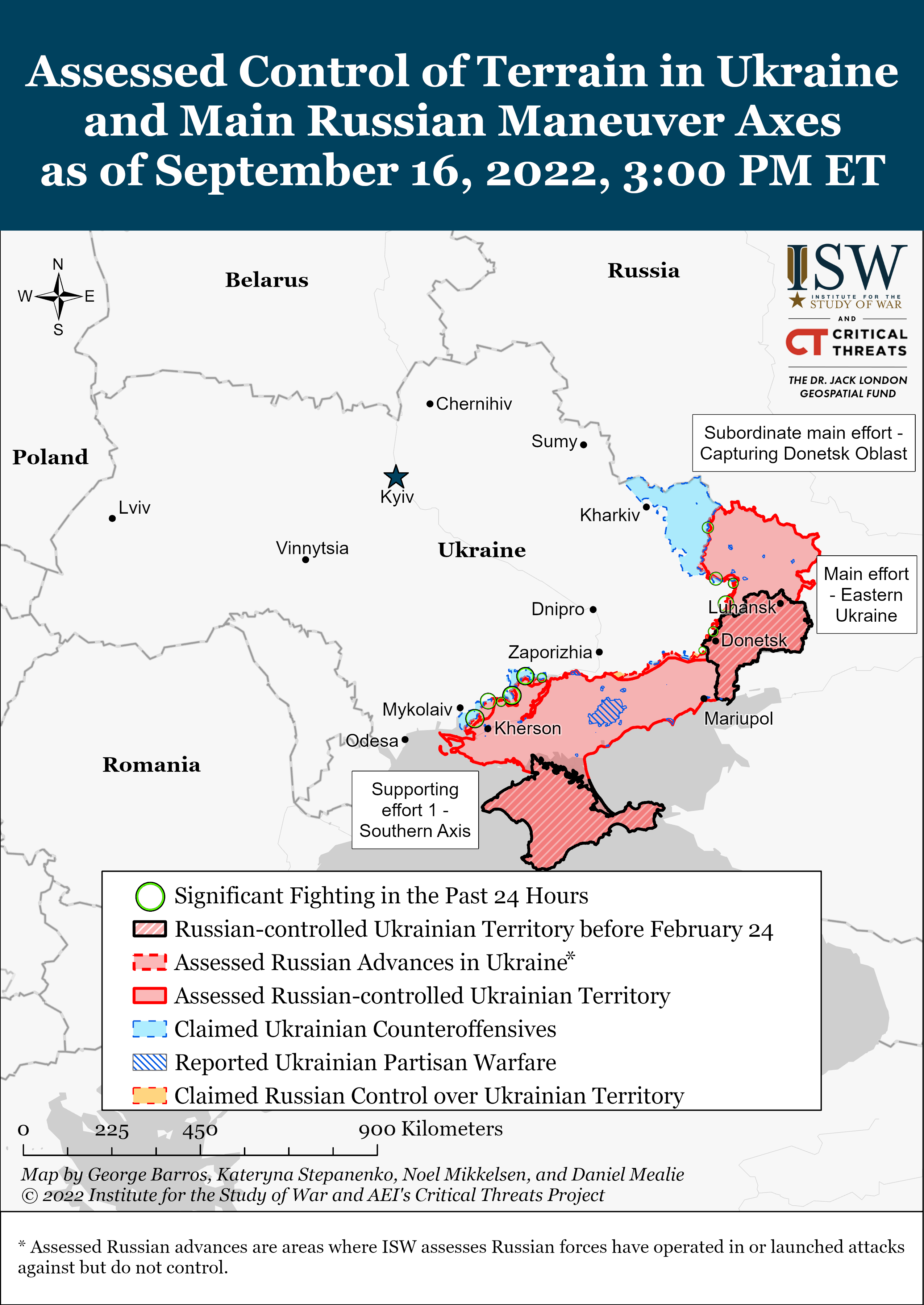 Katherine Lawlor, Grace Mappes, Mason Clark, and Frederick W. Kagan September 16, 8pm ET Click here to see ISW’s interactive map of the Russian invasion of Ukraine. This map is updated daily alongside the static maps present in this report. The revelations of mass graves of civilians and torture chambers in newly liberated Izyum confirm ISW’s previous assessments that the Bucha atrocities were not isolated war crimes but rather a microcosm of Russian atrocities throughout Russian-occupied areas. The Ukrainian General Staff published images on September 16 showing a mass burial site in Izyum, Kharkiv Oblast and noting that Ukrainian President Volodymyr Zelensky said that the site contained more than 400 bodies showing signs of torture and brutality.[1] The Ukrainian Ministry of Reintegration reported that the number of war crimes victims in Izyum may exceed those of Bucha.[2] The head of Ukraine’s National Police, Ihor Klymenko, stated that Ukrainian officials have found 10 Russian torture chambers in Vovch...
 -
ISW Blog - 01:12 Sep 15, 2022
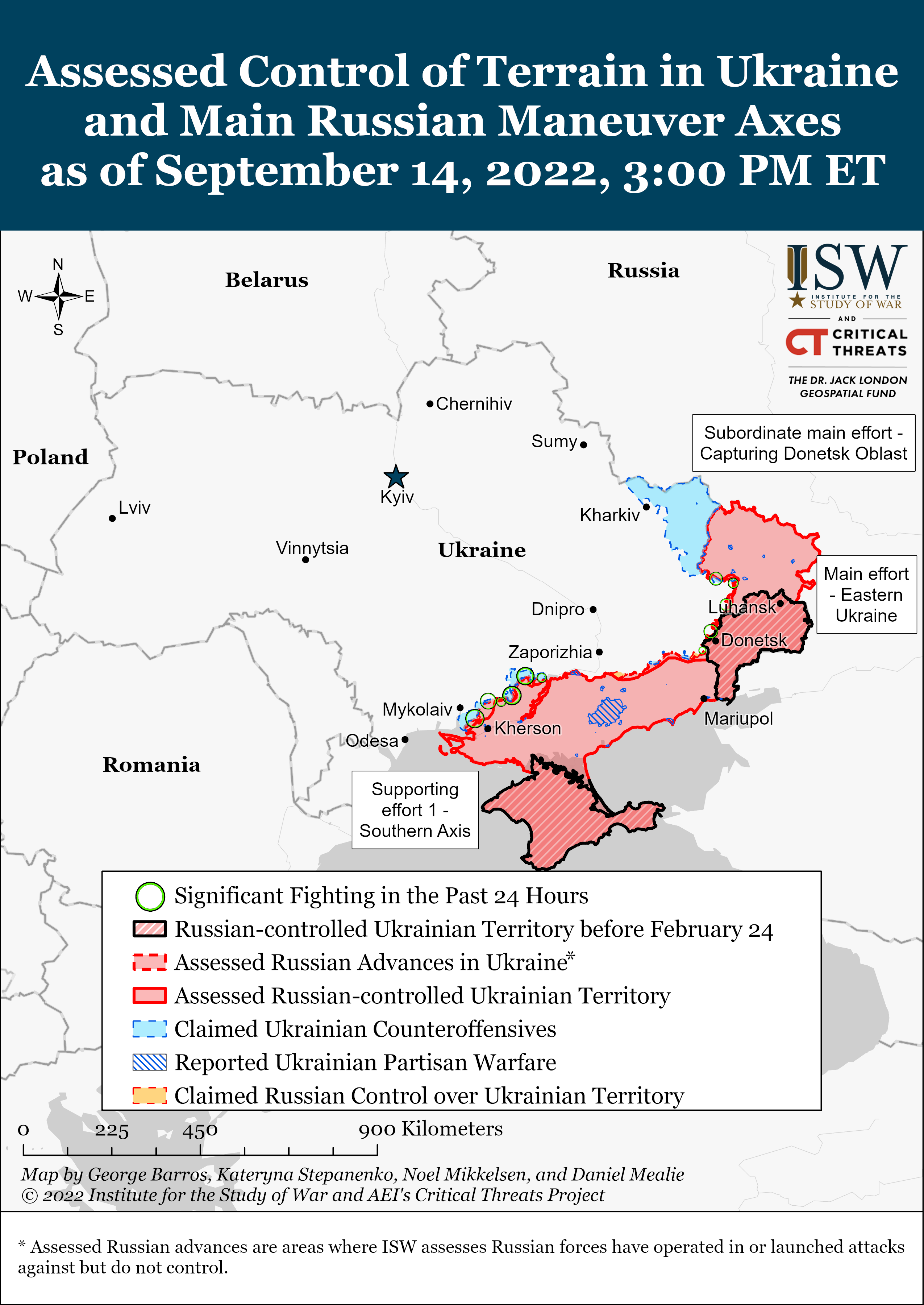 Karolina Hird, Kateryna Stepanenko, Katherine Lawlor, George Barros, and Frederick W. Kagan September 14, 8:15pm ET Click here to see ISW’s interactive map of the Russian invasion of Ukraine. This map is updated daily alongside the static maps present in this report. Wagner Group financier Yevgeny Prigozhin is being established as the face of the Russian “special military operation” in Ukraine. Prigozhin gave a recruitment speech on September 14 announcing that Russian prisoners have been participating in the war since July 1 when they were instrumental in seizing the Vuhlehirska Thermal Power Plant.[1] A Russian milblogger noted that Prigozhin is introducing a “Stalinist” method that allows the Kremlin to avoid ordering a general mobilization that could ignite social tensions in Russian society.[2] Milbloggers have been consistently praising Prigozhin’s success in Ukraine and some even said that he should replace the Russian Defense Minister Sergey Shoigu, whom milbloggers and Kremlin pundits blame for the R...
 -
ISW Blog - 06:00 Sep 11, 2022
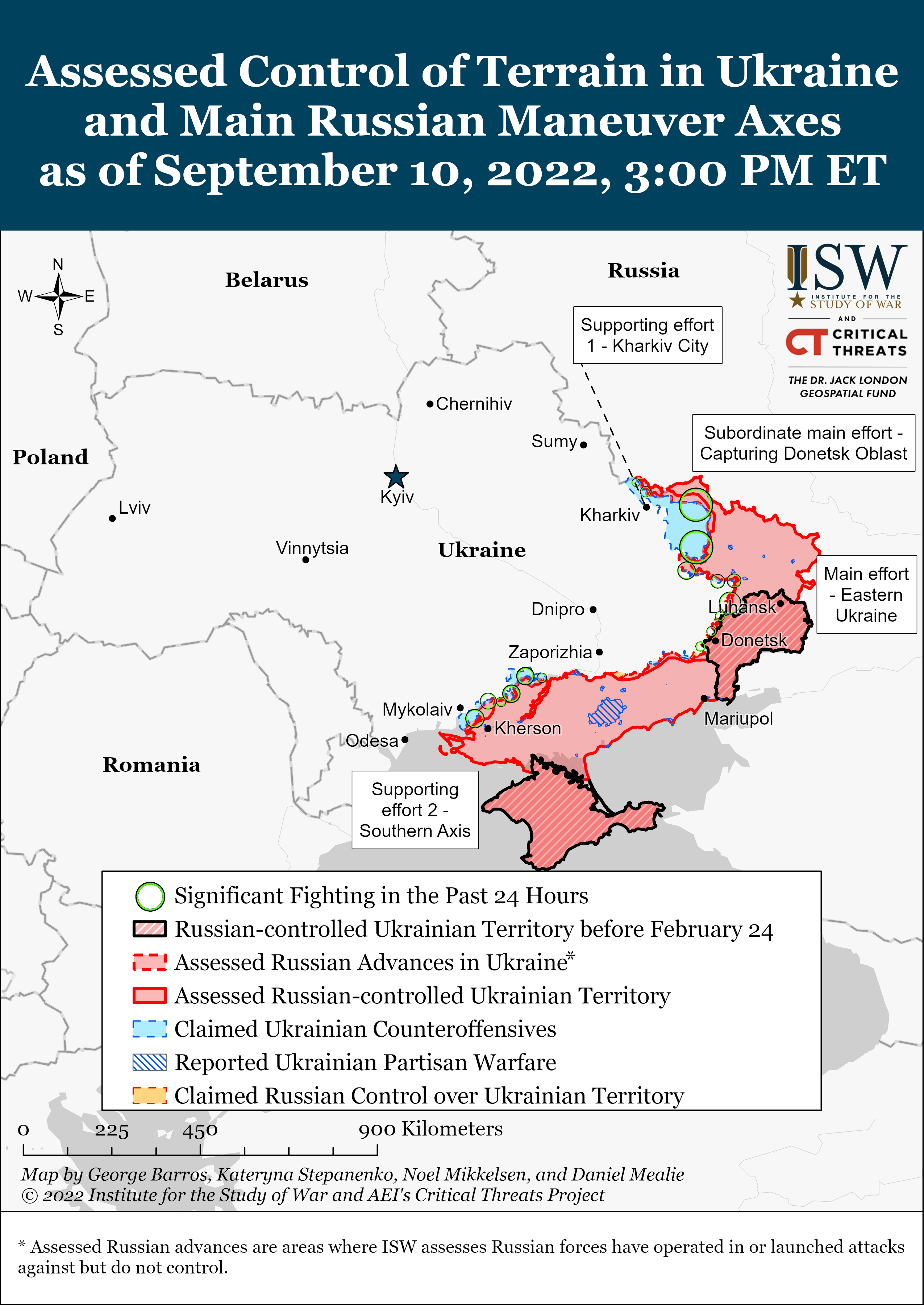 Kateryna Stepanenko, Grace Mappes, George Barros, Angela Howard, and Mason Clark September 10, 11:30pm ET Click here to see ISW’s interactive map of the Russian invasion of Ukraine. This map is updated daily alongside the static maps present in this report. The Ukrainian counteroffensive in Kharkiv Oblast is routing Russian forces and collapsing Russia’s northern Donbas axis. Russian forces are not conducting a controlled withdrawal and are hurriedly fleeing southeastern Kharkiv Oblast to escape encirclement around Izyum. Russian forces have previously weakened the northern Donbas axis by redeploying units from this area to Southern Ukraine, complicating efforts to slow the Ukrainian advance or at minimum deploy a covering force for the retreat. Ukrainian gains are not confined to the Izyum area; Ukrainian forces reportedly captured Velikiy Burluk on September 10, which would place Ukrainian forces within 15 kilometers of the international border.[1] Ukrainian forces have penetrated Russian lines to a depth ...
 -
ISW Blog - 04:15 Sep 10, 2022
 Kateryna Stepanenko, Grace Mappes, George Barros, Layne Philipson, and Mason Clark September 9, 11:15pm ET Click hereto see ISW’s interactive map of the Russian invasion of Ukraine. This map is updated daily alongside the static maps present in this report. Ukrainian forces have captured an estimated 2,500 square kilometers in Kharkiv Oblast in the Kharkiv area counteroffensive as of September 9. Ukrainian President Volodymyr Zelensky and Ukrainian Commander-in-Chief Valery Zaluzhnyi stated on September 8 that Ukrainian forces liberated over 1,000 square kilometers between September 1-8 – a day before Ukrainian forces reached the southern approach to Kupyansk and the Oskil River on September 9.[1]Ukrainian forces are likely clearing pockets of disorganized Russian forces caught in the rapid Ukrainian advance to Kupyansk, Izyum, and the Oskil River, given the influx of observed pictures of Russian prisoners of war in the past 48 hours.[2] Ukrainian forces may collapse Russian positions around Izyum if th...
 -
ISW Blog - 04:35 Sep 09, 2022
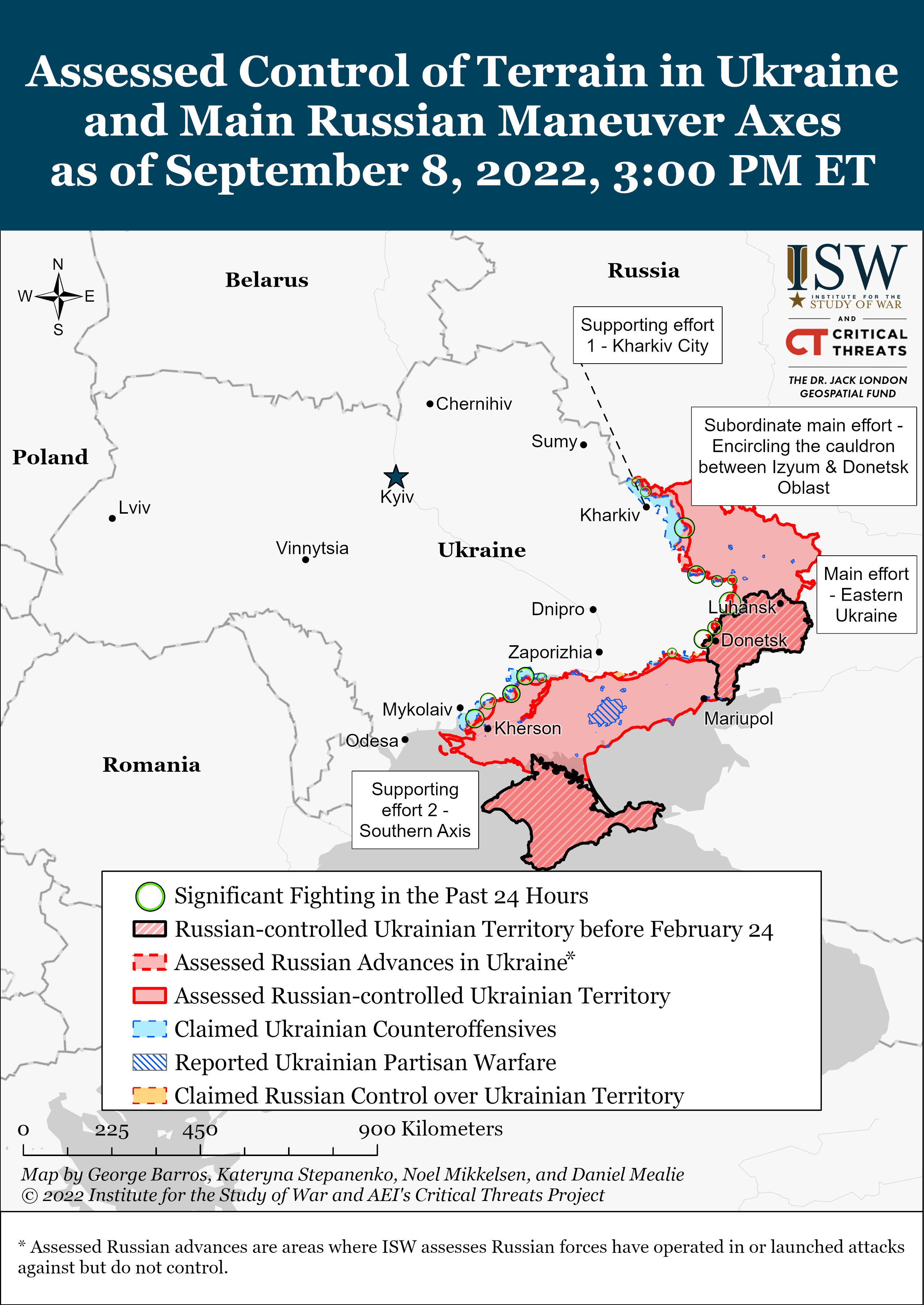 Kateryna Stepanenko, Grace Mappes, George Barros, Layne Philipson, and Mason Clark September 8, 11:00 pm ET Click here to see ISW’s interactive map of the Russian invasion of Ukraine. This map is updated daily alongside the static maps present in this report. Ukrainian successes on the Kharkiv City-Izyum line are creating fissures within the Russian information space and eroding confidence in Russian command to a degree not seen since a failed Russian river crossing in mid-May. Ukrainian military officials announced that Ukrainian forces advanced 50km deep into Russian defensive positions north of Izyum on September 8, but the Russian Ministry of Defense (MoD) notably did not issue any statement regarding Ukrainian advances in Kharkiv Oblast.[1] Ukrainian successes and the Russian MoD’s silence prompted many Russian milbloggers to criticize and debate Russian failures to retain control over the city of Balakliya, approximately 44km northwest of Izyum. Some milbloggers claimed that Russian forces fully or par...