ISW Blog
-
ISW Blog - 03:27 Sep 24, 2022
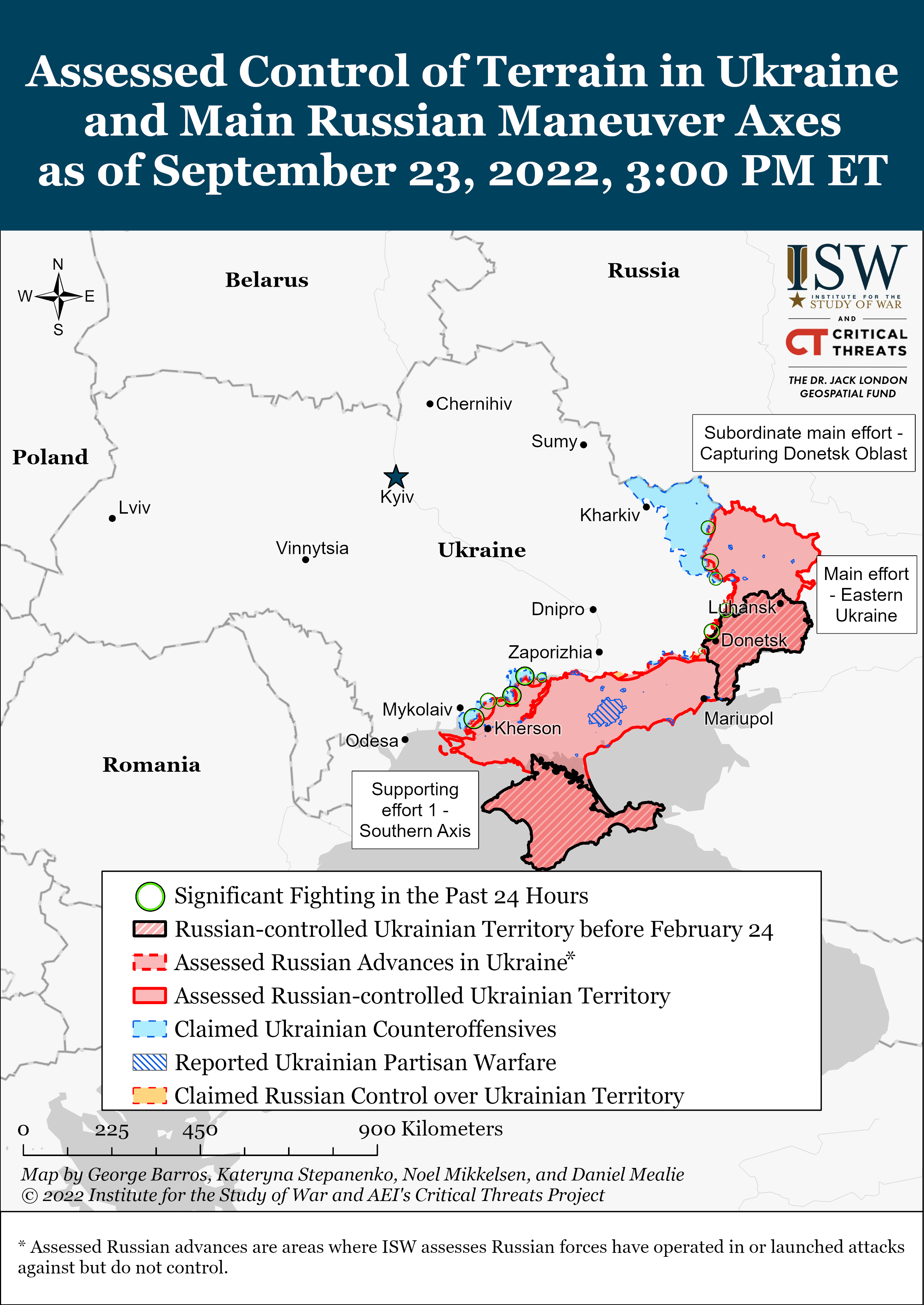 Kateryna Stepanenko, Katherine Lawlor, George Barros, and Frederick W. Kagan September 23, 10:00 pm ET Click here to see ISW’s interactive map of the Russian invasion of Ukraine. This map is updated daily alongside the static maps present in this report. The Russian mobilization system is struggling to execute the task Russian President Vladimir Putin set and will likely fail to produce mobilized reserve forces even of the low quality that Putin’s plans would have generated unless the Kremlin can rapidly fix fundamental and systemic problems. Putin and Defense Minister Sergey Shoigu announced that the Russian Armed Forces would mobilize combat-ready reservists to quickly stabilize the frontlines and regain the initiative on the battlefield.[1] Milblogger and social media reports, however, show that Russian military recruitment centers, enlistment officials, and local administrations are mobilizing men who do not meet the Kremlin’s stated criteria, especially Shoigu’s promise that mobilization would prioritiz...
 -
ISW Blog - 01:02 Sep 23, 2022
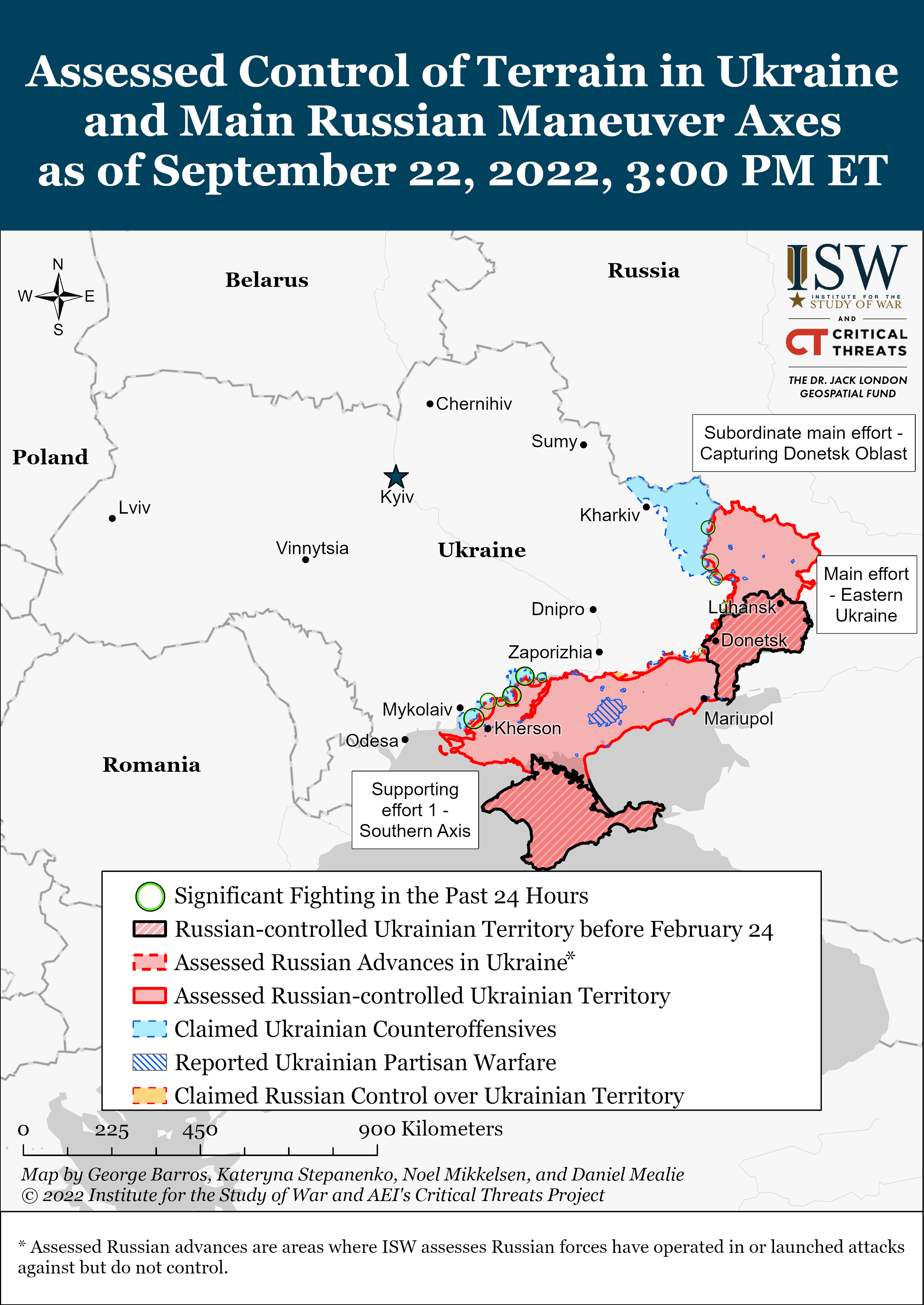 Karolina Hird, Kateryna Stepanenko, Katherine Lawlor, and Mason Clark September 22, 8:15 pm ET Click here to see ISW’s interactive map of the Russian invasion of Ukraine. This map is updated daily alongside the static maps present in this report. The Kremlin’s heavy-handed approach to partial mobilization may successfully meet the Kremlin’s internal quota of mobilized personnel but is unlikely to generate effective soldiers and is prompting significant domestic backlash for little gain. Russian authorities are forcibly recruiting Russian citizens to fight in Ukraine on flimsy pretexts, violating the Kremlin’s promise to recruit only those with military experience. Russian authorities are also demonstrably mobilizing personnel (such as protesters) who will enter the war in Ukraine with abysmal morale. The Kremlin's heavy-handed approach to partial mobilization will likely exacerbate domestic resentment of a measure that would have been unpopular even if implemented without the harsh approaches observed in the...
 -
ISW Blog - 02:04 Sep 22, 2022
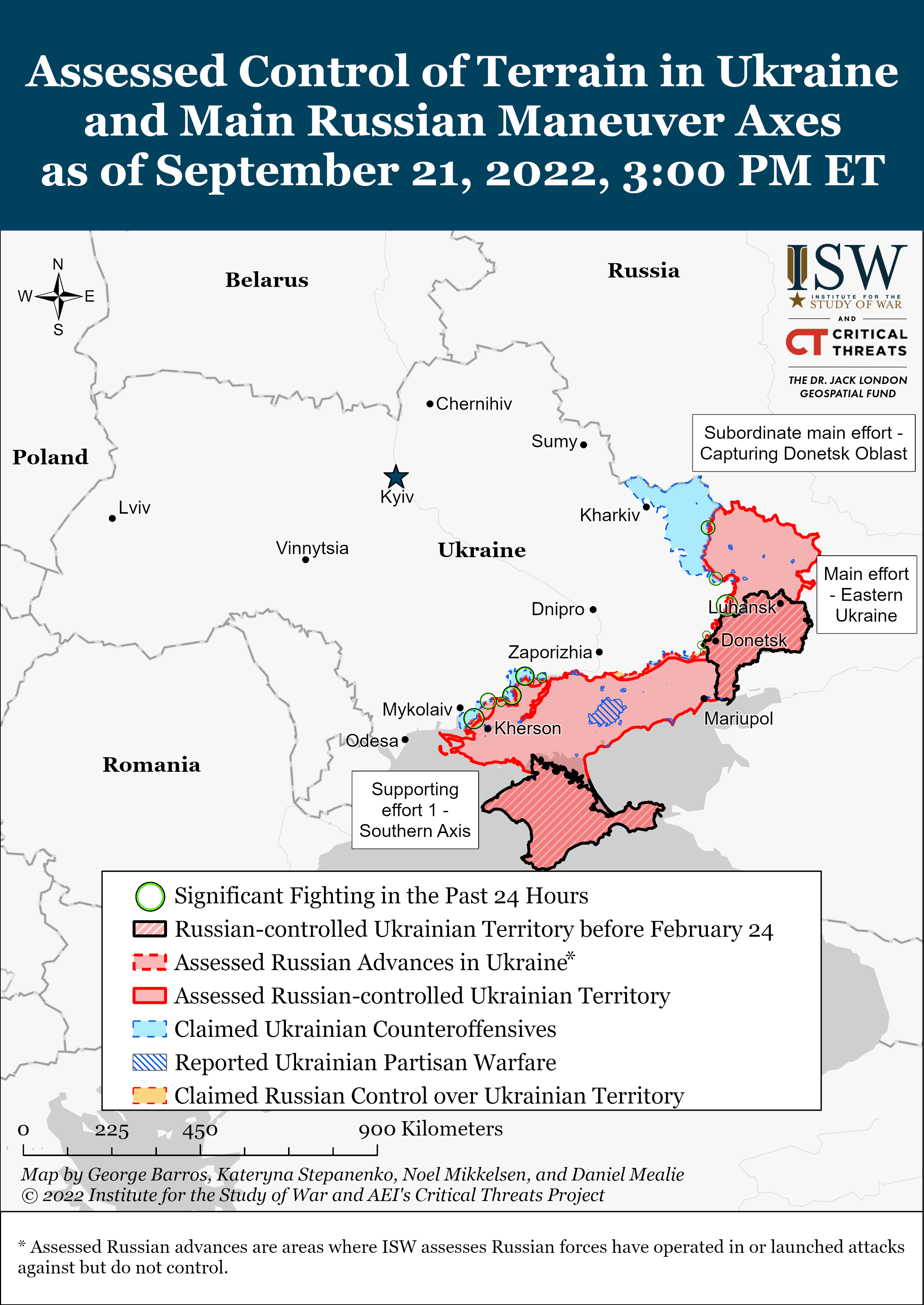 Karolina Hird, Kateryna Stepanenko, Grace Mappes, Mason Clark, Kat Lawlor, and Frederick W. Kagan September 21, 9:30 pm ET Click here to see ISW’s interactive map of the Russian invasion of Ukraine. This map is updated daily alongside the static maps present in this report. Russian President Vladimir Putin’s announcement of “partial mobilization” on September 21 reflected many problems Russia faces in its faltering invasion of Ukraine that Moscow is unlikely to be able to resolve in the coming months.[1] Putin’s order to mobilize part of Russia’s “trained” reserve, that is, individuals who have completed their mandatory conscript service, will not generate significant usable Russian combat power for months. It may suffice to sustain the current levels of Russian military manpower in 2023 by offsetting Russian casualties, although even that is not yet clear. It will occur in deliberate phases, Russian Defense Minister Sergei Shoigu said in an interview on September 21, likely precluding any sudden influx of Ru...
 -
ISW Blog - 02:14 Sep 21, 2022
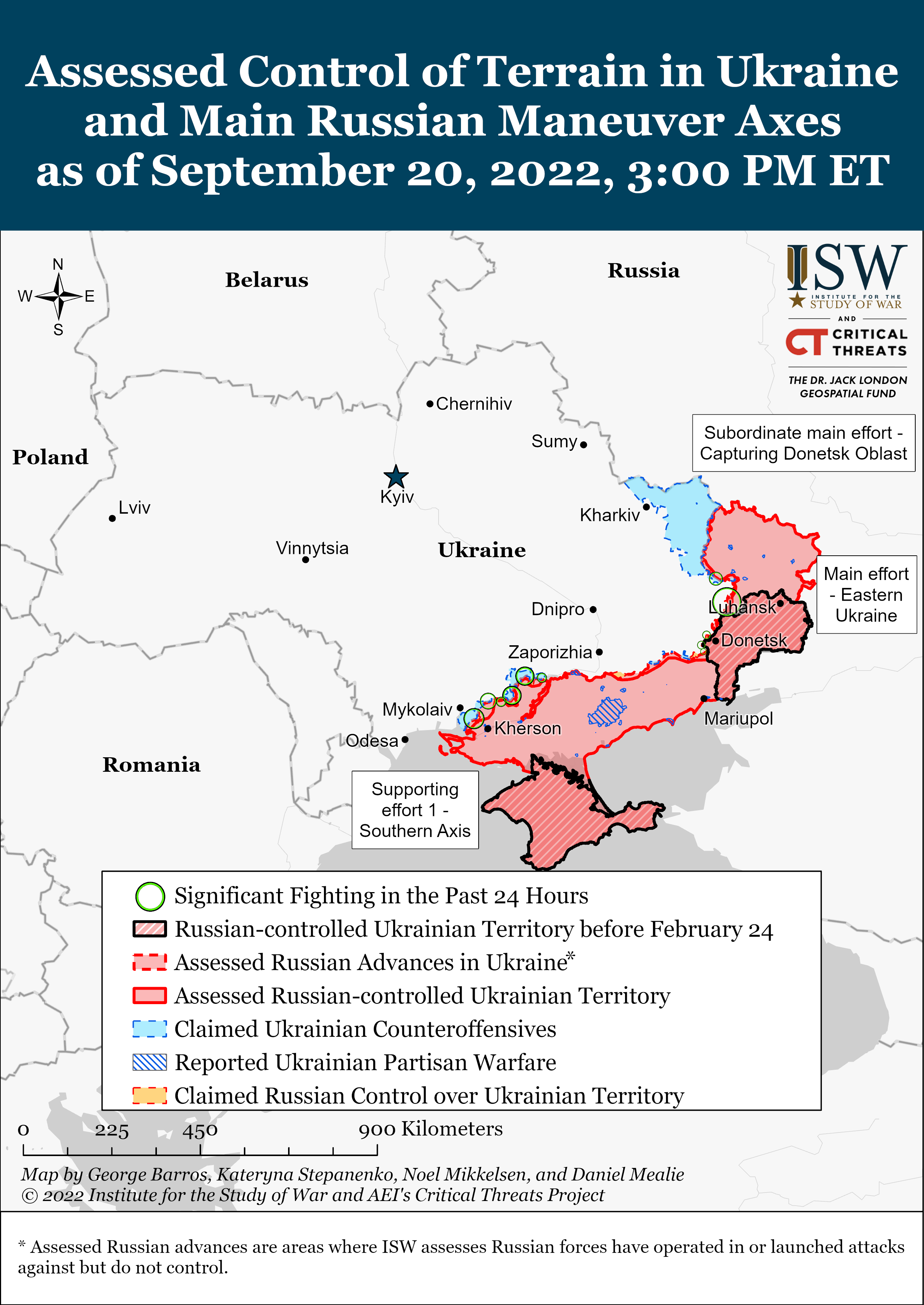 Katherine Lawlor, Karolina Hird, George Barros, and Frederick W. Kagan September 20, 8:45pm ET Click here to see ISW’s interactive map of the Russian invasion of Ukraine. This map is updated daily alongside the static maps present in this report. Russian-appointed occupation officials in Luhansk, Donetsk, Kherson, and Zaporizhia oblasts announced on September 20 that they will hold a “referendum” on acceding to Russia, with a vote taking place from September 23-27.[1] The Kremlin will use the falsified results of these sham referenda to illegally annex all Russian-occupied parts of Ukraine and is likely to declare unoccupied parts of Donetsk, Kherson, and Zaporizhia oblasts to be part of Russia as well. The Kremlin’s annexation plans are primarily targeting a domestic audience; Putin likely hopes to improve Russian force generation capabilities by calling on the Russian people to volunteer for a war to “defend” newly claimed Russian territory. Putin and his advisors have apparently realized that current Russi...
 -
ISW Blog - 02:55 Sep 20, 2022
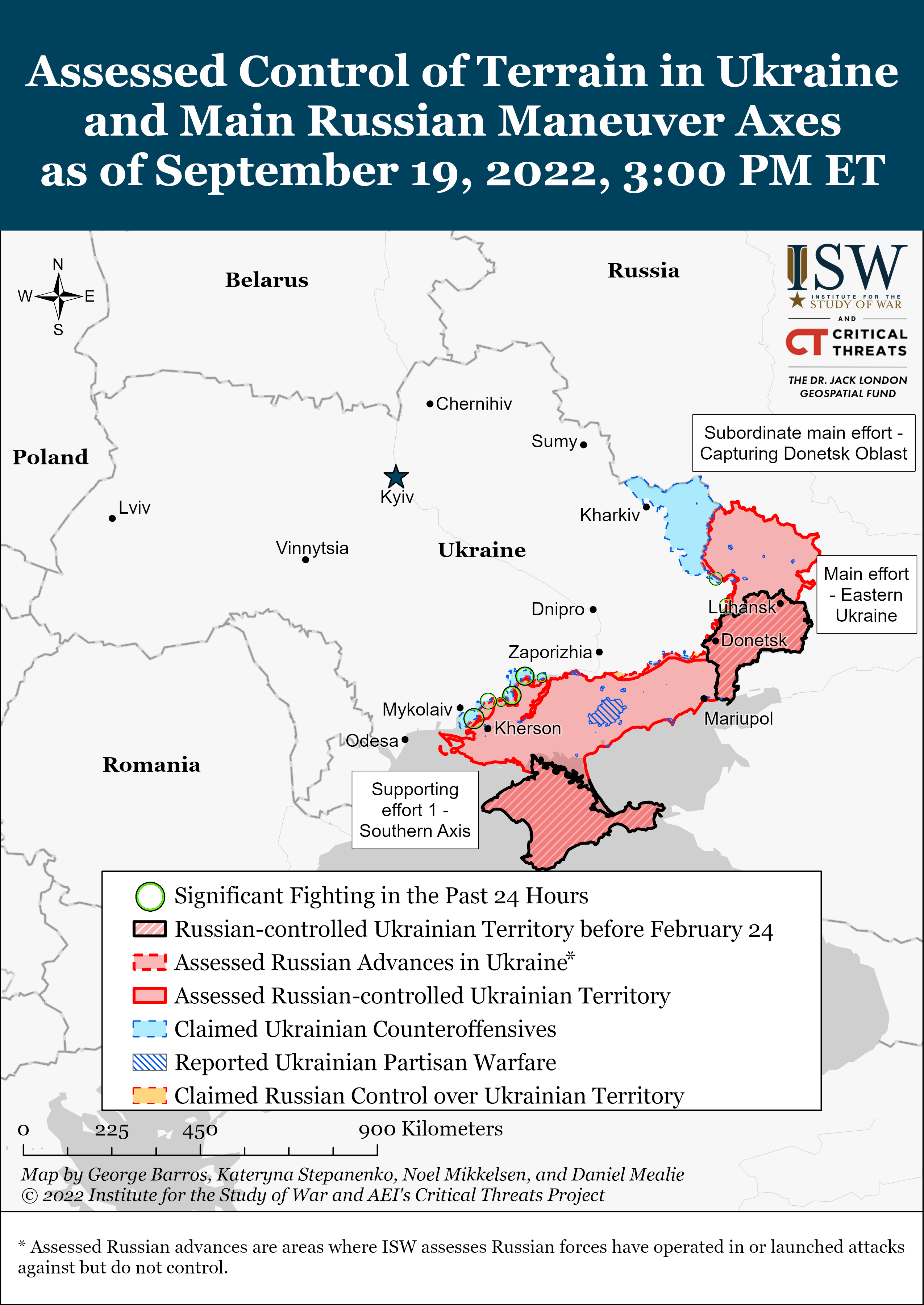 Karolina Hird, Katherine Lawlor, Mason Clark, and Frederick W. Kagan September 19, 9 pm ET Click here to see ISW’s interactive map of the Russian invasion of Ukraine. This map is updated daily alongside the static maps present in this report. Urgent discussion on September 19 among Russia’s proxies of the need for Russia to immediately annex Luhansk and Donetsk oblasts (much of the latter of which is not under Russian control) suggests that Ukraine’s ongoing northern counter-offensive is panicking proxy forces and some Kremlin decision-makers. The legislatures of Russia’s proxies in occupied Ukraine, the Donetsk and Luhansk People’s Republics (DNR and LNR), each called on their leadership to “immediately” hold a referendum on recognizing the DNR and LNR as Russian subjects.[1] Russian propagandist and RT Editor-in-Chief Margarita Simonyan spoke glowingly of the call, referring to it as the “Crimean scenario.” She wrote that by recognizing occupied Ukrainian land as Russian territory, Russia could more easily ...
 -
ISW Blog - 03:27 Sep 19, 2022
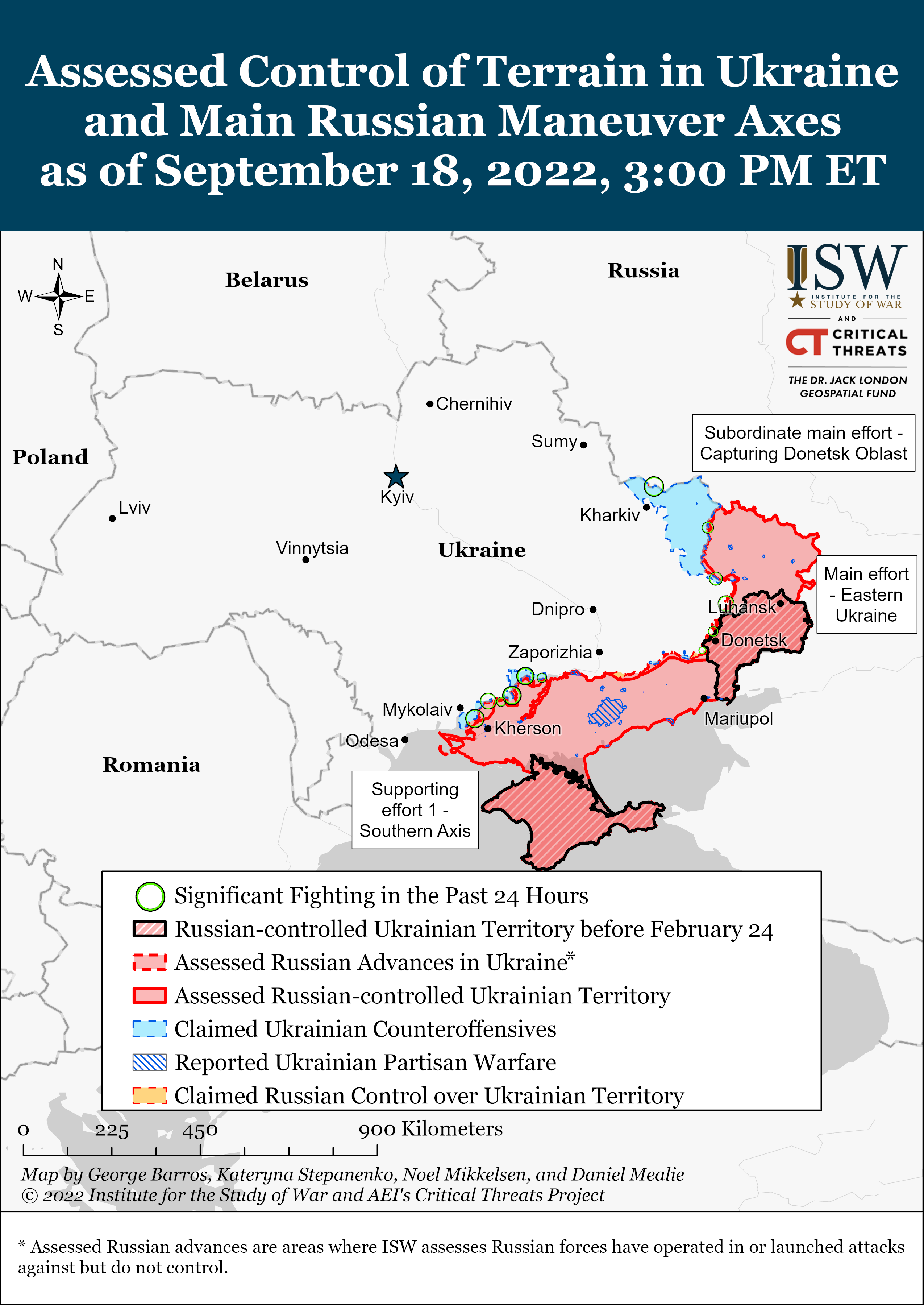 Kateryna Stepanenko, Grace Mappes, and Frederick W. Kagan September 18, 9:35 pm ET Click here to see ISW’s interactive map of the Russian invasion of Ukraine. This map is updated daily alongside the static maps present in this report. Russian President Vladimir Putin is increasingly relying on irregular volunteer and proxy forces rather than conventional units and formations of the Russian Federation Armed Forces. ISW has previously reported that Putin has been bypassing the Russian higher military command and Ministry of Defense leadership throughout the summer and especially following the defeat around Kharkiv Oblast.[1] Putin’s souring relationship with the military command and the Russian (MoD) may explain in part the Kremlin’s increasing focus on recruiting ill-prepared volunteers into ad-hoc irregular units rather than attempting to draw them into reserve or replacement pools for regular Russian combat units. A prominent Russian milblogger reported that Russian forces have “already began the process of...
 -
ISW Blog - 01:59 Sep 18, 2022
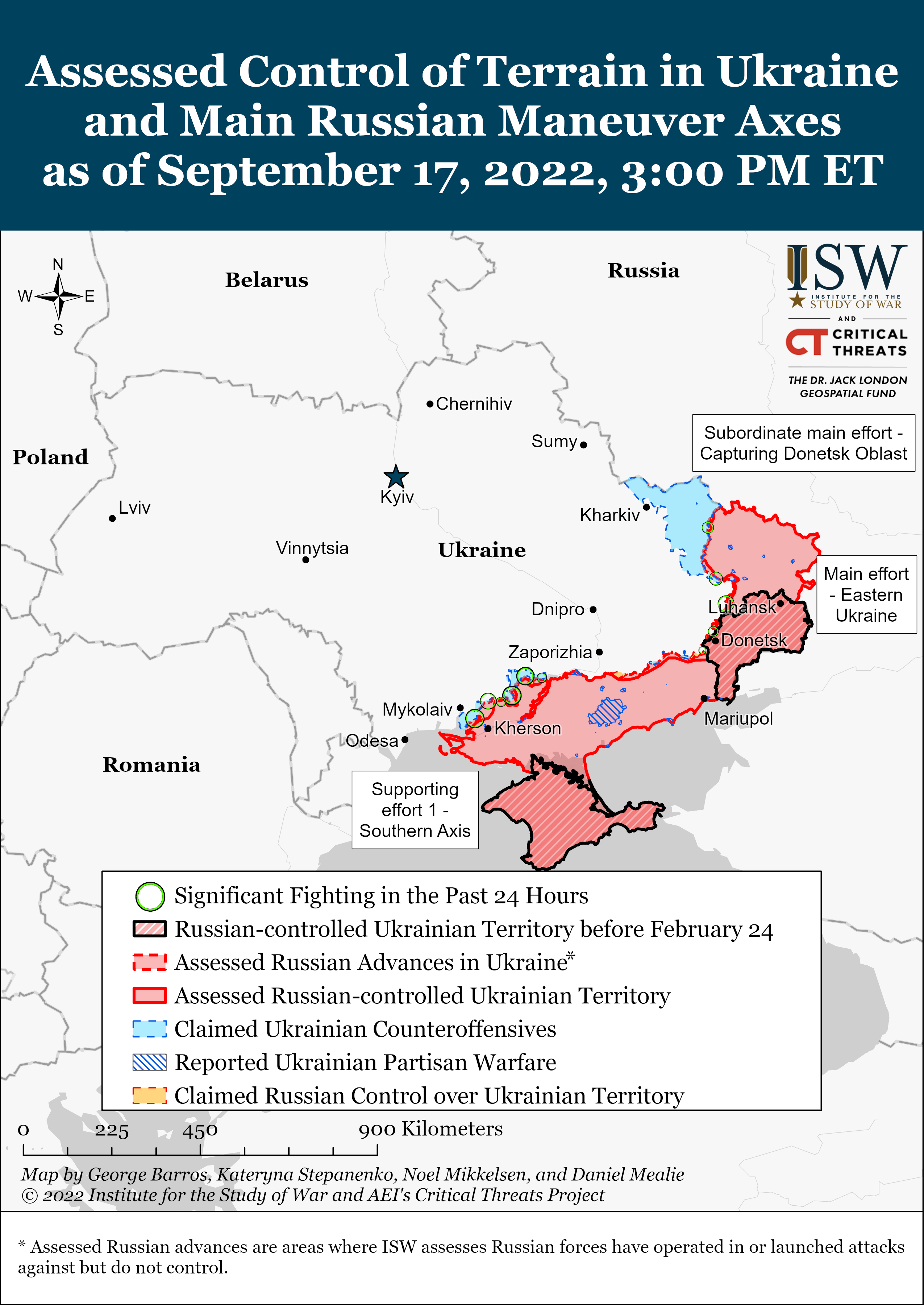 Kateryna Stepanenko, Grace Mappes, Angela Howard, and Frederick W. Kagan September 17, 9:30 pm ET Click here to see ISW’s interactive map of the Russian invasion of Ukraine. This map is updated daily alongside the static maps present in this report. Russian forces continue to conduct meaningless offensive operations around Donetsk City and Bakhmut instead of focusing on defending against Ukrainian counteroffensives that continue to advance. Russian troops continue to attack Bakhmut and various villages near Donetsk City of emotional significance to pro-war residents of the Donetsk People’s Republic (DNR) but little other importance. The Russians are apparently directing some of the very limited reserves available in Ukraine to these efforts rather than to the vulnerable Russian defensive lines hastily thrown up along the Oskil River in eastern Kharkiv Oblast. The Russians cannot hope to make gains around Bakhmut or Donetsk City on a large enough scale to derail Ukrainian counteroffensives and appear to be con...
 -
ISW Blog - 00:45 Sep 17, 2022
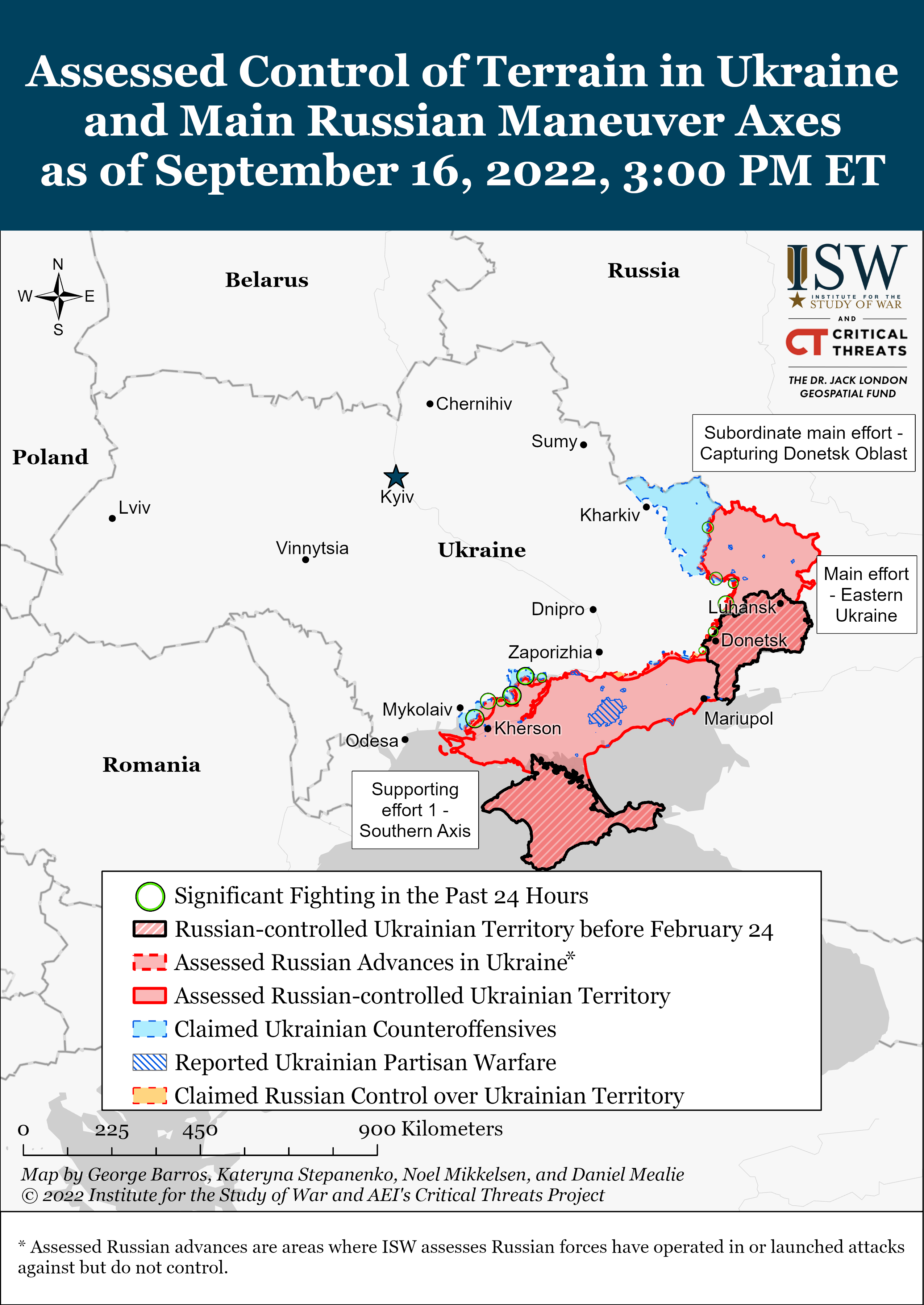 Katherine Lawlor, Grace Mappes, Mason Clark, and Frederick W. Kagan September 16, 8pm ET Click here to see ISW’s interactive map of the Russian invasion of Ukraine. This map is updated daily alongside the static maps present in this report. The revelations of mass graves of civilians and torture chambers in newly liberated Izyum confirm ISW’s previous assessments that the Bucha atrocities were not isolated war crimes but rather a microcosm of Russian atrocities throughout Russian-occupied areas. The Ukrainian General Staff published images on September 16 showing a mass burial site in Izyum, Kharkiv Oblast and noting that Ukrainian President Volodymyr Zelensky said that the site contained more than 400 bodies showing signs of torture and brutality.[1] The Ukrainian Ministry of Reintegration reported that the number of war crimes victims in Izyum may exceed those of Bucha.[2] The head of Ukraine’s National Police, Ihor Klymenko, stated that Ukrainian officials have found 10 Russian torture chambers in Vovch...
 -
ISW Blog - 02:28 Sep 16, 2022
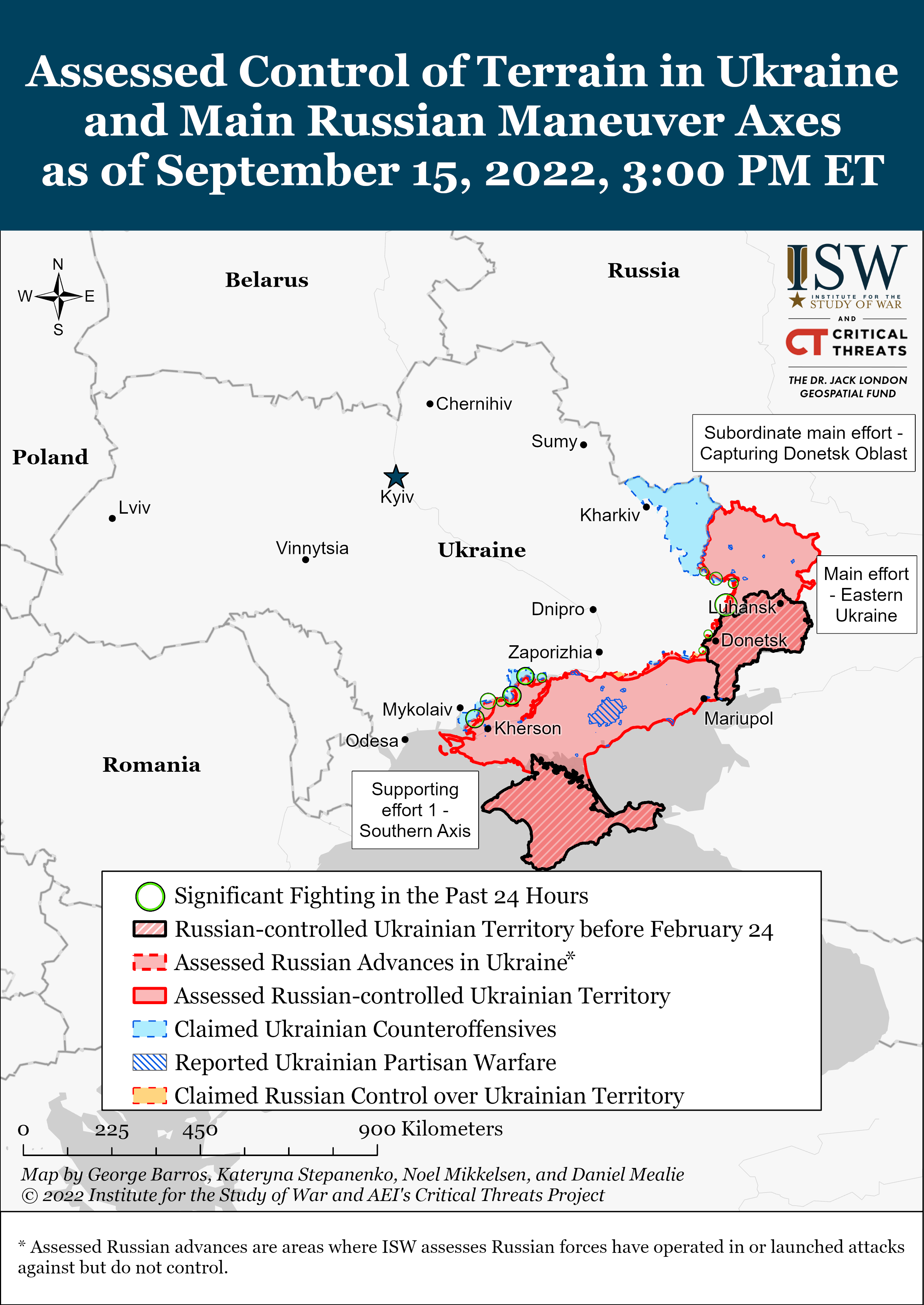 Kateryna Stepanenko, Katherine Lawlor, Grace Mappes, George Barros, and Frederick W. Kagan September 15, 9:30 pm ET Click here to see ISW’s interactive map of the Russian invasion of Ukraine. This map is updated daily alongside the static maps present in this report. Ukrainian forces are continuing counteroffensive operations in eastern Ukraine, increasingly pressuring Russian positions and logistics lines in eastern Kharkiv, northern Luhansk, and eastern Donetsk oblasts. Russian sources reported that Ukrainian forces are continuing ground operations southeast of Izyum, near Lyman, and on the east bank of the Oskil River, reportedly compelling Russian forces to withdraw from some areas in eastern Ukraine and reinforce others.[1] Russian forces in eastern Ukraine will likely struggle to hold their defensive lines if Ukrainian forces continue to push farther east. The Kremlin is responding to the defeat around Kharkiv Oblast by doubling down on crypto-mobilization rather than setting conditions for general mobi...
 -
ISW Blog - 01:12 Sep 15, 2022
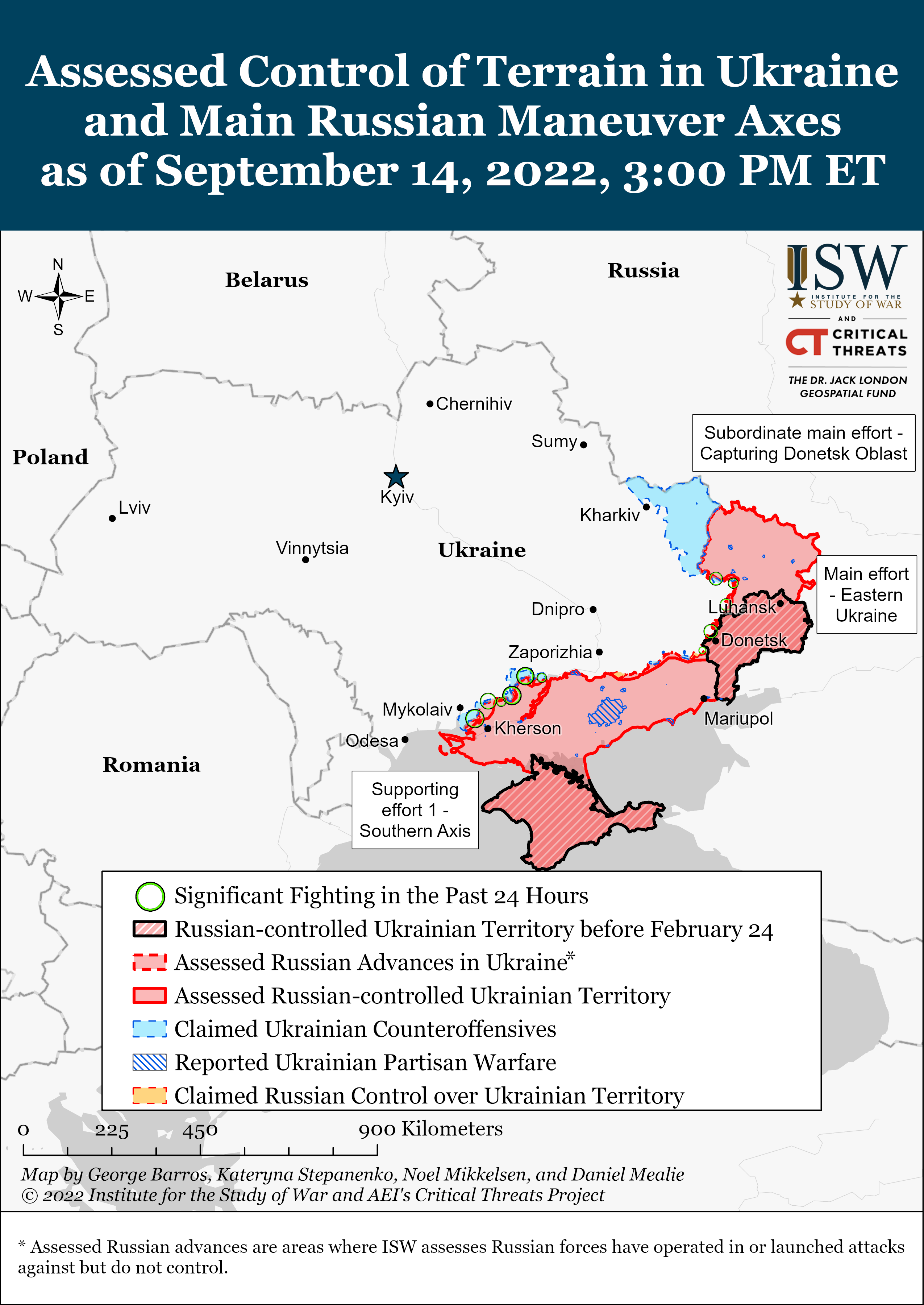 Karolina Hird, Kateryna Stepanenko, Katherine Lawlor, George Barros, and Frederick W. Kagan September 14, 8:15pm ET Click here to see ISW’s interactive map of the Russian invasion of Ukraine. This map is updated daily alongside the static maps present in this report. Wagner Group financier Yevgeny Prigozhin is being established as the face of the Russian “special military operation” in Ukraine. Prigozhin gave a recruitment speech on September 14 announcing that Russian prisoners have been participating in the war since July 1 when they were instrumental in seizing the Vuhlehirska Thermal Power Plant.[1] A Russian milblogger noted that Prigozhin is introducing a “Stalinist” method that allows the Kremlin to avoid ordering a general mobilization that could ignite social tensions in Russian society.[2] Milbloggers have been consistently praising Prigozhin’s success in Ukraine and some even said that he should replace the Russian Defense Minister Sergey Shoigu, whom milbloggers and Kremlin pundits blame for the R...
 -
ISW Blog - 03:28 Sep 14, 2022
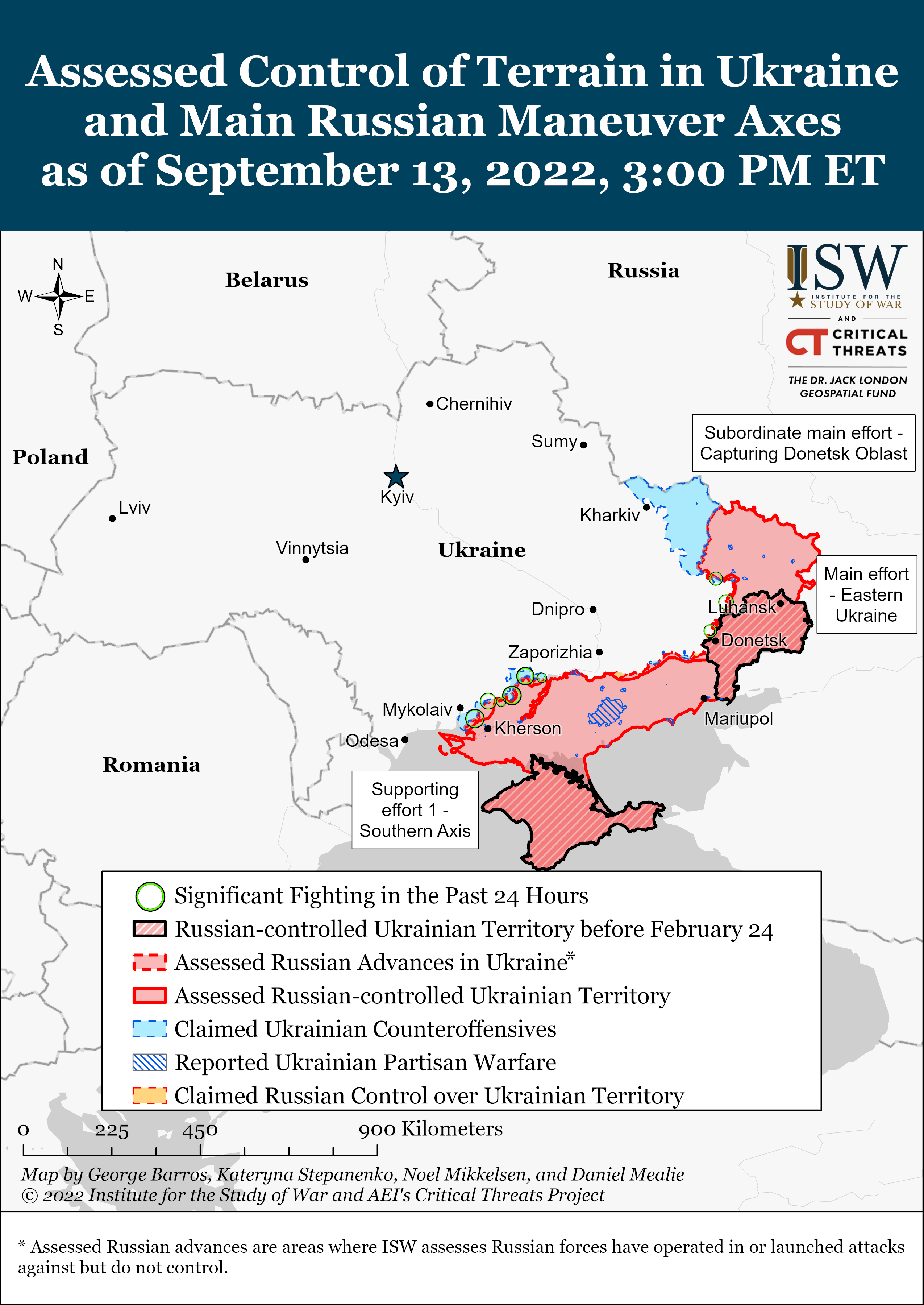 Kateryna Stepanenko, Karolina Hird, Katherine Lawlor, George Barros, and Frederick W. Kagan September 13, 10:15 pm ET Click here to see ISW’s interactive map of the Russian invasion of Ukraine. This map is updated daily alongside the static maps present in this report. The Kremlin acknowledged its defeat in Kharkiv Oblast, the first time Moscow has openly recognized a defeat since the start of the February 2022 invasion of Ukraine. Kremlin officials and state media propagandists are extensively discussing the reasons for the Russian defeat in Kharkiv Oblast, a marked change from their previous pattern of reporting on exaggerated or fabricated Russian successes with limited detail.[1] The Kremlin never admitted that Russia was defeated around Kyiv or, later, at Snake Island, framing the retreat from Kyiv as a decision to prioritize the “liberation” of Donbas and the withdrawal from Snake Island as a “gesture of goodwill.”[2] The Russian Ministry of Defense (MoD) originally offered a similar explanation for th...
 -
ISW Blog - 02:47 Sep 13, 2022
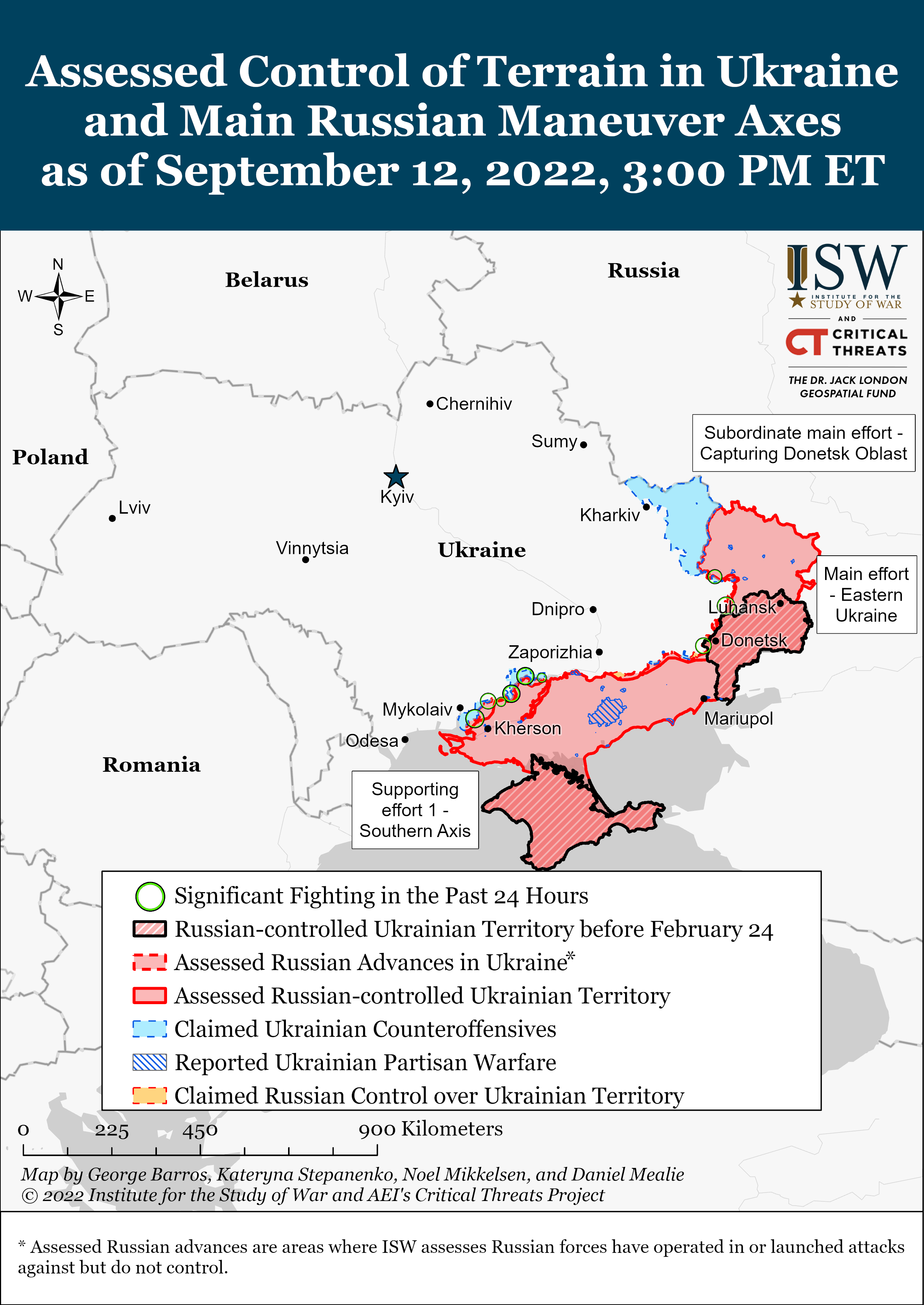 Karolina Hird, Grace Mappes, Katherine Lawlor, George Barros, and Frederick W. Kagan September 12, 8:45pm ET Click here to see ISW’s interactive map of the Russian invasion of Ukraine. This map is updated daily alongside the static maps present in this report. Ukraine’s southern counteroffensive is continuing to have significant impacts on Russian morale and military capabilities in southern Ukraine. Satellite imagery of known Russian positions in Kyselivka, 15km northwest of Kherson City, shows that all but four Russian vehicles have departed from previous forward positions, consistent with rumors that Donetsk People’s Republic (DNR) troops have abandoned Kyselivka and moved back towards the Dnipro River.[1] Kyselivka is an operationally significant location for Russian forces around Kherson City because it is the last major settlement along both the E58 highway and a railway line between current Ukrainian positions and Chornobaivka, the outermost part of Kherson City. The apparent withdrawal of Ru...
 -
ISW Blog - 03:37 Sep 12, 2022
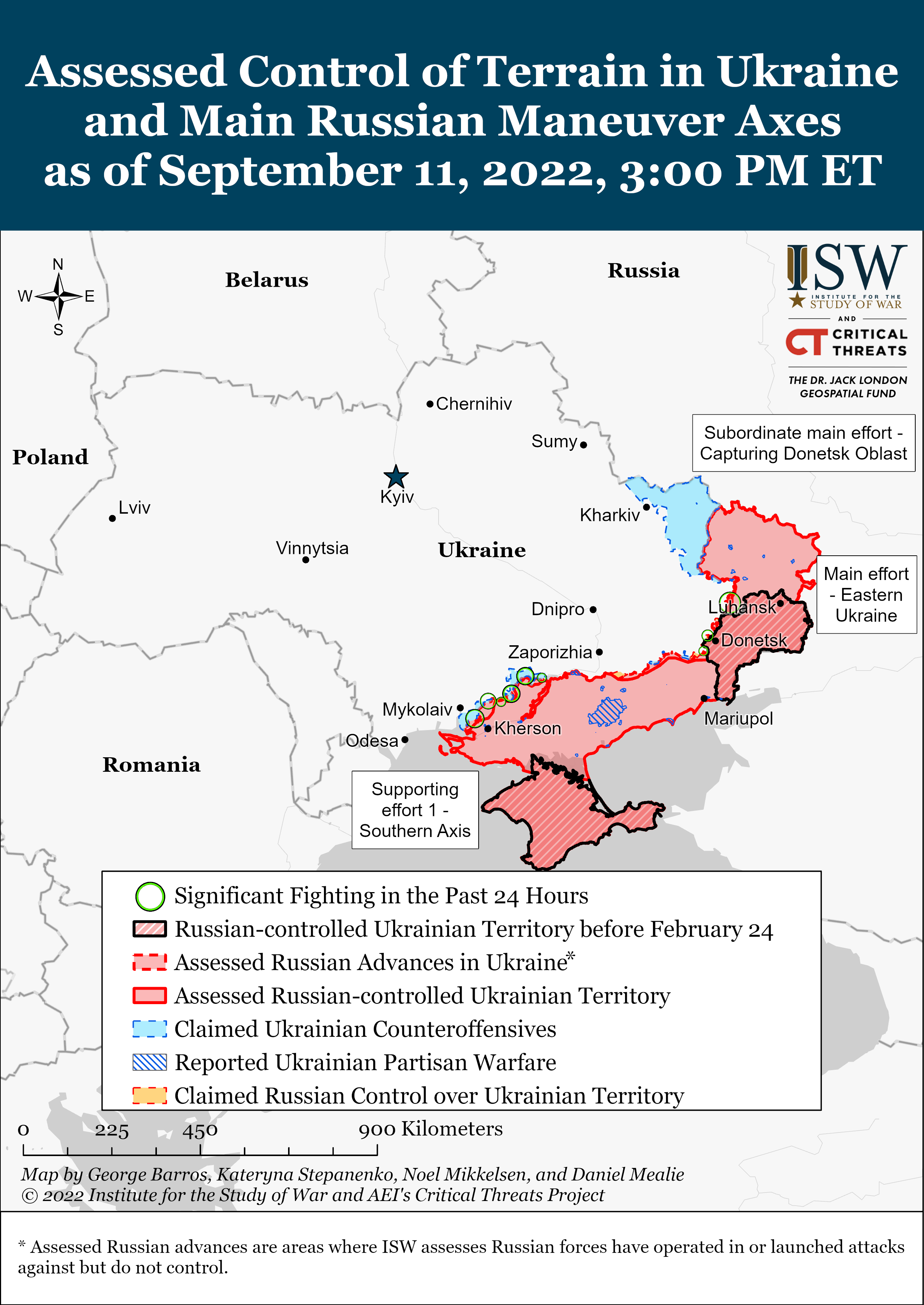 Kateryna Stepanenko, Karolina Hird, Grace Mappes, and Frederick W. Kagan September 11, 10pm ET Click here to see ISW’s interactive map of the Russian invasion of Ukraine. This map is updated daily alongside the static maps present in this report. Ukrainian forces have inflicted a major operational defeat on Russia, recapturing almost all Kharkiv Oblast in a rapid counter-offensive. The Ukrainian success resulted from skillful campaign design and execution that included efforts to maximize the impact of Western weapons systems such as HIMARS. Kyiv’s long discussion and then an announcement of a counter-offensive operation aimed at Kherson Oblast drew substantial Russian troops away from the sectors on which Ukrainian forces have conducted decisive attacks in the past several days. Ukraine’s armed forces employed HIMARS and other Western systems to attack Russian ground lines of communication (GLOCs) in Kharkiv and Kherson Oblasts, setting conditions for the success of this operation. Ukrainian leaders discu...
 -
ISW Blog - 06:00 Sep 11, 2022
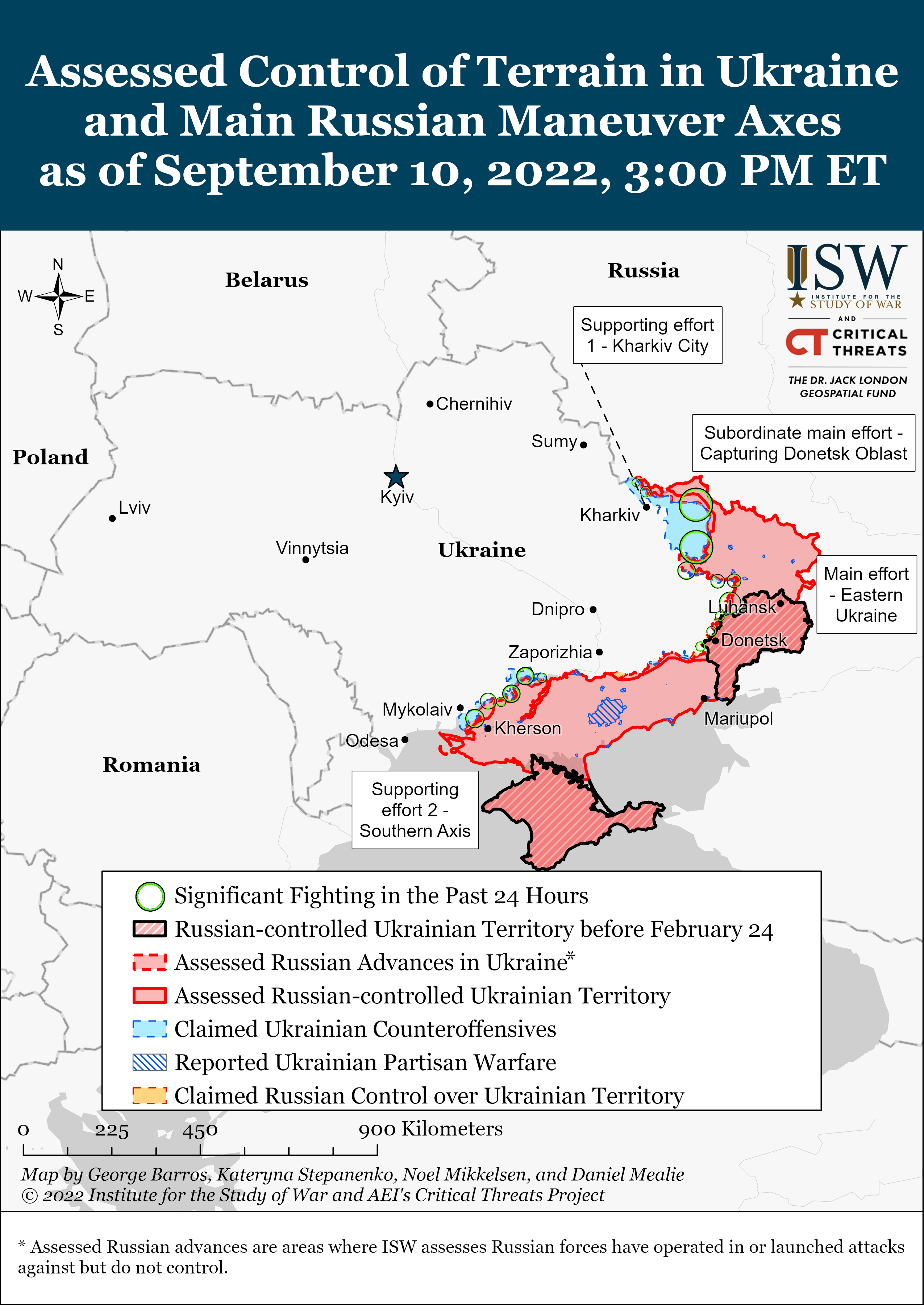 Kateryna Stepanenko, Grace Mappes, George Barros, Angela Howard, and Mason Clark September 10, 11:30pm ET Click here to see ISW’s interactive map of the Russian invasion of Ukraine. This map is updated daily alongside the static maps present in this report. The Ukrainian counteroffensive in Kharkiv Oblast is routing Russian forces and collapsing Russia’s northern Donbas axis. Russian forces are not conducting a controlled withdrawal and are hurriedly fleeing southeastern Kharkiv Oblast to escape encirclement around Izyum. Russian forces have previously weakened the northern Donbas axis by redeploying units from this area to Southern Ukraine, complicating efforts to slow the Ukrainian advance or at minimum deploy a covering force for the retreat. Ukrainian gains are not confined to the Izyum area; Ukrainian forces reportedly captured Velikiy Burluk on September 10, which would place Ukrainian forces within 15 kilometers of the international border.[1] Ukrainian forces have penetrated Russian lines to a depth ...
 -
ISW Blog - 04:15 Sep 10, 2022
 Kateryna Stepanenko, Grace Mappes, George Barros, Layne Philipson, and Mason Clark September 9, 11:15pm ET Click hereto see ISW’s interactive map of the Russian invasion of Ukraine. This map is updated daily alongside the static maps present in this report. Ukrainian forces have captured an estimated 2,500 square kilometers in Kharkiv Oblast in the Kharkiv area counteroffensive as of September 9. Ukrainian President Volodymyr Zelensky and Ukrainian Commander-in-Chief Valery Zaluzhnyi stated on September 8 that Ukrainian forces liberated over 1,000 square kilometers between September 1-8 – a day before Ukrainian forces reached the southern approach to Kupyansk and the Oskil River on September 9.[1]Ukrainian forces are likely clearing pockets of disorganized Russian forces caught in the rapid Ukrainian advance to Kupyansk, Izyum, and the Oskil River, given the influx of observed pictures of Russian prisoners of war in the past 48 hours.[2] Ukrainian forces may collapse Russian positions around Izyum if th...
 -
ISW Blog - 04:35 Sep 09, 2022
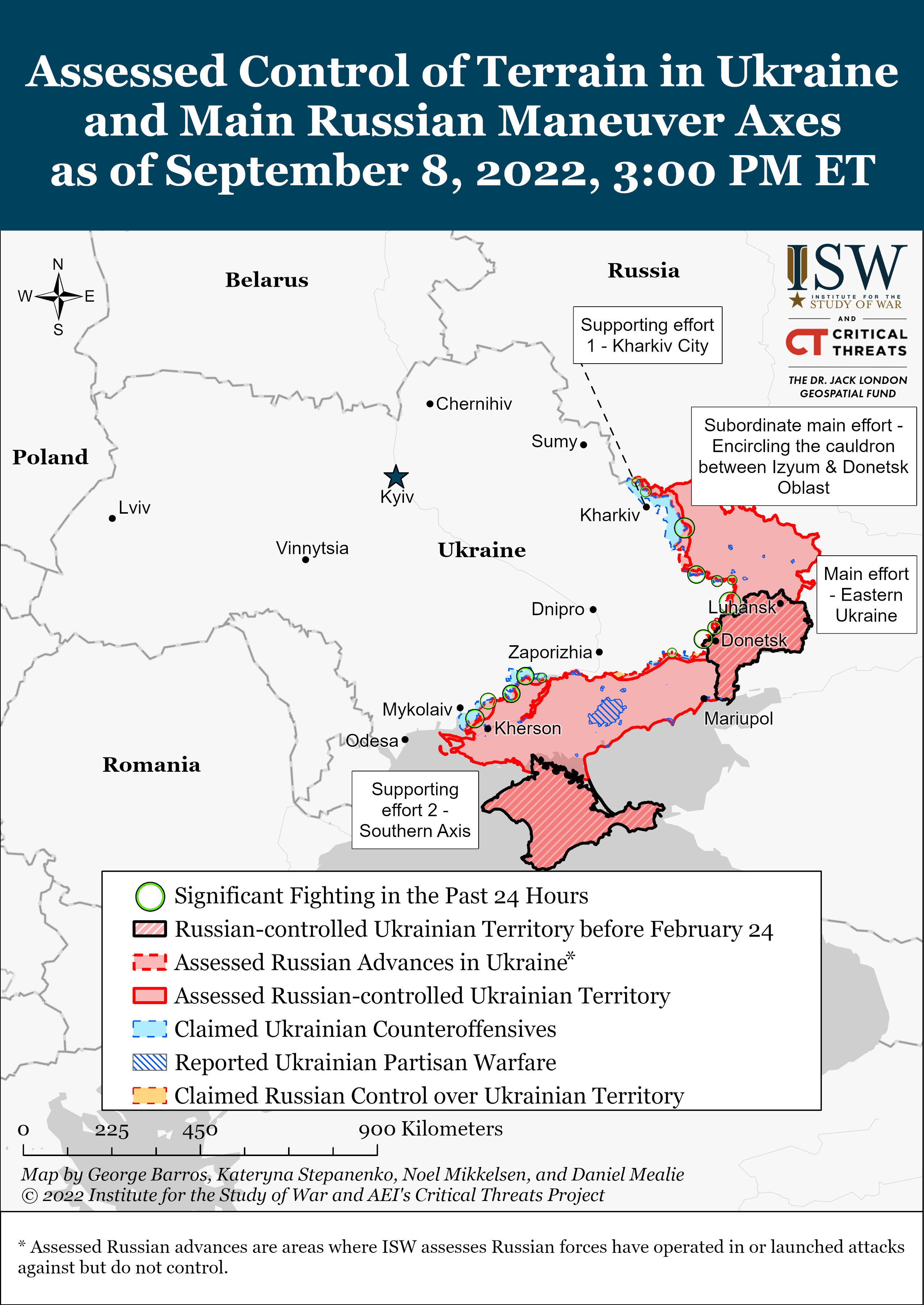 Kateryna Stepanenko, Grace Mappes, George Barros, Layne Philipson, and Mason Clark September 8, 11:00 pm ET Click here to see ISW’s interactive map of the Russian invasion of Ukraine. This map is updated daily alongside the static maps present in this report. Ukrainian successes on the Kharkiv City-Izyum line are creating fissures within the Russian information space and eroding confidence in Russian command to a degree not seen since a failed Russian river crossing in mid-May. Ukrainian military officials announced that Ukrainian forces advanced 50km deep into Russian defensive positions north of Izyum on September 8, but the Russian Ministry of Defense (MoD) notably did not issue any statement regarding Ukrainian advances in Kharkiv Oblast.[1] Ukrainian successes and the Russian MoD’s silence prompted many Russian milbloggers to criticize and debate Russian failures to retain control over the city of Balakliya, approximately 44km northwest of Izyum. Some milbloggers claimed that Russian forces fully or par...
 -
ISW Blog - 02:36 Sep 08, 2022
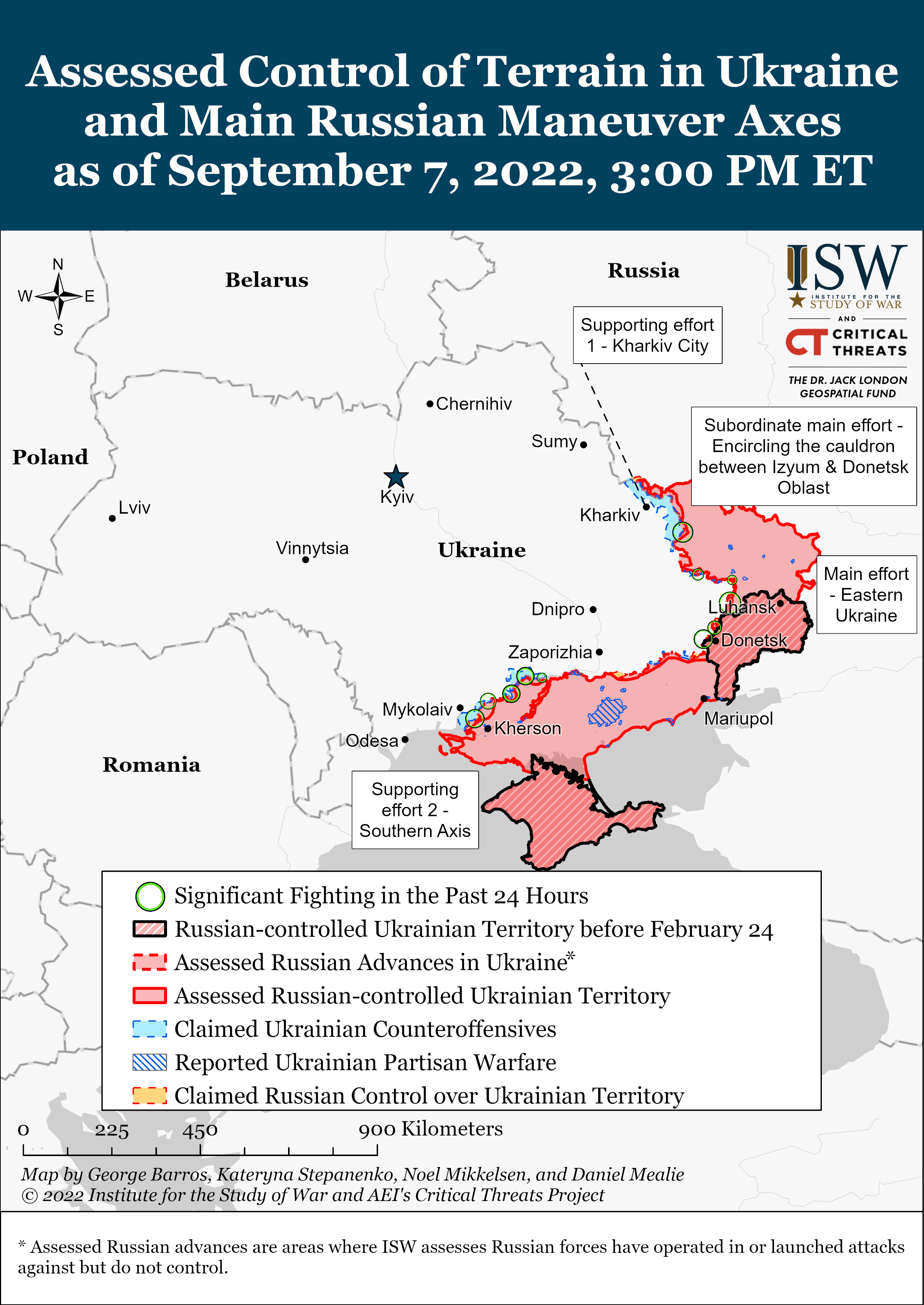 Karolina Hird, Grace Mappes, George Barros, Layne Philipson, and Mason Clark September 7, 9:30 pm ET Click here to see ISW’s interactive map of the Russian invasion of Ukraine. This map is updated daily alongside the static maps present in this report. Ukrainian forces in southeastern Kharkiv Oblast are likely exploiting Russian force reallocation to the Southern Axis to conduct an opportunistic yet highly effective counteroffensive northwest of Izyum. Ukrainian forces likely used tactical surprise to advance at least 20km into Russian-held territory in eastern Kharkiv Oblast on September 7, recapturing approximately 400 square kilometers of ground. Russian sources claimed that Russian troops began deploying reinforcements to the area to defend against Ukrainian advances, and the Russian grouping in this area was likely understrength due to previous Russian deployments to support ongoing efforts to capture the remainder of Donetsk Oblast and support the southern axis.[1] Ukraine’s ongoing operations in Kher...
 -
ISW Blog - 03:07 Sep 07, 2022
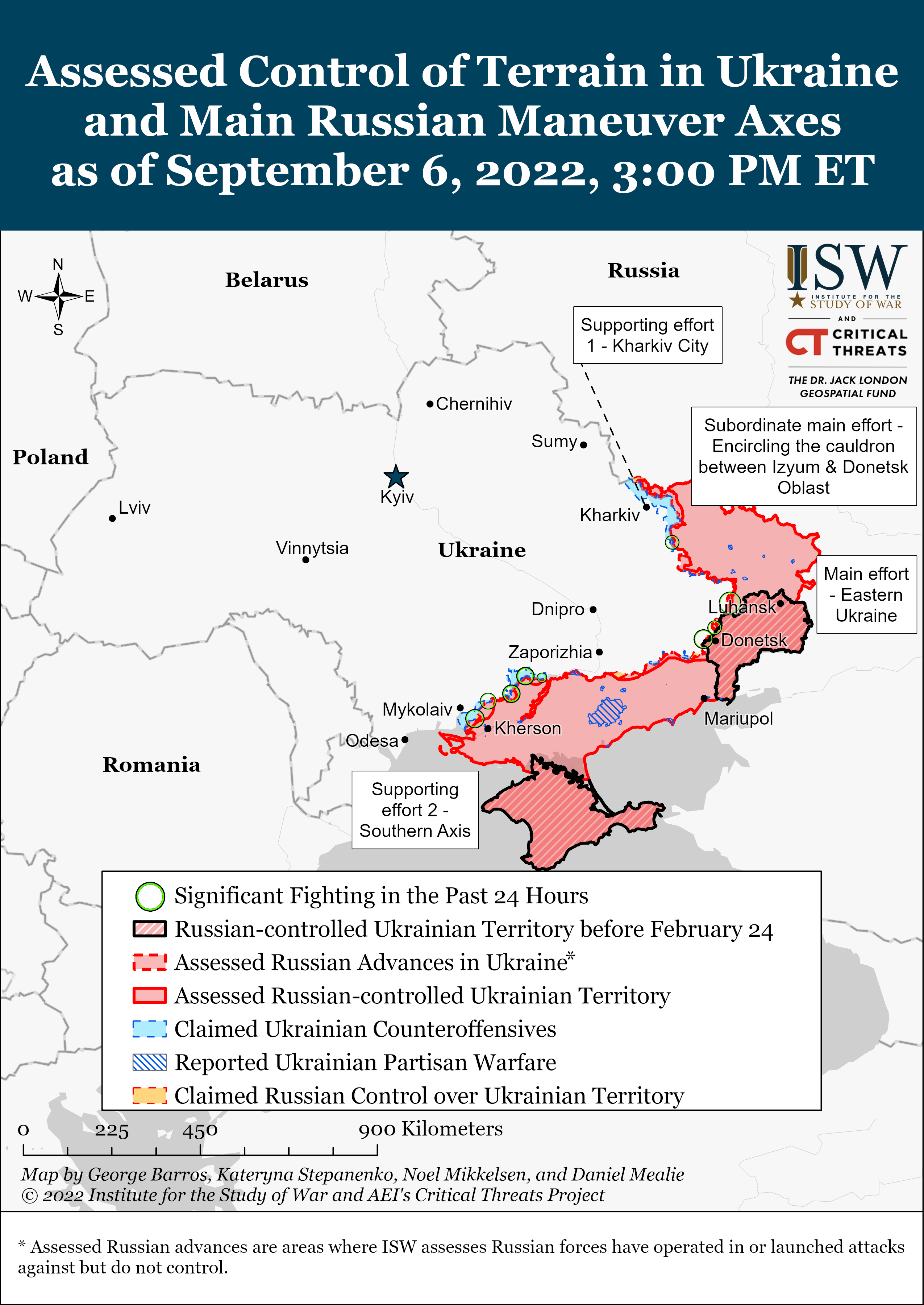 Karolina Hird, George Barros, Layne Philipson, and Frederick W. Kagan September 6, 10:00 pm ET Click here to see ISW’s interactive map of the Russian invasion of Ukraine. This map is updated daily alongside the static maps present in this report. The International Atomic Energy Agency’s (IAEA) September 6 report on the situation at the Zaporizhzhia Nuclear Power Plant (ZNPP) described numerous ways in which Russian occupation authorities and the Russian military are jeopardizing the safe operation of the plant.[1] The report does not attempt to determine which party is responsible for the shelling that has damaged the facility and repeatedly calls on “all relevant parties” to take measures to improve the situation. The moderation and apparent neutrality of that language can overshadow the extremely clear articulation of the Russian activities undermining the plant’s safety and the fact that the report attributes no dangerous actions to Ukraine. The IAEA’s report is thus a coded condemnation of Russian moves ...
 -
ISW Blog - 03:09 Sep 06, 2022
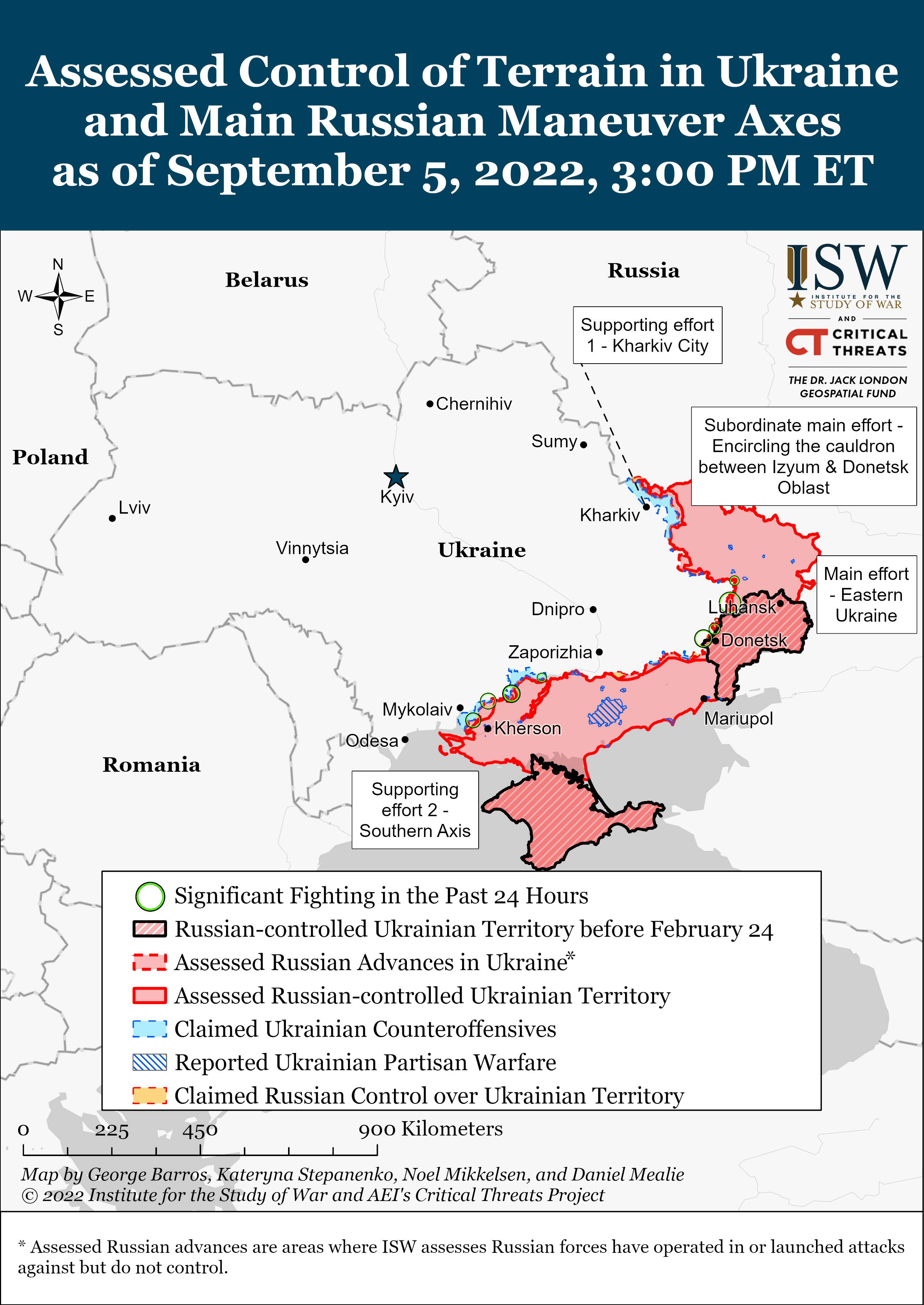 Kateryna Stepanenko, Karolina Hird, Angela Howard, and Mason Clark September 5, 10:30pm ET Click here to see ISW’s interactive map of the Russian invasion of Ukraine. This map is updated daily alongside the static maps present in this report. The Ukrainian counteroffensive is tangibly degrading Russian logistics and administrative capabilities in occupied southern Ukraine. As ISW has previously reported, Ukrainian officials explicitly confirmed that Ukrainian troops seek to attrit Russian logistical capabilities in the south through precision strikes on manpower and equipment concentrations, command centers, and logistics nodes.[1] These counteroffensive actions also have intentional radiating effects on Russian occupation authorities. The head of the Kherson Oblast occupation regime, Kirill Stremousov, told Russian media outlet TASS that his administration has paused annexation referendum plans in Kherson Oblast due to “security” concerns.[2] The Ukrainian Resistance Center similarly reported that Russian oc...
 -
ISW Blog - 03:00 Sep 05, 2022
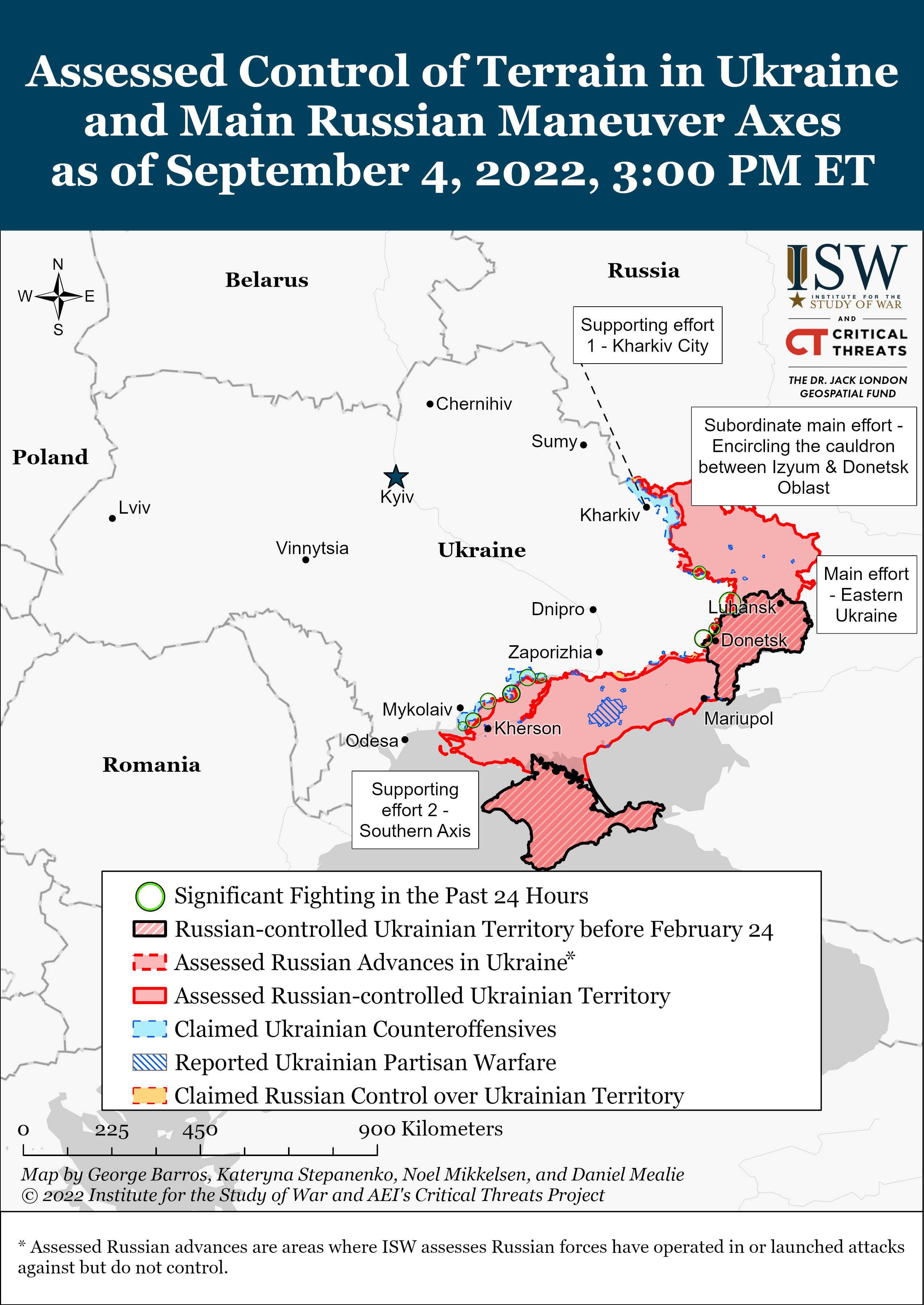 Kateryna Stepanenko, Grace Mappes, Layne Philipson, Frederick W. Kagan September 4, 10:00 pm ET Click here to see ISW’s interactive map of the Russian invasion of Ukraine. This map is updated daily alongside the static maps present in this report. The Ukrainian counteroffensive is making verifiable progress in the south and the east. Ukrainian forces are advancing along several axes in western Kherson Oblast and have secured territory across the Siverskyi Donets River in Donetsk Oblast. The pace of the counteroffensive will likely change dramatically from day to day as Ukrainian forces work to starve the Russians of necessary supplies, disrupt their command and control, and weaken their morale even as counteroffensive ground assaults continue. The Russians will occasionally counterattack and regain some lost ground and will of course conduct likely fierce artillery and air attacks against liberated settlements and advancing Ukrainian troops. Ukrainian forces have made substantial enough progress to begin evok...