Japan | Pakistan
"Japan" in Pakistan feed
-
Dawn - 06:01 Mar 20, 2026
WASHINGTON: Japanese Prime Minister Sanae Takaichi sailed smoothly past a potential clash with Donald Trump on Iran on Thursday — although the US president whipped up a bit of a storm about Pearl Harbor. Days after lashing out at US allies including Japan for failing to heed his calls to help reopen the Strait of Hormuz, Trump praised Tokyo’s efforts related to the Middle East war in vague terms. “I believe that, based on statements (which) were given to us yesterday, the day before yesterday, having to do with Japan, they are really stepping up to the plate,” Trump told reporters as he hosted Takaichi in the Oval Office. After a long pause Trump then added “unlike Nato,” repeating his criticisms of the US-led military alliance with mainly European countries. Trump gave few details about what help Japan might provide in securing the crucial waterway, through which one-fifth of the world’s oil normally passes. But his tone towards Takaichi was far more friendly than the tongue-lashings he has given to allies, ... -
Dawn - 18:06 Mar 19, 2026
Leaders from the United Kingdom, France, Germany, Italy, the Netherlands, and Japan have signalled their readiness to support efforts to ensure the safe passage of commercial vessels through the Strait of Hormuz. “We express our readiness to contribute to appropriate efforts to ensure safe passage through the strait. We welcome the commitment of nations that are engaging in preparatory planning,” the leaders said in a joint statement. The Strait of Hormuz, a crucial shipping route, has been virtually paralysed by the Middle East war. The war erupted on February 28 when the US and Israel began bombing Iran, prompting it to retaliate with strikes targeting US assets and bases in the Gulf and restricting access to the strait. Since March 1, 2026, at least 21 commercial vessels, including 10 tankers, have been attacked or reported incidents in the Gulf, the Strait of Hormuz or the Gulf of Oman, according to the British naval maritime security agency UKMTO. Across all types of vessels, an additional four attacks c... -
Dawn - 20:10 Mar 06, 2026
LAHORE: Pakistan put up an impressive performance to edge Japan 4-3 in the semi-final of the FIH Hockey World Cup qualifier at the Suez Canal Authority Hockey Stadium in Egypt on Friday. The win has guaranteed the Green Shirts a place in the World Cup and marks their return to the global event after eight years. The tournament will be hosted jointly by Belgium and the Netherlands in August. The Pakistan team, led by Ammad Butt, was trailing 3-1 in the third quarter of the match against Japan, when it smashed three goals in the last nine minutes of the final quarter to edge ahead 4-3, snatching victory from the jaws of defeat. Ammad gave his side an early lead in the ninth minute with an impressive field goal. The lead, which remained intact till the end of the first quarter, was neutralised in the second quarter (21st minute) when Japan’s Ryoma Ooka scored a field goal. In an inspiring show, Japan took control of the match in the penultimate quarter when Shota Yamada (35th minute) and Yamasaki Koji (40th minu... -
The Nation - National - 19:00 Mar 06, 2026
ISLAMABAD - Japan, under its Grant Assistance for Grassroots Human Security Projects (GGP) Program, yesterday decided to provide grant assistance of USD 65,470 (equivalent to PKR 18 million) to the Pakistan Red Crescent Society (PRCS) for a project to enhance blood donation services in capital region. -
Dawn - 08:40 Feb 26, 2026
The number of births in Japan fell for the 10th straight year in 2025, official data showed on Thursday, highlighting the challenges for Prime Minister Sanae Takaichi. A total of 705,809 babies were born in Japan, the preliminary health ministry data showed, down 2.1 per cent from 2024. The data includes births to Japanese nationals in Japan, foreign births in Japan and babies born to Japanese nationals overseas. Meanwhile, 505,656 couples got married in 2025, up 1.1pc, while the number of divorces fell 3.7pc to 182,969 cases. There were 1,605,654 deaths, down 13,030 or 0.8pc from 2024. The internal affairs ministry estimated Japan’s overall population as of February at 122.86 million people, down 0.47pc, or 580,000, from a year ago. The world’s fourth-biggest economy has one of the world’s lowest birth rates and a falling and ageing population. This is leading to a host of problems, including labour shortages, a ballooning social security bill and fewer working people paying tax. That in turn is adding to Ja... -
The Nation - National - 03:34 Feb 11, 2026
ISLAMABAD - President Asif Ali Zardari yesterday said that Pakistan and Japan enjoy a relationship rooted in decades of trust, mutual respect, and consistent cooperation as the Japanese embassy hosted a reception marking the 66th birthday of His Majesty Emperor Naruhito of Japan. -
Dawn - 17:57 Feb 08, 2026
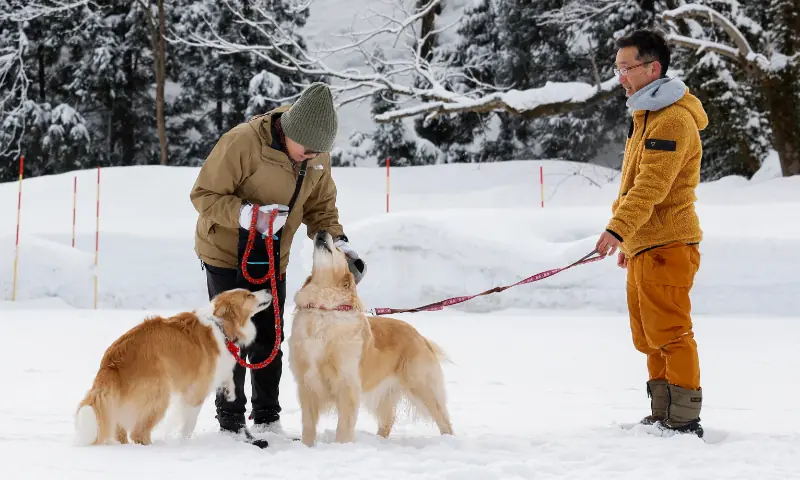 Japanese Prime Minister Sanae Takaichi’s coalition swept to a historic election win on Sunday, paving the way for promised tax cuts that have spooked financial markets and military spending aimed at countering China. The conservative Takaichi, Japan’s first female leader who says she is inspired by Britain’s “Iron Lady” Margaret Thatcher, was projected to deliver as many as 328 of the 465 seats in parliament’s lower house for her Liberal Democratic Party (LDP). The LDP alone sailed past the 233 seats needed for a majority less than two hours after polls closed, on track for one of its best-ever election results. With her coalition partner, the Japan Innovation Party, known as Ishin, Takaichi now has a supermajority of two-thirds of seats, easing her legislative agenda as she can override the upper chamber, which she does not control. Winter election brings blizzard of votes “This election involved major policy shifts — particularly a major shift in economic and fiscal policy, as well as strengthening security...
 -
The Nation - National - 19:00 Feb 06, 2026
ISLAMABAD - Akamatsu Shuichi, Ambassador of Japan to Pakistan, yesterday said that Japan and Pakistan are celebrating the enduring 74 year milestone of diplomatic friendship between the two countries and outlined a roadmap for future cooperation centered on people-to-people interaction. -
Dawn - 10:46 Jan 27, 2026
Hundreds gathered to say farewell to two popular pandas departing Tokyo for China on Tuesday, leaving Japan without any of the beloved bears for the first time in 50 years as ties between the Asian neighbours fray. Panda twins Lei Lei and Xiao Xiao were transported by truck out of Ueno Zoological Gardens, their birthplace, disappointing many Japanese fans who have grown attached to the furry four-year-olds. “I’ve been coming to watch them since they were born,” Nene Hashino, a woman in her 40s wearing a panda-themed jacket and clutching a bear stuffed toy, told AFP. “It feels like my own children are going somewhere far away. It’s sad.” The pandas’ abrupt return was announced last month during a diplomatic spat that began when Japanese Prime Minister Sanae Takaichi hinted that Tokyo could intervene militarily in the event of an attack on Taiwan. Her comment provoked the ire of Beijing, which regards the island as its own territory. The distinctive black-and-white animals, loaned out as part of China’s “panda ... -
Dawn - 11:46 Jan 21, 2026
The world’s biggest nuclear power plant was restarted on Wednesday for the first time since the 2011 Fukushima disaster, its Japanese operator said, despite persistent safety concerns among residents. The plant was “started at 19:02”, Tokyo Electric Power Company (TEPCO) spokesman Tatsuya Matoba told AFP of the Kashiwazaki-Kariwa plant in Niigata prefecture. The regional governor approved the resumption last month, although public opinion remains sharply divided. On Tuesday, a few dozen protesters — mostly elderly — braved freezing temperatures to demonstrate in the snow near the plant’s entrance, whose buildings line the Sea of Japan coast. “It’s Tokyo’s electricity that is produced in Kashiwazaki, so why should the people here be put at risk? That makes no sense,” Yumiko Abe, a 73-year-old resident, told AFP. Around 60 per cent of residents oppose the restart, while 37pc support it, according to a survey conducted in September. TEPCO said on Wednesday it would “proceed with careful verification of each plan... -
The Nation - National - 11:51 Jan 13, 2026
Pakistan and Japan have formalized a grant agreement to enhance pediatric healthcare facilities in South Punjab, with the Japanese government committing $18. -
Dawn - 11:19 Dec 26, 2025
Fourteen people were injured in a stabbing attack in a factory in central Japan during which an unspecified liquid was also sprayed, an emergency services official said on Friday. “Fourteen people are subject to transportation by emergency services,” Tomoharu Sugiyama, a firefighting department official in the city of Mishima in the Shizuoka region, told AFP. He said a call was received at about 4.30pm (12:30pm PKT) from a nearby rubber factory saying “five or six people were stabbed by someone” and that a “spray-like liquid” had also been used. Japanese media, including public broadcaster NHK, reported that police had arrested a man on suspicion of attempted murder. The seriousness of the injuries was unknown, although NHK said all victims remained conscious. Sugiyama said at least six of the 14 victims had been sent to a hospital in a fleet of ambulances. The exact nature of the injuries was also unclear. The factory in Mishima is run by Yokohama Rubber Co., whose business includes manufacturing tyres for t... -
Dawn - 07:35 Dec 12, 2025
A powerful earthquake struck off the coast of northern Japan on Friday, the weather office said, days after an even larger tremor shook the region and injured at least 50. The Japan Meteorological Agency (JMA) upgraded Friday’s quake to magnitude 6.7 and warned that tsunami waves of up to one metre (three feet) could hit the northern Pacific coastline. In the end, waves of up to 20 centimetres were recorded on the main northern island of Hokkaido and in the Aomori region, the JMA said, before the tsunami advisory was lifted. Broadcaster NHK said there was no obvious change at either of the ports where the waves hit. The United States Geological Survey (USGS) also said that the quake measured 6.7 and was 130 kilometres (81 miles) off the city of Kuji in Iwate prefecture on the main island of Honshu. NHK said that the level of shaking was less than the bigger 7.5 tremor late on Monday, which knocked items off shelves, tore apart roads, smashed windows and triggered tsunami waves of up to 70 centimetres. In the ... -
Dawn - 12:46 Dec 10, 2025
Japan has scrambled jets to monitor Russian and Chinese air forces conducting joint patrols around the country, the Japanese defence ministry said late Tuesday, amid rising tensions between Tokyo and Beijing. Two Russian Tu-95 nuclear-capable strategic bombers flew from the Sea of Japan toward the East China Sea to rendezvous with two Chinese H-6 bombers, and performed a “long-distance joint flight” in the Pacific, the ministry said. Four Chinese J-16 fighter jets joined the bombers as they made a round-trip flight between Japan’s Okinawa and Miyako islands, it added. The Miyako Strait between the two islands is classified as international waters. Japan also detected simultaneous Russian air force activity in the Sea of Japan, consisting of one early-warning aircraft A-50 and two Su-30 fighters, the ministry said. Japanese Defence Minister Shinjiro Koizumi said in a post on X on Wednesday that the Russian and Chinese joint operations were “clearly intended as a show of force against our nation, which is a ser... -
Dawn - 17:08 Dec 08, 2025
The Japanese Meteorological Agency (JMA) on Monday reported a 7.6 magnitude earthquake off the coast of its eastern Aomori prefecture. The JMA reported that the epicentre of the quake was registered off the coast of Aomori at a depth of 80 kilometres at 11:15pm local time (7:15pm PKT). On Japan’s 1-7 scale of seismic intensity, the tremor registered as an “upper 6” in Aomori prefecture — a quake strong enough to make it impossible to keep standing or move without crawling. In such tremors, most heavy furniture can collapse and wall tiles and windowpanes are damaged in many buildings. Tsunami warnings were issued for the prefectures of Hokkaido, Aomori and Iwate, and tsunamis from 20 to 70 cm (7 to 27 inches) high were observed at several ports, JMA said. Japanese public broadcaster NHK World reported that a tsunami warning had been issued 10 minutes later, urging citizens along the northeast coast to evacuate. Waves were estimated to reach a height of three metres. There have been no reports of casualties, bu... -
Dawn - 15:22 Nov 19, 2025
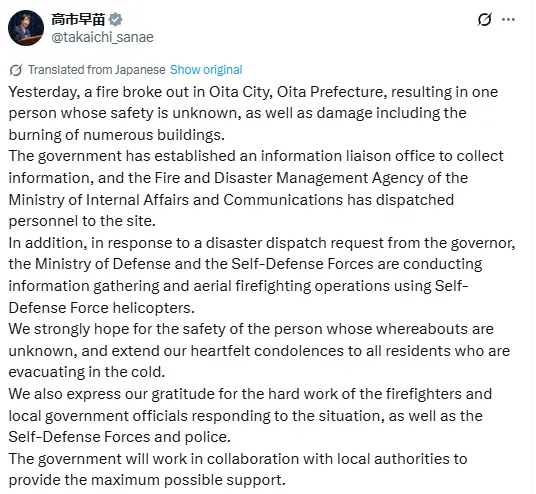 A fire ripped through more than 170 buildings and killed one person in a southern Japanese coastal city on Wednesday, with military and firefighting helicopters scrambling to extinguish the country’s largest urban blaze in almost half a century. Aerial footage from broadcasters showed houses reduced to rubble and thick plumes of smoke rising from the hilly Saganoseki district of Oita city, which overlooks a fishing harbour renowned for its premium Seki-brand mackerel. The flames had also spread to nearby forested slopes and an uninhabited island more than one kilometre off the coast, likely due to strong winds, local media reported. The blaze started on Tuesday evening and has burned 48,900 square metres — roughly the size of seven soccer fields — forcing 175 residents in the district, some 770 kilometres southwest of Tokyo, to flee to an emergency shelter, Japan’s Fire and Disaster Management Agency said. The cause of the fire was under investigation, the agency added. One person has been found dead, local m...
 -
Dawn - 08:35 Nov 16, 2025
A volcano on Sakurajima in southwestern Japan’s Kagoshima Prefecture erupted early on Sunday morning, spewing ash and smoke up to 4,400 metres into the atmosphere, according to Kyodo News. As the eruption continued, the weather agency issued an ashfall forecast for parts of Kagoshima, Kumamoto and Miyazaki prefectures. However, no injuries or building damages have been reported. “An explosive eruption around 12:57am (8:57am PKT) on Sunday at the Minamidake crater sent a plume rising above 4,000m for the first time since October 18 last year,” the news agency said citing the local meteorological observatory. In the latest series of eruptions, large volcanic rocks flew “as far as the fifth station”, but no pyroclastic flows were detected, said Kyodo News. It added that the alert level remains at a three on a scale of five, restricting access to the mountain. Sakurajima is one of Japan’s most active volcanoes and is linked to the Osumi Peninsula on Kyushu, the country’s southwestern main island. The agency adds ... -
Dawn - 08:21 Nov 08, 2025
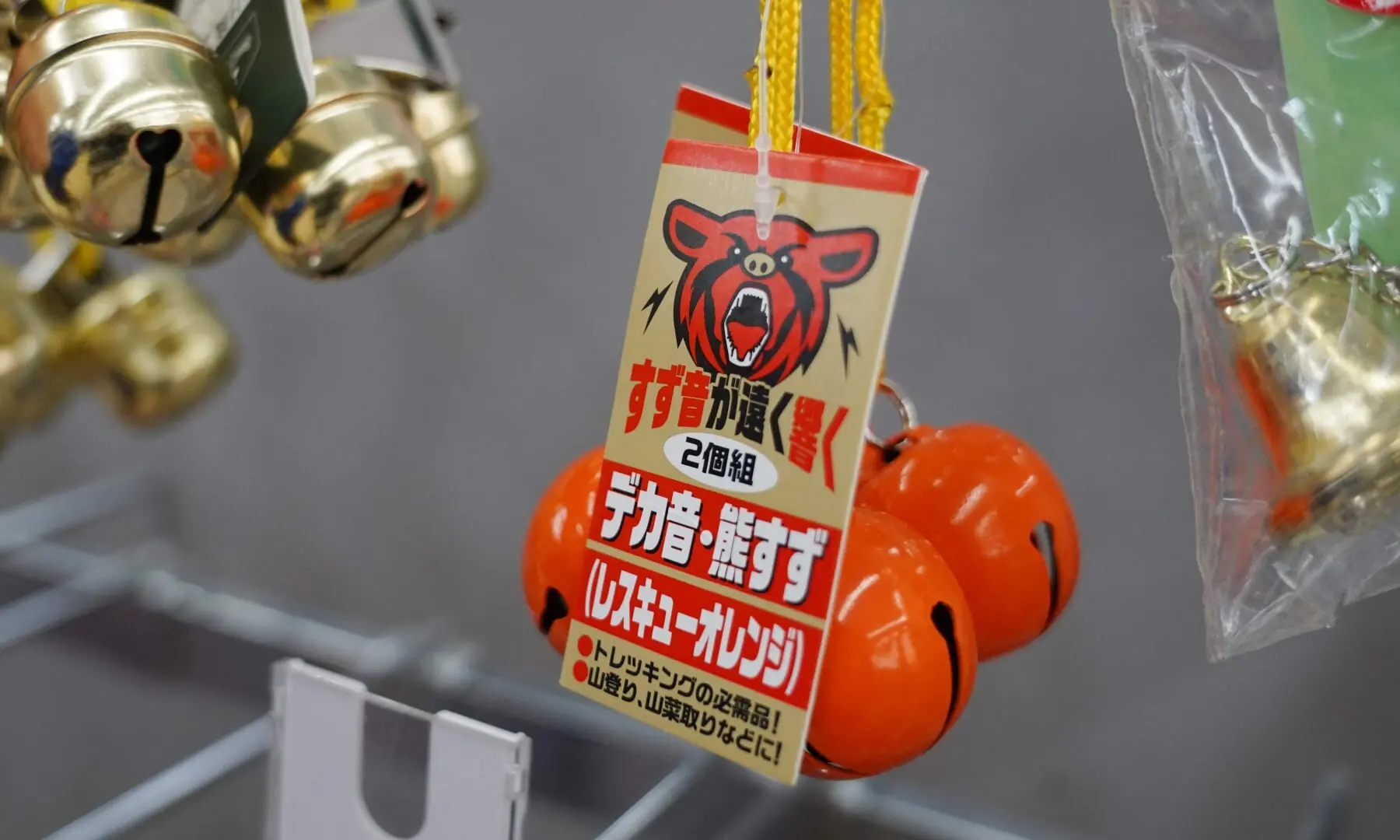 The sense of fear is palpable in parts of northern Japan, where some locals have fastened bells to their bags hoping the noise will keep bears away, while signs warn people to be on guard. The animals have killed a record 13 across the country since April, with a steady flow of reports of bears entering homes, roaming near schools and rampaging in supermarkets. “We hear news almost every day about people being attacked or injured,” said 28-year-old Kakeru Matsuhashi, a traditional “Matagi” hunter, as he walked through a forest clutching a knife. “It’s becoming something that feels personal, and it’s simply frightening,” he added in the northern prefecture of Akita, an area hit by a series of attacks. This year, the number of fatalities is double the previous record of 2023-24, with five months of the fiscal year still to go. Data is patchy from certain regions, but in recent years, Japan has seen among the highest number of fatal attacks globally. Bells used for warning bears of approaching hikers are seen at...
 -
Dawn - 06:08 Oct 28, 2025
United States President Donald Trump and Japanese Prime Minister Sanae Takaichi signed a framework agreement on Tuesday for securing the supply of rare earths, as both countries aim to reduce China’s dominance of some of the key electronic components. The leaders signed the documents, which included critical minerals, at the neo-Baroque-style Akasaka Palace in Tokyo, beneath three chandeliers decorated from top to bottom with gold ornamentation, as aides applauded. View this post on Instagram No direct mention was made publicly by the leaders about China, which processes over 90 per cent of the world’s rare earths, making it the source of each country’s concern about its mineral supply chain. Beijing has recently expanded export curbs. Trump and Chinese President Xi Jinping are set to meet on Thursday on the sidelines of the Asia-Pacific Economic Cooperation in South Korea to discuss a deal that would pause steeper US tariffs and Chinese rare earths export controls. Japan and the US would use economic policy ... -
Dawn - 05:56 Oct 21, 2025
Japan got its first woman prime minister on Tuesday after Sanae Takaichi, a China hawk and social conservative, forged an 11th-hour coalition deal. Japan’s fifth premier in as many years will lead a minority government and has a full in-tray, not least a scheduled visit by US President Donald Trump next week. Parliament appointed Takaichi, an admirer of Margaret Thatcher, as prime minister on Tuesday, after she unexpectedly won a majority in a first round of voting. She will formally take office after meeting the emperor later. The former heavy metal drummer became on October 4 head of the Liberal Democratic Party (LDP), which has governed almost non-stop for decades but is losing support. Six days later the Komeito party, uncomfortable about Takaichi’s conservative views and an LDP slush fund scandal, quit their coalition. This forced Takaichi to form an alliance with the reformist, right-leaning Japan Innovation Party (JIP), which was signed on Monday evening. JIP wants to lower the consumption tax rate on ...