Ramazan | Pakistan
"Ramazan" in Pakistan feed
-
Dawn - 08:12 Mar 20, 2026
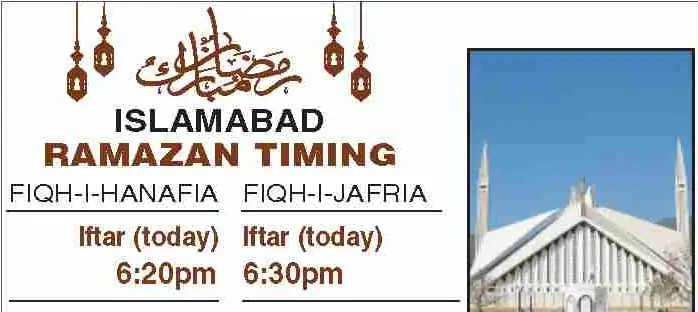 Times for this Ramazan’s (1447 AH) last Iftar for the federal and provincial capitals are listed below: Islamabad Iftar Fiqh-i-Hanafia — 6:20pm Fiqh-i-Jafria — 6:30pm Karachi Iftar Fiqh-i-Hanafia — 6:44pm Fiqh-i-Jafria — 6:57pm Lahore Iftar Fiqh-i-Hanafia — 6:14pm Fiqh-i-Jafria — 6:24pm Peshawar Iftar Fiqh-i-Hanafia — 6:26pm Fiqh-i-Jafria — 6:36pm Quetta Iftar Fiqh-i-Hanafia — 6:45pm Fiqh-i-Jafria — 7:03pm
 -
Dawn - 17:21 Mar 13, 2026
The Foreign Office (FO) said on Friday that Pakistan strongly condemned the continued closure of the historic Jama Masjid in occupied Kashmir’s Srinagar on the last Friday of Ramazan, calling on the international community to take notice. In a statement, the FO said, “Pakistan strongly condemns the continued closure of the historic Jama Masjid in Srinagar on the last Friday of the holy month of Ramazan. “Preventing worshippers from offering congregational prayers at one of the most revered mosques in the valley constitutes a serious violation of religious freedom and fundamental human rights in Indian Illegally Occupied Jammu and Kashmir,” it said. The FO said that for the seventh consecutive year since India had revoked the region’s special autonomy, occupation authorities had “sealed the mosque and barred Kashmiri Muslims from gathering for prayers on this spiritually significant day”. “Such restrictions on religious practice, particularly during the sacred month of Ramzan, are deeply concerning,” it stated... -
Dawn - 12:38 Mar 10, 2026
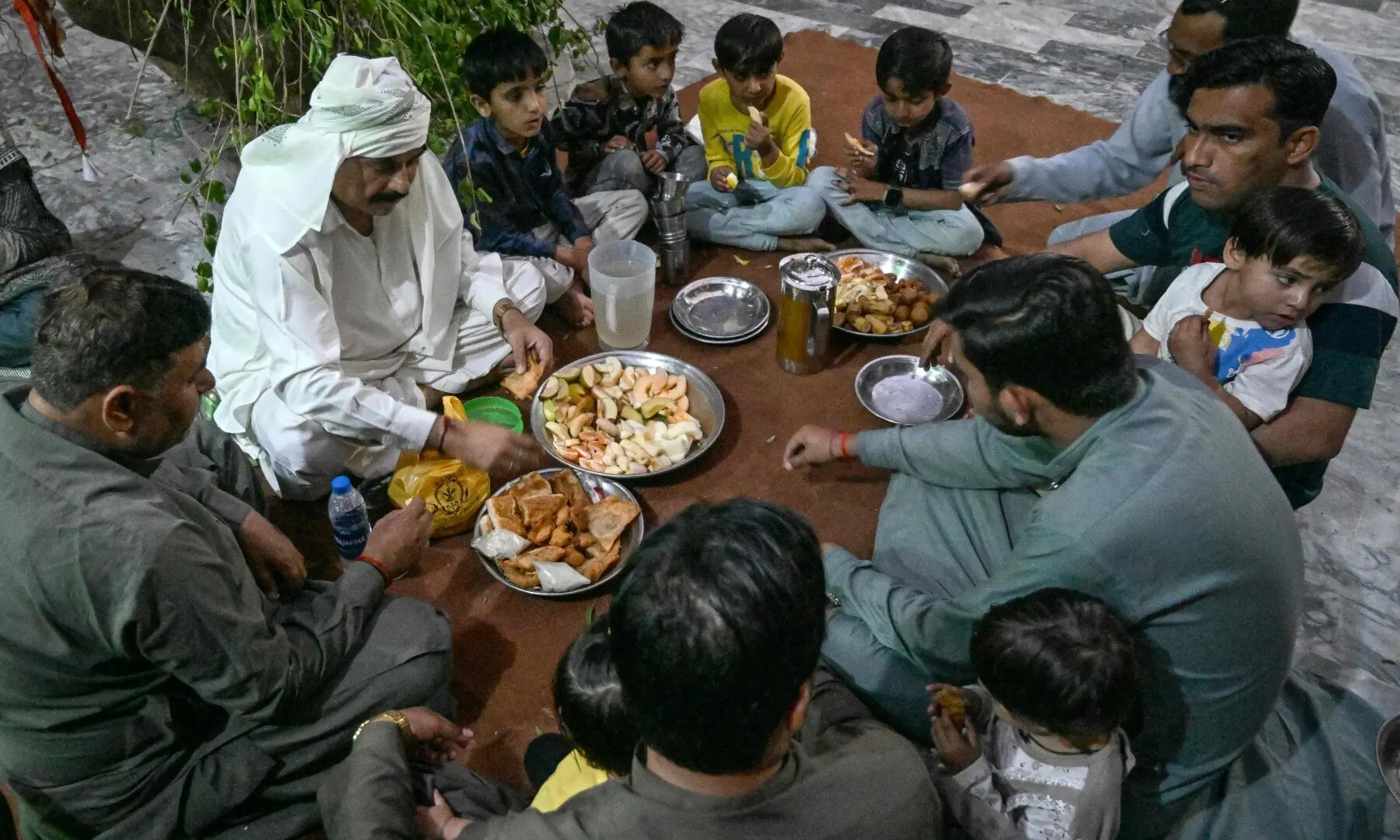 Partab Shivani, a Hindu in Pakistan, has fasted on and off during Ramazan for years, but this time is different as he practices abstinence for the entire holy month. Every year, he and his friends in Mithi arrange Iftar to foster peace and solidarity between the two religions. “I believe we need to promote interfaith harmony. First, we are humans — religions came later,” Shivani, a 48-year-old social activist, told AFP, adding that he also reads the teachings of the Buddha. “His message is about peace and ending war. Peace can spread through solidarity and by standing with one another. Distance only widens the gap between people,” he added. This photograph taken on February 26, 2026 shows Mohan Lal Malhi (2L), a Hindu caretaker of a Sufi shrine, breaking his fast during Ramazan at Mithi in the Tharparkar district of Sindh. — AFP Most of the country’s Hindu population, which comprises two per cent population, lives in rural areas of Sindh. In Mithi itself, most of the 60,000 inhabitants are Hindu. Many of the ...
 -
The Nation - National - 19:00 Mar 08, 2026
ISLAMABAD - Inspector General of Police (IGP) Syed Ali Nasir Rizvi chaired an Operational Commanders’ Conference to review the law and order situation in the federal capital and issued directions to ensure foolproof security during the last ten days of Ramazan, including Aitikaf and the sacred nights, besides ordering. -
The Nation - National - 10:57 Mar 07, 2026
Pakistan Railways has introduced a new schedule for its reservation offices during the holy month of Ramazan, which has come into effect from today. -
The Nation - National - 06:22 Mar 04, 2026
The distribution of financial assistance under the Ramazan relief package will begin in Peshawar today (Wednesday), as the Khyber Pakhtunkhwa government rolls out support for low-income families across the province. -
Dawn - 08:28 Mar 01, 2026
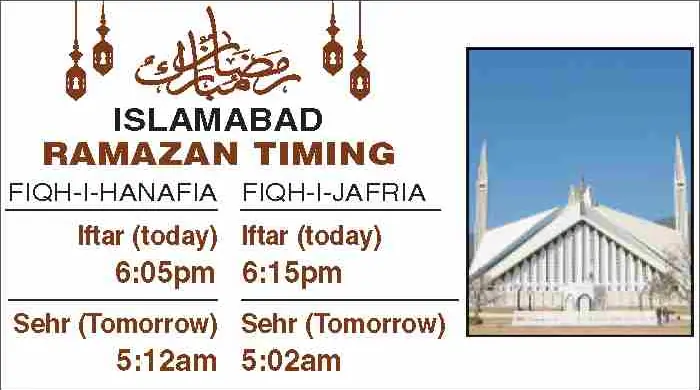 Times for today’s Iftar (Ramazan 11) and tomorrow’s Sehri (Ramazan 12) for the federal and provincial capitals are listed below: Islamabad Fiqh-i-Hanafia Iftar (today) — 6:05pm Sehri (tomorrow) — 5:12am Fiqh-i-Jafria Iftar (today) — 6:15pm Sehri (tomorrow) — 5:02am Karachi Fiqh-i-Hanafia Iftar (today) — 6:35pm Sehri (tomorrow) — 5:35am Fiqh-i-Jafria Iftar (today) — 6:48pm Sehri (tomorrow) — 5:31am Lahore Fiqh-i-Hanafia Iftar (today) — 6:00pm Sehri (tomorrow) — 5:09am Fiqh-i-Jafria Iftar (today) — 6:10pm Sehri (tomorrow) — 4:59am Peshawar Fiqh-i-Hanafia Iftar (today) — 6:11pm Sehri (tomorrow) — 5:18am Fiqh-i-Jafria Iftar (today) — 6:21pm Sehri (tomorrow) — 5:08am Quetta Fiqh-i-Hanafia Iftar (today) — 6:32pm Sehri (tomorrow) — 5:38am Fiqh-i-Jafria Iftar (today) — 6:50pm Sehri (tomorrow) — 5:37am
 -
The Nation - National - 19:00 Feb 24, 2026
LAHORE - A special meeting chaired by Punjab Chief Minister Maryam Nawaz Sharif on Tuesday was informed that for the first time in the province’s history prices of essential commodities have registered a decline of over 50 percent during Ramazan. -
The Nation - National - 17:43 Feb 24, 2026
The Pakistan Meteorological Department has indicated that Ramazan is expected to last 30 days this year, as the Shawwal crescent is unlikely to be visible on March 19. -
Dawn - 18:25 Feb 22, 2026
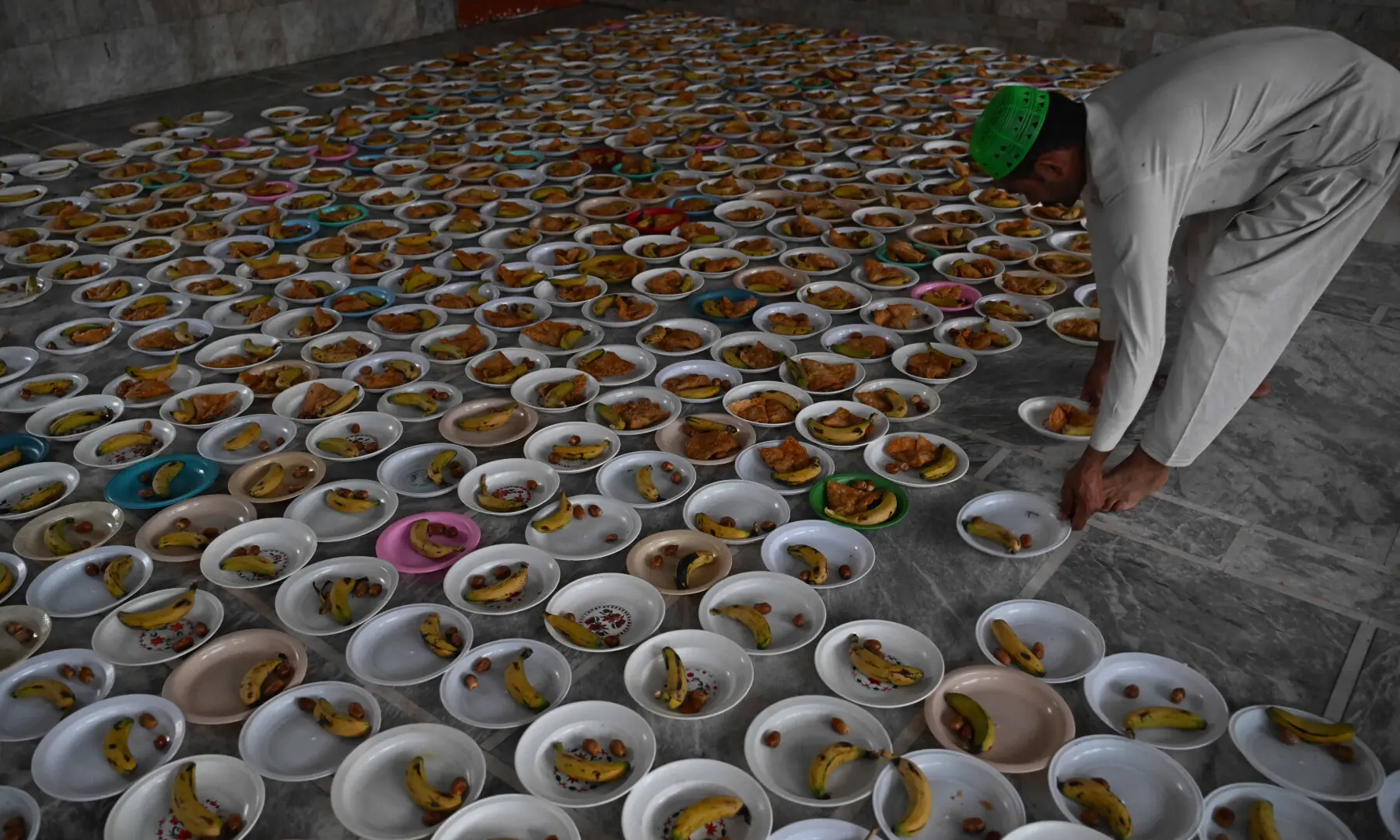 Ramazan, the ninth month of the Islamic calendar, is a time when Muslims fast from dawn to sunset, focusing on prayer, charity and deepening their connection with the Almighty. Homes and mosques come alive with pre-dawn meals (sehri) and the evening ritual of breaking the fast. Across Pakistan, communal iftars bring people together, as neighbours, friends and even strangers share meals to end the day’s fast. Held in mosques, community centres and public spaces, these gatherings are about more than just food, as they nurture unity, strengthen bonds, and foster a sense of togetherness. They also create spaces for conversation, understanding and generosity, embodying the spirit of the holy month. Photographs from cities across Pakistan capture these quiet, meaningful moments: prayers in reflection, the preparation of iftar, the laughter and chatter around shared tables, and the calm anticipation as the sun sets. Together, they paint a picture of Ramazan as a time of patience, gratitude, humility and spiritual re...
 -
The Nation - National - 12:22 Feb 20, 2026
With the arrival of Ramazan, both local and international carriers have sharply increased ticket prices for Umrah travel, citing a spike in pilgrim bookings. -
Dawn - 07:41 Feb 20, 2026
Five incarcerated senior leaders of the PTI urged the party to halt protest activities during the holy month of Ramazan, according to a joint letter sent to the media on Friday. The letter was written by Shah Mehmood Qureshi, Omar Sarfraz Cheema, Dr Yasmin Rashid, Ejaz Chaudhry and Mian Mahmoodur Rasheed, all incarcerated in Kot Lakhpat jail in Lahore. It was sent via their lawyer, Advocate Rana Mudassar Umar. The letter also criticised President Asif Ali Zardari’s recent comments on incarcerated PTI founder and ex-premier Imran Khan. Last week, President Zardari had said it was the duty of leaders to fight and go to jail to protect their party and safeguard the people. Without naming Imran, he added that they had already started complaining about conditions in jail after an 18-month detention, while he himself had spent 14 years in prison without losing courage. “We strongly condemn Asif Ali Zardari’s recent rhetoric on the founder of the PTI,” the letter said, adding that Imran was currently serving his jai... -
The Nation - National - 19:00 Feb 19, 2026
LAHORE - Punjab Chief Minister Maryam Nawaz Sharif has directed authorities to further tighten security arrangements across the province during Ramazan, calling for comprehensive measures to safeguard worshippers and the general public. -
Dawn - 14:34 Feb 19, 2026
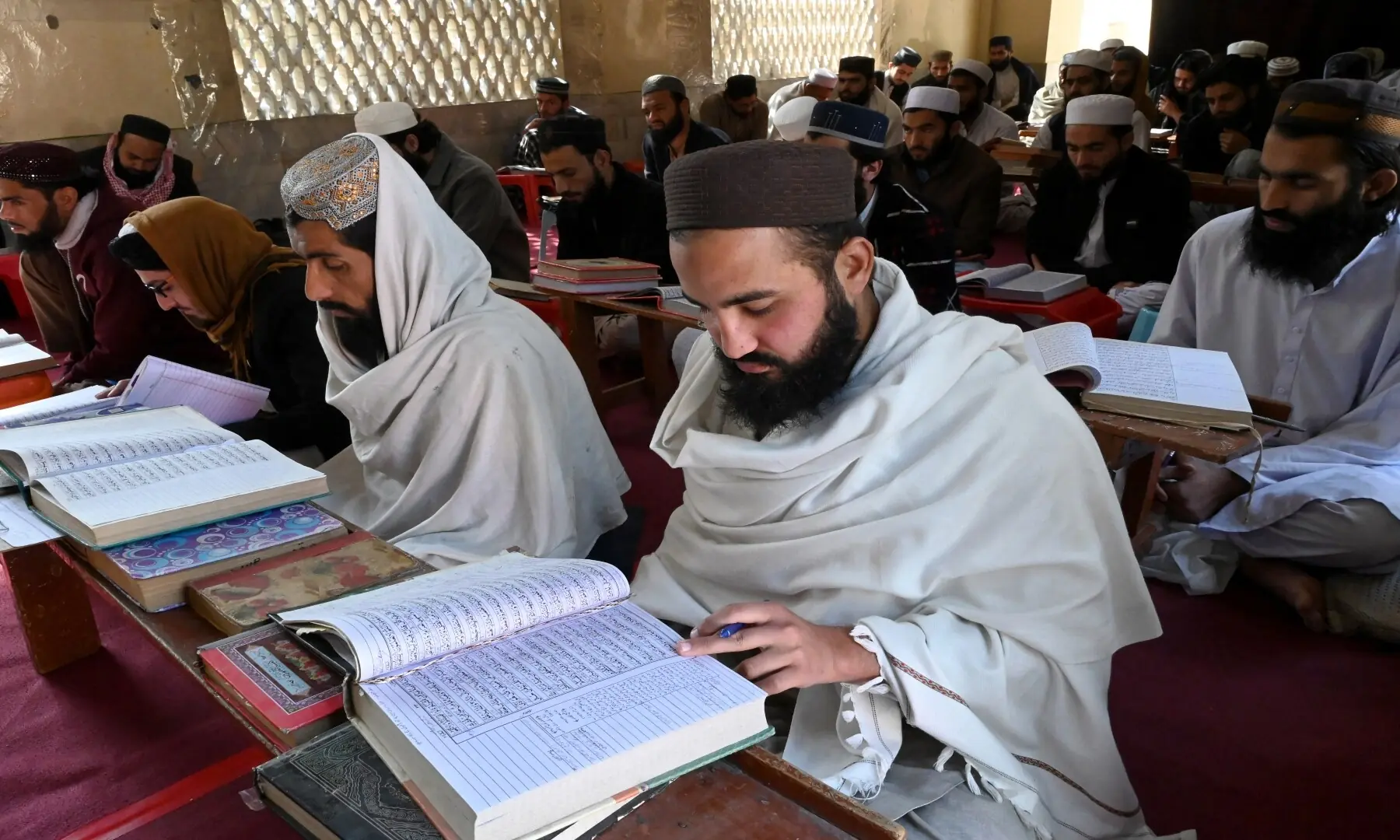 Ramazan is welcomed by Muslims around the world as a sacred month of fasting, reflection and spiritual renewal, observed by more than 1.9 billion people across different countries. From dawn to sunset, Muslims fast from food and drink, dedicating the month to prayer, charity and community. Mosques fill for nightly Taraweeh prayers, families gather for iftar meals at sunset, and acts of generosity increase as believers seek spiritual growth and closeness to Allah. Beyond the physical fast, Ramazan emphasises patience, self-discipline and compassion for those less fortunate, making it one of the most significant and unifying periods in the Islamic calendar. Here are some glimpses from different countries, including Pakistan, Occupied Kashmir, Palestine, Sudan, Nigeria, Kosovo, Malaysia and Indonesia, capturing how communities welcomed the holy month with prayers, acts of charity, and communal meals. Madrassa students recite the Quran on the first day of Ramazan, in Peshawar on February 19, 2026. — Abdul Majeed ...
 -
Dawn - 12:37 Feb 19, 2026
Australian police said on Thursday they had launched an investigation after a threatening letter was sent to the country’s largest mosque, the third such incident in the lead-up to Ramazan. The letter sent to Lakemba Mosque in Sydney’s west on Wednesday contained a drawing of a pig and a threat to kill the “Muslim race”, local media reported. Police said they had taken the letter for forensic testing and would continue to patrol religious sites, including the mosque, as well as community events. The latest letter comes weeks after a similar message was mailed to the mosque, depicting Muslims inside a mosque on fire. Police have also arrested and charged a 70-year-old man in connection with a third threatening letter sent to Lakemba Mosque’s staff in January. The Lebanese Muslim Association, which runs the mosque, told the Australian Broadcasting Corp (ABC) it had written to the government to request more funding for additional security guards and CCTV cameras. Some 5,000 people are expected to attend the mosq... -
Dawn - 11:30 Feb 19, 2026
The Economic Coordination Committee (ECC) on Thursday approved the release of Rs19 billion for Prime Minister Shehbaz Sharif’s Ramazan package. On February 12, PM Shehbaz had announced a Rs38bn Ramazan relief package, which would benefit more than 12 million families — around 36m people — through direct digital payments. In a post on X, the finance ministry said Finance Minister Muhammad Aurengzeb remotely chaired a meeting of the ECC. The post said that the ECC approved the “immediate release” of Rs19bn for the prime minister’s package to “ensure timely disbursement of assistance to vulnerable families”. “The remaining requirement out of the proposed Rs25bn will be released as and when necessary, in line with fiscal space,” the ministry said. “The prime minister’s Ramazan relief package 2026 is designed to provide targeted cash assistance to low-income households during the holy month, using National Socio-Economic Registry data to ensure transparency and objective beneficiary selection,” the finance ministr... -
The Nation - National - 17:55 Feb 18, 2026
The Benazir Income Support Programme has announced a major increase in financial assistance for eligible women ahead of the holy month of Ramazan. -
Dawn - 15:58 Feb 18, 2026
The Central Ruet-i-Hilal Committee announced on Wednesday that the Ramazan moon was sighted, and the holy month would begin in Pakistan on Thursday (February 19). The announcement was made by committee chairman, Maulana Abdul Khabir Azad, as it met in Peshawar for the moon sighting. Speaking to the media after the meeting, Azad said that the skies were clear in some areas and cloudy in others. He said that testimonies were received from several parts of the country, including Quetta, Islamabad, Waziristan, Dir, Karachi, Buner, Mardan and Tando Allahyar. “Therefore, it was decided with consensus that the first day of Ramazan would be on Thursday,” he said. Separately, according to the Daily Star, the crescent moon was sighted in Bangladesh, while The Hindu reported that it was also spotted in India. Saudi Arabia, Oman, Qatar, the United Arab Emirates and Afghanistan observed their first day of fasting on Wednesday after the crescent moon was sighted on Tuesday night. Prime Minister Shehbaz Sharif extended “hea... -
Dawn - 19:30 Feb 17, 2026
The Ramazan moon was sighted in Saudi Arabia and the United Arab Emirates on Tuesday night, according to Gulf News. In separate reports, the publication said that Wednesday (Feb 18) would be the first day of the holy month in both countries. The official Saudi Press Agency also said on X that Wednesday would be the first day of the holy month in the kingdom. Tolo News, meanwhile, also announced that Ramazan would begin on February 18 in Afghanistan. “In a statement issued by the Supreme Court, it said that in the provinces of Parwan, Kandahar, Helmand, and Zabul, a large number of people sighted the crescent moon of Ramadan and reported it to the Sharia courts,” it said in a post on X. Saudi Arabia’s Gulf neighbours Oman, Qatar and the UAE also made similar announcements. Last week, the Space and Upper Atmosphere Research Commission (Suparco) said that the first day of Ramazan in Pakistan “likely to fall” on February 19 (Thursday). However, the agency said the final announcement regarding the beginning of the... -
Dawn - 13:10 Feb 17, 2026
For people living with gastritis or peptic ulcer disease, Ramazan fasting can require extra care. Common causes of this ailment include bacterial infection, smoking, long-term use of painkillers, overeating, and frequent consumption of spicy, fatty, or acidic foods. Symptoms often include stomach pain, heartburn, bloating, burping, acid reflux, and a burning or aching sensation in the upper abdomen. These symptoms tend to worsen when the stomach remains empty for long hours, making fasting during Ramazan particularly challenging for some individuals. What to consider during fasting Whether a person with gastritis or an ulcer can fast during Ramazan depends on the severity of the condition. Skipping meals, especially sehri, can significantly increase stomach acidity and should be avoided. Sehri should include slow-digesting carbohydrates to help sustain energy and reduce gastric irritation during fasting hours. If appetite is low, light but nourishing foods such as milk, dates, and sufficient water are recomme...