Iran | News
-
AD.nl - 00:41 Jun 16, 2026
De eerste Iraanse schepen hebben maandagavond een gebied in de Golf van Oman doorkruist dat geblokkeerd werd door de Amerikaanse marine. Dat gebeurde nadat Iran en de VS een akkoord tekenden. Wat er precies in staat is nog onbekend, maar volgens de Amerikaanse vicepresident JD Vance gaat het om een ‘vrij algemeen document van anderhalve bladzijde’. Volg alle ontwikkelingen in het Midden-Oosten in ons liveblog. -
The Nation - National - 21:07 Jun 15, 2026
ISLAMABAD - Pakistan on Monday warmly welcomed the understanding reached between the United States and the Islamic Republic of Iran, appreciating the trust reposed in the country by the leadership of both nations. -
NU.nl - 21:02 Jun 15, 2026
Bij de WK-wedstrijd van Iran tegen Nieuw-Zeeland wordt een groot protest verwacht. Bij het SoFi Stadium in Los Angeles hebben zich uren voor de wedstrijd, die in de nacht van maandag op dinsdag (Nederlandse tijd) wordt gespeeld, al groepen tegenstanders van het Iraanse regime verzameld. -
Haaretz - 20:57 Jun 15, 2026
For the Lebanese people, the unclear Lebanon file in the U.S.-Iran deal leaves hundreds of thousands of civilians waiting to return to their homes, in the midst of a collapsing economy that cannot withstand another period of instability, with fundamental questions still unanswered -
Haaretz - 19:00 Jun 15, 2026
'We will remain in the security zones for as long as required to defend our country,' the prime minister said, as Iran and the U.S. are set to sign an agreement on Friday. A senior U.S. official said earlier Israel's withdrawal is not a clause in the deal -
Haaretz - 18:36 Jun 15, 2026
As Iran and the U.S. are set to officially sign a memorandum of understanding Friday, a senior White House official said Israel's withdrawal from Lebanon will not be part of the deal. Prime Minister Benjamin Netanyahu later reiterated Israel will remain in Lebanon's 'buffer zone' -
Adevarul Romania - 17:30 Jun 15, 2026
Un oficial american de rang înalt a declarat că Statele Unite și Iran au semnat un acord care prevede reluarea treptată a traficului maritim prin Strâmtoarea Ormuz, precum și relaxarea unor măsuri restrictive americane asupra Teheranului. -
FD - 16:30 Jun 15, 2026
Het voorlopige akkoord tussen de VS en Iran wordt in Israël met een storm van kritiek onthaald. Maandag voerde de Israëlische luchtmacht opnieuw aanvallen uit in Libanon. -
Dawn - 14:29 Jun 15, 2026
The Pakistan Stock Exchange’s (PSX) benchmark KSE-100 index gained over 4,000 points on Monday as the US and Iran reached a preliminary agreement aimed at ending a war that began over three months ago and upended the global economy. The KSE-100 index rose by 4,639.92 points (2.69 per cent) to close at 177,039.82 from the previous close of 172,399.90. The market marked an intraday low of 175,085 at 11am, eventually reaching an intraday high of 177,176.72 at 3:25pm. Yousuf M. Farooq, director of research at Chase Securities, said the market opened higher today as sentiment improved following the announcement of a deal between the US and Iran, along with expectations that the Strait of Hormuz would remain open. Oil prices also opened lower, easing concerns over inflationary pressures going forward, he noted. He said that investors were awaiting today’s monetary policy announcement. Later in the day, the State Bank of Pakistan announced that it would keep the policy rate unchanged at 11.5pc. The market continues ... -
ukrinform.net - 11:40 Jun 15, 2026
Spanish Prime Minister Pedro Sánchez welcomed the announcement of the signing of a memorandum of understanding between the United States and Iran, while urging people not to forget the cost of this armed conflict. -
CryptoSlate - 10:10 Jun 15, 2026
Bitcoin climbed back above $65,000 earlier today, reversing weeks of intense selling pressure after a sudden diplomatic breakthrough between the United States and Iran lifted a major geopolitical cloud over global financial markets. Data from CryptoSlate shows that the flagship digital asset rose more than 3% to reach as high as $65,940, but has since […] The post Bitcoin jumps as Trump’s Iran deal reopens Hormuz – but will Warsh’s first Fed meeting kill the rally? appeared first on CryptoSlate. -
Dawn - 09:49 Jun 15, 2026
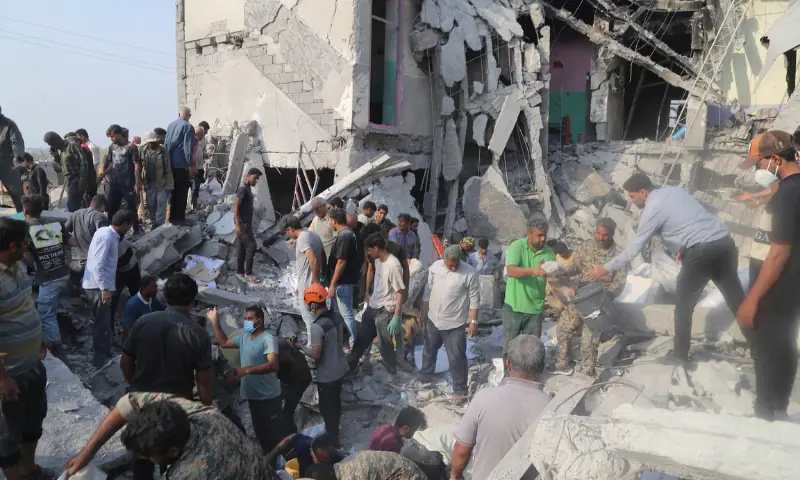 US and Iranian officials have agreed on a framework deal to end the war, halt hostilities on all fronts, and reopen the Strait of Hormuz, with the future of Iran’s nuclear programme and sanctions relief to be settled in later negotiations. US President Donald Trump announced that the agreement was “complete” and ordered an end to the US blockade of Iranian ports, while Prime Minister Shehbaz Sharif confirmed that a peace agreement had been reached after intensive talks, adding that the official signing ceremony would take place on June 19 in Switzerland. Iran also confirmed the framework understanding and ceasefire, saying the fighting would stop immediately, though key issues such as uranium enrichment and the release of frozen assets would be decided in subsequent discussions. Below is a timeline of the key events that led up to the agreement. February 28 The US and Israel launched an attack on Iran via air and sea: a series of explosions in Tehran, including near the residence of the supreme leader. A US-I...
 -
NRC.nl Economie - 09:06 Jun 15, 2026
Minstens 38 keer eerder kondigde de Amerikaanse president Donald Trump aan dat een deal met Iran dichtbij was. -
Dawn - 07:17 Jun 15, 2026
US and Iranian officials said they had agreed on a framework to end the war, halt the US blockade of Iran and reopen the Strait of Hormuz, a preliminary pact that sent oil prices falling but leaves the fate of Iran’s nuclear programme to further negotiations. “The Deal with the Islamic Republic of Iran is now complete,” US President Donald Trump wrote on his Truth Social platform around 5:30pm ET local time in Washington (2130 GMT) on Sunday. His post came shortly after Prime Minister Shehbaz Sharif announced a deal had been struck early on Monday local time. PM Shehbaz said in a post on X that “following intensive talks, we are pleased to announce that the Peace Deal between the United States of America and Islamic Republic of Iran has been REACHED. Both sides have declared the immediate and permanent termination of military operations on all fronts, including in Lebanon”. He added that the “official signing ceremony” would be on Friday, June 19, in Switzerland. “We would like to thank the United States of A... -
Haaretz - 07:07 Jun 15, 2026
Mehr news agency reported that the memorandum of understanding includes a permanent cease-fire in Lebanon, the release of all frozen Iranian assets and a plan for the reconstruction of Iran worth approximately $300 billion presented by the U.S. and mediators -
Cointelegraph.com - 06:47 Jun 15, 2026
 US President Donald Trump says the US and Iran have a deal for a “toll-free opening of the Strait of Hormuz,” sending Bitcoin to a two-week high. Bitcoin came just shy of $66,000 during Monday morning trading after US President Trump claimed that the US had brokered a peace deal with Iran that would reopen the Strait of Hormuz. “The deal with the Islamic Republic of Iran is now complete. Congratulations to all!” Trump posted on his Truth Social platform late on Sunday. “I hereby fully authorize the toll-free opening of the Strait of Hormuz, and, simultaneously herewith, authorize the immediate removal of the United States Naval blockade,” Trump said. “Ships of the World, start your engines. Let the oil flow!” Read more
 -
Dawn - 06:14 Jun 15, 2026
Oil prices slip to their lowest since March as US, Iran reach preliminary agreement to reopen Hormuz
Oil prices slipped to their lowest since March on Monday after US President Donald Trump and Iran’s deputy foreign minister said they had reached an initial deal to end the war and to resume traffic through the Strait of Hormuz. Brent crude futures fell $4.08, or 4.7 per cent, to $83.25 a barrel by 0415 GMT and US West Texas Intermediate was at $80.53, down $4.35, or 5.1pc. Both contracts fell to their lowest levels since March 10 on Monday after tumbling more than 3pc on Friday. The US and Iran will sign a memorandum of understanding in Switzerland on Friday, said Prime Minister Shehbaz Sharif, who first announced the agreement. Trump said on Sunday that the Strait of Hormuz would be open “toll free” and that a US naval blockade of Iranian ports would also end. Iran’s semi-official Mehr news agency said the draft deal called for reopening the Strait of Hormuz within 30 days under Iranian arrangements. “The geopolitical risk premium that had been built into crude is now being unwound quite aggressively as tra... -
The Nation - National - 05:17 Jun 15, 2026
Prime Minister Shehbaz Sharif on Monday announced that the United States and Iran had reached a peace agreement following intensive diplomatic engagement, with both sides agreeing to end military operations and move towards a formal settlement. -
AD.nl - 23:31 Jun 14, 2026
Er is een vredesakkoord tussen de VS en Iran bereikt. Dat meldt de Pakistaanse premier Shehbaz Sharif op X. Dit zal op vrijdag 19 juni in Zwitserland door beide landen ondertekend worden. -
Haaretz - 22:55 Jun 14, 2026
The deal between Tehran and Washington came as Israel was on high alert for possible missile fire after Iran vowed to retaliate against an Israeli strike in Beirut's southern suburbs, also known as the Dahiyeh. Iran ultimately called off its planned missile strikes