Trump | Pakistan
"Trump" in Pakistan feed
-
Dawn - 19:41 Apr 02, 2026
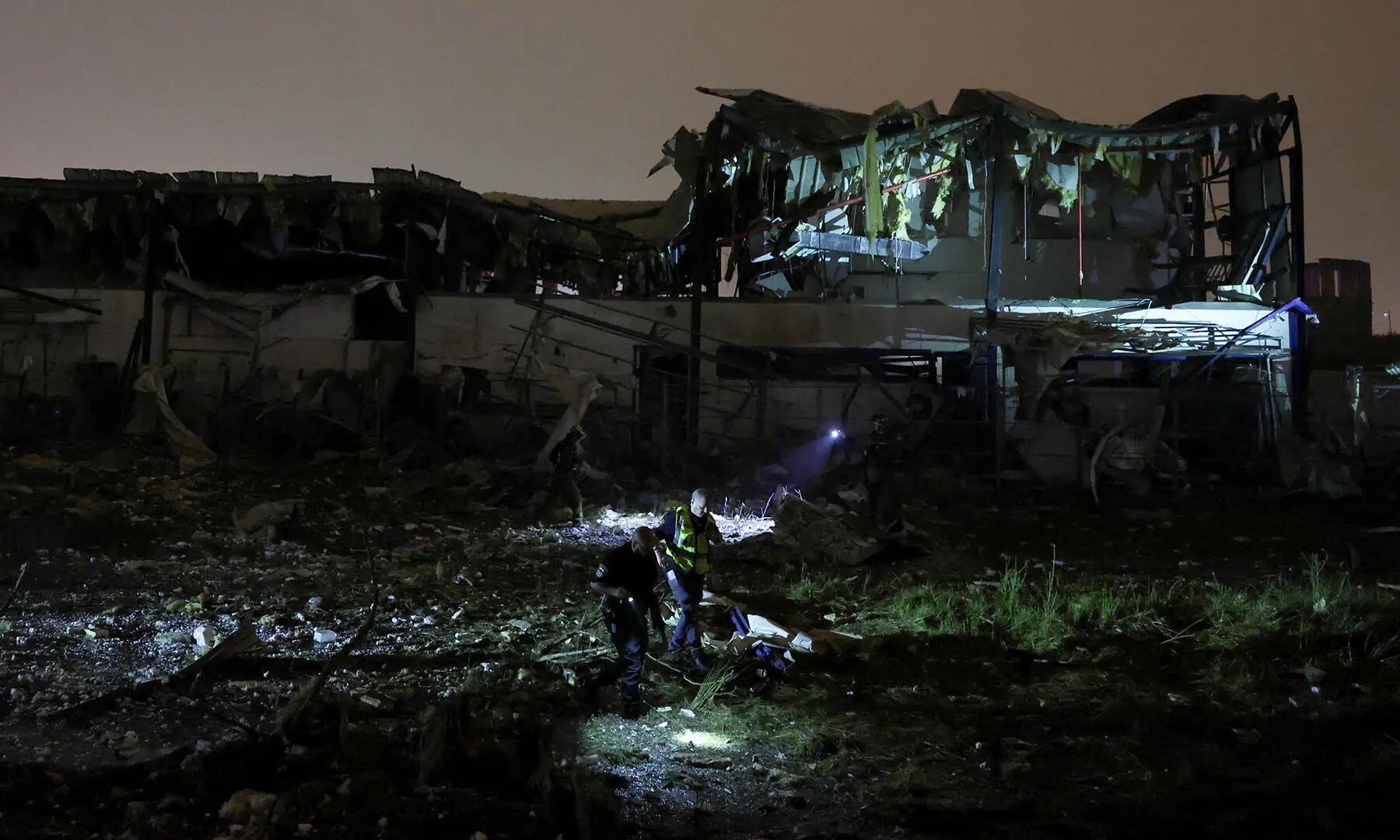 The 34th day of the US-Israel war against Iran unfolded in the immediate aftermath of US President Donald Trump’s speech, which, rather than opening any pathway to de-escalation, appeared to have hardened positions across the conflict spectrum. The remarks triggered swift Iranian retaliation, and reinforced a trajectory of sustained attrition with an increasingly central focus on economic pressure and maritime control. In his speech, Trump declared that US and Israeli objectives were nearing completion, while committing to another two to three weeks of intensified strikes and warning that Iran could be pushed “back to the Stone Age” if it failed to reopen the Strait of Hormuz. Trump’s formulation looked to be a combination of coercive diplomacy and continued military escalation, even as it left ambiguity over the precise end state being sought. The immediate Iranian response underscored the limited deterrent effect of the speech as Iran’s Islamic Revolutionary Guard Corps launched one of its largest single-ni...
 -
Dawn - 18:19 Apr 02, 2026
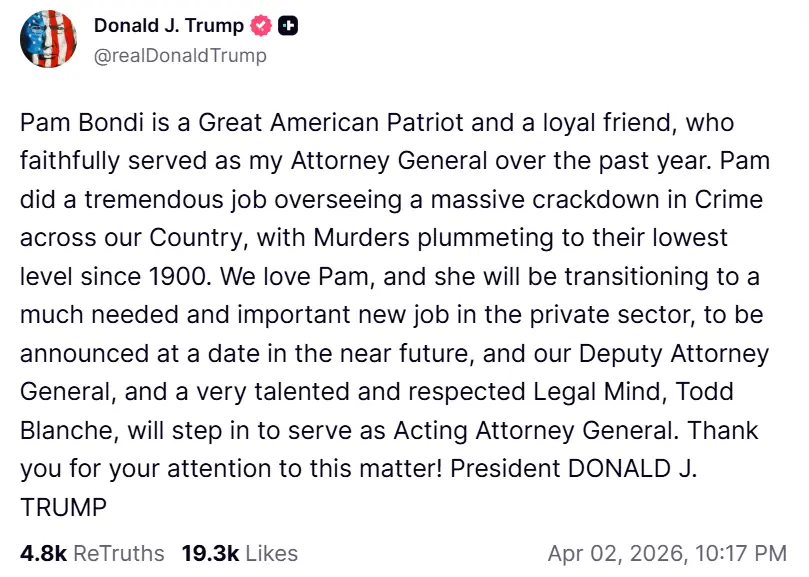 US President Donald Trump has removed Attorney General Pam Bondi from her post, a White House official said on Thursday, following mounting frustration with her performance, including her handling of investigative files related to the late financier and sex offender Jeffrey Epstein. Trump had also reportedly grown frustrated that Bondi was not moving quickly enough to prosecute critics and adversaries whom he wanted to face criminal charges. In a social media post, Trump praised Bondi as a “Great American patriot and a loyal friend” and said she will move to a job in the private sector. Trump said Deputy Attorney General Todd Blanche, his former personal lawyer, will lead the Justice Department in the interim. During her tenure as the top US law enforcement official, Bondi was a combative champion of Trump’s agenda and dismantled the Justice Department’s longstanding tradition of independence from the White House in its investigations. But it was repeated criticism over the Epstein files, including from Trump...
 -
Dawn - 11:29 Apr 02, 2026
The Pakistan Stock Exchange’s (PSX) benchmark KSE-100 index sank by 3,500 points on Thursday, after a press conference by United States President Donald Trump dampened investor hopes of a quick end to the war on Iran. The KSE-100 index dropped by 4,073.85 points, or 2.62 per cent, to stand at 151,505.26 points as of around 12:15pm, in a change of course from the bullish momentum it had sustained over the past two days. It closed at 152,011.26 points, down 3,500.30 points or 2.25pc, from the previous close of 155,511.56. Topline Securities said that the local bourse remained under pressure, “tracking the negative momentum in global markets” after remarks by Trump on the ongoing war on Iran dented investor sentiment. “Escalating geopolitical tensions, coupled with a surge in oil prices, kept market participants on the back foot, reinforcing a cautious stance throughout the session,” it said. “Selling pressure prevailed across the board, dragging the index to an intraday low of 5,489 points. The market eventuall... -
Dawn - 06:59 Apr 02, 2026
WASHINGTON: President Donald Trump signalled that the ongoing US-Israeli military campaign against Iran could conclude within weeks, even as he warned of intensified strikes and issued sweeping claims about the scale of damage inflicted on Tehran. In a 19-minute prime-time address from the White House, Trump described the conflict as a “decisive, overwhelming victory” and said the United States was “getting very close” to finishing the “job” in Iran. “We are going to hit them extremely hard over the next two to three weeks. We are going to bring them back to the Stone Age, where they belong,” Trump said during the address from the White House. “In the meantime, discussions are ongoing.” While suggesting that the war may soon end, the president made clear that military operations would intensify before any resolution. He did not define the terms of the “deal” he is demanding from Tehran, nor did he outline a diplomatic framework. Trump claimed Iran’s military capacity had been severely degraded. He said its mi... -
Dawn - 06:53 Apr 02, 2026
WASHINGTON: Democrats sharply criticised United States President Donald Trump following his national address on the ongoing war in Iran, framing the conflict as deadly, costly, and lacking clear objectives. In a 19-minute prime-time address from the White House, Trump described the conflict as a “decisive, overwhelming victory” and said the US was “getting very close” to finishing the “job” in Iran. “We are going to hit them extremely hard over the next two to three weeks. We are going to bring them back to the Stone Age, where they belong,” Trump said. “In the meantime, discussions are ongoing.” Democratic National Committee (DNC) Chair Ken Martin said Trump’s address was a failed attempt to justify a war that has already burdened Americans and strained the economy. “Tonight, Americans watched Donald Trump desperately try to justify his deadly and costly war of choice in Iran that has killed over a dozen brave service members and injured hundreds more,” Martin said. “Trump offered no new information to the A... -
Dawn - 19:06 Apr 01, 2026
With President Donald Trump present, US Supreme Court justices signalled skepticism on Wednesday toward the legality of his directive to restrict birthright citizenship in the US, part of his hardline immigration approach that would upend the long-held understanding of a key constitutional provision. In his historic visit to the top US judicial body, Trump, wearing a red tie and dark suit, sat in the front row of the public gallery of the ornate courtroom after arriving by motorcade from the White House. The Republican president then left midway through the proceedings, not long after the Justice Department lawyer arguing for his administration completed his presentation. Most of the nine justices, conservatives and liberals alike, grilled the lawyer with questions about the legal validity of Trump’s executive order and its practical implications. The court has a 6-3 conservative majority. The justices heard more than two hours of arguments in the administration’s appeal of a lower court’s decision that block... -
Dawn - 17:35 Apr 01, 2026
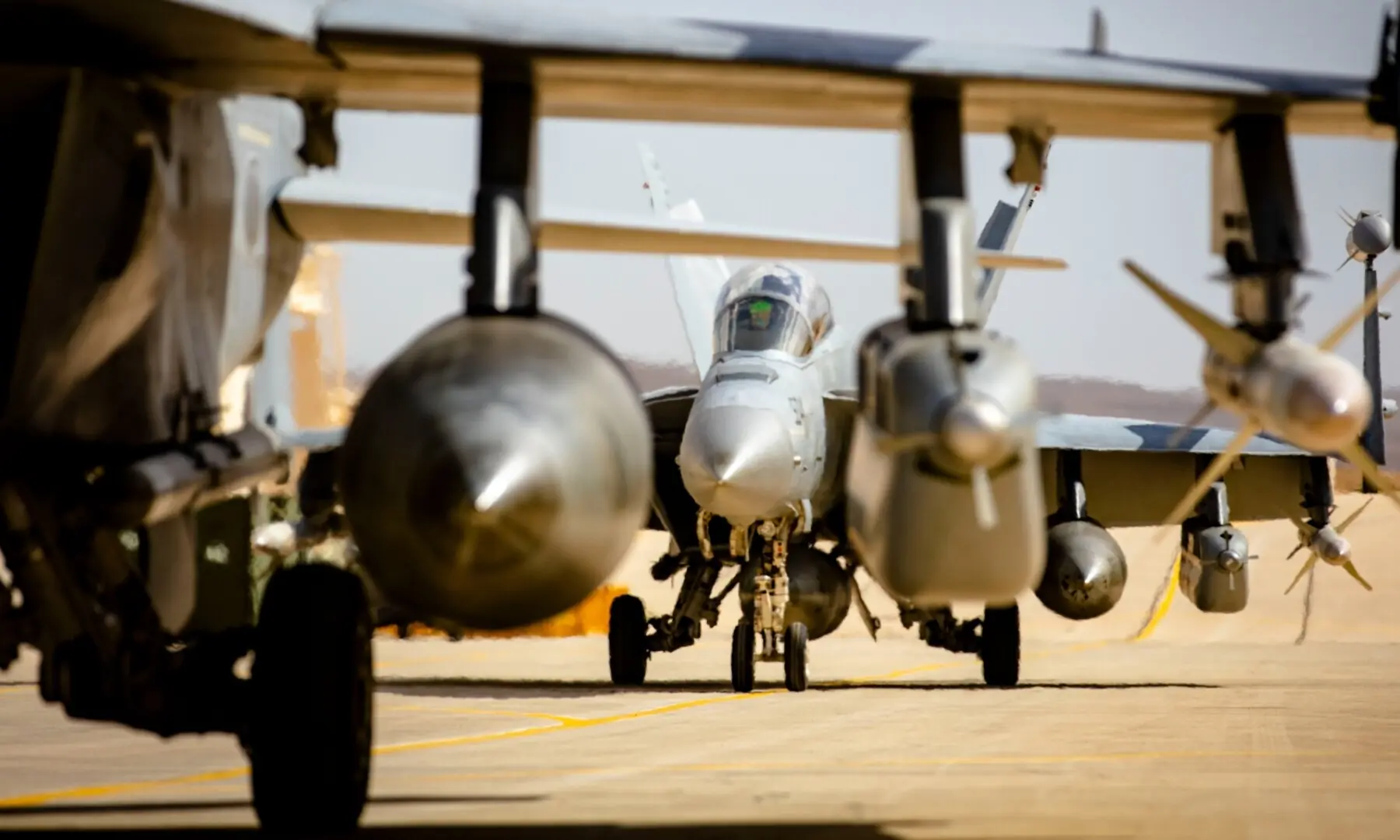 As the 33rd day of the US-Israel war against Iran drew to a close, all eyes were on US President Donald Trump’s speech later tonight, which diplomats and military analysts alike foresee as a defining moment that could set the next trajectory of the conflict, even as developments on the ground pointed less to de-escalation and more to an impending shift toward a higher risk escalation likely centred on control of critical maritime arteries. Speculation around the speech dominated the information space, with Trump’s public messaging about a possible “two-to-three-week” exit widely interpreted as tactical ambiguity rather than a genuine off-ramp; particularly in light of parallel military movements that suggested preparation for escalation, including the deployment of 18 A-10 Thunderbolt II aircraft which are designed for close air support of ground troops, heightened alert status for elements of a Marine Expeditionary Unit, and sustained heavy lift air traffic involving C-17 and C-5 transports, alongside the fo...
 -
The Express Tribune - 15:59 Apr 01, 2026
Says Strait of Hormuz 'fully' under its control Trump considers quitting NATO Discusses Iran ceasefire talk -
Dawn - 13:28 Apr 01, 2026
WASHINGTON: US President Donald Trump is set to address his nation at 9pm EST on Wednesday (6:00am on Thursday in Pakistan) to provide what the White House has described as “an important update on Iran,” fuelling speculation that he may declare an end to the five-week conflict — with or without a negotiated settlement. US media outlets, reporting the announcement, noted that Trump has brushed aside the need for a formal agreement to end hostilities. Speaking to reporters at the White House on Tuesday, he said US forces would likely leave Iran in “two or three weeks.” “We leave because there’s no reason for us to do this,” Trump said. “We’ll be leaving very soon.” In remarks that appeared to redefine the war’s objectives, he suggested that a negotiated settlement was no longer essential. “Iran doesn’t have to make a deal. It’s a new regime. They are much more accessible,” he said, adding that if the war has prevented Iran from developing a nuclear weapon, “then we’ll leave whether we have a deal or not.“ Domes... -
Dawn - 14:56 Mar 31, 2026
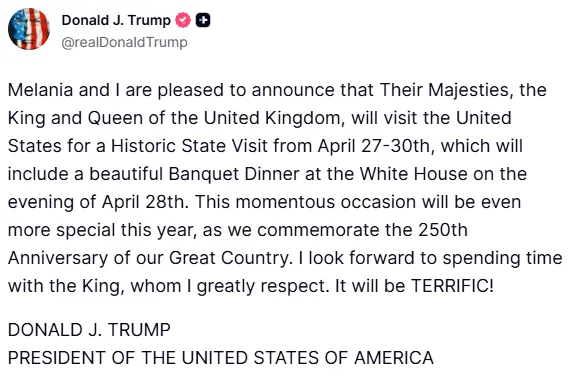 King Charles will make a state visit to the United States in late April, Buckingham Palace said on Tuesday, a high-profile trip that the British government hopes will help to repair relations with President Donald Trump, damaged by the war on Iran. Charles and his wife Queen Camilla will visit the US in a long-planned trip to mark the 250th anniversary of that country’s independence from British rule, before the couple visits Bermuda. “Their majesties’ programme will celebrate the historic connections and the modern bilateral relationship between the United Kingdom and the United States,” Buckingham Palace said, adding the trip was being made on the advice of the British government. It will be the first state visit by a British monarch since 2007, when Charles’ mother Queen Elizabeth made what was the fourth such US trip of her reign. Trump said the king and queen’s visit would begin on April 27 with a banquet dinner at the White House the next day. “I look forward to spending time with the King, whom I great...
 -
Dawn - 16:32 Mar 30, 2026
A scrubby island in the Gulf that is roughly one third the size of Manhattan, Kharg Island is the nerve centre of the Iranian oil industry — and at the heart of US President Donald Trump’s latest efforts to pressure Tehran. On Monday, Trump vowed that a failure by Iran to agree a deal to end the war could see the United States “completely obliterating” the export hub. A day earlier, he had said the United States could take the island, eyed by the Pentagon for ground operations, “very easily”. So what are Trump’s options, and how might Iran react if he presses on this pressure point? What is Kharg Island? It may be a mere scrap of land, but Kharg handles around 90 per cent of Iran’s crude exports, according to a report by US bank JP Morgan. Located in the north of the Gulf, around 30 kilometres from the Iranian coast and more than 500km from the Strait of Hormuz, it has no oil wells. But it has Iran’s largest oil terminal, oil pipelines, storage tanks and related infrastructure. It also has military facilities... -
The Express Tribune - 16:17 Mar 29, 2026
Protests driven by backlash against Iran conflict, Trump policies -
Dawn - 12:01 Mar 29, 2026
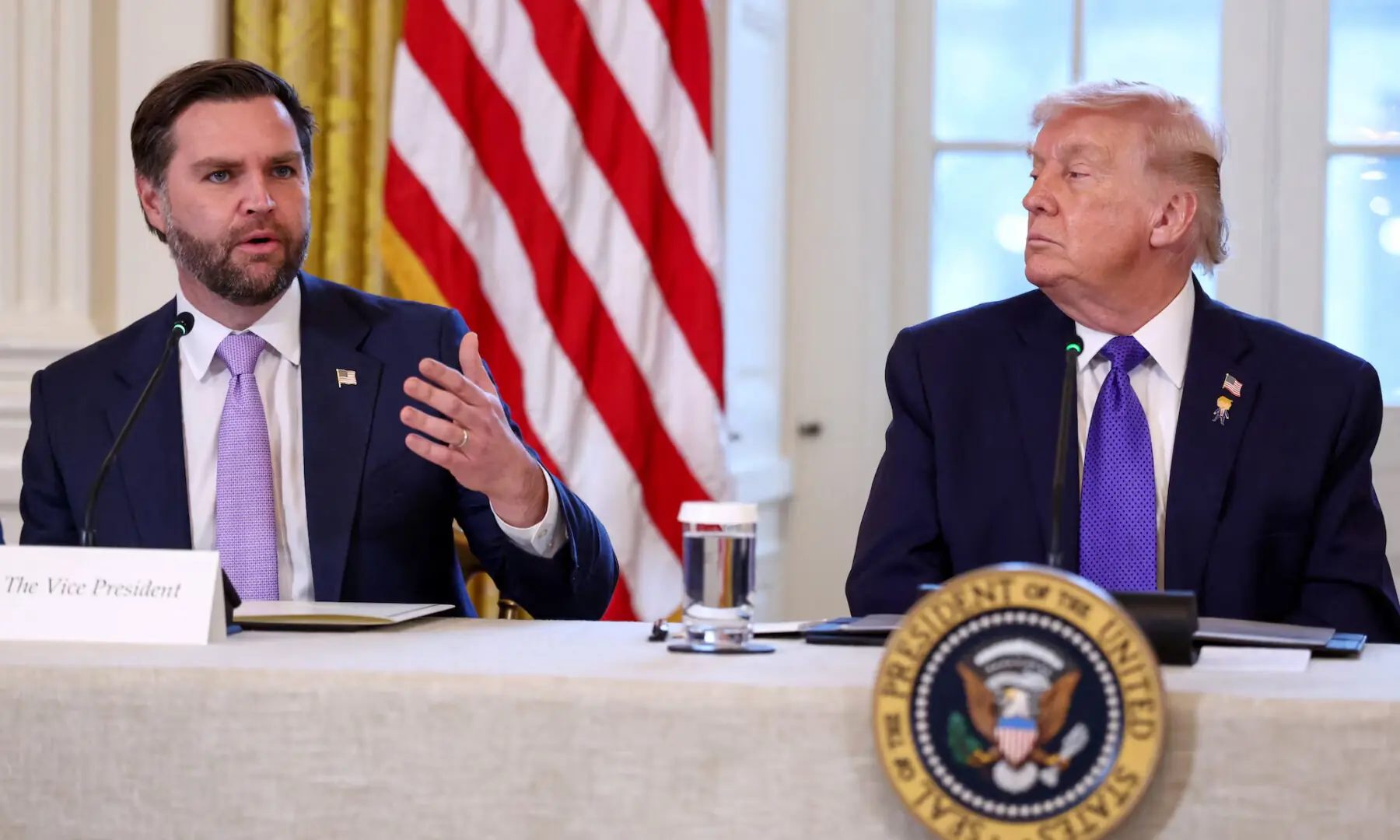 As the war in Iran threatens to imperil United States President Donald Trump’s legacy, the political stakes also are rising for two of his top lieutenants: Vice President JD Vance and Secretary of State Marco Rubio. The pair, widely viewed as potential successors to Trump, have been thrust into still-developing negotiations to end the war at a moment when the Republican Party is already weighing its post-Trump future. Vance has taken a cautious approach, reflecting his scepticism toward prolonged US military involvement, while Rubio has aligned himself closely with Trump’s hawkish stance and emerged as one of the administration’s most vocal defenders of the campaign. Trump has said both men were involved in efforts to force Iran to accept US demands to dismantle its nuclear and ballistic missile programmes and allow oil traffic to pass freely through the Strait of Hormuz. With the next presidential election due in 2028 and term limits barring Trump from running again, the president has been putting the succes...
 -
Dawn - 02:06 Mar 29, 2026
WASHINGTON: Demonstrators decrying President Donald Trump’s policies took to city streets across the United States on Saturday in the third edition of the “No Kings” rallies that organisers hoped will be the largest single-day non-violent protest in US history. The two previous No Kings events attracted millions of participants. Singers Bruce Springsteen and Joan Baez headlined a rally at the state capitol in Minnesota, where upward of 100,000 people gathered in an area that became a flashpoint over Trump’s crackdown on illegal immigration and the incursion of federal immigration agents into Democratic-led urban centres. Other major rallies took place in New York, Los Angeles and Washington, but two-thirds of the events were happening outside major city centres, a nearly 40 per cent jump for smaller communities from the movement’s first mobilisation last June. “The defining story of this mobilisation is not just how many people are protesting, but where they are protesting,” said Leah Greenberg, co-founder of... -
Dawn - 09:11 Mar 28, 2026
United States President Donald Trump said on Friday that “Cuba is next” in his latest threat against the Caribbean island, as he dismissed concerns that recent American military actions would cost him political support. Cuba’s communist government has faced mounting pressure from Trump, who imposed a de facto oil blockade in January and mused about “taking” the country. Speaking at the Saudi-backed FII Priority investment forum in Miami, Trump said his Make America Great Again (MAGA) movement wanted “strength” and “victory”, citing the January raid where US forces seized Venezuelan leader Nicolas Maduro. “I built this great military. I said, “You’ll never have to use it,” but sometimes you have to use it,” Trump said. “And Cuba is next, by the way. But pretend I didn’t say that.” Trump did not specify what he planned to do with Cuba, telling the media to “disregard that statement” before repeating “Cuba’s next” to laughter from the audience. In his Friday speech, the Republican president also made a teasing c... -
Dawn - 13:28 Mar 27, 2026
US paper currency will bear President Donald Trump’s signature starting this summer, the first time a sitting president has signed American money, the Treasury Department said on Thursday. The redesigned notes, planned to mark the 250th anniversary of American independence, will also, for the first time in 165 years, drop the signature of the US treasurer, who reports to the Treasury Secretary and oversees the Bureau of Engraving and Printing, the US Mint and other Treasury functions. The first $100 bills with Trump’s signature and that of US Treasury Secretary Scott Bessent will be printed in June, followed by other bills in subsequent months. The new bills may take several weeks to circulate through banks. The Treasury is still producing notes bearing the signatures of former president Joe Biden’s Treasury secretary, Janet Yellen, and former Treasurer Lynn Malerba. Malerba will be the last of an unbroken line of treasurers whose signatures have appeared on US federal currency since 1861, when the US g... -
The Express Tribune - 12:07 Mar 26, 2026
Calling the Iran conflict a shame, Trump says the only reason he is doing it is to stop death -
The Express Tribune - 11:12 Mar 26, 2026
'They're great negotiators and are begging for a deal, but I don't know if we'll do that,' Trump says -
Dawn - 06:45 Mar 26, 2026
Israel launched strikes across Iran on Thursday, hours after US President Donald Trump said Tehran wanted a deal to end the nearly four-week war despite its top diplomat rejecting any talks with Washington. The conflict has mushroomed to draw in nations around the Middle East, sending energy markets into a tailspin and threatening to torpedo the global economy. Iran, under near-daily bombardment since a joint US-Israeli attack started the war on February 28, was hit early on Thursday by what the Israeli army said was “a wide-scale wave of strikes targeting infrastructure”, including in the central city of Isfahan. In turn, an Iranian missile attack activated sirens across central Israel, including Tel Aviv and parts of Jerusalem, on Thursday morning, according to the Israeli military, the first launches it identified from Iran in more than 14 hours. Trump, whose daily statements have swung wildly from threatening to conciliatory, said talks to end the war were ongoing with Iran, but that officials in Tehran w... -
Dawn - 06:33 Mar 26, 2026
United States President Donald Trump will meet Chinese President Xi Jinping in May during his first visit to China in eight years, a closely watched trip postponed due to the ongoing Iran war. Trump’s effort to reschedule the trip reflected the Republican president’s eagerness to project confidence in a challenging Middle East war and simultaneously to manage a tense relationship between the world’s biggest economies. Initially slated to travel next week, Trump will now visit Beijing on May 14 and 15, he said in a Truth Social post on Wednesday. Trump added that he would host Xi for a reciprocal visit in Washington later this year. “Our Representatives are finalising preparations for these Historic Visits,” Trump said. “I look very much forward to spending time with President Xi in what will be, I am sure, a Monumental Event.” China’s embassy said it had no information to provide on the announcement of the visit. Beijing normally does not detail Xi’s schedule more than a few days in advance. The long-schedule...