Europe | News
-
ukrinform.net - 14:38 May 10, 2026
Paris Mayor Emmanuel Gregoire tried his hand at Petrykivka painting for the first time during Europe Day celebrations at the Place de la Republique square. -
ukrinform.net - 19:31 May 09, 2026
A large-scale international memorial and unity run titled "I Run with Europe" was held in Kyiv to mark Europe Day. -
ukrinform.net - 11:37 May 09, 2026
Russia will remain the greatest security threat to Europe for the foreseeable future, and Germany must strengthen its own defense capabilities to prevent an open military conflict. -
Cointelegraph.com - 14:00 May 08, 2026
 Criminal teams behind wrench attacks usually consist of three to five people, often posing as delivery drivers or luring victims into ambushes, said CertiK. Estimated losses from global crypto wrench attacks reached $101 million in the first four months of 2026, with most attacks occurring in Europe, according to Web3 security company CertiK. With just 34 documented crypto wrench attacks, the losses have nearly doubled those of 2025, which came in at $52.2 million. Europe accounted for 82% of incidents, according to CertiK. The frequency of wrench attacks has increased since 2025. They involve physical force to gain access to a victim’s crypto holdings and have taken the form of home invasions, kidnappings and other extortion attempts. CertiK said there have been 34 attacks since the start of the year. Read more
 -
JPost.com - Antisemitism - 17:37 May 07, 2026
The ceremony opened a series of international commemorations observed according to the Hebrew date marking the surrender of Nazi Germany and the end of World War II.
-
Defense News - 16:46 May 07, 2026
A new paper identifies “ten central capability gaps” Europe needs to plug to be able to act autonomously, without U.S. military assistance. -
Cointelegraph.com - 10:15 May 06, 2026
 OKX Card data shows most crypto spending in Europe is on groceries and dining, signaling growing everyday use over luxury purchases. OKX Card users in Europe spent mostly on groceries, restaurants and other routine purchases in the product’s first month, according to transaction data shared Wednesday. In the first month of use across the European Economic Area (EEA), grocery stores and supermarkets accounted for 26% of all OKX Card transactions, while restaurants and fast food together made up 18%, ahead of travel and online marketplaces, according to the data. The analysis covers settled purchase transactions made with the OKX Card in the EEA between Jan. 28 and Feb. 26, across the top 20 merchant types by transaction count, volume or unique users, the company said. Read more
 -
Cointelegraph.com - 13:03 May 05, 2026
 The Bank of Italy’s deputy governor floated the evaluation of tokenized SEPA payments, as the ECB experiments with tokenized digital payment frameworks to avoid stablecoin competition. European financial institutions should assess whether the Single Euro Payments Area (SEPA) can be extended into tokenized payments, Bank of Italy Deputy Governor Chiara Scotti said, as policymakers look for ways to keep euro-denominated settlement central to digital finance. Scotti called a tokenized extension of SEPA an “important area for reflection” during a Monday speech at the Digital Assets and Monetary Policy Transmission workshop in Rome, saying Europe’s existing payments framework offers scale, shared standards and interoperability. Her comments come as the Eurosystem prepares a pilot for Pontes, a distributed ledger technology settlement initiative designed to link market DLT platforms with TARGET Services and settle transactions in central bank money. The pilot is expected by the third quarter of 2026. Read more
 -
Dawn - 13:40 May 01, 2026
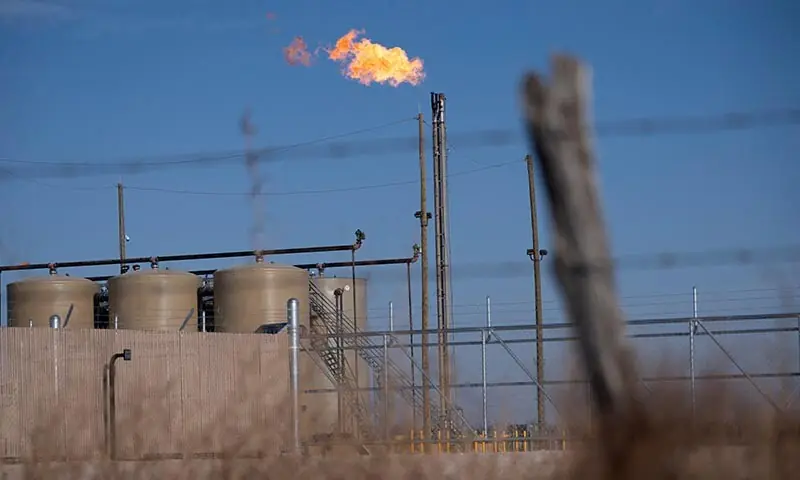 The US war on Iran has boosted prices of globally traded natural gas by throttling exports from the Gulf. In West Texas, gas is so abundant that some producers must pay to have it taken away. The war and Iran’s attacks on Gulf energy producers have halted 20 per cent of global liquefied natural gas (LNG) supply. Qatari LNG facilities have been damaged, and tankers have been unable to sail through the Strait of Hormuz waterway at the Gulf’s entry because of Iranian threats to fire on them. The crisis has exposed a major split in the global gas market: Import-dependent countries across Europe and Asia are scrambling for scarce supplies, but the US — the world’s largest gas producer, consumer and exporter — remains awash in fuel, with prices near 17-month lows. But US pipelines are full and LNG export plants are at capacity, so that cheap US gas cannot reach overseas buyers, creating a bifurcation much more stark than in the oil markets. Since the war began on February 28, gas futures at the US Henry Hub benchma...
 -
Cointelegraph.com - 14:24 Apr 30, 2026
 Brighty data shows Spain leading EURC retail usage, offering an early look at how euro stablecoins are being used under MiCA. Spain appears to be the strongest retail market for Circle’s euro-pegged stablecoin EURC on crypto banking platform Brighty, according to company data. Spain led EURC usage by a wide margin in 2025 and the first quarter of 2026, accounting for about 36% of transactions and 25% of volume, according to Brighty data seen by Cointelegraph. “For Spanish users, EURC functions essentially as a standard euro on a card with no exchange rate friction when transacting against USDC,” Brighty co-founder Nick Denisenko said. Read more
 -
CryptoSlate - 11:58 Apr 27, 2026
Bitcoin traded below $78,000 on Monday as EU markets opened for the week. BTC price hit $77,819, down 0.28% over 24 hours, with a market capitalization near $1.56 trillion and 24-hour volume of around $32.1 billion. Total crypto liquidations stood near $295 million over the previous 24 hours on CoinGlass. Bitcoin had been pressing the […] The post Bitcoin flash crashes below $78,000 at Europe market open with nearly $295 million in crypto liquidations appeared first on CryptoSlate. -
Cointelegraph.com - 11:15 Apr 27, 2026
 Banking Circle's stablecoin settlement launch follows its CASP approval, entering a crowded market with SocGen, Sygnum and a 12-bank euro stablecoin consortium. Luxembourg-based Banking Circle has launched stablecoin settlement services after receiving a Crypto Asset Service Provider (CASP) license from Luxembourg's financial regulator on April 15, expanding into regulated fiat-to-stablecoin and stablecoin-to-fiat settlement for institutional clients. The rollout includes support for Circle's USDC, Paxos' USDG and Banking Circle's own euro stablecoin EURI, expanding the bank's digital asset settlement capabilities beyond its initial EURI launch in August 2024. In a Monday announcement, the bank said it serves more than 750 payment companies, financial institutions and marketplaces that move and convert over 1.5 trillion euros (roughly $1.7 trillion) annually across its infrastructure. Chief digital asset officer Kirit Bhatia said in the release that stablecoins are "a natural extension" of the bank's infrastr...
 -
CoinDesk - 13:00 Apr 26, 2026
In an interview, Ben Zhou said the crypto exchange is at least two years away from breaking even in Europe. -
Cointelegraph.com - 13:28 Apr 22, 2026
 Smaller crypto companies across Europe face mounting compliance costs as MiCA moves from framework to enforcement, raising fears of market consolidation. The European Union’s Markets in Crypto Assets Regulation (MiCA) transition period is entering its final stretch, forcing smaller crypto firms across the EU to either secure authorization quickly or prepare to shut down regulated services. The transitional period ends across the bloc on July 1, after which any crypto asset service provider operating without a MiCA license must stop serving EU clients. Early movers like United Kingdom-based exchange CoinJar, which said it secured MiCA authorization in Ireland in 2025, call the regime a necessary maturation that rewards compliance-first players, but founders in markets like Poland warn thousands of virtual asset service providers (VASPs) could fall off a regulatory cliff as deadlines hit. Companies face a hard stop of July 1 for the longest 18-month grandfathering window, with some national regimes already clos...
 -
ukrinform.net - 14:17 Apr 18, 2026
The head of the International Air Transport Association (IATA), Willie Walsh, has urged Europe to develop "well-coordinated plans" in case limits on aviation fuel are introduced due to the war in the Middle East. -
Haaretz - 11:10 Apr 17, 2026
Europe had not fallen below 29 days of jet fuel cover since 2020, but some countries are now under 20. Airlines are cutting flights, raising fees and trimming routes as officials warn shortages could disrupt peak summer travel if supplies through the Strait of Hormuz remain blocked -
Cointelegraph.com - 11:55 Apr 16, 2026
 Executives at Paris Blockchain Week said European firms interested in Bitcoin treasury strategies are working around shallower capital markets and tighter constraints than in the US. European companies exploring Bitcoin treasury strategies are unlikely to replicate the playbook pioneered by Michael Saylor’s Strategy, according to industry executives, who pointed to structural differences between US and European capital markets. Speaking at Paris Blockchain Week 2026, Thomas Vogel, a partner in the Paris and Frankfurt offices of Latham & Watkins, said the constraints on issuing financial instruments in Europe differ significantly from those in the US, making a direct replication of the model difficult. “If you issue convertibles in the US, the constraints are not the same as when you issue them out of a French balance sheet or a balance sheet in Europe,” Vogel said, pointing to differences in market depth, regulation and investor behavior. Read more
 -
Cointelegraph.com - 10:21 Apr 15, 2026
 The exchange said the new product is available across the European Economic Area through its Malta-based MiFID business, with up to 10x leverage and multi-asset collateral. OKX said Wednesday it is rolling out a Europe-specific crypto derivatives product called X-Perps, extending its regulated offering across the European Economic Area (EEA) through its Malta-based MiFID business. The company said the new derivatives product is available to retail and institutional traders across all 30 EEA countries. OKX said the platform is purpose-built in compliance with the Markets in Financial Instruments Directive (MiFID), a European Union regulatory framework governing financial instruments such as securities and derivatives. Read more
 -
Cointelegraph.com - 12:46 Apr 12, 2026
 Stablecoin adoption in Europe is shifting from strategy to execution, with demand increasingly driven by real-world needs. Banks and corporates across Europe are moving beyond exploration and are now actively selecting infrastructure partners to support stablecoin adoption, according to Lamine Brahimi, co-founder and managing partner at crypto custody technology provider Taurus. Brahimi told Cointelegraph that 18 months ago, most conversations were still educational, focused on understanding stablecoins and their risks. Today, firms with board-level approval are preparing to go live. He said the introduction of the EU’s Markets in Crypto-Assets Regulation (MiCA) has accelerated that transition by replacing fragmented national rules with a single bloc-wide regulatory regime. “In the past 12 months alone some of Europe's most stringent financial institutions are all arriving at the same conclusion, digital assets, including stablecoins, belong inside the existing banking stack, not beside it,” he said. Read mor...
 -
Defense News - 23:00 Apr 09, 2026
U.S. President Donald Trump has discussed with advisers the option of removing some U.S. troops from Europe, a senior White House official told Reuters.