Iran | News
-
The Nation - National - 09:32 Jul 03, 2026
Prime Minister Shehbaz Sharif departed from Islamabad on a one-day official visit to Iran to attend the funeral of Iran's late Supreme Leader, Ayatollah Ali Khamenei. -
Dawn - 18:44 Jul 02, 2026
Prime Minister Shehbaz Sharif will visit Iran and Turkiye from July 3 to July 5, Foreign Office (FO) spokesperson Tahir Andrabi confirmed on Thursday. Addressing a weekly briefing, Andrabi said that during his visit to Iran, the premier would participate in the funeral of late supreme leader Ayatollah Ali Khamenei, who was assassinated in US-Israeli strikes on February 28. The FO spokesperson said PM Shehbaz will travel to Iran first for Khamenei’s funeral. Deputy PM and Foreign Minister Ishaq Dar, cabinet members and senior officials will accompany the premier on his visit. “The prime minister will convey condolences on behalf of the people and government of Pakistan to the Iranian leadership and the bereaved families while reaffirming solidarity with the brotherly nation in their hour of profound grief,” he said. PM Shehbaz will then visit Istanbul at the invitation of Turkiye’s President Recep Tayyip Erdogan, Andrabi said. He added that the premier will “hold discussions on the entire gamut of bilateral re... -
AD.nl - 17:47 Jul 02, 2026
Iran verwacht miljoenen rouwenden bij begrafenis ayatollah Ali Khamenei, mogelijk nieuw wereldrecord
Iran maakt zich op voor de megabegrafenis van ayatollah Ali Khamenei. De begrafenis begint zaterdag in Teheran. De 86-jarige ayatollah wordt vijf dagen later begraven in zijn thuisstad Mashhad. Bij de ceremonies en langs de processie worden miljoenen mensen verwacht. -
The Nation - National - 16:45 Jul 02, 2026
ISLAMABAD: Shehbaz Sharif will embark on official visits to Iran and Türkiye beginning Friday, according to an official statement. -
Haaretz - 12:53 Jul 02, 2026
Iran warned the U.S. and Israel against any new attack as it prepares for Ayatollah Ali Khamenei's funeral, vowing a swift and harsh response while tightening security and imposing temporary airspace restrictions -
Dawn - 17:14 Jul 01, 2026
President Donald Trump said on Monday that the United States is “getting along well” with Iran, as the two countries began indirect talks via mediators in Doha on Wednesday, in a bid to advance negotiations and ease tensions following exchanges of fire between the two sides. “The denuclearisation of Iran is moving along well,” Trump told reporters before leaving for a trip. “They’ve had very good meetings, and we’ll see.” He added that Tehran had “come a long way” in negotiations with Washington. “We hit them very hard last week. I think they’re fine,” he said. “It’s the denuclearisation of Iran, it’s very simple, and Iran can never have a nuclear weapon.” Both the US and Iran said they would send officials to discuss the Islamabad Memorandum of Understanding (MoU) aimed at ending the Middle East war, but Iran insisted direct negotiations would not take place. A diplomat, speaking on condition of anonymity to discuss the sensitive talks, confirmed negotiations were underway, after earlier saying the foes woul... -
JPost.com - Energy & Infrastructure - 12:55 Jul 01, 2026
According to expert estimates, Iran's revenues total approximately $3.5 billion – based on oil prices over the past two weeks.
-
JPost.com - Business & Innovation - 12:55 Jul 01, 2026
-
Dawn - 08:32 Jul 01, 2026
WASHINGTON: US President Donald Trump has held a series of meetings with senior national security officials to review US policy towards Iran, including whether Washington should continue negotiations with Tehran or resume broader military strikes, according to the Wall Street Journal. Trump has been briefed on options for a possible return to broader military confrontation with Iran but has, for now, chosen to continue diplomatic negotiations, according to a report by the Wall Street Journal citing US officials familiar with internal deliberations. The Journal said the discussions involved Defence Secretary Pete Hegseth and Joint Chiefs Chairman Gen. Dan Caine, as officials assessed whether the United States should abandon talks with Tehran and resume full-scale military strikes. Some officials involved in the deliberations reportedly described the harder option internally as “finishing the job”. While the deliberations reflect renewed debate within the administration over escalation, the report said Trump ha... -
Haaretz - 08:25 Jul 01, 2026
According to the report, Trump believes another round of attacks could derail diplomatic contacts and reduce the chances of ultimately dismantling Iran's nuclear program, thus preferring targeted strikes against Iran when it violates truce agreements -
AD.nl - 20:18 Jun 30, 2026
Iran wil pas verder onderhandelen met de Verenigde Staten als er is voldaan aan de voorwaarden van de voorlopige overeenkomst tussen de twee landen, zegt hoofdonderhandelaar Mohammad Bagher Ghalibaf. Volgens hem zijn alle huidige gesprekken er enkel op gericht om die afspraken uit te voeren. Volg alle ontwikkelingen in het Midden-Oosten in ons liveblog. -
Adevarul Romania - 15:56 Jun 30, 2026
Iran a respins propunerea președintelui francez Emmanuel Macron de a coopera pentru curățarea minelor din Strâmtoarea Ormuz, avertizând Parisul să nu intervină într-una dintre cele mai importante rute maritime strategice din lume. -
Haaretz - 07:09 Jun 30, 2026
Iran is sending a technical delegation to Qatar this week, yet the Foreign Ministry spokesperson said this had 'no relation' to Trump sending his son-in-law, Jared Kushner and his envoy Steve Witkoff to lead the negotiating team, and denied the two sides will meet -
Dawn - 17:54 Jun 29, 2026
ISLAMABAD: As part of Pakistan’s efforts to help broker an end to the war in the Middle East, Prime Minister Shehbaz Sharif will pay official visits to Iran and Turkiye from July 3 to 6, sources in the PM Office told Dawn on Monday. The US military said it carried out new strikes on early Sunday on multiple targets in Iran, in response to a fresh Iranian attack on a ship transiting the Strait of Hormuz. Tehran responded by launching strikes against US bases in Bahrain and Kuwait before both sides agreed to halt attacks. Sources said that during his visit, the prime minister will meet the leadership of both Iran and Turkiye and call on Tehran and Washington to exercise restraint, particularly following the signing of the Islamabad Memorandum of Understanding (MoU) as part of the peace process. The strikes underscored the fragility of the Pakistan-brokered interim peace deal aimed at ending a war launched by the United States and Israel on February 28, which disrupted shipping through the Strait of Hormuz and r... -
Cointelegraph.com - 17:44 Jun 29, 2026
 Bitcoin faced its own battle for support as US stocks headed higher and analysts warned of a lack of "conviction" among BTC buyers. Bitcoin (BTC) struggled near $60,000 around Monday’s Wall Street open as bulls increasingly risked a support/resistance flip. Key points: Read more
 -
Dawn - 08:42 Jun 29, 2026
Iran and the United States agreed to halt recent hostilities in the Gulf and renew talks regarding their dispute over the Strait of Hormuz, a US official said on Sunday, raising hopes of saving an interim peace deal that was under pressure from days of tit-for-tat strikes. The exchanges have underscored the fragility of a Pakistan-brokered agreement to end the conflict that has killed thousands and snarled the flow of oil shipments through the vital Strait of Hormuz. “Technical talks are slated to continue on all areas of the memorandum of understanding (MoU). Both sides will stand down for now and vessels can move freely,” the official said, referring to the 14-point agreement that was signed on June 18 under which the strait would be reopened for traffic. Iran has not immediately commented on the US statement. Axios, which first reported the cessation of hostilities, citing a senior US official, said talks would resume on Tuesday in Qatar. A return to diplomacy would follow several days of strikes and count... -
Dawn - 15:27 Jun 28, 2026
LAHORE: Petroleum Minister Ali Pervaiz Malik on Sunday said that Pakistan was “considering” purchasing cheaper Iranian oil and gas. The option of sourcing Iranian crude oil supplies has again become available to Pakistan after a temporary easing of US sanctions on Tehran. By availing this opportunity, Pakistan could source discounted crude and refine it locally to produce higher-value petroleum products. Sourcing crude oil from Iran could generate import cost savings of $170-340 million for Pakistan, assuming it imports 10-20 per cent of its total petroleum requirement at a discount, including freight savings. But, while industry experts say local refineries are technically capable of processing Iranian crude, commercial and operational challenges remain, particularly due to the high furnace oil yield and the absence of significant domestic demand for the fuel. Against this backdrop, Malik said while speaking to the media in Lahore that Pakistan was now mulling sourcing cheaper crude oil from Iran. He added t... -
Dawn - 12:25 Jun 28, 2026
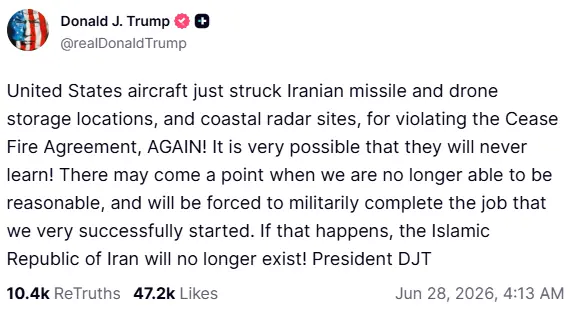 Iran’s Foreign Minister Abbas Araghchi warned on Sunday that any attempt to bypass the Strait of Hormuz routes agreed with the United States would “increase tensions” in the Middle East, as the countries traded attacks and accusations of violating a fragile ceasefire in the region. Araghchi’s warning came after the US military said it carried out new strikes on early Sunday on multiple targets in Iran, in response to a fresh attack on a ship transiting the Strait of Hormuz. Tehran responded by launching strikes against US bases in Bahrain and Kuwait. The exchanges underscored the fragility of a Pakistan-brokered interim peace deal aimed at ending a war launched by the United States and Israel on February 28, which disrupted shipping through the Strait of Hormuz and rattled global energy markets. “Any attempt to adopt new or separate arrangements compared to what is underway by the Islamic Republic of Iran, will only lead to more complicated situations and delays in the reopening of the Strait of Hormuz, and w...
 -
FD - 12:04 Jun 28, 2026
Bijna het hele weekend hebben de Verenigde Staten en Iran elkaar bestookt. De oplopende spanningen zijn slecht nieuws voor de olie- en gasmarkt. -
Dawn - 07:07 Jun 28, 2026
The Democratic Republic of Congo became the latest underdogs to roar at the World Cup on Saturday, battling into the knockout rounds for the first time as Iran’s rollercoaster campaign ended in elimination. A chaotic finale to the tournament’s expanded group phase saw Austria and Algeria fill the final two berths in the last 32 late on Saturday after battling to an extraordinary 3-3 draw in Group J — a result that dashed Iran’s hopes of advancing from their group. A win for either Austria or Algeria would have allowed Iran to squeeze into the last 32, and it looked as if the Asian side would advance when Riyadh Mahrez scored in the third minute of stoppage time to put the Algerians into a 3-2 lead. But Iranian joy was short-lived when Sasa Kalajdzic arrowed in a header in the sixth minute of injury time to snatch a draw for Austria and spark pandemonium in Kansas City. Austria midfielder Marcel Sabitzer, who scored Austria’s second goal, described the closing moments as “weird”. “It’s a draw normally, so you ...