Iran | News
-
The Nation - National - 15:35 Apr 21, 2026
Pakistan is awaiting an official response from Iran regarding the confirmation of its delegation for the second round of proposed talks between the United States and Iran in Islamabad, Federal Minister for Information Attaullah Tarar said on Tuesday. -
Haaretz - 14:26 Apr 21, 2026
The head of the Mossad said in a Memorial Day speech that his 'thoughts and heart were filled with pride' during the 2026 Iran war in the actions of an agent who died outside of Israel when a boat carrying mostly Israeli and Italian intelligence personnel capsized in a storm on Lake Maggiore -
Adevarul Romania - 00:00 Apr 21, 2026
SUA și Iran au negociat la Islamabad, în Pakistan, dar sunt departe de a ajunge la un acord, chiar dacă a fost semnat un armistițiu temporar. John Bolton consideră că India poate media cel mai bine această speță. -
Haaretz - 20:04 Apr 20, 2026
A 19-year-old accused of carrying out missions for Iran is accused of recruiting his 21-year-old friend to forge documents, and even planned to undergo training in an Arab country, Israeli security agencies said -
NU.nl - 18:42 Apr 20, 2026
Hallo en welkom in dit liveblog. Hier houden we je op de hoogte van de aanvallen van Israël en de VS op Iran, de Iraanse tegenaanvallen en de verdere ontwikkelingen in het Midden-Oosten. -
Dawn - 18:41 Apr 20, 2026
US delegation expected in Islamabad but uncertainty prevails over talks amid mixed signals from Iran
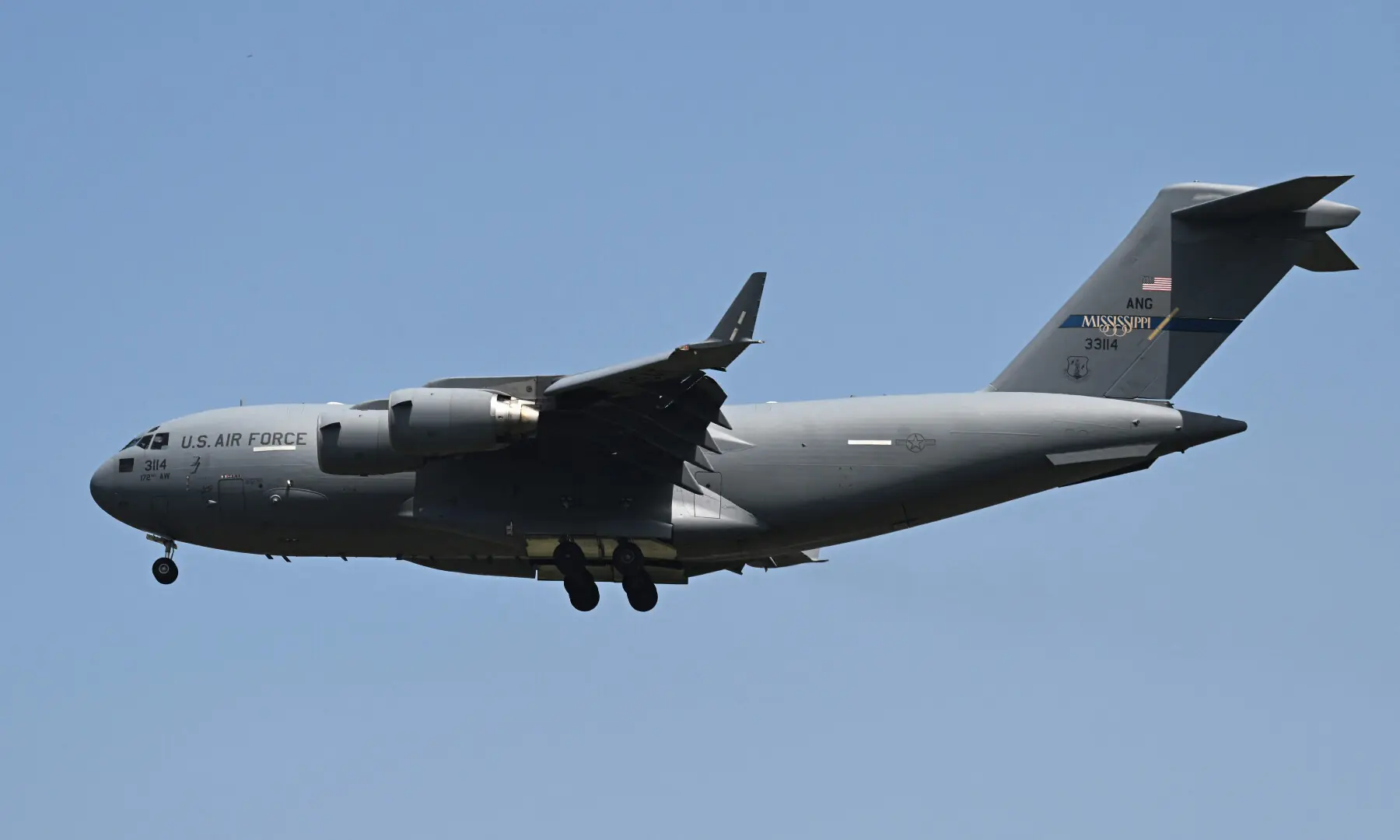 Key developments Trump has confirmed an American delegation will be arriving in Pakistan for talks. While he said on Monday evening that JD Vance and an American delegation were en route to Islamabad, US news outlets reported that the US vice president had yet to depart Iran says it has yet to decide whether it will attend next round of talks with US; parliament speaker highlights lack of trust in Washington Tight security in Islamabad for arrival of foreign delegations; Red Zone sealed and public transport in twin cities suspended Uncertainty prevailed on Monday over whether the United States and Iran would hold a second round of direct talks, as mixed signals emerged from Tehran amid intensifying tensions with Washington, even as Islamabad prepared to host the two sides. Meanwhile, US Donald Trump confirmed that a US team would be in Islamabad for the expected talks. However, it was not clear when the team would depart and arrive in Pakistan. Initially, Trump told The New York Post on Monday evening that US...
 -
Dawn - 12:02 Apr 20, 2026
Interior Minister Mohsin Naqvi on Monday held separate meetings with the Iranian and US envoys to discuss arrangements made for a second round of Islamabad Talks between the two warring parties. Naqvi’s intensified efforts come as Islamabad continues to set the stage for a possible second round of negotiations between Washington and Tehran, after the first round ended without an agreement. The Ministry of Interior issued separate press releases detailing Naqvi’s interactions with US Charge d’Affaires to Pakistan Natalie Baker and Iran’s Ambassador to Pakistan Reza Amiri Moghadam. According to a statement issued later in the day, Naqvi discussed “arrangements for a second round of Islamabad Talks” with the Iranian envoy, telling him that the preparations for it were complete. “Foolproof security arrangements have been made for foreign delegations,” Naqvi told Moghadam. Iran said earlier on Monday that Tehran has yet to decide on whether to send its delegation, and there is no official confirmation so far that ... -
Haaretz - 07:09 Apr 20, 2026
Iran said it would not participate in a second round of negotiations in Pakistan before the cease-fire expires on Tuesday, as the U.S. has maintained a naval blockade of the Strait of Hormuz and seized an Iranian vessel, while both countries have exchanged military threats -
CoinDesk - 05:36 Apr 20, 2026
Bitcoin traded at $74,335 after Iran reimposed controls on the Strait of Hormuz over the weekend, with the modest 1.6% pullback standing out against a 5.7% jump in Brent and a 1.2% drop in European equity futures. -
NU.nl - 23:05 Apr 19, 2026
Een Amerikaanse delegatie reist maandag naar Pakistan voor nieuwe gesprekken met Iran. Het is maar de vraag of ze daar in gesprek kunnen met een Iraanse delegatie. Het Iraanse regime ziet deelname aan een tweede onderhandelingsronde namelijk vooralsnog niet zitten. -
AD.nl - 22:50 Apr 19, 2026
Iran heeft in de nacht van zondag op maandag gedreigd met vergelding vanwege de Amerikaanse aanval op het onder Iraanse vlag varende vrachtschip Touska. Een woordvoerder van het militaire hoofdkwartier Khatam al-Anbiya zei dat de VS met de aanval het staakt-het-vuren hebben geschonden. Volg alle ontwikkelingen in het Midden-Oosten in ons liveblog. -
Dawn - 21:00 Apr 19, 2026
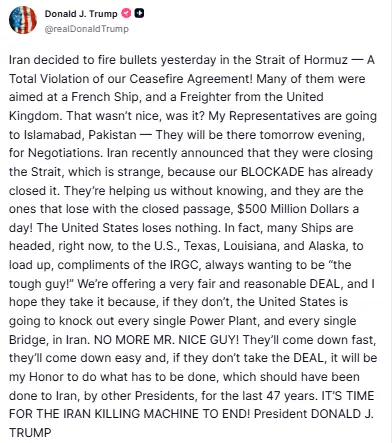 President Donald Trump announced on Sunday that representatives from Washington were heading to Islamabad and they would be “there tomorrow evening for negotiations” with Iran. The US president made the announcement in a Truth Social post, where he also insisted that Washington was offering Tehran “a very fair and reasonable” deal. “And I hope they take it because, if they don’t, the United States is going to knock out every single Power Plant, and every single Bridge, in Iran,” he warned. “NO MORE MR. NICE GUY! They’ll come down fast, they’ll come down easy and, if they don’t take the DEAL, it will be my Honour to do what has to be done, which should have been done to Iran, by other Presidents, for the last 47 years. IT’S TIME FOR THE IRAN KILLING MACHINE TO END!” US media outlets reported, citing the White House spokesperson and officials, that Vice President JD Vance would lead the American delegation, and that Trump’s envoy Steve Kushner and the president’s son-in-law Jared Kushner would also be part of t...
 -
ukrinform.net - 18:21 Apr 19, 2026
Presidents Volodymyr Zelensky of Ukraine and Alexander Stubb of Finland have discussed the situation on the front lines in Ukraine and security challenges related to the war in Iran. -
The Nation - National - 15:28 Apr 19, 2026
Deputy Prime Minister and Foreign Minister Ishaq Dar held separate telephone conversations with Canada’s Foreign Minister Anita Anand and Iran’s Foreign Minister Abbas Araghchi on Sunday, focusing on evolving regional developments. -
ukrinform.net - 12:42 Apr 19, 2026
European allies are worried that an inexperienced U.S. negotiating team is pushing for a quick, high-profile framework agreement with Iran that could deepen, rather than resolve, existing issues between the sides. -
Dawn - 08:19 Apr 19, 2026
Britain’s government is set to announce legislation next month to move the country closer to the European Union, as the Iran war sours the United Kingdom’s so-called special relationship with the United States. US President Donald Trump’s unpredictability and stream of insults towards America’s historic ally are adding impetus to Prime Minister Keir Starmer’s bid to deepen ties with the 27-nation bloc, a decade after Britons narrowly voted to leave the EU. “We have a government that is already eager to move closer towards the EU, and the events in Iran provide an opportunity to speed up that process,” Evie Aspinall, director of the British Foreign Policy Group think-tank, told AFP. Starmer’s administration is preparing an EU “reset” bill that will give ministers powers to align UK standards with EU single market rules as they evolve — something called “dynamic alignment”. King Charles III will announce the legislation on May 13 when he reads out Starmer’s legislative plans for the coming months, a government ... -
Dawn - 06:17 Apr 19, 2026
North Korea fired ballistic missiles into the sea on Sunday, accelerating its missile launches amid Iran war tensions and talk of possible meetings with the US and South Korea. Pyongyang’s intense missile activity — this was the fourth such launch this month and the seventh of the year — is meant to display its self-defence capabilities while gaining international leverage, some experts said. “The missile launches may be a way of showing that — unlike Iran — we have self-defence capabilities,” said South Korean former presidential security adviser Kim Ki-jung. “The North also appears to be exerting pressure preemptively and make a show of force before engaging in dialogue with the United States and South Korea,” he said. Iran war, Trump visit loom over launches The seven-week-old US-Israeli war against Iran, which Washington says aims to curb Tehran’s nuclear programme, could reinforce Pyongyang’s nuclear ambitions, experts and former South Korean officials say. US President Donald Trump, preparing for a summ... -
AD.nl - 01:08 Apr 19, 2026
Iran heeft de Straat van Hormuz opnieuw geblokkeerd en ziet schepen die er toch door willen als doelwit. De Amerikaanse president Trump heeft laten weten zich niet te willen laten ‘chanteren’ met gedraai over de blokkade. Volg alle ontwikkelingen in het Midden-Oosten in ons liveblog. -
Cointelegraph.com - 18:27 Apr 18, 2026
 The Iranian government chose Bitcoin as a payment method for oil tolls due to its confiscation-resistant properties, but only dollar stablecoins have been used so far. Iran’s government naming Bitcoin (BTC) as a payment method for oil ships crossing the Strait of Hormuz highlights its role as a neutral, strategic asset, according to Sam Lyman, head of research at digital asset advocacy organization Bitcoin Policy Institute (BPI). The government selected BTC as one of the payment methods for the tolls because of its censorship-resistant qualities, Lyman told Cointelegraph. He said: Iran is accepting oil tolls in Chinese yuan, US dollar-pegged stablecoins and BTC. However, there is “no onchain evidence” of a BTC toll payment so far, Lyman said, adding that the “majority” of Iran’s crypto transactions are denominated in US dollar stablecoins. Read more
 -
CryptoSlate - 15:30 Apr 18, 2026
US-listed spot Bitcoin exchange-traded funds (ETFs) recorded their largest single-day capital inflow since January on April 17, as the reopening of a critical Middle Eastern shipping route sparked a broader market rotation into risk assets. According to SoSoValue data, the 12 products drew approximately $664 million in fresh capital on April 17. The surge was […] The post US Bitcoin ETFs pull in $664M in largest daily inflow since January, because Iran reopened Hormuz for a few hours appeared first on CryptoSlate.