The Binance attackers moved most of the stolen SOL and continued laundering funds through THORChain after the protocol resumed swaps. The attackers behind the $6.3 billion Binance hack have moved about 81% of the stolen Solana (SOL) as they continue laundering assets through the cross-chain swap protocol THORChain. Wallets grouped under the Binance hacker entity held 182,443 SOL (worth $16.9 million), or roughly 18.8% of the total 970,522 SOL stolen during the exploit, according to blockchain data platform Arkham. Lookonchain reported on Wednesday that the attackers split SOL across multiple wallets, selling it for USDC, bridging to Ethereum to buy Ether, and ultimately swapping ETH for Bitcoin (BTC) via THORChain.
A European entity may have lost $106 million from exchange accounts, while a wallet associated with a Solana arbitrage bot may have lost another $786,000. An unidentified entity in the European Union may have lost more than $106 million from accounts at multiple cryptocurrency exchanges on Sunday, according to blockchain investigator ZachXBT. In a Monday post, ZachXBT said funds suspected to have been stolen were withdrawn in USDC and USDT before being moved through several cryptocurrencies and blockchains. The suspected attacker swapped USDC for Ether (ETH), used instant exchange services including WellWallet and Kyrrex, and converted funds into Monero (XMR) through the swap service Wagyu.
Crypto exchange Gate said it froze two linked accounts as US investigators urged platforms to block transactions tied to the $6.3 billion theft. The hackers behind Binance’s $6.3 billion theft have begun converting stolen Solana tokens into Bitcoin after largely emptying the wallets used to launder funds on Tron, according to blockchain investigators. Lookonchain reported Sunday that the hackers had moved 486,970 Solana (SOL) tokens, worth about $46.4 million, and were swapping them for Bitcoin (BTC) through Relay. The activity involves funds that escaped the freezes imposed after Thursday’s theft, the largest in cryptocurrency history. Industry partners, including Tether and Circle, froze about $3 billion in stolen assets, while investigator SomaXBT estimated the attackers still controlle…
The move follows the addition of Tron support and Polygon’s acquisition of Coinme. Polygon Labs is expanding Open Money Stack, its suite of services connecting bank accounts, crypto wallets and payouts, to the Solana network. The expansion lets businesses building on Solana use Open Money Stack to accept funding from bank accounts, provide customer wallets and arrange payouts. Polygon Labs CEO Marc Boiron told Cointelegraph that customer demand and stablecoin activity drove the decision to expand to Solana and, earlier this month, Tron.
The company’s Hong Kong unit issued six-month notes under its $3 billion program, extending blockchain-based distribution to institutional investors. The Hong Kong arm of Mirae Asset Securities, one of South Korea’s largest securities firms, has issued tokenized notes on Solana to institutional investors. The transaction involved six-month floating-rate notes issued under the firm’s $3 billion structured note program, according to Wednesday’s announcement. Singapore-based digital market infrastructure operator Marketnode acted as an authorized distributor. Mirae Asset Securities managed token issuance, payments and the notes’ lifecycle using its internal digital infrastructure. The company said the transaction could provide a model for distributing a wider range of structured products thro…
Solana’s first major consensus upgrade is targeting 99% finality reduction, seeking to offer users near-immediate transaction settlement and more responsive applications. Solana’s first major consensus upgrade, Alpenglow, went live on mainnet around 1:54 pm UTC on Wednesday, according to the Solana Foundation’s Alpenglow dashboard. Alpenglow seeks to reduce transaction finality by 99%, to roughly 150 milliseconds from about 12.8 seconds, according to the Solana Foundation’s July announcement. The upgrade’s first phase, Votor, replaces the existing voting and finalization mechanism with direct validator voting and a certificate-based system designed to cut transaction finality to roughly 150 milliseconds. A later phase will introduce Rotor, a new block data-distribution protocol intended to…
BlackRock’s proposed Bitcoin fund would use options to limit potential losses and gains, adding another strategy to its existing Bitcoin and Ether ETF lineup. BlackRock, the world’s largest asset manager, is looking to expand its crypto fund lineup with a Bitcoin exchange-traded fund (ETF) that offers limited downside protection in exchange for capped gains. The world’s largest asset manager on Monday filed a preliminary prospectus with the US Securities and Exchange Commission for the iShares Bitcoin Managed Protection ETF (PBIT). The proposed ETF would use options linked to BlackRock’s iShares Bitcoin Trust ETF (IBIT) rather than holding Bitcoin (BTC) directly, according to the preliminary prospectus filed with the US Securities and Exchange Commission (SEC).
The former medical device maker has liquidated its Solana treasury and is offering to repurchase shares and warrants using its $223.8 million cash holdings. SkyAI, formerly Sharps Technology, has sold its entire Solana (SOL) treasury and launched a tender offer to repurchase up to $201.3 million in shares and warrants, reversing its cryptocurrency accumulation strategy. The company held approximately $223.8 million in cash as of Oct. 16 after liquidating its SOL holdings, according to a filing with the US Securities and Exchange Commission on Monday. The tender offer allows shareholders and warrant holders to sell their securities directly back to SkyAI at a fixed price. It covers up to 95% of each class of the company’s outstanding shares and warrants, funded entirely by cash on hand.
Solana has had no reported mainnet outages in two years, but concentrations in stake, hosting and client software should be monitored, according to a report. Solana has made significant progress in terms of network health across resilience, economic security and performance indicators, according to a Fidelity report. Solana has had no reported mainnet outages in two years, but concentrations in stake, hosting and client software could threaten this, according to the report by Fidelity’s Center for Applied Technology (FCAT). The report said economic security was supported by substantial staking participation and incentives that reward validator performance. Low latency, expanded capacity and inexpensive transactions also support practical use at scale.
Solana Foundation President Lily Liu said registrations quadrupled overnight, exceeding the attendance limit registered with local authorities. The Solana Accelerate event in Shanghai was postponed after pre-registration exceeded the event cap set by local authorities, according to Lily Liu, president of the Solana Foundation. Event registration quadrupled overnight following publicity for the event, Liu wrote in a Friday X post, adding that organizers decided to postpone the event to “comply with local requirements.” Earlier on Friday, X users claimed that the event was “abruptly suspended” as law enforcement officers were stationed at the venue.
Tokenized equities have reached nearly $3.3 billion in value as investors embrace round-the-clock access beyond Wall Street hours. Most trading in tokenized stocks on major blockchains now takes place outside regular US market hours, offering an early indication that around-the-clock trading could be one of the biggest advantages of putting equities onchain. According to Blockworks data cited by The Kobeissi Letter, more than 70% of tokenized stock trading volume on BNB Chain occurs outside the traditional 9:30 am to 4 pm Eastern trading session. The figure is 63% on Solana and nearly 60% on Base.
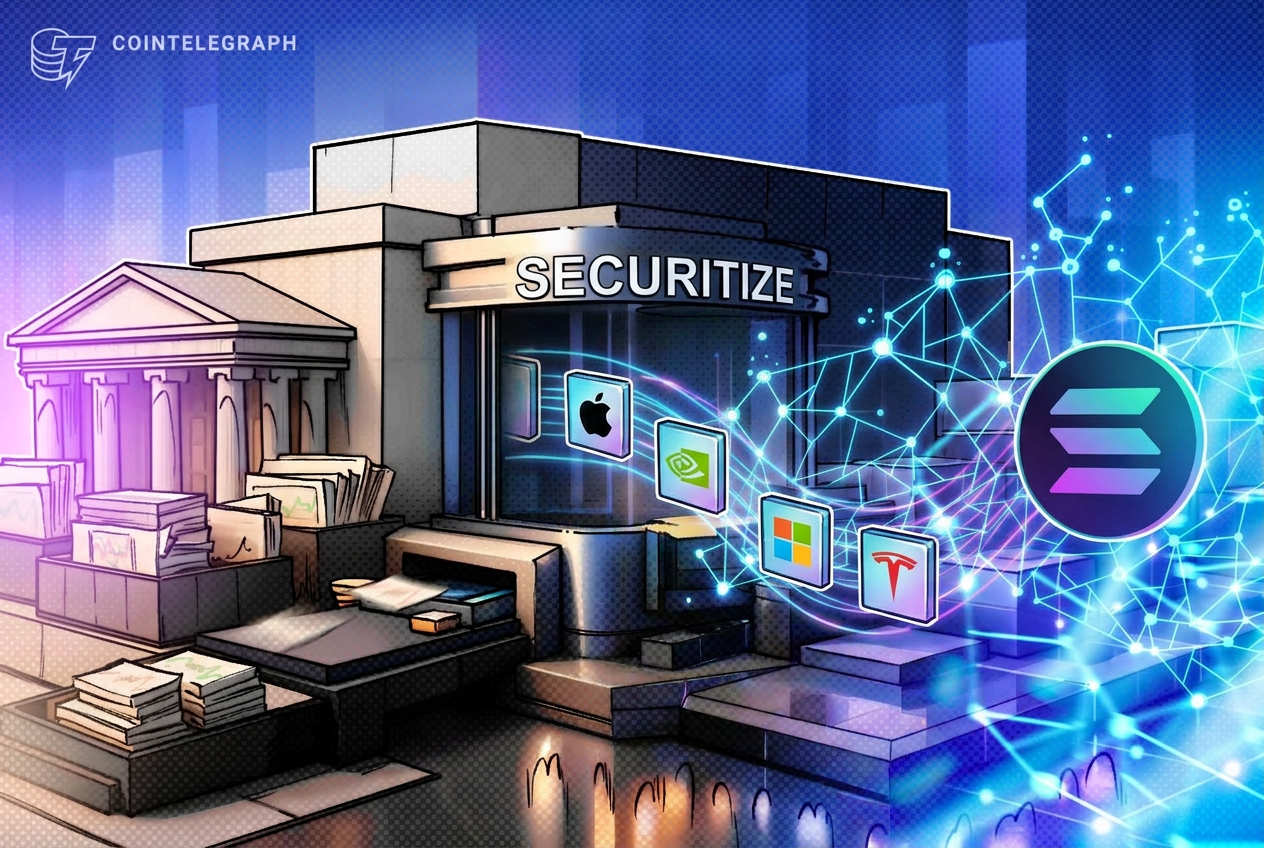
Securitize’s new offering gives eligible investors access to tokenized shares of 12 US companies, with dividend and voting rights and plans for round-the-clock trading. Securitize shares climbed about 10% Thursday as the company launched tokenized versions of major US stocks on Solana, offering eligible investors exposure to equities backed by underlying shares with dividend and voting rights. The new offering, called Securitize Stocks, includes tokenized shares of Apple, Nvidia, Microsoft, Tesla and eight other US-listed companies. The tokens are backed one-for-one by underlying shares and will initially trade during extended market hours through Securitize’s registered broker-dealer platform, according to Thursday’s announcement. Securitize (SECZ) stock. Source: Yahoo Finance
ZetaChain plans to wind down its Cosmos-based layer 1 and migrate ZETA to Solana, joining other crypto projects moving away from standalone chains. ZetaChain tokenholders have approved a plan to wind down the project’s layer-1 blockchain and migrate its native ZETA token to Solana. Governance proposal 68 passed Sunday with 99.4% support and 58% participation, exceeding the network’s 40% quorum requirement. Under the proposal, ZETA will become an SPL token on Solana through a 1:1 conversion, with the same ticker and total supply. According to the proposal, the vote does not immediately trigger ZetaChain’s shutdown or migration. Core contributors will submit a second proposal detailing the withdrawal window for assets linked to other blockchains, snapshot block height, shutdown timetable,…
Solana raised its transaction size limit to 4,096 bytes, giving developers more room for zero-knowledge proofs and transactions with multiple signatures. Solana raised its maximum transaction size from 1,232 bytes to 4,096 bytes to allow developers to fit more complex operations into a single transaction, including zero-knowledge proofs and new onchain signature schemes. The upgrade was activated on mainnet on Tuesday at the start of epoch 1,035 around 1:00 am UTC, according to blockchain data shared by the Solana Foundation. The upgrade also introduced the v1 transaction format, which maintains full backward compatibility with legacy transactions. Existing transaction formats continue working for applications and wallet providers, but protocols that want to benefit from the size increase…
Memecoin platform Pump.fun accounted for most of the new tokens among launchpads, as the Solana network notched a new all-time daily issuance high. The Solana network reached an all-time high in daily token issuance, surpassing the number of new coins issued during the peak of the memecoin cycle in late 2024. More than 263,000 new Solana Program Library (SPL) tokens were minted on the Solana blockchain on Wednesday, marking a new record high, according to Solscan. Some 40,000 to 50,000 daily tokens were issued on Solana at the peak of the memecoin cycle in December 2024. Of the total 40,360 tokens issued through launchpads, memecoin platform Pump.fun accounted for the majority, or 34,184 coins, according to Blockworks’ dashboard.
Fomo generated $1.76 million on Friday, beating Pump.fun’s $1.1 million, though the memecoin launchpad remains ahead over 30 days. Social trading platform Fomo generated more daily revenue than memecoin launchpad Pump.fun on Friday. Fomo generated $1.76 million in daily revenue on Friday, compared with Pump.fun’s $1.1 million, according to DefiLlama data. Pump.fun remains ahead over longer periods. It generated more than $57 million over the past 30 days, compared with $17.6 million for Fomo.
The approved proposal doubles Solana’s annual disinflation rate from 15% to 30%, reducing future SOL issuance while leaving its long-term inflation target unchanged. Solana validators have approved a proposal to double the network’s annual disinflation rate, reducing future SOL issuance. According to finalized voting results, the proposal received 67% support, with 25.16% voting against and 7.84% abstaining. Overall participation reached 60.7% of eligible stake. The proposal, known as SGP-0002 or Double Disinflation, increases Solana’s annual disinflation rate from 15% to 30%, while leaving the network’s long-term inflation target of 1.5% unchanged.
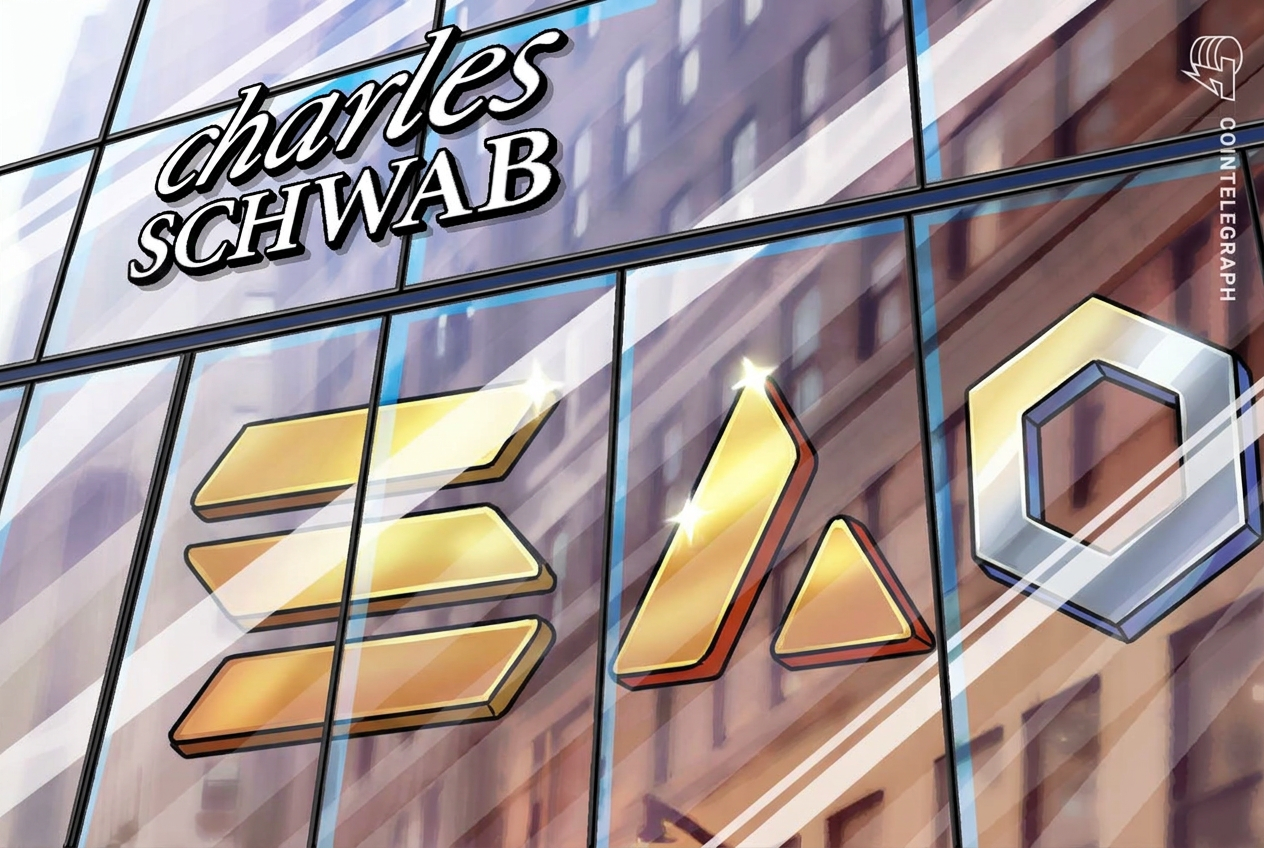
The financial services giant plans to expand Schwab Crypto beyond Bitcoin and Ether just months after rolling out direct crypto trading to retail clients. US financial services giant Charles Schwab plans to add Solana (SOL), Avalanche (AVAX) and Chainlink (LINK) to its crypto trading platform in the coming months, expanding its direct cryptocurrency offering beyond Bitcoin (BTC) and Ether (ETH). Schwab Crypto began rolling out to retail clients in May, initially offering direct Bitcoin and Ether trading alongside traditional investments through Schwab’s website, mobile app and thinkorswim platform. The brokerage said it planned to add more cryptocurrencies and digital assets over time, though it did not specify which assets it is considering or provide a timeline beyond the three newly ann…
Tokenized real-world assets on Solana are nearing $4 billion as network activity accelerates alongside a broader recovery in crypto markets. Transaction activity on the Solana blockchain reached a record high in July, preceding a sharp rally that pushed SOL above $100 for the first time since February amid a broader crypto market recovery. Onchain data presented by The Kobeissi Letter showed that Solana processed a record 4.2 billion transactions in July, up 13.5% from the previous month. Transaction counts have risen by roughly 2 billion since December, representing a 91% increase. The growth has coincided with a broader expansion in tokenized real-world assets. The Kobeissi Letter cited RWA.xyz data showing that the value of distributed RWAs across tracked blockchain networks has climbed…
Solana reduced its slot time for the first time since genesis as it works toward a 200-millisecond target aimed at reducing network latency. Solana reduced its slot time to 350 milliseconds, marking the first such reduction since the inception of the network, according to the Solana Foundation’s vice president of technology, Jacob Creech. “We’re in a new era of 350ms. Next stop, 300ms,” Creech said in a Friday X post. Average slot times on Solana stood at 360ms at press time, down from the network’s original 400ms target, according to the Solana slot time explorer.