Pakistan
-
Dawn - 05:45 Aug 16, 2026
A dominant Bangladesh stunned hosts Australia to win the first Test by nine wickets in Darwin on Sunday for a historic maiden Test victory on Australian soil. After bowling Australia out for 284 and needing 57 to win, the visitors cruised past the total when Mominul Haque slashed Beau Webster to the backward point boundary. Bangladesh dominated Australia throughout the match and the margin of victory will send shockwaves through the cricketing world. After bowling Australia out for 198 in the first innings, the visitors always looked the more likely to win. They kept the pressure on throughout Sunday and didn’t panic when Cameron Green (104) brought up his third Test century after lunch on day four. Green was offered no real support from his teammates and the Bangladeshis kept taking vital scalps to leave Australia on the ropes, with Mehidy Hasan Miraz taking 5-66. The visitors went into the match with most observers giving them no chance of winning. Their only warm-up game, against a Cricket Australia XI, en... -
The Nation - National - 05:36 Aug 16, 2026
ISLAMABAD/ Murree - President of the Pakistan Muslim League-Nawaz (PML-N) Nawaz Sharif on Saturday reiterated his commitment to serving the people of Azad Jammu and Kashmir and addressing their grievances as soon as possible. -
The Nation - National - 05:30 Aug 16, 2026
RAWALPINDI - Chief of Army Staff (COAS) and Chief of Defence Forces (CDF) Field Marshal Syed Asim Munir, NI (M), HJ hosted a reception in honour of Pakistan Army veterans on the occasion of Independence Day. -
Dawn - 05:28 Aug 16, 2026
 In Europe and the United States, the post-1945 era marked a shift from ‘mass parties’ to broad ‘big-tent’ parties. Mass parties had operated on strict class lines. Democratic socialist outfits appealed to industrial workers, while conservative parties represented business elites and religious traditionalists. Big-tent politics had already taken root in North America due to its vast geography, rapid industrialisation, and diverse immigrant and Black populations. To build winning national majorities, the Democratic and Republican parties developed broad platforms, accommodating competing internal factions under a shared umbrella and a loose ideological core. This was the beginning of big-tent parties. The Democratic Party in the US, especially from the early 1930s onwards, has housed democratic socialists, progressives, social liberals and pro-business centrists, alongside its conservative Southern wing, which existed within the party till the early 1960s. The latter was mainly to bag votes from the ‘Bible belt...
 -
The Nation - National - 05:28 Aug 16, 2026
ISLAMABAD - Prime Minister Shehbaz Sharif on Saturday directed the National Disaster Management Authority (NDMA) to utilize all available resources to provide maximum assistance and relief to the people affected by floods across the country. -
The Nation - National - 05:10 Aug 16, 2026
LAHORE - Punjab Chief Minister Maryam Nawaz Sharif on Saturday reviewed the progress on the “Punjab AI Vision 2029” and set a target to transform Punjab into the most artificial intelligence (AI)-enabled province in South Asia by 2029. -
Dawn - 04:58 Aug 16, 2026
HYDERABAD: An Indonesian woman, Indah Marlyan, was recovered under judicial orders and handed over to her country’s consulate by the district police on Saturday. The woman had married a man, Naik Mohammad Shaikh alias Mohammad Hamza Mirza. She had submitted a complaint to the consulate alleging that she was being subjected to domestic violence. The consulate took up the matter with Sindh government functionaries and an application was filed through the women development department before the additional district judge-V under Section 491 Cr.PC for her recovery. SSP Hyderabad Shahzeb Chachar told Dawn on Saturday that the woman, along with her infant baby girl, was handed over to the Indonesian consulate under judicial supervision. The police have detained Naik Mohammad. The action was taken by police after the women development department through its employee, Ishtiaq Channa, filed the application in the court for her recovery. The applicant said that the woman was held in wrongful confinement by Naik Mohammad... -
Dawn - 04:05 Aug 16, 2026
KARACHI: Investigators probing the Mir Raza Ali murder case are questioning as many as 35 persons who were found to have been in contact with the deceased over the phone. The information was provided by the newly appointed investigating officer (IO), DSP Siraj Lashari, to a judicial magistrate on Saturday. Young businessman and IBA graduate Mir Raza had gone missing on July 28 and his bullet-riddled body was found a day later in bushes in Gulistan-i-Jauhar. On Saturday, DSP Lashari appeared in court and sought more time to file a progress report as he took over the case just two days ago. DSP Lashari tells court no one named as accused yet; murder probe still underway He stated that around 35 suspects were being interrogated as the call data record reflected that they were in contact with the victim. He submitted that the police have yet to name anyone as accused since the investigation was still underway and more time was needed to conclude it. He sought more time to complete the investigation as well as to ... -
Dawn - 04:04 Aug 16, 2026
PAKISTAN celebrated its 79th Independence Day a couple of days ago. Once again, the anniversary arrived wrapped in the optimism that perhaps the next year will be different and bring some relief to ordinary citizens. The source of this optimism is the Makkah Joint Defence Agreement. Walls have been covered with graffiti, while streets have been decorated with buntings, flags and pictures of the leaders of Pakistan, Saudi Arabia and Türkiye. Pakistan’s streets witnessed similar enthusiasm just over a decade ago, when the country’s power elites sold the nation the dream of the China-Pakistan Economic Corridor (CPEC). Though the Makkah Agreement is different from CPEC in essence, as the latter project was conceived as a plan for economic connectivity, the recent trilateral accord is a geopolitical initiative involving the region’s middle powers, and ordinary people have attached their hopes to it. Just as they expected CPEC to bring relief to their lives, create employment and generate economic activity, the pe... -
Dawn - 03:54 Aug 16, 2026
THE Makkah Joint Defence Agreement, signed by Pakistan, Saudi Arabia and Turkiye on Aug 7, stands out for one clause: an attack on any of the three countries is an attack on all. Coming in the wake of the recent tensions in the Middle East, this agreement has the potential to reshape the strategic layout of the region. Pakistan’s foreign ministry has described the agreement as a reflection of a “shared commitment” to further strengthen the “collective security” of the region. Understandably, the Makkah Agreement does not give the specifics of the commitments that each side has made. Such matters lie in the realm of operational details that are generally kept confidential. What is, however, clear is that it is not a military bloc. Nor is it aimed at any specific country. Since these three countries have different threat perceptions, the agreement seems to be an attempt to enhance their collective deterrence and defence capabilities to deal with any aggression. In the midst of the US-Iran tensions, Saudi Arabia... -
Dawn - 03:47 Aug 16, 2026
ALTHOUGH Balochistan has been experiencing varying degrees of tumult for over two decades now, currently, the troubled province is witnessing near-constant terrorist activity and lawlessness. The rulers in both Islamabad and Quetta often downplay the situation, but there are moments when they themselves admit that all is not well in Balochistan. For instance, on Friday, when the nation was celebrating Independence Day, the province’s Chief Minister Sarfraz Bugti extended an olive branch to those engaged in violence. Mr Bugti advised the lawless elements to “return to the national mainstream” and talk to the government. However, he added, and rightly so, that the state would not talk to those who were involved in the killing of innocent people. In recent times, terrorist activity in Balochistan has become noticeably brazen. While ordinary citizens and security personnel are often targeted, even the high-level guardians of the state are not safe. On Friday, Balochistan Home Minister Ziaullah Langove’s convoy ca... -
Dawn - 03:33 Aug 16, 2026
QUETTA: Balochistan Home Minister Mir Ziaullah Langove has said there were no “no-go areas” in the province, though terrorists remained active along the Quetta-Karachi national highway and security forces were conducting operations against them. Speaking at a press conference here on Saturday, Mr Langove accused armed groups of carrying out terrorism and extortion in the name of an “independence struggle” and urged people to support the state and national institutions in the fight against terrorism. Mr Langove thanked the people of Balochistan for celebrating Independence Day with enthusiasm and praised the security forces for maintaining security across the province. He highlighted healthcare facilities provided in Kalat and Khaliqabad, saying residents, particularly women, had previously faced difficulties transporting patients to hospitals because ambulances were unavailable. The government had provided 30 to 35 ambulances in the two areas, he said, but alleged that terrorists had taken them away. Minister... -
Dawn - 03:32 Aug 16, 2026
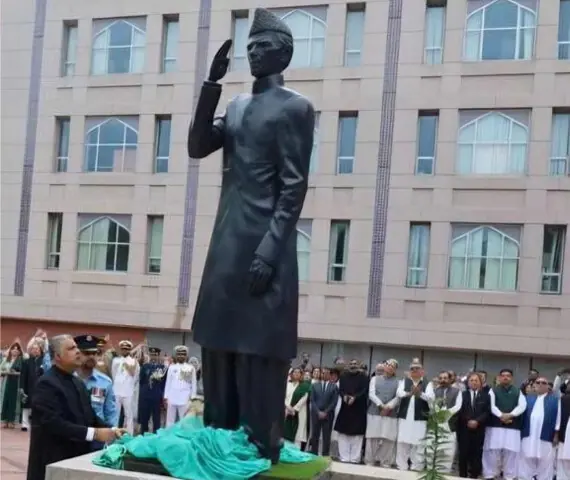 AMBASSADOR Rizwan Saeed Sheikh inaugurates the Quaid’s statue.—Courtesy Pakistan Embassy in Washington WASHINGTON: A statue of Quaid-i-Azam Mohammad Ali Jinnah was unveiled at the Pakistan Embassy in Washington on Friday, giving the country’s Independence Day celebrations a distinctly historical dimension and placing the founder of Pakistan at the centre of a ceremony that also highlighted the evolving Pakistan-United States relationship. Ambassador of Pakistan to the US Rizwan Saeed Sheikh unveiled the statue during an Independence Day ceremony attended by members of the Pakistani-American community, diplomats and media representatives. The statue, donated by the Quaid-i-Azam Foundation of Houston, will remain permanently at the embassy. Its unveiling comes as Pakistan prepares to mark Jinnah’s 150th birth anniversary later this year. Paying tribute to the founder, Ambassador Sheikh said the nation remained grateful to Mr Jinnah for his constitutional struggle and tireless efforts that turned the ide...
 -
Dawn - 03:29 Aug 16, 2026
HYDERABAD: The Federation of Pakistan Chambers of Commerce and Industry (FPCCI) has expressed concern over the sales tax hike on hybrid vehicles, from 8.5 per cent to 25pc, and warned that this short-sighted policy would hurt consumers and cripple the auto industry. In a statement issued on Saturday, Adeel Siddiqui, a member of the FPCCI Executive Committee, noted that tax concessions on hybrid vehicles expired on June 30 and with no new auto policy notified in time, the Federal Board of Revenue restored the general sales tax rate of 25pc on hybrid electric vehicles and plug-in hybrid vehicles. He said that this represented a massive increase from earlier preferential rates of 8.5pc for hybrids up to 1800cc and 12.75pc for those above 1800cc. So, he said, the auto industry was in chaos and automakers have temporarily halted production and stopped issuing invoices because they do not know which sales tax rate to apply. Calls for notifying new auto policy immediately He said that a production halt affected thou... -
Dawn - 03:25 Aug 16, 2026
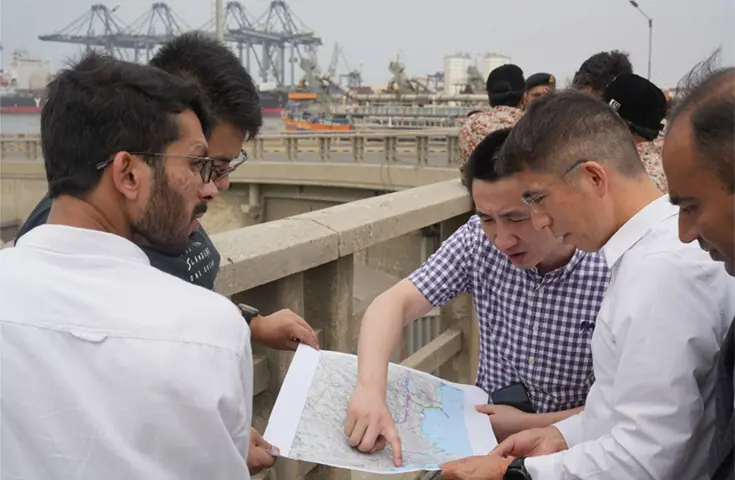 Officials from a mission of five multilateral international lenders survey the Karachi Railway Division, as it will be connected to ML-1.—Courtesy Railways • Phase-I covers 480km Karachi-Rohri railway section • Online market engagement with contractors, consultants set for Sept 8 • Project expected to take up to three years to complete LAHORE: Civil work on the $2.5 billion first phase of the Main Line-1 (ML-1) railway project is likely to begin in January 2027, as Pakistan Railways (PR) accelerates market consultations, pre-bid preparations and other processes required to meet the timeline set by Prime Minister Shehbaz Sharif. PR has announced an online early market engagement session for Sept 8, inviting local and international civil works contractors as well as project design and monitoring consultants to discuss project readiness, procurement progress and strategy, developments since March and other matters related to the first phase. “We are trying our level best to launch this project as early as possib...
 -
Dawn - 03:17 Aug 16, 2026
GILGIT: Climate change-induced shifts in weather patterns have worsened conditions on the peaks of the Karakoram Range in Gilgit-Baltistan, creating serious difficulties for mountaineers. No climber managed to summit the world’s second-highest mountain, K2 (8,611 metres), or Gasherbrum-I (8,080 metres), this summer. Around 40 foreign climbers also failed to reach the summits of Gasherbrum-II (8,035 metres), Broad Peak (8,047 metres) and Nanga Parbat (8,126 metres) this year. Persistent storms, heavy snowfall, unstable snow conditions and an exceptionally high avalanche risk created hurdles for climbers attempting to summit peaks in Gilgit-Baltistan, particularly five of the 14 eight-thousanders. No climber managed to summit K2, Gasherbrum-I this summer Expedition teams usually spend weeks at base camps assessing weather forecasts, fixing ropes and acclimatising before beginning their summit push. Mountaineers have experienced persistent bad weather, avalanches, rockfalls, strong winds and unpredictable condit... -
Dawn - 03:05 Aug 16, 2026
SEOUL: South Korean President Lee Jae Myung proposed talks with North Korea on Saturday to formally end the long-running Korean war, as Pyongyang deepens ties with Moscow while asserting its status as an “irreversible” nuclear state. The two Koreas remain technically at war because their 1950-53 conflict ended with an armistice rather than a peace treaty. Lee made the proposal in his speech at a ceremony marking the anniversary of Korea’s liberation from Japan’s 1910-45 colonial rule. “Let us put down our intention to threaten each other and begin discussions to end the long-running war as the directly involved parties,” Lee said in his speech. Two countries are still at war since their 1950s confrontation ended without a peace treaty “Through this, it may also be possible to discuss effective measures to halt the advancement of North Korea’s nuclear capabilities,” he added. Lee’s proposal came as North Korea this week denounced upcoming annual US-South Korean military drills, warning of stronger deterrence m... -
Dawn - 02:57 Aug 16, 2026
• Several others injured as three hideouts targeted in Shor Pard • Search underway for those who escaped QUETTA: Security forces killed 10 terrorists and injured many others in an intelligence-based operation in Shor Pard area of Khuzdar district on Saturday. During the operation, security forces cordoned off and engaged multiple terrorist hideouts. According to security sources, the terrorists were operating in three separate groups, leading to an intense exchange of fire with the security forces. “As a result of the operation, 10 terrorists were killed, while several others sustained injuries,” security sources said. They said that following the engagement, security forces launched an extensive search and clearance operation across the surrounding area. Efforts were underway to track down the terrorists who managed to escape. Security forces have reaffirmed their determination to continue targeted operations against terrorist elements and to eliminate the threat of terrorism from the region. They pledged t... -
Dawn - 02:25 Aug 16, 2026
• Federal minister Aleem Khan, Sindh governor to meet goods transporters in Karachi • Security authorities join efforts to help break deadlock ISLAMABAD: With congestion beginning to build at the ports due to a pile-up of containers, the eight-day strike by truckers and edible oil tankers could end on Sunday (today) following a crucial round of talks at Governor House in Karachi between senior federal and provincial government officials and representatives of the transporters. Sources in the federal government told Dawn that the prolonged disruption and its impact on trade had prompted official efforts to resolve the dispute, with security authorities also becoming involved in attempts to break the deadlock. “The concerns of the striking truckers and edible oil tankers are genuine, but the government too has its procedural limitations,” a senior official said, adding that the transporters were seeking a strong guarantor regarding implementation of any agreement. Communications Minister Abdul Aleem Khan, who w...