Bangladesh | Pakistan
"Bangladesh" in Pakistan feed
-
Dawn - 13:49 Feb 12, 2026
The World Health Organisation has said the risk of the deadly Nipah virus spreading was low after three cases of infection were recently confirmed in India and Bangladesh. Nipah, which spreads from animals to humans, has no vaccine and a fatality rate ranging from 40 to 75 per cent, according to the UN health body. “In the past few weeks, three cases of Nipah — two in India and one in Bangladesh — made headlines and caused concern about a wider outbreak,” WHO chief Tedros Adhanom Ghebreyesus told a press conference in Geneva on Wednesday. WHO assessed the risk of spread of the Nipah virus regionally and globally and found it low, he added. Two cases of Nipah were confirmed last month in India’s West Bengal state, while one patient died in Bangladesh last week after contracting the virus. “The two outbreaks were not related, although both occurred along the India-Bangladesh border, and share some of the same ecological and cultural conditions, as well as populations of the species of fruit bat that are known t... -
Dawn - 12:35 Feb 10, 2026
Pakistan Cricket Board (PCB) Chairman Mohsin Naqvi on Tuesday said in the context of his recent engagements with Bangladesh Cricket Board (BCB) and International Cricket Council (ICC) officials that the purpose was to “get respect for Bangladesh”. Naqvi said this while speaking to the media in Peshawar, a day after the government announced it was withdrawing its decision to boycott the group-stage match against India in the T20 World Cup, scheduled for February 15. The development followed protracted negotiations between the ICC, the cricket boards of Pakistan and Bangladesh, consultations among national leaders and interventions by friendly nations such as Sri Lanka and the United Arab Emirates. The now-withdrawn decision to boycott the match against arch-rival India was announced by the government on February 1 after Bangladesh were replaced by Scotland in the tournament, following their refusal to tour India over safety concerns in the wake of soured political relations between the Asian neighbours. The ma... -
Dawn - 04:52 Feb 08, 2026
LAHORE: Bangladesh has expressed keen interest in procuring freight wagons and passenger coaches after Pakistan offered the rolling stock at prices cheaper than those in other countries. A two-member delegation, headed by a senior Bangladeshi official, has also visited the Pakistan Railways (PR) carriage factory in Islamabad and the Mughalpura Workshop in Lahore to receive a briefing from the railway authorities and to witness the rolling stock manufacturing process, Dawn has learnt. According to the Lahore-based PR authorities, Mr Farhad Islam, Bangladesh’s Secretary for International Organisations and Consular Affairs and Designate D-8 Commissioner and Mohammad Iqbal Hussain Khan, High Commissioner of Bangladesh to Pakistan, visited the Mughalpura workshop on Friday. Muhammad Nasir Khalili, Chief Mechanical Engineer (Carriage and Wagons), briefed the delegation on the overall functioning, technical capabilities, and ongoing projects of the PR’s workshops. A short documentary highlighting the workshops’ oper... -
Dawn - 06:44 Feb 07, 2026
The World Health Organization said on Friday that a woman had died in northern Bangladesh in January after contracting the deadly Nipah virus infection. The case in Bangladesh, where Nipah cases are reported almost every year, follows two Nipah virus cases identified in neighbouring India, which has already prompted stepped-up airport screenings across Asia. The patient in Bangladesh, aged between 40 and 50 years, developed symptoms consistent with Nipah virus on January 21, including fever and headache followed by hypersalivation, disorientation and convulsion, the WHO added. She died a week later and was confirmed to be infected with the virus a day later. The person had no travel history but had a history of consuming raw date palm sap. All 35 people who had contact with the patient are being monitored and have tested negative for the virus, and no further cases have been detected to date, the WHO said. Nipah is an infection that spreads mainly through products contaminated by infected bats, such as fruit.... -
Dawn - 10:26 Feb 05, 2026
Pakistan Super League (PSL) franchise Lahore Qalandars announced on Thursday that it had directly signed Bangladesh pacer Mustafizur Rahman for PSL’s 11th edition, spending over Rs60 million. “Our Bangladeshi brother, Mustafizur, picked in 2016 and 2018, is now our direct signing and finally back with the family. Once a Qalandar, always a Qalandar. “Amount spent on DS: PKR6.44 crore,” the announcement on Lahore Qalandar’s X account said. Mustafizur had registered for the PSL in early January, following his release from the Kolkata Knight Riders (KKR) squad for the Indian Premier League (IPL). The 30-year-old left-arm pacer, known for his variations and death-over bowling, was acquired by KKR for INR 9.20 crore in the IPL mini-auction held in December. He was the only Bangladesh player signed for the season. KKR announced his release after receiving instructions from the Board of Control for Cricket in India (BCCI). The decision came amid strained relations between India and Bangladesh, linked to reports of a... -
The Nation - National - 17:37 Jan 29, 2026
Direct air travel between Pakistan and Bangladesh is set to resume today after a 14-year hiatus, marking a major step forward in bilateral relations between the two countries. -
Dawn - 10:43 Jan 26, 2026
A Bangladesh court on Monday sentenced Dhaka’s fugitive former police chief and two senior colleagues to be hanged for crimes against humanity committed during the rule of ousted prime minister Sheikh Hasina. All three, including the capital’s former police chief, Habibur Rahman, were tried in absentia, and their whereabouts are not known. The verdict comes ahead of elections on February 12, the first in the South Asian country of 170 million people since Hasina’s overthrow in August 2024. Five other ex-police officers were sentenced to varying terms. The case concerned the killing of six protesters in Dhaka on August 5, 2024, the day Hasina fled to India as protesters stormed her palace. Up to 1,400 people were killed between July and August 2024 when Hasina’s government launched a brutal campaign to silence the protesters, according to the United Nations. “The police forces… opened fire with lethal weapons… causing death to the aforesaid six persons,” judge Golam Mortuza Mozumder read to the court in Dhaka.... -
Dawn - 10:08 Jan 25, 2026
The absence of Bangladesh from next month’s T20 World Cup is a sad moment for the game and should serve as a call for stakeholders to work towards uniting the sport, not dividing it, the International Cricketers’ Association said on Sunday. Bangladesh were replaced by Scotland in the 20-team showpiece on Saturday following their refusal to tour India over safety concerns in the wake of soured political relations between the Asian neighbours. The governing International Cricket Council (ICC) rejected Bangladesh’s request to move their matches to tournament co-host Sri Lanka, saying it was not feasible to change the schedule so close to the February 7 start of the tournament. “The withdrawal of Bangladesh from the T20 World Cup, and resulting absence of a valued cricketing nation from cricket’s pinnacle international T20 event, is a sad moment for our sport, the Bangladesh players and fans, and one that requires deep reflection,” World Cricketers’ Association (WCA) Chief Executive Tom Moffat said in a statement... -
The Nation - National - 09:04 Jan 25, 2026
Deputy Prime Minister and Foreign Minister Ishaq Dar on Saturday held a telephone conversation with Bangladesh’s Foreign Minister Mohammad Touhid Hossain, during which both sides reaffirmed their commitment to enhancing bilateral cooperation. -
Dawn - 18:20 Jan 24, 2026
The International Cricket Council (ICC) on Saturday announced that Scotland would replace Bangladesh at the T20 World Cup, which is scheduled to be held in India next month. Bangladesh had announced on Jan 4 that it would not play its T20 World Cup matches in India after its player Mustafizur Rahman was released by his Indian Premier League (IPL) team amid growing tensions between the two countries. Subsequently, Bangladesh had “formally requested” the ICC to shift their games to Sri Lanka, which the council had rejected. However, Bangladesh had insisted it would not travel to India for the tournament. In the statement posted on its website on Saturday, the ICC stated that the decision was made in the absence of “any credible or verifiable security threat” to the Bangladesh national team in India. “Scotland has been called up to take Bangladesh’s place in Group C, joining England, Italy, Nepal and the West Indies,” the ICC announced. The ICC noted that Scotland, ranked the 14th-highest T20 team in the world, ... -
Dawn - 13:32 Jan 22, 2026
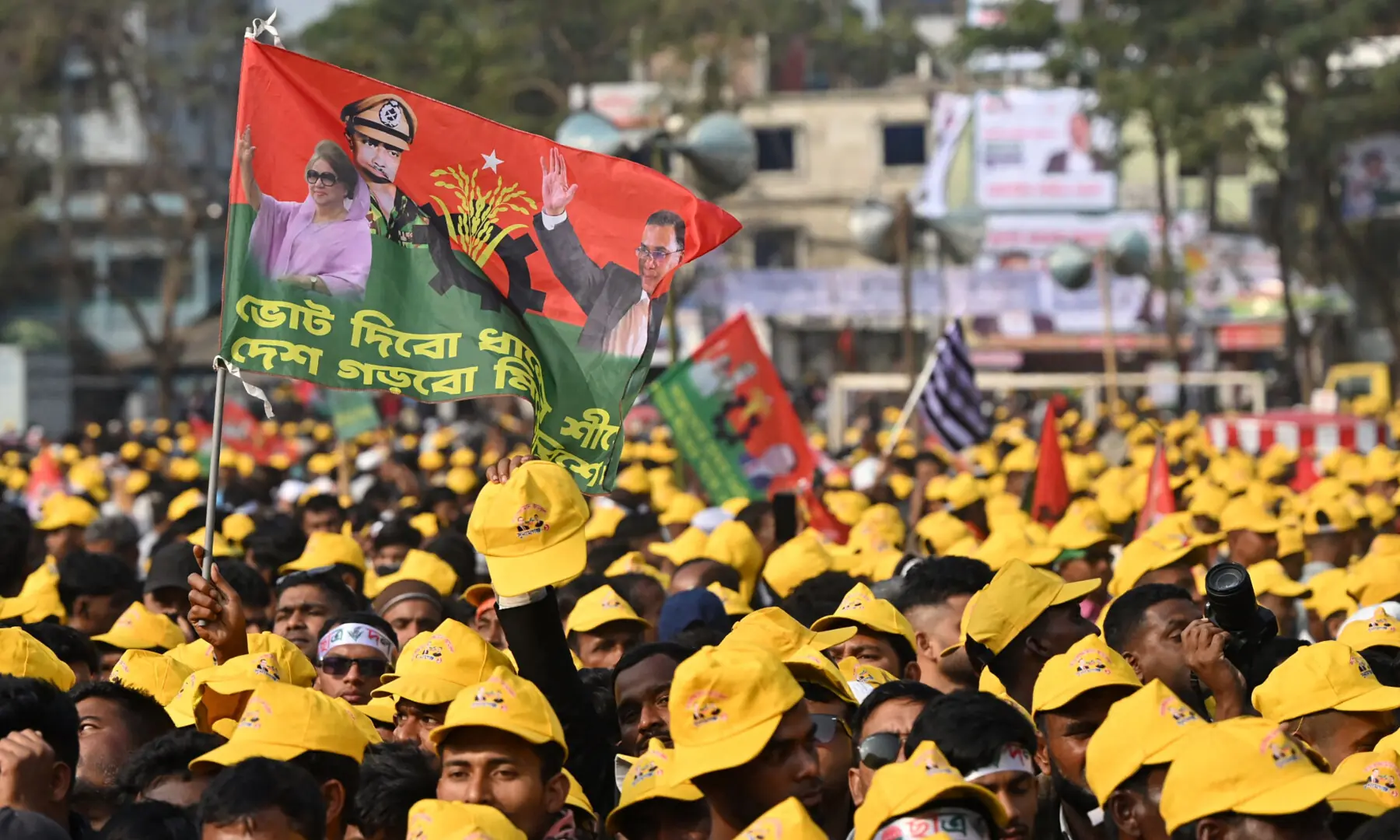 Bangladesh began official campaigning on Thursday for the hugely anticipated general elections next month, the first since the 2024 uprising ended the autocratic rule of Sheikh Hasina. Tens of thousands of flag-waving supporters of key frontrunner Tarique Rahman of the Bangladesh Nationalist Party (BNP) crowded the streets of the northern city of Sylhet, chanting his name. “We have liberated the country from autocratic rule,” prime ministerial hopeful Rahman, who returned to Bangladesh in December after 17 years in exile, told crowds of BNP loyalists. “Now we must establish the rights of the people.” Rahman vowed to create jobs for “millions of unemployed youth” and support women’s economic independence. “Do we have a leader? Yes, we do,” BNP loyalists shouted, carrying placards of Rahman. Bangladesh Nationalist Party (BNP) supporters gather for a rally ahead of the upcoming national election, in Sylhet on Jan 22, 2026. — AFP Key rival Jamaat-i-Islami began its campaign in the capital Dhaka, after being crush...
 -
Dawn - 12:49 Jan 22, 2026
Bangladesh will not travel to India to play in next month’s T20 World Cup, its cricket board said on Thursday, effectively ruling the country out of the tournament. According to ESPN Cricinfo, the decision was announced after a meeting in Dhaka between Bangladesh Cricket Board (BCB) President Aminul Islam Bulbul, CEO Nizamuddin, Sports Adviser Asif Nazrul and several national team players. “Our only demand is to play the World Cup – but not in India,” the BCB president told reporters. The International Cricket Council (ICC) announced that it would not be making any changes to the World Cup schedule or groups, days after Bangladesh requested that its matches be moved to Sri Lanka after refusing to play in India. “We will go back to the ICC with our plan to play in Sri Lanka,” the BCB president said. “They did give us a 24-hour ultimatum but a global body can’t really do that. ICC will miss out on 200 million people watching the World Cup (if Bangladesh is axed). It will be their loss…” “Bangladesh is a cricket... -
Dawn - 15:23 Jan 21, 2026
The International Cricket Council (ICC) on Wednesday announced that it would not be making any changes to the Men’s T20 World Cup schedule or groups, days after Bangladesh requested that its matches be moved to Sri Lanka after refusing to play in India. Bangladesh announced on Jan 4 that it would not play its T20 World Cup matches in India after its player Mustafizur Rahman was released by his Indian Premier League (IPL) team amid growing tensions between the two countries. Subsequently, Bangladesh had “formally requested” the ICC to shift their games to Sri Lanka. The T20 World Cup begins on February 7 with Bangladesh in England’s Group C. The team is scheduled to play all of their group matches in Kolkata and Mumbai. In a statement issued on Wednesday, the ICC said the decision was reached after “considering all security assessments conducted, including independent reviews, all of which indicated there was no threat to Bangladesh players, media persons, officials and fans at any tournament venues in the cou... -
Dawn - 06:46 Jan 21, 2026
India will withdraw its diplomats’ families and dependents from Bangladesh in the face of security threats as tension rises ahead of a February 12 general election, an Indian official said on Wednesday. Campaigning begins on Thursday for Bangladesh’s election, which has sparked protests and counter-protests. Ties between the South Asian neighbours soured after former prime minister Sheikh Hasina fled to India in 2024, following deadly protests. India’s past support for Hasina has frayed relations between the two neighbours since her overthrow. India’s withdrawal move was part of “internal readjustments”, the official said, without elaborating. The official, who spoke on condition of anonymity, pointed to Indian media reports of New Delhi’s decision. It was not immediately clear when the families would return. The foreign ministries of India and Bangladesh did not immediately respond to requests for comment. In December, India summoned Bangladesh’s high commissioner, or ambassador to voice its concern over wha... -
Dawn - 17:27 Jan 17, 2026
U-19 World Cup: No handshake between India and Bangladesh at toss but players shake hands after game
The captains of India and Bangladesh skipped the customary handshake during the toss of their U-19 World Cup match but the two sides did shake hands at the end of the game, which the former won. At the toss, Bangladesh’s acting captain Zawad Abrar and India’s captain Ayush Mhatre did not do the customary handshake at the pre-match toss, which the former won. “There were, however, handshakes between the teams at the end of the game, which India won by 18 runs (DLS method),” ESPN Cricinfo reported. The report also quoted a statement from the Bangladesh Cricket Board (BCB) as saying that the “absence of a handshake with the opposition captain was completely unintentional and resulted from a momentary lapse in concentration”. “There was no intent whatsoever to show discourtesy or disregard towards the opposition,” the report quoted the BCB as saying in a statement. “The board has viewed the matter with due seriousness, as upholding the spirit of cricket and respect for opponents is a fundamental prerequisite for ... -
Dawn - 12:33 Jan 13, 2026
Bangladesh’s cricket board said on Tuesday it had repeated its refusal to travel to India for next month’s T20 World Cup during talks with the International Cricket Council (ICC). Bangladesh announced on Jan 4 that it would not play its T20 World Cup matches in India after its player Mustafizur Rahman was released by his Indian Premier League (IPL) team amid growing tensions between the two countries. Subsequently, Bangladesh “formally requested” the ICC to shift their games to Sri Lanka. The World Cup begins on February 7, with Bangladesh scheduled to play their four group matches in India. On Tuesday, during a video conference with the ICC, the Bangladesh Cricket Board (BCB) said it had “reiterated its request for the ICC to consider relocating Bangladesh’s matches outside India”. “The BCB reaffirmed its position regarding the decision not to travel to India, citing security concerns,” the board said in a statement. “While the ICC highlighted that the tournament itinerary has already been announced and requ... -
Dawn - 05:46 Jan 09, 2026
The visa sections of three Bangladesh missions in India have been closed temporarily on security grounds, Foreign Affairs Adviser Touhid Hossain said on Friday. “What I have done is that I have asked our three missions to keep their visa sections closed for the time being. It’s a security issue,” he told reporters at the foreign ministry, responding to a question on whether Bangladesh missions in India had restricted tourist visas for Indians. He did not name the missions. However, diplomatic sources said the visa sections of the Bangladesh High Commission in New Delhi, the Deputy High Commission in Kolkata, and the Bangladesh Assistant High Commission in Agartala have been closed. The visa sections at Bangladesh missions in Chennai and Mumbai, however, remain operational, sources said. Over the past few weeks, protests have taken place near Bangladesh missions in India. Following the ouster of the Awami League regime, the Indian High Commission restricted tourist visas to Bangladeshis, citing security concer... -
Dawn - 15:31 Jan 08, 2026
Bangladesh air chief discusses enhancing defence cooperation in meetings with CDF Munir, naval chief
The air chief of Bangladesh on Thursday discussed avenues for enhancing defence cooperation with Pakistan in separate meetings with Chief of Defence Forces (CDF) and Chief of the Army Staff (COAS) Field Marshal Asim Munir, and Chief of the Naval Staff Admiral Naveed Ashraf. Bangladesh Air Force Air Chief Marshal (ACM) Hasan Mahmood Khan called on CDF Munir at the General Headquarters (GHQ) in Rawalpindi, the Inter-Services Public Relations (ISPR) said in a press release. “During the meeting, matters of mutual interest, regional security dynamics and avenues for enhancing bilateral defence and military cooperation were discussed,” the statement read. “Both sides underscored the importance of strengthening professional collaboration, training exchanges and defence ties between the Armed Forces of Pakistan and Bangladesh.” According to the ISPR, ACM Khan lauded the “professionalism of Pakistan Armed Forces and appreciated their contributions towards regional peace and stability”. CDF Munir reiterated Pakistan’s ... -
The Nation - National - 07:59 Jan 08, 2026
Bangladesh and Pakistan are set to resume direct flights after more than ten years, signaling warming ties between the two countries, Dhaka’s national carrier Biman Bangladesh Airlines announced on Thursday. -
Dawn - 11:58 Jan 07, 2026
Bangladesh cricket said on Wednesday it was in talks with the International Cricket Council (ICC) for a “practical” solution to its request to move its T20 World Cup matches out of India. India forced Bangladesh fast bowler Mustafizur Rahman to quit the Indian Premier League (IPL) on Saturday, prompting anger in Dhaka. With ties tense between the two countries, Bangladesh wants the ICC to shift their World Cup games from India to co-hosts Sri Lanka, citing security concerns. The World Cup begins on February 7 and Bangladesh are scheduled to play their four group matches in India. Senior Bangladesh Cricket Board (BCB) official Nazmul Abedeen Fahim told AFP today that talks were ongoing with the ICC “regarding security issues”. A BCB statement said it would “continue constructive engagement with the ICC and relevant event authorities”, seeking an “affable and practical solution that ensures the smooth and successful participation of the team”. The BCB said it was “firmly committed to placing the highest priorit...