Dawn
Source:
https://www.dawn.com
Found 12682 news
-
Dawn - 18:47 Feb 18, 2026
ISLAMABAD: The Pakistan Telecommunication Authority (PTA) said on Wednesday that 5G spectrum auction would be held on March 10 and no changes were likely to be made in the schedule, saying that the sale was likely to fetch between $300-$700 million. The authority is offering 597 megahertz (MHz) in several bands in the upcoming auction and three existing telecom operators have been mandated to obtain a minimum of 100 MHz in the auction process. “With the prescribed rate, even if 300 MHz is obtained by the telecommunication operators without any competitive bidding, the government will get $300 million,” PTA Director General Licensing retired brigadier Aamir Shahzad told a media briefing. “And if all the 597 MHz is sold at auction at a slightly competitive rate, $700 million will be available for the government, but this scenario is less likely to happen,” he added. Shahzad said that the auction would be conducted using a multi-round electronic clock auction format, with the main allocation stage starting on Ma... -
Dawn - 18:43 Feb 18, 2026
Ahead of inaugural Board of Peace meeting, Asif says recognition of Israel ‘not on the cards at all’
Defence Minister Khawaja Asif said on Wednesday that recognition of Israel by Pakistan was “not on the cards at all” as he highlighted the country’s support for the Palestinian cause. The minister made the remarks in an interview with France 24. The comments come as the inaugural meeting of the Board of Peace, led by US President Donald Trump, will be held in Washington on February 19. Prime Minister Shehbaz Sharif and Deputy Prime Minister Ishaq Dar will be attending the meeting. In the interview, Asif was asked about Pakistan’s decision to join the Board of Peace and if the country would contribute troops for a military force in Gaza. “I don’t see any problem in that. It all depends on what sort of terms of reference are drafted for that peace force,” he said, highlighting that Pakistan was a part of UN peacekeeping missions. “So we have that experience. Palestine is a cause that is very close to our hearts. We have been demonstrating solidarity with them for many, many, many decades,” he said. He said that... -
Dawn - 17:11 Feb 18, 2026
Punjab Information Minister Azma Bokhari on Wednesday said that the Basant festival, which was revived by the provincial government earlier this month in Lahore after an 18-year hiatus, would now be celebrated in February 2027. “I want to state categorically … that Basant will be celebrated in February 2027. No suggestion for celebrating it before that is under consideration,” she said in a video message posted by the Punjab government’s official account on X. She also noted that people in a couple of cities had celebrated the festival over the last few days. “We did not give a harsh reaction at that as there were no losses reported,” Bokhari added. The Punjab minister highlighted people’s “excitement” for the festival and said she shared the same sentiment. Bokhari reiterated that the Basant would be celebrated in February 2027 and would be “bigger and better than the one held this year”. The three-day Basant festival was celebrated in Lahore from February 6-8, following the Punjab government’s decision to l... -
Dawn - 16:22 Feb 18, 2026
Shadab Khan said Pakistan believed they could go on and win the T20 World Cup after their best performance of the tournament secured the last Super Eights berth on Wednesday. Pakistan bowled out Namibia for 97 to win by a colossal 102 runs in Colombo and bounce back in style after a defeat to arch-rivals India had left them in danger of elimination. Pakistan rode on an undefeated maiden T20 international century by opener Sahibzada Farhan to post 199-3. Spinners Usman Tariq and Shadab Khan then shared seven wickets to rout Namibia in 17.3 overs. “We didn’t take this game lightly after so much talk about one match against India,” said Shadab, who scored a brisk 22-ball 36 and grabbed 3-19. “We are on the right track to achieve the goal of winning the World Cup and we are following a process,” he added. Shadab warned that the Super Eights, which Pakistan will begin with a match against New Zealand in Colombo on Saturday before facing England and co-hosts Sri Lanka next week, will be a step up. “There are eight ... -
Dawn - 15:58 Feb 18, 2026
The Central Ruet-i-Hilal Committee announced on Wednesday that the Ramazan moon was sighted, and the holy month would begin in Pakistan on Thursday (February 19). The announcement was made by committee chairman, Maulana Abdul Khabir Azad, as it met in Peshawar for the moon sighting. Speaking to the media after the meeting, Azad said that the skies were clear in some areas and cloudy in others. He said that testimonies were received from several parts of the country, including Quetta, Islamabad, Waziristan, Dir, Karachi, Buner, Mardan and Tando Allahyar. “Therefore, it was decided with consensus that the first day of Ramazan would be on Thursday,” he said. Separately, according to the Daily Star, the crescent moon was sighted in Bangladesh, while The Hindu reported that it was also spotted in India. Saudi Arabia, Oman, Qatar, the United Arab Emirates and Afghanistan observed their first day of fasting on Wednesday after the crescent moon was sighted on Tuesday night. Prime Minister Shehbaz Sharif extended “hea... -
Dawn - 15:43 Feb 18, 2026
United Arab Emirates (UAE) President Mohamed bin Zayed Al Nahyan has appeared in a meeting with US Senator Lindsey Graham for the first time after rumours about his health spread following a now-deleted Turkish presidency statement. Earlier this month, Turkiye’s President Recep Tayyip Erdogan went to Saudi Arabia and was meant to later visit the neighbouring United Arab Emirates, amid an ongoing rift between the two Gulf powers. But on Sunday, Erdogan said he was postponing his Abu Dhabi trip because the Emirati leader had a “health problem” — in a statement that was later deleted. The incident fuelled rumours online about Sheikh Mohamed’s health, with his Wikipedia page even briefly being edited to say he had died. On Wednesday, the presidential court shared video footage of the Emirati president, smiling alongside powerful US Republican Senator Lindsey Graham during a meeting at Qasr Al Shati in Abu Dhabi. The UAE’s official WAM news agency also shared photographs of the meeting, in which Sheikh Mohamed app... -
Dawn - 15:03 Feb 18, 2026
ISLAMABAD: The Supreme Court on Wednesday granted journalist Sohrab Barkat post-arrest bail against surety bonds worth Rs200,000 in a case registered under the Prevention of Electronic Crimes Act (Peca). The case against Barkat has been registered over accusations of spreading misinformation about state institutions during an interview he conducted. A two-member bench headed by Justice Naeem Akhtar Afghan and including Justice Miangul Hassan Aurangzeb took up Barkat’s bail petition in the case, which was filed against a January 21 order of the Lahore High Court (LHC) that had rejected the journalist’s previous bail plea. The petition was moved by Advocate Saad Rasool on Barkat’s behalf with the latter currently imprisoned at Kot Lakhpat jail in Lahore. During the hearing on Thursday, Deputy Attorney General Raja Muhammad Shafqat Abbasi contended that the charges levelled against Barkat entailed 10 years’ imprisonment. Justice Afghan, however, observed that the court even granted bail to those facing charges u... -
Dawn - 14:46 Feb 18, 2026
ISLAMABAD: The Islamabad High Court (IHC) on Wednesday fixed for hearing the appeals of human rights lawyer advocate Imaan Mazari and her husband Hadi Ali Chattha against their conviction in the controversial social media posts case. According to the cause list issued by the registrar’s office, IHC’s Justice Muhammad Asif will take up the appeals on Thursday (February 19). The court also scheduled for hearing applications seeking the suspension of sentences awarded to the two lawyers. Last month, Imaan and Hadi were handed a total of 17 years in jail on multiple charges under the Prevention of Electronic Crimes Act (Peca) by a sessions court in Islamabad, sparking outrage among rights groups, opposition parties, and other segments of society. The written order by Additional District and Sessions Judge Muhammad Afzal Majoka said the prosecution had proved its case against Imaan and Hadi under Sections 9 (glorification of an offence), 10 (cyberterrorism) and 26-A (false information) of Peca. Under Section 9 of... -
Dawn - 14:10 Feb 18, 2026
The power and petroleum ministers on Wednesday assured the nation that there would be no electricity and gas loadshedding during Sehr and Iftar throughout the month of Ramazan. Addressing a joint press conference alongside Petroleum Minister Ali Pervaiz Malik, Power Minister Awais Leghari said, “We have decided that there will be absolutely no loadshedding in any area — unless there is a huge fault God forbid — during the timings of Sehr and Iftar. “Even economic loadshedding in areas with high-loss feeders will be restricted at the time of Sehr and Iftar,” he added. Leghari noted that it was Prime Minister Shehbaz Sharif’s wish that those fasting were provided with utility services in a proper and timely manner so they “do not face any issues”. Meanwhile, Malik stated that “complete arrangements” had been made to ensure the supply of gas “with maximum pressure from 3am to 10:30pm, especially during Sehr and Iftar”. Leghari affirmed that it would be ensured that “there is no suspension of electricity during t... -
Dawn - 13:17 Feb 18, 2026
An Indian university has been asked to vacate its stall at the country’s flagship artificial intelligence (AI) summit after a staff member was caught presenting a commercially available robotic dog made in China as its own creation, two government sources said. “You need to meet Orion. This has been developed by the Centre of Excellence at Galgotias University,” Neha Singh, a professor of communications, told state-run broadcaster DD News this week in remarks that have since gone viral. But social media users quickly identified the robot as the Unitree Go2, sold by China’s Unitree Robotics for about $2,800 and widely used in research and education globally. The episode has drawn sharp criticism and has cast an uncomfortable spotlight on India’s artificial intelligence ambitions. The embarrassment was amplified by IT Minister Ashwini Vaishnaw, who shared the video clip on his official social media account before the backlash. The post was later deleted. The stall remained open to visitors as of Wednesday morni... -
Dawn - 12:38 Feb 18, 2026
Google will build new subsea cables from its planned artificial intelligence (AI) hub in India and other locations, the US company announced on Wednesday, as New Delhi hosts a major artificial intelligence summit. Global tech giants are racing to unveil deals and investments in the country this week, as world leaders and top industry figures gather to discuss the opportunities and challenges that AI poses. Google’s announcement follows its October commitment to spend $15 billion over five years to construct its largest AI infrastructure hub outside the United States, in Visakhapatnam, an Indian port city in the southeastern state of Andhra Pradesh, also known as Vizag. The US giant said it would build “three subsea paths connecting India to Singapore, South Africa, and Australia”. It will also create “four strategic fiber-optic routes that bolster network resilience and capacity between the United States, India, and multiple locations across the Southern Hemisphere”. These would include a direct cable connect... -
Dawn - 12:31 Feb 18, 2026
KARACHI: A large number of people gathered outside the Karachi Press Club on Wednesday to protest the killing of a man during an alleged encounter by the Counter Terrorism Department (CTD) a day earlier, alleging that the deceased was a student who was earlier arrested by law enforcers. On Tuesday, the CTD said that officials had conducted a raid on a house in Shah Latif Town on a terrorist hideout. According to the department, the men inside the house opened fire on officials, who then retaliated, leading to the deaths of four suspects. The CTD said the suspects belonged to the Bashir Zeb network of Fitna al-Hindustan, a term used by the state for Balochistan-based terrorist groups. However, on Wednesday afternoon, a large number of residents of Old Golimar, including women and children, protested and staged a sit-in outside the KPC, demanding justice for Hamdan, one of the killed suspects identified by the CTD. The deceased’s father, Mohammed Ali said that on December 29, 2025, his son Hamdan was allegedly ... -
Dawn - 11:52 Feb 18, 2026
The United States will deter Iran from acquiring nuclear weapons “one way or the other”, US Energy Secretary Chris Wright warned on Wednesday. US President Donald Trump “believes firmly we cannot have a nuclear-armed Iran,” Wright told reporters in Paris on the sidelines of meetings of the International Energy Agency. “They’ve been very clear about what they would do with nuclear weapons. It’s entirely unacceptable,” Wright said. “So one way or the other, we are going to end, deter Iran’s march towards a nuclear weapon,” he added. US and Iranian officials held talks in Geneva on Tuesday aimed at averting the possibility of US military intervention to curb Tehran’s nuclear programme. Iran said following the talks that they had agreed on “guiding principles” for a deal to avoid conflict. US Vice President JD Vance, however, said Tehran had not yet acknowledged all of Washington’s red lines. -
Dawn - 11:09 Feb 18, 2026
Bangladesh’s Prime Minister Tarique Rahman has named a former commerce minister to steer the country’s troubled economy and kept the defence portfolio for himself as he formed his first cabinet. Rahman was sworn into office on Tuesday after a landslide election victory, taking over from the interim administration that had led the country of 170 million people since a deadly 2024 uprising that toppled the autocratic government of Sheikh Hasina. The 50-member cabinet announced in a gazette notification issued late Tuesday includes Amir Khasru Mahmud Chowdhury, 76, a businessman and veteran lawmaker who has now returned to the finance ministry. Chowdhury is tasked with reviving growth after months of turmoil that rattled investor confidence in the world’s second-largest garment exporter. He had previously served in the cabinet of Rahman’s late mother, three-time prime minister Khaleda Zia, but was forced to resign in 2004. According to media reports, his resignation came after he had granted permission for Taiwa... -
Dawn - 10:46 Feb 18, 2026
ISLAMABAD: The opposition alliance Tehreek-i-Tahafuz-i-Ayin-i-Pakistan (TTAP) announced on Wednesday it would end its days-long sit-in at Parliament House over ex-premier Imran Khan’s health concerns. However, it reiterated the demand being voiced by Imran’s family to grant the PTI founder access to his personal physicians and allow jail meetings with his relatives. Senate Opposition Leader Allama Raja Nasir Abbas — flanked by National Assembly counterpart Mehmood Khan Achakzai, PTI Chairman Gohar Ali Khan and PTI Secretary General Salman Akram Raja — addressed the media in Islamabad after a Supreme Court hearing concerning Imran’s cases. “Thanks to God, there is a minor improvement compared to the situation before, when the vision had gone completely — just a little bit,” Abbas told reporters. However, he criticised the government for “not taking on board” Imran’s family or personal doctors. The senator reiterated that Imran’s longtime physicians, Dr Aasim Yusuf and Dr Faisal Sultan, should be allowed to exa... -
Dawn - 10:25 Feb 18, 2026
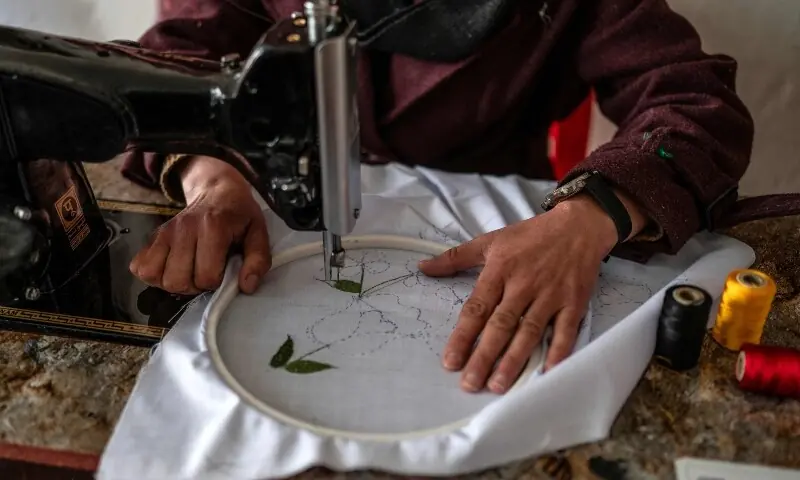 With women banned from most jobs in Afghanistan, an embroidery boutique run by 22-year-old Rahima Alavi is a surprising and treasured sight in Bamiyan. “Spring flowers, tailoring and embroidery,” reads a sign outside Alavi’s small store, which opened in January after a months-long search for work. “I really feel proud because I can support my family, my parents and three sisters. I can pay the rent,” said Alavi, who was wearing a burgundy coat that had a few pieces of leftover coloured thread stuck to it. This photograph taken on January 20, 2026 shows Afghan tailoress Rahima Alavi embroidering a scarf at her boutique in Bamiyan. —AFP Demonstrating her new skills, she guided material through her sewing machine to create delicate silk leaves and flowers. Alavi is one of more than five million people who have returned to the country since 2023 from Pakistan and Iran, which have been pushing back Afghans after hosting them for decades. Having grown up in rural Bamiyan province, where she helped her parents with ...
 -
Dawn - 08:33 Feb 18, 2026
LAHORE: A model criminal court (minor offences) on Wednesday issued a judgment in a domestic abuse case, convicting a man of assaulting his wife and mother-in-law. Judicial Magistrate Hamidul Rahman Nasir conducted the trial, which involved testimony from several witnesses, including the victims and police investigators. The incident took place on April 2, 2021, when a dispute erupted at the man’s residence in the jurisdiction of the Shafiqabad police station. According to the first information report (FIR), the conflict began when the man allegedly pressured his wife to seek employment against her wishes. When she refused, he and several of his family members reportedly began to beat her. Following a telephone call from the wife, her mother and brother arrived at the scene. The prosecution argued that during the ensuing confrontation, the man assaulted his mother-in-law, tearing her clothes and beating her until she lost consciousness. Neighbours eventually intervened to rescue the victims. The couple had be... -
Dawn - 07:58 Feb 18, 2026
QUETTA: The Balochistan Counter-Terrorism Department (CTD) on Wednesday said a total of 14 suspected militants were killed in separate security operations in Quetta and Barkhan districts. In a statement, the CTD said eight armed men were killed during a security operation in Quetta’s Darakhshan area. “Eight armed persons were killed in a fire exchange during the operation,” read the statement, adding that three CTD personnel were injured during the action. According to the CTD, weapons and ammunition were recovered from the killed miscreants. It noted that the dead individuals were said to be from a banned outfit. In a separate statement, the CTD said “six terrorists were killed in a fire exchange” during an intelligence-based operation in Barkhan. “All security personnel remained safe,” it stated, adding that arms and ammunition were recovered from the killed militants. “The terrorists were involved in the planning of disruptive actions,” the CTD said, reaffirming to continue its efforts to eliminate terrori... -
Dawn - 06:52 Feb 18, 2026
PESHAWAR: Two officials were martyred and two others injured when militants attacked Yarik police station and a customs office in Dera Ismail Khan on Wednesday, police said. According to officials, attackers opened fire with automatic weapons on the Yarik police station and a nearby customs office, located along the China-Pakistan Economic Corridor (CPEC) route. A police spokesperson said the officials martyred in the attack were customs official Israr Khan and police constable Mohammad Bilal. The injured, identified as Hazrat Umar and Khayal Mohammad, were shifted to the District Headquarters Hospital’s trauma centre, where they were undergoing treatment. Police said the attackers also fired at passenger buses travelling on the CPEC route, causing panic in the area. A customs vehicle was set ablaze during the assault. Security personnel returned fire, prompting the assailants to flee. A heavy police contingent reached the site soon after the incident, and a search operation was launched in the surrounding ar... -
Dawn - 05:37 Feb 18, 2026
Israeli police has arrested the imam of Al-Aqsa Mosque, Sheikh Mohammed al-Abbasi, from inside the mosque’s courtyards in occupied Jerusalem. The Palestinian news agency Wafa, citing local sources, reported that “Israeli forces detained Sheikh al-Abbasi inside the courtyards of Al-Aqsa Mosque“ on Monday evening without giving any reason. It added that the arrest “comes amid escalating Israeli measures against the blessed Al-Aqsa Mosque, including restrictions on imams, preachers and worshippers stationed there, limitations on the entry of worshippers, and intensifying incursions carried out by settlers under heavy protection from Israeli police”. Hamas condemned the arrest of al-Abbasi in a statement on Tuesday, saying he had been “served with an order banning him from the mosque”. The movement said the measure “constitutes blatant interference in the affairs of Al-Aqsa and an unacceptable assault on its imams”. Hamas added: “The escalating violations by the fascist occupation government against the sanctity ...
12682 items