Dawn
Source:
https://www.dawn.com
Found 12682 news
-
Dawn - 02:21 Jul 29, 2026
ISLAMABAD: The Federal Tax Ombudsman (FTO) has detected what it termed an organised scam involving the import and clearance of an iPhone 16 and directed the Federal Board of Revenue (FBR) to investigate the alleged role of FedEx, Customs officials and private individuals to determine whether similar frauds have occurred across the country. Federal Tax Ombudsman Zafar Hijazi in his order released on Tuesday observed that the case pointed to a coordinated scheme through which a lawful consignee was deprived of his duty-paid mobile phone for more than one-and-a-half years despite paying all applicable taxes. The complaint was filed by Muhammad Nausherwan Khan, who stated that his sister in Canada sent him an iPhone 16 Plus through FedEx in December 2024. After the handset arrived in Karachi, he paid the PTA tax of Rs138,526 but alleged that the phone was never delivered to him. He later discovered that a forged authority letter had allegedly been used to release the device to another person. During the proceedin... -
Dawn - 02:20 Jul 29, 2026
ISLAMABAD: The power division on Tuesday blamed the Ministry of Finance for a Rs61 billion increase in power sector circular debt, which rose to Rs1.675 trillion by June 30 this year from Rs1.614tr a year earlier. “Due to the budget deduction of Rs98bn, the circular debt witnessed an increase of Rs61bn” during FY2025-26, the power division said in a statement. It did not release the end-year financial report, which is pending regulatory and statutory approval. As such, the power sector circular debt, excluding K-Electric, concluded the fiscal year at Rs1.675tr. Under the International Monetary Fund programme, the government has committed to no increase in circular debt flow and a gradual reduction in its stock. The end-December 2025 target under the programme was met and appreciated by the IMF. The power division said a total of Rs893bn was allocated for the power sector in the federal budget for FY26. “However, a deduction of Rs98bn was subsequently made. Had the power sector received the full allocated budg... -
Dawn - 18:44 Jul 28, 2026
FIFA said Tuesday it plans to sell a stake in the business operations of the World Cup and its other competitions through the creation of a semi-private subsidiary. World football’s governing body said it would retain a majority share in FIFA Forward Enterprise (FFE) but hoped to raise $4.2 billion later this year by “carefully selecting long-term investors who will purchase minority, non-controlling interests”. FIFA’s statement was a rapid response to a story in British newspaper The Times based on leaks of the plan from two sources. The Times reported that FIFA president Gianni Infantino, 56, stood to profit from the scheme by becoming commissioner of the FFE after his expected next term expires in 2031. The article also said discussion had started with potential investors. It named Joshua Kushner, brother of US President Donald Trump’s son-in-law Jared, as well as an arm of JP Morgan Chase, the US bank that attempted to finance the failed breakaway European Super League. European football’s governing body ... -
Dawn - 18:31 Jul 28, 2026
A specially modified Airbus A350 plane touched down in France on Tuesday after a record 24-hour test flight from Australia, ahead of its joining Qantas’s fleet next year. Its 23,076-kilometre journey — across three continents and two oceans, and through two sunsets and two dawns — was one of the most-watched flights shown on the Flightradar24 tracking site. It was also a crucial step before Australian airline Qantas receives its first A350-1000ULR in April next year, to be followed by 11 others for services able to link Australia non-stop to destinations in the United States and Europe. The ULR in its designation stands for “ultra long distance”, a feat made possible by an additional 20,000-litre rear centre fuel tank being fitted to Airbus’s A350-1000 model. The flight from Australia to France took precisely 24 hours and 24 minutes. On its outbound flight last week, from Toulouse to Melbourne, the test aircraft flew 17,000 kilometres in 19 hours and 12 minutes. The return trip simulated a trajectory the plan... -
Dawn - 17:59 Jul 28, 2026
The government on Tuesday increased the price of petrol by Rs1.63 and increased the price of high-speed diesel (HSD) by Rs1.55 per litre, respectively, passing on the impact of fluctuating global oil prices following renewed hostilities in the Persian Gulf. Following the changes, the price of petrol stands at Rs335.81 per litre, while that of HSD stands at Rs388.38 per litre. The government is charging a total of Rs110 per litre in taxes and duties on petrol and Rs96 on diesel. The Petroleum Division’s notification said the new prices would be applicable for July 29 (Wednesday). The diesel price has come down from a peak of Rs520.35 recorded on April 3. Its price had started rising from Rs281 per litre after the US-Iran war broke out on February 28. The petrol price had peaked at Rs458.41 on April 3 after beginning its upward trajectory from Rs266 in the first week of March. Earlier, Petroleum Minister Ali Pervaiz Malik announced that fuel prices would now be fixed on a daily basis due to fluctuations in inte... -
Dawn - 17:47 Jul 28, 2026
KARACHI: Two suspected robbers were shot dead and a policeman was martyred in an encounter in Karachi’s Orangi Town early on Tuesday morning, according to police and rescue services officials. The senior superintendent of police (SSP) of District West, Tariq Illahi Mastoi, said that four police officials of District West were conducting routine motorcycle patrolling near Liaquat Chowk, within the limits of Pakistan Bazaar Police Station, when they encountered armed robbers. Upon seeing the police party, the suspects opened indiscriminate fire. The police retaliated in self-defence, resulting in an exchange of fire, he said. The SSP added that both armed suspects were killed during the exchange of fire. Two pistols along with ammunition, spent shell casings, and the motorcycle being used by the suspects were recovered from their possession. However, during the encounter, 26-year-old constable Hassan Ali sustained firearm injuries and was immediately taken to the hospital for medical treatment. “Despite the bes... -
Dawn - 17:42 Jul 28, 2026
Information Minister Attaullah Tarar on Tuesday, while referring to the recent violence in Azad Jammu and Kashmir (AJK), said the protests by the proscribed Joint Awami Action Committee (JAAC) were not peaceful but violent, alleging the involvement of militant elements pursuing a foreign agenda and backed by Indian funding. “Peaceful and transparent elections were held in AJK, with all the mainstream political parties participating fully. The people of Kashmir responded to the call of the election,” he stated, referring to the first phase of elections held in the region on Monday. In Rawalakot alone, a total of 600,000 votes were cast, making it a massive success, he said, adding that political parties held public rallies and conducted their election campaigns as usual. “The response from the people was spectacular.” However, he said, the banned outfit could not accept this political activity and the peaceful and transparent elections. He also referred to the press conference held earlier in the day by senior... -
Dawn - 17:40 Jul 28, 2026
 Israeli Prime Minister Benjamin Netanyahu visited the White House on Tuesday for his first in-person talks with President Donald Trump since the Iran war began, as the leaders sought to patch over public disagreements on the conflict. The meeting, which took place behind closed doors, was expected to be dominated by the war, which began with US and Israeli strikes on Iran in late February but has seen a recent pause in the fighting as Washington says it wants to give negotiations a chance. Israel has not taken part in the latest round of hostilities between the United States and Iran, which flared earlier this month as an April ceasefire collapsed. The talks — which the White House described as “positive and productive” — lasted for about an hour and a half. The meeting is the eighth between the leaders since Trump’s return to office in early 2025 and comes ahead of key electoral tests later this year for both Netanyahu and the US president: national elections in Israel and midterm polls in the United States....
 -
Dawn - 15:38 Jul 28, 2026
Coalition partners PPP, PML-N spar after first phase of AJK elections as political temperatures rise
The PPP and the PML-N, coalition partners in the Centre, traded barbs on Tuesday after the conclusion of the first phase of elections in Azad Jammu and Kashmir (AJK), with Bilawal Bhutto-Zardari’s party alleging rigging in the polls and Punjab Chief Minister Maryam Nawaz urging it to accept defeat. The PML-N grabbed nine out of the 13 constituencies of AJK’s Mirpur division in yesterday’s elections, preliminary results issued by the Election Commission showed. Polls in AJK are being held in three phases over security concerns, with the first set of polls held in Mirpur division on Monday. Scuffles, violence and allegations of rigging had marred the polling process, with the PML-N and PPP accusing each other of electoral malpractice. In a televised statement, Punjab Chief Minister Maryam Nawaz hailed the “outstanding victory” of the PML-N in the first phase of the AJK elections, urging the PPP to accept defeat. “The PPP should have accepted its defeat by affirming the spirit of democracy, but I felt aggrieved ... -
Dawn - 14:48 Jul 28, 2026
 Footprints left on a muddy lakeshore in northern Kenya around 1.43 million years ago are providing new insight into the size and behaviour of a species in the human evolutionary lineage that was the last of its kind, known for extensive anatomical adaptations for eating tough vegetation. The species, Paranthropus boisei, is known mostly from skull and tooth fossils. Now, researchers working along the eastern side of Kenya’s Lake Turkana have identified 21 footprints made by eight individuals of this species who appear to have been walking together on a mudflat. They attributed the tracks to this species based on foot shape and gait, and concluded they probably were left by adult males, due to their size. The footprints provide a glimpse into social dynamics in Paranthropus boisei, including the fact that males sometimes travelled across the landscape in groups, without females or children. Species in the human evolutionary lineage are called hominins. “In all, this is another amazing snapshot that gives us in...
 -
Dawn - 14:10 Jul 28, 2026
ISLAMABAD: After six years of deadlock, the government on Tuesday approved the Brownfield Refining Policy to modernise the country’s petroleum refineries, with an estimated investment of about $6bn, to improve product quality and increase production. The Brownfield Refining Policy is a regulatory framework aimed at upgrading existing oil refineries, modernising their operations and improving their financial viability. The policy — approved by the Cabinet Committee on Energy (CCoE), led by Prime Minister Shehbaz Sharif — provides stability clauses to protect investment, offers tax incentives and foreign exchange accounts for the import of machinery against the export of furnace oil, besides enhancing offshore and onshore storage capacity for greater energy security. The policy, revised by amending the original 2023 legislation, now supersedes all previous refining policies. Under the Brownfield Refining Policy, the five existing refineries will improve product quality, quantity and product mix through upgradat... -
Dawn - 13:34 Jul 28, 2026
ISLAMABAD: Prime Minister Shehbaz Sharif on Tuesday directed the relevant authorities to eliminate unnecessary posts and positions in government departments to improve performance, the Prime Minister’s Office (PMO) said. In a statement, the PMO said PM Shehbaz chaired a review meeting on the federal government’s right-sizing initiatives and measures to enhance public sector efficiency. “Modern technology and improved training should be utilised to significantly enhance the performance of government institutions,” the PMO stated. During the meeting, the prime minister was apprised that under the right-sizing initiative, the Utility Stores Corporation, Pakistan Public Works Department, and Pakistan Agriculture Storage and Services Corporation had already been closed, resulting in savings for the national exchequer, the statement said. “The prime minister directed that a third-party audit be conducted of the posts and institutions abolished under the right-sizing initiative, instructing the Right-Sizing Committe... -
Dawn - 13:09 Jul 28, 2026
India’s Supreme Court on Tuesday ordered the release of under-18s arrested during the youth protests over exam leaks and said authorities must ensure surveillance footage is preserved after petitioners alleged police brutality against demonstrators. Indian media reports said Chief Justice Surya Kant also directed authorities to preserve the digital and personal data of people who participated in the demonstrations and barred any coercive action against them. The reports said Kant took interim steps in response to petitions filed by student protesters and activists seeking action against police and paramilitary forces for what they said was the use of excess force and pellet guns during the weeks-long demonstrations in the national capital and other cities. He called for the preservation of all footage, including from drones, body cameras, and CCTV footage, and directed authorities to ensure protesters’ data was not made public. Police officers injured, solicitor general says “Whoever has committed excess … at... -
Dawn - 12:21 Jul 28, 2026
ISLAMABAD: With an unprecedented 97pc increase, the federal government on Tuesday set the value of blood money (diyat) at more than Rs19 million for the fiscal year 2026-27. According to a notification issued by the Ministry of Finance, the government set the value of diyat at Rs19,352,390, as required under the Pakistan Penal Code (PPC), 1860. Diyat is compensation for murder payable by the offender to the heirs of the victim. The amount reflects the value of 30,630 grams of silver under subsection (2) of Section 323 of the PPC. The notified value of blood money marks an increase of around 97pc from the FY2025-26 value of Rs9,828,670, mainly because of an increase in the value of silver. The notified value of diyat stood at Rs6,757,902 for FY2023-24, which also marked a phenomenal 56pc increase over Rs4,318,524 in FY2022-23. Section 323 of the PPC requires that the court, subject to the injunctions of Islam as laid down in the Holy Quran and Sunnah and keeping in view the financial position of the convict an... -
Dawn - 11:56 Jul 28, 2026
PPP Chairman Bilawal Bhutto-Zardari on Tuesday demanded that the government and the “protesters” agree to the formation of a truth and reconciliation commission to resolve ongoing tensions in Azad Jammu and Kashmir (AJK). The PPP has repeatedly called for the establishment of a truth and reconciliation commission amid protests in AJK. Over the past month, the regional administration and the JAAC have been at odds over various issues, most notably the committee’s demand to abolish the 12 seats in the region’s Legislative Assembly, which has resulted in protests across the region. Addressing an event in Muzaffarabad, the PPP chairman said, “It is necessary that during these historic elections, we restore peace and maintain fairness and transparency. To honour the future of Kashmir and Pakistan’s stance on Kashmir, this is not about anyone’s victory or defeat. The state and the protestors will have to accept this recommendation from the PPP.” Bilawal said he had been campaigning for the formation of the commissi... -
Dawn - 11:56 Jul 28, 2026
 A 7.1-magnitude earthquake hit Japan’s southern Kumamoto prefecture on Tuesday, knocking out power to thousands of homes, rupturing roads and leaving some trapped and others presumed dead inside a partially collapsed shopping mall. Speaking to reporters at her office in Tokyo, Japanese Prime Minister Sanae Takaichi said authorities were still assessing the full extent of the damage in the area, which was devastated by a deadly quake a decade ago. “We have already been informed that people have been injured. Power outages and fires have occurred in some areas, and there has also been damage to roads and bridges and the collapse of buildings,” Takaichi said. “I ask everyone to take action to protect themselves, including evacuating to a safe location.” Japanese Prime Minister Sanae Takaichi speaks to the media at the Prime Minister’s Office, in Tokyo after a 7.1-magnitude earthquake hit southern Japan on July 28, 2026. — AFP Around 300,000 people have been instructed to go to evacuation centres, the disaster ma...
 -
Dawn - 11:38 Jul 28, 2026
Deputy Prime Minister and Foreign Minister Ishaq Dar on Tuesday said the government was “confident” that trade between Pakistan and the United States could double to $20 billion over the next five years. Dar made the remarks while addressing a delegation of US congressmen and businessmen in Islamabad. The gathering included US congressmen Ryan Zinke and Michael James Baumgartner, who are on a visit to Pakistan. Addressing the event, Dar called strong and mutually beneficial economic ties “the true measure of a mature strategic partnership and friendship”. Noting that the US is Pakistan’s largest single-country export destination, he said that goods trade between the two countries in the last fiscal year reached $9.4bn. “While encouraging this figure … we are confident that we can double bilateral trade to $20bn over the next five years by fully harnessing the complementarity of our economies,” the deputy premier said. He said the Pak-US partnership was “mutually rewarding”, as Pakistan remained among the larg... -
Dawn - 11:11 Jul 28, 2026
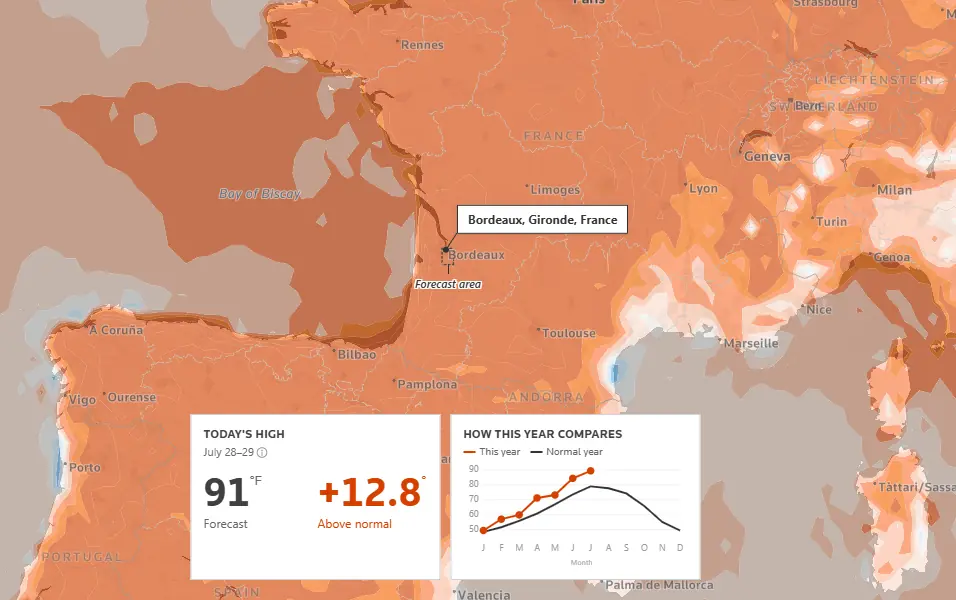 Firefighters raced on Tuesday to subdue huge wildfires that have forced unprecedented evacuations of tens of thousands of people across France and Spain, as western Europe braced for another heatwave. The fires have torn through a region already battered by a blisteringly hot and dry summer. Crews were seeking to capitalise on more favourable weather before a new wave of higher temperatures settled in from Wednesday. In the Bordeaux region of France, firefighters contained the forest blaze overnight, while in Spain, authorities allowed people from nine out of 11 towns in the central Toledo province to return to their homes. However, fires still raged out of control in Madrid and nearby provinces, prompting heightened vigilance. One Spanish evacuee described a “red hell” of fire, portraying intense scenes as residents fled with little more than clothes on their backs. Europe, the world’s fastest warming continent, has endured record-breaking heatwaves this year. Scientists say human-driven climate change is in...
 -
Dawn - 11:02 Jul 28, 2026
The PML-N grabbed nine out of the 13 constituencies of Azad Jammu and Kashmir’s (AJK) Mirpur division in yesterday’s elections, preliminary results issued by the Election Commission showed on Tuesday. Polls in AJK are being held in three phases over security concerns, with the first set of polls held in Mirpur division on Monday. Scuffles, violence and allegations of rigging had marred the polling process, with the PML-N and PPP accusing each other of electoral malpractice. According to preliminary results issued by the AJK Election Commission (Forms-26 and Forms-27), the PML-N emerged as the winner in nine constituencies, while the PPP could secure only four seats. Form-27 lists cumulative results based on votes cast on the polling day and by the election staff in advance polling. Form-26 comprises only the ballots cast on the main polling day, July 27, in this case. Results breakdown Following an intense election campaign by both parties in the lead-up to the polls, the PML-N emerged victorious in Mirpur di... -
Dawn - 10:18 Jul 28, 2026
A fresh spell of rainfall is expected in the country from July 29 to August 5, the Pakistan Meteorological Department (PMD) said on Tuesday as several parts of the country reeled from a preceding spell and subsequent flooding. “Monsoon currents from the Arabian Sea and Bay of Bengal are likely to penetrate upper and central parts of the country from July 29,” the Met Office said in its forecast, adding that a westerly wave currently affecting northern areas would likely strengthen from August 1 and affect most of the upper and central parts of the country. PMD warned that heavy rainfall may cause urban flooding in low-lying areas of Islamabad, Rawalpindi, Peshawar, Nowshera, Gujranwala, Gujrat, Sialkot, Lahore, Multan and Faisalabad from July 30 to August 4. It also warned of landslides in KP, particularly in Dir, Chitral, Swat, Kohistan, Buner, Battagram, Mansehra, Haripur and Abbottabad, as well as in GB, Murree, Galliyat and AJK from July 30 to August 5. According to the advisory, heavy rainfall may also p...
12682 items