Karachi | Pakistan
"Karachi" in Pakistan feed
-
The Nation - National - 09:12 Sep 03, 2026
KARACHI: A case has been registered against police officers and other individuals in Karachi over allegations of fraud, misuse of authority and an attempt to implicate a citizen in a false case to extort money. -
The Nation - National - 07:08 Sep 03, 2026
Starting from September 3, direct flights between Tashkent and Karachi have been launched by Centrum Air. -
The Express Tribune - 05:53 Sep 03, 2026
Party's Karachi chief says lawyers, traders support strike as most major markets and commercial centres remain closed -
The Nation - National - 12:47 Aug 30, 2026
France has permanently closed its consulate in Karachi, with the French Consulate formally announcing the end of its operations in the city. -
The Nation - National - 09:45 Aug 16, 2026
KARACHI: A crucial round of talks between goods transporters and government representatives will be held in Karachi today (Sunday) in a bid to end the countrywide wheel-jam strike, which has entered its ninth day. -
Dawn - 03:54 Aug 15, 2026
ON the night of Aug 13, 2026, Mir Raza Ali’s father was on TV imploring — as he had been doing for some time — for justice. It is now over two weeks since Mir Raza Ali, a 25-year-old businessman, left his home on an ill-fated trip that would be his last. The gruesome nature of his death, questions surrounding the initial police investigation and the inconsistent behaviour of the officials demonstrate why parents in Karachi so fear their children leaving their homes. In this sense, there are at least three dimensions to the death of Mir Raza Ali. First is the immense grief and the individual tragedy faced by the family of the young man. The death of one so young is heartbreaking enough, but the horrific details of this case and the mystery that surrounds those who appeared to have tortured and killed him have deepened the tragedy. Second is the story of lapses in the investigation of his death and the dismissive attitude of Karachi’s police force towards the violent deaths of young people. Third, there is the ... -
The Nation - National - 09:58 Aug 14, 2026
KARACHI: At least one woman was killed and 94 people were injured in separate incidents of celebratory gunfire across Karachi during Independence Day celebrations, rescue authorities said on Friday. -
Dawn - 08:04 Aug 14, 2026
KARACHI: At least two people were killed and 94 others injured in celebratory firing incidents in Karachi on the eve of Pakistan’s Independence Day, officials said on Friday. Police Surgeon Dr Summaiya Syed said 17 people were brought to Civil Hospital, 24 were brought to Abbasi Shaheed Hospital and 53 were brought to Jinnah Postgraduate Medical Centre. She added that one male from PIB Colony and an infant died in aerial firing incidents. The doctor said another woman was also brought to the hospital with a gunshot wound, who later died. However, police said that the incident was caused due to the accidental firing of a gun. Earlier Edhi said that 86 people had been injured in aerial firing incidents, including 10 women, 17 children and 59 men. Firing incidents were reported in Lyari, Saddar, Korangi, Malir, Azizabad, North Nazimabad, Nazimabad, Gulbahar, Gulshan-i-Iqbal, Orangi Town, Jamshed Quarters and Defence, it said. Meanwhile, police in Karachi’s East district launched a crackdown against aerial firing... -
Dawn - 05:05 Aug 14, 2026
KARACHI: At least 86 people have been injured in celebratory firing incidents in Karachi on the eve of Pakistan’s Independence Day, rescue officials said on Friday. According to Edhi, the injured include 10 women, 17 children and 59 men. In a statement, the rescue service said 24 people, including one woman, four children and 19 men, were brought to Abbasi Shaheed Hospital. It added that 35 people, including four women, three children and 28 men, were brought to Jinnah Hospital; and 26 people, including 10 children, four women and 12 men, were taken to Civil Hospital. The statement added that one woman was shifted to a private hospital. Firing incidents were reported in Lyari, Saddar, Korangi, Malir, Azizabad, North Nazimabad, Nazimabad, Gulbahar, Gulshan-i-Iqbal, Orangi Town, Jamshed Quarters and Defence, it said. Meanwhile, police in Karachi’s East district launched a crackdown against aerial firing on Independence Day and took 10 suspects into custody from various areas. In a statement, police said weapons... -
Dawn - 14:25 Aug 13, 2026
KARACHI: A sessions court on Thursday acquitted alleged drug baroness Anmol alias Pinky in three narcotics cases registered at Karachi’s Gizri police station. The three cases were registered against Pinky at the Gizri police station in 2020, 2021 and 2022, and she had been declared an absconder. Additional District and Sessions Judge South Irshad Hussain heard Pinky’s pleas seeking acquittal. During the hearing, her counsel contended that she had been named in the cases on the basis of statements made by the co-accused, who had subsequently been acquitted. “Following the acquittal of the co-accused, there can be no case for conviction for the accused (Pinky),” the lawyer said. According to one of the court orders, a copy of which is available with Dawn, Pinky was named in a 2021 case by two accused arrested for possessing narcotics, who claimed that she had supplied the drugs to them. A supplementary charge sheet submitted by the Counter-Terrorism Department (CTD) last month revealed that Pinky had over a doz... -
Dawn - 07:15 Aug 13, 2026
KARACHI: The Sindh High Court (SHC) directed the provincial government on Thursday to constitute a committee for an “independent, impartial and comprehensive” inquiry into the HIV outbreak among children at Karachi’s Kulsum Bai Valika Hospital. A two-member SHC bench, headed by Justice Adnanul Karim Memon and comprising Justice Muhammad Jaffer Raza, issued the directive as it announced its reserved judgement on a plea seeking an independent inquiry, registration of a case and lifelong medical treatment as well as appropriate compensation for the affected children. The outbreak was initially reported late last year, following which the Sindh government carried out screening at the Sindh Employees Social Security Institution (SESSI)-run hospital located in Karachi’s SITE area. According to data shared by the Sindh government, at least 78 children have been found infected with HIV at the hospital while a screening in the nearby area also confirmed 120 additional cases. But Advocate Tariq Mansoor, the lawyer who ... -
Dawn - 17:11 Aug 11, 2026
ISLAMABAD: The Privatisation Commission on Tuesday approved the appointment of a financial adviser for the outsourcing of Lahore and Karachi airports. In a statement, the commission said its board of directors had approved a “consortium led by EY-Parthenon as the top-ranked interested party” for appointment as financial adviser for the outsourcing of Allama Iqbal International Airport, Lahore, and Jinnah International Airport, Karachi. The board also constituted a negotiation committee to finalise the Financial Advisory Services Agreement (FASA) with the successful consortium, the statement added. Meanwhile, the commission appointed the Manila-based Asian Development Bank (ADB) last month as financial and transaction adviser for the outsourcing of New Islamabad International Airport. The commission said its board also took up the privatisation of Lahore Electric Supply Company (Lesco) and Multan Electric Power Company (Mepco) as major transactions, necessitating the appointment of financial advisers in accord... -
The Nation - National - 03:45 Aug 11, 2026
LAHORE - Punjab Chief Minister Maryam Nawaz Sharif on Monday expressed her desire to serve not only the people of Punjab but also those of Sindh and other provinces, saying she genuinely felt the difficulties faced by the people of Karachi and Sindh. -
Dawn - 17:24 Aug 07, 2026
Several major thoroughfares in Karachi were blocked or affected by traffic disruptions on Friday as Jamaat-i-Islami held protest sit-ins in the city as part of a nationwide demonstration against the petroleum levy. A day earlier, the party announced that it would stage sit-ins at 510 locations across the country by blocking major roads. In a traffic advisory issued, the Karachi traffic police warned that traffic flow could be affected due to the protests and sit-ins, with slow-moving traffic, temporary diversions and partial road closures expected on several major thoroughfares. The affected areas included Mazar-i-Quaid, Numaish Chowrangi, Saddar, Sharea Faisal, Sharae Pakistan, UP Mor, Power House Chowrangi, Defence Housing Authority, Sea View, Shahrah-i-Orangi, Hub River Road, Super Highway and National Highway. The traffic police advised citizens to avoid travelling to the affected areas unless necessary, and urged them to select alternative routes and allow extra travel time before setting out. Meanwhile,... -
Dawn - 10:21 Aug 06, 2026
KARACHI: A Karachi court on Thursday allowed the exhumation of Institute of Business Administration (IBA) graduate Mir Raza Ali’s body, which was found last month with a gunshot wound to the chest in the bushes in Gulistan-i-Jauhar. The court issued the order on an application filed by Ali’s father, after a controversy emerged between the Karachi police surgeon and investigators over alleged loopholes in the medico-legal report regarding the post-mortem examination. In its order, the court directed the police surgeon and the Sindh health secretary to constitute a medico-legal board for the exhumation of Ali’s body “under intimation to this court at the earliest possible date and time”. The court order, issued after the ruling by Judicial Magistrate Hameedullah, stated that Ali’s father, Mir Hussain Ali Khan, had filed an application seeking the exhumation of his son’s body in accordance with law. He also requested the formation of a medico-legal board, comprising senior forensic experts and pathologists, unde... -
The Nation - National - 09:58 Aug 06, 2026
A judicial court in Karachi has approved the exhumation of late businessman Mir Raza Ali’s body as part of the ongoing investigation into his death, directing authorities to conduct a fresh post-mortem examination. -
Dawn - 08:15 Aug 05, 2026
Karachi police have registered a case under terrorism charges following a scuffle between two groups at the Muttahida Qaumi Movement-Pakistan’s headquarters in Karachi on Sunday. The first information report, dated August 4 and a copy of which is available with Dawn, was registered at the New Town police station on behalf of the state, through Assistant Sub-Inspector Mirza Anwar Baig. It invoked Sections 147 (punishment for rioting), 148 (rioting, armed with deadly weapon), 149 (every member of an unlawful assembly, guilty of offence committed in prosecution of common object), 337-A(i) (shajjah-i-khafifah or injuring someone’s head or face), 337H(ii) (punishment for hurt by rash or negligent act), 324 (attempt to murder), and 188 (disobedience to an order lawfully promulgated by a public servant) of the Pakistan Penal Code (PPC) and Section 7 (punishment for acts of terrorism) of the Anti-Terrorism Act. Two named suspects, identified as Azhar alias Lumba and Zeeshan Habib, and 20-25 unidentified individuals h... -
Dawn - 15:59 Aug 04, 2026
All foreign media personnel will now require a No Objection Certificate (NOC) from the Ministry of Information and Broadcasting (MOIB) to travel to any city outside Islamabad, Lahore and Karachi for news coverage, according to recently issued guidelines. The new Foreign Media Facilitation Guidelines, 2026, outline requirements for the registration and accreditation of “foreign media houses, organisations and outlets working in Pakistan and all eligible journalists, media owners, media professionals, sources, freelancers, sponsors, fixers, attached persons, assignees etc, of Pakistan working or contributing for them”. All foreign media personnel already accredited or registered with the MOIB’s External Publicity (EP) Wing will require a mandatory NOC from the wing for movement to any city except Islamabad, Lahore and Karachi, in order to produce “news content, story, video, film, documentary or social media content” for official use. For leisure trips to Abbottabad and Murree, a NOC may be granted by the EP Wi... -
Dawn - 15:30 Aug 04, 2026
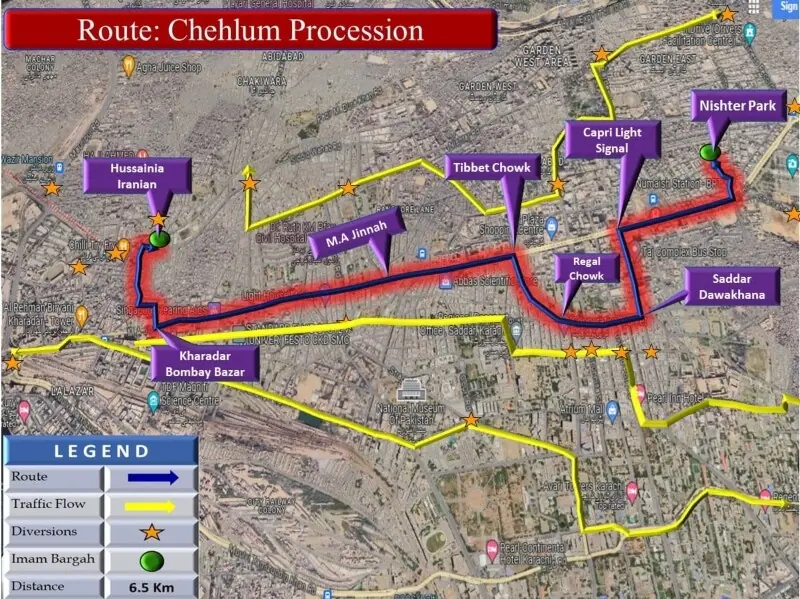 The main mourning procession to mark Chehlum concluded successfully in Karachi on Tuesday amid heavy security, according to the police. Sindh Chief Minister Syed Murad Ali Shah expressed satisfaction and gratitude over the peaceful conclusion of Chehlum processions. He praised the Sindh Rangers, police and other law enforcement agencies for their excellent performance. The chief minister also thanked procession organisers and religious scholars for their cooperation, the CM’s spokesperson said. Home Minister Ziaul Hassan Lanjar also praised the Sindh police for the peaceful observance and successful conclusion of Chehlum processions. Chehlum, also known as Arbaeen (40 in Arabic), marks the 40th day of mourning for the martyrdom of Imam Husain (AS), the grandson of the Holy Prophet Muhammad (PBUH). It is marked by processions by Shia Muslims across the country. In an earlier update at 4:50pm, the police said the front of the main procession had reached Eidgah Chowk, while its tail was at Britto Road, en route ...
 -
The Nation - National - 09:26 Aug 02, 2026
KARACHI: Police in Karachi’s Gulistan-e-Jauhar area have arrested the alleged mastermind behind a series of residential robberies, officials said.