California | Crypto
"California" in Crypto feed
-
Cointelegraph.com - 21:37 Mar 27, 2026
 The executive order is the latest in a wave of legal actions in the US seeking to curb government insider trading on prediction markets. California Governor Gavin Newsom signed an executive order on Friday, expanding rules to curb public servants and those close to them from benefiting from insider trading on prediction markets tied to political or economic events they can influence or are privy to. The order prohibits “gubernatorial appointees,” public officials appointed to office by the governor of the state, from using “confidential or non-public information” gleaned from performing their duties to profit from related prediction markets. Newsom’s executive order also extends the prohibition to include spouses, family members or former business partners of the appointed officials from using non-public information to profit. “Public service should not be a get-rich-quick scheme,” Newsom said. He added: Read more
 -
Cointelegraph.com - 09:32 Jan 31, 2026
 Ripple co-founder Chris Larsen and venture capitalist Tim Draper are backing Grow California, a new political effort aimed at countering union-backed wealth tax proposals. Two high-profile crypto figures are preparing to pour tens of millions of dollars into California politics, aiming to reshape the state Legislature by backing moderate, business-friendly candidates and countering the influence of labor unions. The effort, operating under the banner of Grow California, is backed by Chris Larsen, a longtime Democratic donor and co-founder of Ripple, and Tim Draper, a venture capitalist known for his support of Bitcoin (BTC), according to The New York Times. “The government unions do a great job,” Larsen reportedly told the outlet. “But that’s going to clash with a lot of the things that are going to make California successful if there’s no counterforce,” he added. Read more
 -
Cointelegraph.com - 13:00 Jan 04, 2026
 Crypto billionaires in California are threatening to leave the state, but are they ready to make good on their promise, or is an impending wealth exodus more of a paper tiger? Crypto billionaires are threatening to leave the state of California after a prominent trade union proposed a 5% assets tax on residents worth more than $1 billion. The Service Employees International Union-United Healthcare Workers West proposed the new tax back in November 2025. The trade union suggested that the new tax would bring in up to $100 billion from 200 state residents, more than making up for federal funding cuts to California’s state healthcare program. The measure will require 850,000 signatures before it can be put on the ballot for a popular vote in the 2026 elections in November. Prominent investors and billionaires based in California, such as PayPal co-founder Peter Thiel and Google co-founder Larry Page, have already threatened to leave. Others have argued that a billionaire exit could remove crucial sources of tax ...
 -
Cointelegraph.com - 02:48 Dec 29, 2025
 Crypto executives, including Bitwise CEO Hunter Horsley and Castle Island Ventures founding partner Nic Carter, have pushed back against a proposed billionaire tax in California. A proposed 5% tax on billionaires' wealth in California has drawn a strong response from crypto executives, who argue it would trigger an exodus of entrepreneurs and capital flight, and would be wasted anyway. The ballot initiative, known as the 2026 Billionaire Tax Act, proposes a 5% tax on net wealth above $1 billion to help fund the health care system and state assistance programs, according to the SEIU United Healthcare Workers West union. As the proposed wealth tax is partly assessed against unrealized gains, some billionaires may need to sell stock or parts of their businesses to raise funds to pay the tax, which would either be payable in one installment, or over five years with interest payments. Read more
 -
Cointelegraph.com - 15:00 Oct 21, 2025
 California’s SB 822 ends forced crypto sell-offs and requires holders to send in-kind transfers of unclaimed crypto to the state, promoting stronger consumer rights. California’s Senate Bill 822 (SB 822), signed into law by Governor Gavin Newsom in October 2025, makes California the first US state to protect unclaimed crypto assets from forced liquidation. Treating digital assets similarly to bank accounts and securities, SB 822 requires unclaimed cryptocurrencies to be transferred in their native form rather than immediately liquidated. This helps prevent forced liquidation of assets like Bitcoin (BTC) or Ether (ETH), which could otherwise trigger taxable events for holders without their consent. Read more
 -
Cointelegraph.com - 13:30 Oct 16, 2025
 California’s new law states that abandoned Bitcoin can’t be immediately sold by the state, which may ease recovery and lower burdens on exchanges. Over the weekend, California Governor Gavin Newsom signed a bill into law that preserves abandoned Bitcoin (BTC) holdings — a step forward that could provide legal clarity for custodians and crypto holders. The bill was an update to unclaimed property law (UPL) and contained one key provision: Abandoned Bitcoin or crypto holdings that are transferred to the state must be maintained in their original format (not sold for cash) for a certain amount of time. States with similar laws require that crypto be liquidated into cash immediately. This can create difficulties for recovering lost property and also creates administrative burdens for exchanges and crypto custodians. Read more
 -
Cointelegraph.com - 20:35 Oct 13, 2025
 The laws will likely impact social media companies and websites offering services to California residents, including minors, using AI tools. California Governor Gavin Newsom announced that the US state would establish regulatory safeguards for social media platforms and AI companion chatbots in an effort to protect children. In a Monday notice, the governor’s office said Newsom had signed several bills into law that will require platforms to add age verification features, protocols to address suicide and self-harm, and warnings for companion chatbots. The AI bill, SB 243, was introduced by state Senators Steve Padilla and Josh Becker in January. Padilla cited examples of children communicating with AI companion bots, allegedly resulting in some instances of encouraging suicide. The bill requires platforms to disclose to minors that the chatbots are AI-generated and may not be suitable for children, according to Padilla. Read more
 -
Cointelegraph.com - 01:08 Sep 24, 2025
 Ian Calderon, a former California lawmaker and Bitcoiner, started his campaign for California governor as a long shot among several established candidates. Former California Assemblymember and Bitcoin advocate Ian Calderon has kicked off his campaign for California governor in 2026, entering a crowded and competitive race to replace Gavin Newsom. Calderon confirmed his bid for governor in a post to X on Tuesday, centering most of his promises around affordable homes, groceries and gas while positioning himself as a Bitcoin (BTC) proponent. “My generation pays bills on our phones, we send money to each other with Venmo and we save in Bitcoin — but the people running our government, they’re trying to use yesterday’s ideas to solve today’s problems, and it isn’t working,” he said. Read more
 -
Cointelegraph.com - 14:19 Sep 10, 2025
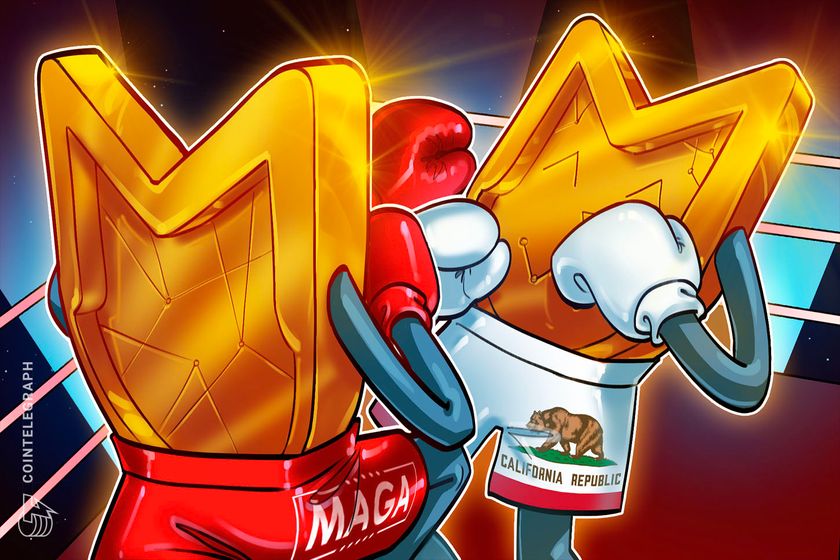 How TRUMP, DJT and WLFI clash with California’s crypto rules and why Newsom teased a “Trump Corruption Coin.” Political memecoins are tokens themed around real politicians or campaigns. They trade less on utility and more on narrative or community sentiment, which can push them up during election cycles. Most of these memecoins are launched on Solana or Ethereum, with platforms like Pump.fun lowering costs and making it easy for thousands of short-lived tokens to appear. Read more
 -
CryptoSlate - 22:16 Sep 01, 2025
California Governor Gavin Newsom said he will intensify his attacks on President Donald Trump by launching a memecoin and expanding a wave of social media posts designed to parody the former president’s online persona, NBC Los Angeles reported. The governor made the revelations during a recent appearance as a guest co-host on the “Pivot” podcast […] The post California gov Gavin Newsom to launch memecoin to continue ‘trolling’ Trump appeared first on CryptoSlate. -
CryptoSlate - 00:00 Jul 16, 2025
California Governor Gavin Newsom announced the California Breakthrough Project on July 15, enlisting executives from Coinbase, Ripple, MoonPay, and other technology firms to help streamline state operations. Newsom convened the advisory group at Ripple’s San Francisco headquarters on June 6. Participants include Ripple Executive Chair Chris Larsen and unnamed executives from MoonPay and Coinbase. The cohort will work with agency staff to […] The post Coinbase and Ripple execs join California officials to streamline state operations appeared first on CryptoSlate. -
Cointelegraph.com - 16:18 Jul 15, 2025
 The California Breakthrough Project held its first meeting at Ripple’s San Francisco headquarters, according to journalist Eleanor Terrett. California Governor Gavin Newsom has launched a new government efficiency task force that includes representatives from various crypto firms, potentially signaling the state’s recognition that blockchain technology could enhance public services. The task force, dubbed California Breakthrough Project, has tapped executives from Ripple, Coinbase, MoonPay and others to “advise and advance government efficiency and collaboration,” journalist Eleanor Terrett reported Tuesday. According to Terrett, the task force held its inaugural meeting at Ripple’s San Francisco headquarters on June 6. It aims to foster collaboration between California regulators and industry leaders across the technology and business sectors, address government inefficiencies and boost transparency around public services. Read more