Here | Crypto
"Here" in Crypto feed
-
Cointelegraph.com - 22:05 Mar 19, 2026
 Need to know what happened in crypto today? Here is the latest news on daily trends and events impacting Bitcoin price, blockchain, DeFi, NFTs, Web3 and crypto regulation. Today in crypto, US Securities and Exchange Commission (SEC) Chair Paul Atkins offered further clarity on why NFTs generally fall outside securities law, the European Central Bank (ECB) is looking for experts to help build out the digital euro’s real-world integrations, and the SEC approved Nasdaq’s tokenization pilot. US Securities and Exchange Commission (SEC) Chair Paul Atkins has clarified how the agency intends to approach digital asset regulation following an interpretative notice issued this week. In prepared remarks for a Thursday speech at the Practising Law Institute, Atkins said that the SEC would take a different approach to digital assets than its previous “regulation by enforcement” campaign. According to the SEC chair, the agency would first focus on its interpretation of how federal securities laws apply to crypto following ...
 -
Cointelegraph.com - 11:19 Mar 13, 2026
 XRP’s technical and onchain signals hint at a significant breakout, with bulls eyeing an “explosive” rally toward $2.55. XRP’s (XRP) price was up 3% on Friday to trade above $1.40 as several technical and onchain indicators suggested it was due for a “significant” upward breakout. Key takeaways: XRP’s Bollinger Bands indicator now sees the potential for a massive price breakout. Read more
 -
Cointelegraph.com - 17:12 Mar 09, 2026
 Mining Bitcoin on a desktop in 2026 may sound simple, but is it profitable? Do rising network difficulty and energy costs mean the end of PCs as Bitcoin mining equipment? Bitcoin mining began in 2009 as a hobby-friendly activity where users could earn BTC using CPUs and later GPUs. By 2026, the landscape has shifted entirely to industrial-scale operations dominated by specialized ASIC hardware. Modern Bitcoin mining runs at roughly 1 zettahash per second, with network difficulty reaching a record 144.4 trillion in February 2026. This makes it virtually impossible for standard PCs to compete meaningfully. Even when joining mining pools, a home PC’s contribution is so small that payouts amount to negligible fractions of a cent per day, while electricity costs, hardware wear, cooling and fees continue to accumulate. Read more
 -
Cointelegraph.com - 21:45 Mar 05, 2026
 Crypto markets spent the week chasing green, but Ether’s rally toward $2,500 might hit significant setbacks. Cointelegraph explains why. Key takeaways: ETH derivatives signal a shift to safety as professional desks hedge against downside risks and global instability. Institutional preference for decentralization keeps Ethereum dominant despite its recent drop in network activity. Read more
 -
Cointelegraph.com - 18:57 Mar 03, 2026
 Ether reserves held on exchanges fell to a new multi-year low as ETH price struggles to trade above $2,000. Will the supply crunch benefit bulls or bears? The balance of Ether (ETH) held on exchanges has slid to a multiyear low, with more than 31 million ETH leaving centralized exchanges in February, marking the largest monthly withdrawal since November. While the ETH price remained near $2,000, derivatives data shows a split between small buyers and larger sellers, raising the question of how the price may respond if demand becomes uniform across both retail and whale wallets. Crypto analyst Arab Chain said that more than 31.6 million ETH left major exchanges in February, the highest monthly outflow since November. Binance led with roughly 14.45 million ETH withdrawn, nearly half of the total. OKX followed with about 3.83 million ETH, and Kraken recorded close to 1.04 million ETH. Read more
 -
Cointelegraph.com - 21:30 Feb 28, 2026
 Ethereum’s dominant total value locked and widespread adoption by traditional finance institutions confirm its role as the base of global onchain finance. Will Ether price follow? Key takeaways: Institutional adoption of the Ethereum network accelerates despite Ether disappointing price action. Ethereum and its layer-2s hold 65% of TVL market share. Vitalik Buterin is shifting focus toward base layer scalability and ZK-EVM to ensure long-term onchain efficiency and security. Read more
 -
Cointelegraph.com - 20:12 Feb 26, 2026
 Bitcoin trades below most holders’ cost basis, but a rally above $74,500 could change everything. Can the bulls pull it off? Bitcoin (BTC) has rebounded 7.45% over the past two days after dropping to $62,400 on Tuesday, below a key onchain price support. Despite the bounce, holders who bought six months to two years ago remain at an average cost of $74,500, a level that now stands as a potential inflection point. As BTC moves higher, the concentration of supply around $74,500 stands as a key test for the current trend; a decisive reclaim of that level may signal demand and a shift in short-term market structure. Bitcoin’s realized price tracks the average onchain acquisition cost for a given UTXO age band. For coins aged 18 to 24 months, that level stands near $64,200. Read more
 -
Cointelegraph.com - 22:37 Feb 25, 2026
 Bitcoin markets are bracing for Friday’s $10.5 billion monthly options expiry. Does the data show bulls or bears at an advantage? Key takeaways: Bitcoin bulls need a 9% rally from current levels to take the advantage in Friday’s $10.5 billion options expiry. The 90% correlation between Bitcoin and the Nasdaq 100 Index shows that tech investor sentiment drives market confidence. Read more
 -
Cointelegraph.com - 21:45 Feb 23, 2026
 Traders struggle to determine if the crypto market bottom is in, but liquidity fears, AI industry valuation worries, and BTC mining strength could send Bitcoin back to $75,000. Key takeaways: Historical data shows Bitcoin often outperforms during trade wars and liquidity injections despite initial macro fear. Resilient mining activity and a shift to net long positions on CME futures suggest professional traders are buying the dip. Read more
 -
Cointelegraph.com - 20:11 Feb 18, 2026
 Ethereum onchain data and a bear pennant on the daily chart suggest that bears may target the $1,100 level. Would a dip to that zone represent a generational buy opportunity? Ether (ETH) price printed a bear pennant on the daily chart, a technical chart formation associated with strong downward momentum. This weakening technical setup and declining network activity may signal the continuation of ETH’s bear trend and possibly send the altcoin’s price to $1,100. A bear pennant pattern is a bearish setup that forms after the price consolidates inside an up-sloping triangle following a sharp price drop. The pennant will resolve once the price breaks below the lower trend line of the pennant at $1,950. If this happens, the ETH/USD pair could drop by as much as the previous downtrend’s height. This places the measured target for ETH price at $1,100, down 43% from the current price. Read more
 -
Cointelegraph.com - 19:16 Feb 11, 2026
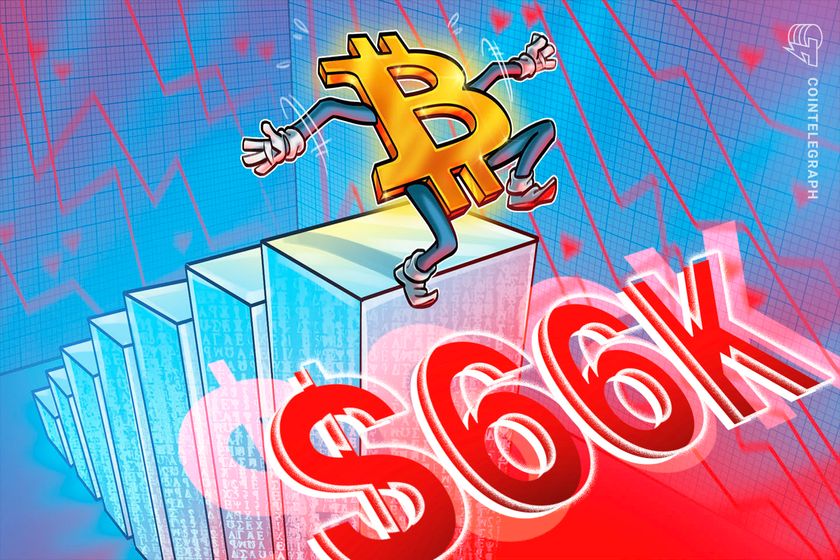 Bitcoin price crumbled back toward its 2026 low as a lack of fresh capital inflows, weak investor sentiment, and rising selling in spot markets chipped away at the $66,000 level. Bitcoin (BTC) has now retraced for three straight days, slipping below $66,000 during the New York session on Wednesday. The decline came after a failed push above $70,000, as weak buying interest allowed sellers to maintain control. Onchain data suggest that the pullback is possibly driven by spot-led selling on Binance, while the lack of a Coinbase premium during the US market session signals muted participation from US investors. Key takeaways: Read more
 -
Cointelegraph.com - 21:48 Feb 10, 2026
 Bitcoin’s double-digit rebound and brief trading above $72,000 may confirm $60,000 was the bottom, but data shows top traders are refusing to open longs. Key takeaways: The Bitcoin long-to-short indicator at Binance hit a 30-day low, signaling a sharp decline in bullish leverage demand. US-listed Bitcoin exchange-traded funds reversed a negative trend with $516 million in net inflows following a period of heavy liquidations. Read more
 -
Cointelegraph.com - 22:17 Feb 05, 2026
 Bitcoin fell below 63,000 as investors reacted to dismal US economic data, a weakening stock market and fears of an AI industry bubble. Does data forecast a return to $90,000 by March? Key takeawys: Bitcoin fell below $63,000 as weak US job data and concerns over AI industry investments fueled investor risk aversion. Options markets show a 6% chance of Bitcoin returning to $90,000 by March. Read more
 -
Cryptonews.com - 20:42 Jan 29, 2026
SEC & CFTC leaders have described crypto oversight moving toward clearer lines as Senate committees debate a market-structure bill. The SEC has emphasized tokenized securities, while the CFTC has sought authority for spot trading. Stablecoins have been treated mainly as a congressional issue so far. The post SEC & CFTC Chairs Break Silence: “Sensible Crypto Rules” Coming – Here’s What Changes appeared first on Cryptonews. -
Cryptonews.com - 15:13 Jan 28, 2026
Binance founder Changpeng Zhao (CZ) responded to criticism over his “buy and hold” tweet, explaining that he was emphasizing long-term crypto adoption rather than market manipulation. The post Binance Founder CZ Fires Back at FUD Over ‘Buy and Hold’ Tweet — Here’s What He Really Meant appeared first on Cryptonews. -
Cointelegraph.com - 20:51 Jan 27, 2026
 Data shows February tends to be one of BTC’s best performing months, leading Bitcoin network economist Timothy Peterson to dub it the real “Uptober” event. Will history repeat? Bitcoin’s (BTC) monthly gains have been limited to just 2.2%, but February could mark a bullish shift. Since 2016, the week ending Feb. 21 has recorded the highest median return at 8.4%, with Bitcoin closing higher 60% of the time. Key takeaways: February has delivered a median 7% weekly BTC return historically, outperforming October’s seasonal strength. Read more
 -
Cryptonews.com - 19:42 Jan 27, 2026
Gemini has said it is closing Nifty Gateway, the 2018 NFT marketplace it bought in 2019, after placing it in withdrawal-only mode. Users have until Feb. 23, 2026 to move USD, ETH or NFTs. Gemini has said it will keep NFTs via Gemini Wallet as the sector shrinks. The post Gemini Shuts Down Nifty Gateway NFT Marketplace – Here’s What’s Next for Holders appeared first on Cryptonews. -
Cointelegraph.com - 16:10 Jan 27, 2026
 Traders said Ether was preparing for a breakout to new all-time highs, with $10,000 ETH price target in sight. Ether’s (ETH) was down 14% from its 2026 high above $3,200 and 41% below its $4,950 all-time high, reached in August 2025. Despite this drawdown, traders remain optimistic about the ETH price rising higher as long as a key support level is reclaimed. Key takeaways: Ether traders are bullish on a $10,000 ETH price despite a 41% drawdown from all-time highs. Read more
 -
Cryptonews.com - 13:41 Jan 26, 2026
Bitcoin steadies near $87K as Robert Kiyosaki ignores volatility, citing debt risks and dollar erosion, while technical charts hint at a possible rebound. The post Bitcoin Price Prediction: Rich Dad Poor Dad Author Kiyosaki Ignores Price Crash – Here’s Why He’s More Bullish Than Ever appeared first on Cryptonews. -
Decrypt - 22:30 Jan 21, 2026
Will the tech billionaire attempt a takeover of an airliner out of spite? Here’s the background on Musk’s latest beef, and what it’s really all about.