CLARITY | Crypto
"CLARITY" in Crypto feed
-
CoinDesk - 12:00 Oct 24, 2026
Apex Group CEO Peter Hughes warned that the failure of the U.S. Clarity Act will drive digital asset businesses toward faster-moving jurisdictions in Asia and the Middle East. -
Decrypt - 20:16 Oct 07, 2026
The House Financial Services chairman credited the SEC and CFTC for stepping in after the Clarity Act's collapse but said only "permanent law change" can secure U.S. leadership. -
Cointelegraph.com - 16:06 Oct 07, 2026
 Representative French Hill hopes lawmakers could pass a cryptocurrency market structure bill before the next session of Congress in 2027 as SEC and CFTC actions weren’t sufficient Representative French Hill, who chairs the House Financial Services Committee, said that though US financial regulators were moving forward with addressing digital assets, their actions lacked the long-term stability of legislation from Congress. In a Wednesday Fox Business interview, the Arkansas lawmaker said the US Securities and Exchange Commission (SEC) and Commodity Futures Trading Commission (CFTC) had taken steps to address crypto regulations after the US Senate failed to pass the Digital Asset Market Clarity (CLARITY) Act last month. Both financial agencies have proposed rulemaking to handle different aspects of overseeing and enforcing crypto regulations, but Hill said their response following the failed CLARITY vote “[fell] short” of legislative solutions. “I still have hope [...] that we can get [CLARITY] passed in the ...
-
Cointelegraph.com - 17:40 Oct 05, 2026
 CFTC Chair Michael Selig claimed that the agency was using its “existing statutory authorities“ to address crypto regulation after Congress failed to advance a market structure bill. US Commodity Futures Trading Commission (CFTC) Chair Michael Selig said that the agency will move forward on crypto regulation at the direction of President Donald Trump “with or without legislation” from Congress. Speaking at the Fordham Law Blockchain Regulatory Symposium on Monday, Selig announced proposals giving crypto companies the option to operate under the CFTC’s umbrella rather than dealing with the patchwork of regulations offered by individual US states. According to written remarks from the event, the CFTC chair said that it had issued an advanced notice of proposed rulemarking for companies “offering retail customers the ability to trade crypto assets on a margined, leveraged, or financed basis,” calling the regulation ‘CTX.’ Read more
-
Cryptonews.com - 08:58 Sep 28, 2026
The CLARITY Act remains stalled after Senate cloture failed, while lawmakers weigh changes to stablecoin yield, ethics, oversight and more. The post CLARITY Act 2.0: Failed Senate Vote Opens Door to a Rewrite appeared first on Cryptonews. -
Cointelegraph.com - 20:26 Sep 25, 2026
 Former CFTC Commissioner Summer Mersinger joined the Blockchain Association in 2025 after resigning during her second term at the federal commodities regulator. Update (Sept. 25, 10:20 pm UTC): This article has been updated to clarify Kristin Smith’s role with the Solana Policy Institute. Summer Mersinger, formerly a commissioner with the US Commodity Futures Trading Commission (CFTC), will step down as CEO of the Blockchain Association and leave the advocacy organization at year’s end after one of the group’s legislative priorities faced a significant setback in Congress. On Friday, the Blockchain Association (BA) announced that Mersinger would step down as CEO on Oct. 16, when the group’s former chief executive, Kristin Smith, would return to lead the organization as interim CEO in addition to her existing role as president of the Solana Policy Institute. Mersinger joined the Blockchain Association in June 2025 after leaving the CFTC three years before her second term as a commissioner was scheduled to end....
-
CoinDesk - 21:29 Sep 22, 2026
Senator Cynthia Lummis said the crypto industry should "pin it on the Democrats" in her first public remarks after last week's failed Clarity Act vote. -
Cointelegraph.com - 15:55 Sep 22, 2026
 Control of the US House and Senate is up for grabs in 2026, and some advocates speculate that the crypto industry could ratchet up attempts to sway elections after the CLARITY vote. Last week’s US Senate failure to advance a digital asset market structure bill could light a fire under cryptocurrency industry groups seeking to sway key congressional races in the 2026 US midterm election that‘s just 42 days away. Senators on Sept. 15 voted 49 in favor and 50 against advancing the Digital Asset Market Clarity (CLARITY) Act, significantly reducing the chances of Congress passing the legislation with limited days in session before 2027. While some crypto advocates haven’t ruled out the possibility of CLARITY coming up for another vote before the next session of Congress, at least one of the industry’s political action committees (PACs) isn’t taking any chances. Read more
-
CryptoSlate - 10:30 Sep 22, 2026
Four Republican senators who voted to advance the CLARITY Act on Sept. 15 also appear as named supporters on a bank-backed amendment seeking tougher restrictions on stablecoin yield. As Punchbowl News reported on Sept. 21, John Cornyn, John Curtis, Cindy Hyde-Smith, and Lisa Murkowski all voted “Yes” on the procedural motion, which fell short 49-50. […] The post CLARITY Act needs 11 more Senate votes, but 4 of the 49 it already has want the bill changed appeared first on CryptoSlate. -
CryptoSlate - 06:10 Sep 22, 2026
A million-plus contacts showed mobilization; the 49-50 Senate defeat showed why reach alone cannot deliver a bipartisan coalition. The post Stand With Crypto’s 4 million registered advocates couldn’t get the CLARITY Act through the Senate appeared first on CryptoSlate. -
Cointelegraph.com - 15:08 Sep 21, 2026
 Coinbase draws scrutiny after the CLARITY Act stalls, while the SEC moves ahead with tokenized stocks and crypto firms push deeper into payments. The crypto industry spent much of the past two years preparing for regulatory clarity in Washington. This week, one of its biggest legislative priorities hit a major roadblock. The CLARITY Act failed to advance in the Senate on Tuesday, falling short of the 60 votes needed to bring the bill to the floor for debate. The setback significantly narrows the bill’s path this year, with the Senate calendar tightening ahead of the Nov. 3 midterm elections. Strategists say crypto exchanges such as Coinbase may have more at stake than most from the stalled legislation. Read more
-
Cointelegraph.com - 23:37 Sep 20, 2026
 Crypto missed out CLARITY, but tokenized stocks were legalized and the Bitcoin Reserve advanced. Meanwhile Standard Chartered says Arbitrum’s price could increase 70 times by 2030. After a year’s buildup, the US Senate failed to pass a cloture motion on the Digital Asset Market Clarity (CLARITY) Act. The motion received just 49 votes in favor and 50 against, well short of the 60 votes required. However, Republican Senator Thom Tillis’s “no” vote was not all it seemed, and he confirmed he’d only switched sides at the last minute to enable him to call a new vote in future. Read more
-
CryptoSlate - 09:06 Sep 19, 2026
Bitcoin hit an intraday high of $81,400 on Friday, approaching the low-$82,000 zone that has capped every recovery attempt since late August. US spot Bitcoin ETF shares stop trading once American markets close for the weekend. Any further push through that ceiling over the next two days would occur in continuously open crypto markets, without […] The post Bitcoin survived the Fed and CLARITY, and now faces the next major test at $82,000 this weekend appeared first on CryptoSlate. -
Cointelegraph.com - 17:55 Sep 18, 2026
 Coinbase, Strategy and other crypto-linked stocks rallied Friday as the CFTC and SEC moved ahead with crypto-related actions under existing authority. Crypto-linked stocks rebounded sharply on Friday, reversing losses that followed the Senate’s failure to advance the CLARITY Act earlier this week, as Bitcoin climbed back above $80,000. Strategy led the gains, rising more than 13%, while Coinbase and American Bitcoin climbed about 11% each. Robinhood gained nearly 9%, according to Yahoo Finance data. Source: Yahoo Finance Read more
-
CryptoSlate - 12:46 Sep 18, 2026
Tokenized stocks and wallet-linked derivatives can launch under new relief, while durable rights and jurisdiction remain unresolved. The post SEC and CFTC bypass Congress to open crypto access after CLARITY fails – with a catch appeared first on CryptoSlate. -
CryptoSlate - 09:20 Sep 18, 2026
Seven Democratic senators said Sept. 16 that CLARITY's failed Senate vote was not the end. The crypto market-structure bill fell short 49-50 the previous day on a procedural motion that needed 60 votes to advance. Getting from that statement to a law now depends on a compressed legislative calendar, still-unresolved policy disputes, and a House […] The post CLARITY Act needs 3 more senators and a race against the clock for a 2026 revival appeared first on CryptoSlate. -
Cointelegraph.com - 17:00 Sep 17, 2026
 CLARITY isn’t dead after failing a key Senate vote, but with time running short and Democrats still demanding changes, its path forward is narrowing. Water, water everywhere and not a drop to drink may be the sentiment of the crypto industry, lobbyists and lawmakers who’ve spent the last year trying to get the CLARITY Act over the line. No shortage of negotiations, amendments or political wrangling; yet not enough to get the bill moving through the Senate. The CLARITY Act may have rammed into a Senate-shaped hurdle this week, but it isn’t dead on arrival yet — let’s go with walking wounded. Read more
-
Cointelegraph.com - 20:51 Sep 16, 2026
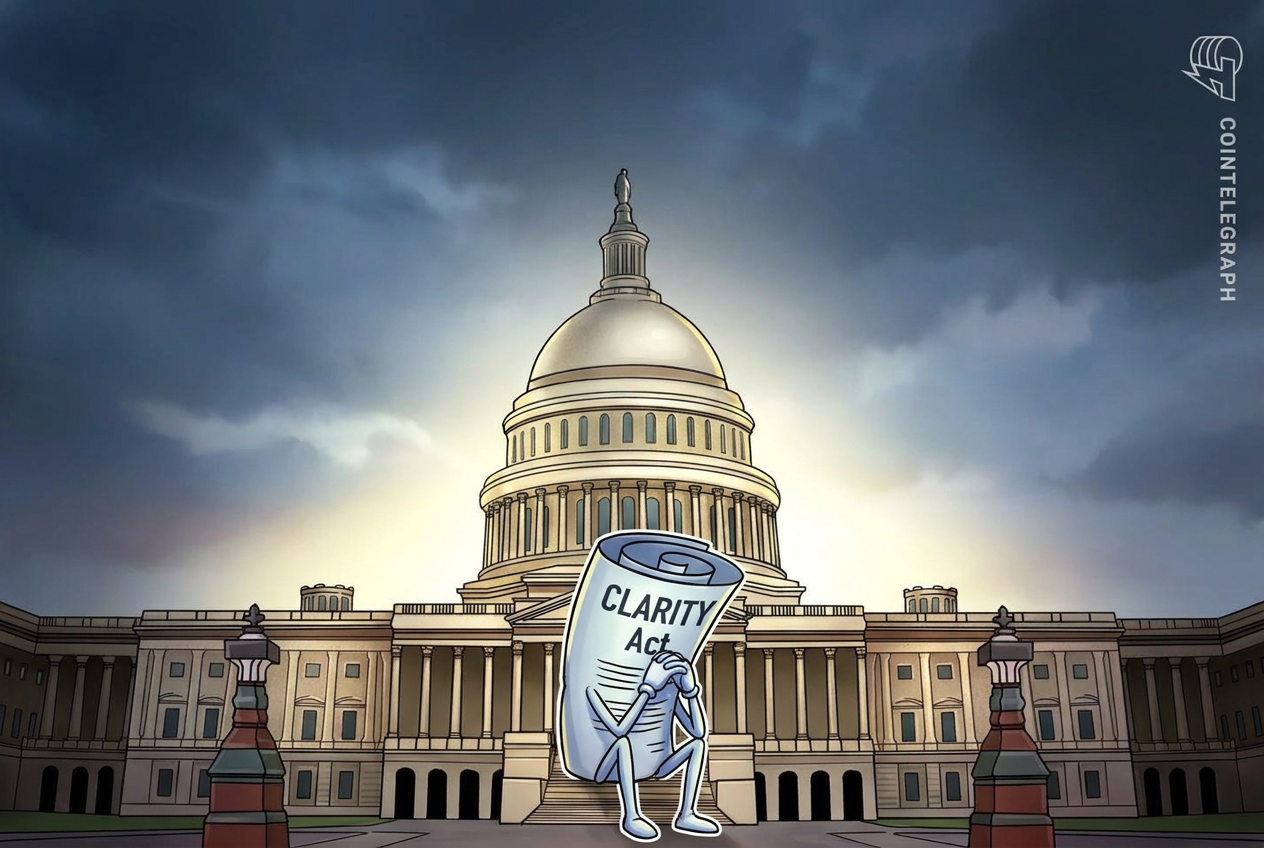 Digital Sovereignty Alliance managing director Adrian Wall said senators from both parties are considering another attempt to advance the crypto market structure bill before the current Congress ends. The CLARITY Act could get another chance in Congress during the post-election lame-duck session despite failing to advance in the Senate this week, according to Digital Sovereignty Alliance managing director Adrian Wall. Wall said Wednesday that he has spoken directly with senators from both parties who are considering another attempt to advance the crypto market structure legislation before the current Congress ends. “There is an appetite to put this forward even during the lame duck period of Congress,” Wall said during Cointelegraph’s Chain Reaction show on X. “Is it easy? No. It’s going to be very complicated. It’s a long shot.” Read more
-
CryptoSlate - 20:30 Sep 16, 2026
Failed cloture delayed a statutory framework while existing XRP access remained intact and post-vote fund demand stayed unmeasured. The post XRP falls hard after CLARITY vote as Ripple’s regulatory advantage faces a new test appeared first on CryptoSlate. -
Cointelegraph.com - 15:52 Sep 16, 2026
 A strategist at the Danish bank said Coinbase has more at stake in the CLARITY setback because its trading business is directly exposed to US market-structure rules. While Bitcoin and crypto-linked stocks fell sharply after the US Senate failed to advance the Digital Asset Market Clarity, or CLARITY, Act, Saxo Bank believes exchanges like Coinbase have more at stake than most because clearer rules could directly affect their trading businesses. In a Wednesday note, Saxo strategist Ruben Dalfovo said Coinbase (COIN) is the most directly exposed to developments around CLARITY because market-structure rules could determine registration requirements, which assets can trade and who can participate in US crypto markets. “Coinbase is most exposed to clearer market rules because trading and crypto participation directly affect its business,” Dalfovo wrote. Read more