Robinhood | Crypto
"Robinhood" in Crypto feed
-
Cointelegraph.com - 09:24 Apr 08, 2026
 Cathie Wood's ARK Invest increased its Robinhood stake after the platform was selected to operate government-backed “Trump Accounts” for youth savings and investment. Cathie Wood’s ARK Invest has increased its exposure to Robinhood Markets, purchasing roughly $13 million worth of shares after the trading platform secured a role in a new government-backed savings initiative. ARK’s Tuesday trade disclosures show a fresh accumulation of Robinhood shares across multiple funds. ARK Innovation ETF (ARKK) led the charge, purchasing 132,116 HOOD shares. Additional buying came from the ARK Next Generation Internet ETF (ARKW), which added 33,607 shares, and the ARK Fintech Innovation ETF (ARKF), which picked up 16,918 shares. Related: Bernstein sees potential bottom for crypto stocks ahead of Q1 earnings Read more
 -
Decrypt - 15:21 Mar 04, 2026
The investment firm of tech investor Cathie Wood bought the dip on Coinbase and Robinhood ahead of Wednesday's strong opening. -
Cointelegraph.com - 08:06 Mar 04, 2026
 The purchases came as geopolitical tensions tied to the US and Israel's conflict with Iran weighed on global markets, pushing major indexes lower. Cathie Wood’s Ark Invest increased its exposure to crypto-related equities, adding shares of Coinbase and Robinhood Markets across several of its exchange-traded funds (ETFs) as broader markets pulled back. The company purchased a combined 22,452 shares of Coinbase across the ARK Innovation ETF (ARKK), ARK Next Generation Internet ETF (ARKW) and ARK Fintech Innovation ETF (ARKF), according to trade notifications for Tuesday. Based on Coinbase’s closing price of $182.36 during the day, the purchase was valued at about $4.1 million. Ark also accumulated 158,587 shares of Robinhood through the same ETFs. With Robinhood closing at $76.07, the transaction was valued at about $12 million. Read more
 -
Cointelegraph.com - 11:55 Feb 19, 2026
 Robinhood plans a mainnet launch later this year as the testnet hosts experimental assets, including stock-style tokens. Robinhood’s Ethereum layer-2 network processed 4 million transactions in its first week of public testnet activity, according to CEO Vlad Tenev. In a Thursday post on X, Tenev said developers have begun experimenting with applications on the L2 network, which was built for tokenized real-world assets (RWAs) and blockchain-based financial services. “The next chapter of finance runs onchain,” he wrote. The trading platform launched the Robinhood Chain testnet last week as an Ethereum layer 2 built using Arbitrum technology. The launch followed about six months of private testing and is intended to serve as a high-throughput environment for financial applications. Read more
 -
CryptoSlate - 15:10 Feb 15, 2026
Crypto winter has a branding problem. The phrase makes it sound like the chain goes quiet, wallets stop moving, and the whole machine turns cold. However, the cleanest proof of retail pulling back rarely lives on-chain. The people who vanish first aren’t the power users bridging stables into DeFi or the long-term holders shuffling coins […] The post Robinhood’s $221 million crypto revenue drop shows crypto winter isn’t on chain and retail already moved appeared first on CryptoSlate. -
Cointelegraph.com - 08:37 Feb 12, 2026
 Cathie Wood’s ARK Invest bought nearly $50 million of Robinhood, Bullish and Circle shares as Bitcoin dipped and US spot BTC ETFs saw $276 million in outflows. ARK Invest, the investment firm led by Bitcoin bull Cathie Wood, snapped up a significant batch of crypto-linked stocks on Wednesday as BTC briefly dipped below $66,000. ARK purchased 433,806 shares of Robinhood (HOOD) for approximately $33.8 million, according to a trade notification reviewed by Cointelegraph. The asset manager also boosted its exposure to crypto exchange Bullish (BLSH) and USDC (USDC) issuer Circle (CRCL), acquiring 364,134 shares valued at $11.6 million and 75,559 shares worth $4.4 million, respectively. Read more
 -
Decrypt - 01:31 Feb 11, 2026
Robinhood said developers will begin experimenting with applications on its Ethereum layer-2 network, while providing key technical feedback. -
Cointelegraph.com - 01:30 Feb 11, 2026
 Robinhood is testing its own Arbitrum‑based Ethereum layer‑2, deepening its push into tokenized stocks and DeFi infrastructure alongside other major exchanges. Robinhood has launched a public testnet for Robinhood Chain, its new Ethereum layer‑2 network built using Arbitrum technology that aims to bring tokenized real‑world and digital assets onchain. According to a release shared with Cointelegraph, the testnet, which is now live for developers, offers network access points, documentation at docs.chain.robinhood.com, compatibility with standard Ethereum development tools and early integrations from infrastructure partners. Robinhood says the chain is designed for “financial‑grade” use cases, including 24/7 trading, seamless bridging, self‑custody, and decentralized products such as tokenized asset platforms, lending markets, and perpetual futures exchanges. Read more
 -
Cointelegraph.com - 20:26 Jan 29, 2026
 The Series B extension values the New York–based crypto infrastructure company at about $1.5 billion and includes backing from institutional investors. Digital asset infrastructure provider Talos raised a $45 million extension to its Series B funding round, valuing the company at about $1.5 billion. The extension included new strategic investors such as Robinhood Markets, Sony Innovation Fund, IMC, QCP and Karatage, alongside returning investors a16z crypto, BNY and Fidelity Investments, according to the company. "We extended our Series B round to accommodate interest from strategic partners,” said Talos CEO Anton Katz. Talos said proceeds will be used to expand product development across its trading, portfolio management, execution, treasury and settlement tools and to support tokenized traditional assets on its platform. Read more
 -
Cryptonews.com - 15:34 Jan 29, 2026
Talos has raised a $45M Series B extension from new investors including Robinhood, Sony Innovation Fund, IMC, QCP and Karatage. The financing has brought Series B to $150M and set post-money valuation near $1.5B, with some proceeds settled in stablecoins. It has cited BlackRock Aladdin RFQ work too. The post Talos Raises $45M Series B Extension Backed by Robinhood, Bringing Total Funding to $150M appeared first on Cryptonews. -
CoinDesk - 19:00 Jan 10, 2026
CoinDesk sat down with Robinhood’s head of crypto, Johann Kerbrat, to get an update on its upcoming layer-2 network, its tokenized stocks program, and its staking offerings. -
CoinDesk - 16:10 Dec 17, 2025
Robinhood stands to gain more from prediction markets than Coinbase as users plan to deploy fresh capital rather than sell existing crypto, the bank said. -
CryptoSlate - 07:30 Dec 14, 2025
Robinhood has spent the past few years trying to outgrow its meme-stock reputation, and the clearest sign that it is thinking differently now sits far from Menlo Park. In early December, the company said it would buy PT Buana Capital Sekuritas, a small Indonesian brokerage, and PT Pedagang Aset Kripto, a licensed digital asset trader, […] The post Robinhood is constructing a “regional triangle” that unlocks the one thing US regulators won’t permit appeared first on CryptoSlate. -
Cointelegraph.com - 18:10 Nov 26, 2025
 The deal for FTX-linked MIAXdx puts Robinhood and Susquehanna in direct competition with Kalshi and Polymarket as interest in prediction markets heats up. A company with ties to the defunct cryptocurrency exchange FTX is being acquired by Robinhood Markets and Susquehanna International Group as part of a push into prediction markets. According to a Reuters report on Tuesday, Robinhood and Susquehanna will acquire a 90% stake in LedgerX, one of the few solvent companies tied to FTX following its bankruptcy filing in 2022. The move came just hours after Robinhood announced the launch of a futures and derivatives platform with options for prediction markets. Robinhood initially reported the acquisition of a majority stake in MIAXdx, an exchange and clearinghouse licensed by the US Commodity Futures Trading Commission. MIAXdx, previously known as LedgerX, was acquired by Miami International Holdings (MIAX) for $50 million in 2023 amid FTX’s bankruptcy. MIAX will retain a 10% stake in the firm, according to Reute...
 -
CoinDesk - 21:34 Nov 18, 2025
Robinhood is working on infrastructure developments, said Offchain Labs' A.J. Warner, including 24/7 trading, and leveraging technologies like Arbitrum Stylus for compatibility. -
Cointelegraph.com - 19:48 Nov 07, 2025
 Crypto stocks slid as macro fears, government shutdown jitters and lingering fallout from October's $19 billion liquidation hit investor sentiment. Shares of crypto-focused companies have tumbled this week, capping a bruising stretch for the digital asset sector marked by renewed macroeconomic fears and lingering fallout from October’s liquidity crunch and mixed corporate earnings. Coinbase (COIN), Block Inc. (XYZ) and Robinhood (HOOD) have fallen 11% to 14% this week, according to Google Finance data, erasing recent gains and underscoring the fragile sentiment surrounding crypto-linked equities. On Oct. 30, Coinbase reported stronger-than-expected earnings and revenue as it advanced its “Everything Exchange” initiative, aimed at expanding the volume and diversity of tradable assets on its platform. Yet, despite the upbeat results, shares failed to maintain momentum amid broader market pressures and declining risk appetite. Read more
 -
Cointelegraph.com - 19:48 Nov 07, 2025
Crypto stocks slid as macro fears, government shutdown jitters and lingering fallout from October's $19 billion liquidation hit investor sentiment. Shares of crypto-focused companies have tumbled this week, capping a bruising stretch for the digital asset sector marked by renewed macroeconomic fears and lingering fallout from October’s liquidity crunch and mixed corporate earnings. Coinbase (COIN), Block Inc. (XYZ) and Robinhood (HOOD) have fallen 11% to 14% this week, according to Google Finance data, erasing recent gains and underscoring the fragile sentiment surrounding crypto-linked equities. On Oct. 30, Coinbase reported stronger-than-expected earnings and revenue as it advanced its “Everything Exchange” initiative, aimed at expanding the volume and diversity of tradable assets on its platform. Yet, despite the upbeat results, shares failed to maintain momentum amid broader market pressures and declining risk appetite. Read more -
Decrypt - 19:34 Oct 27, 2025
Professional sports are emerging as a notable tailwind for Robinhood as the firm’s prediction market offering grows, says Compass Point. -
Decrypt - 14:20 Oct 20, 2025
A large-scale Amazon Web Services outage Monday led to downtime for both Coinbase and Robinhood, yielding complaints from users. -
Cointelegraph.com - 11:29 Oct 20, 2025
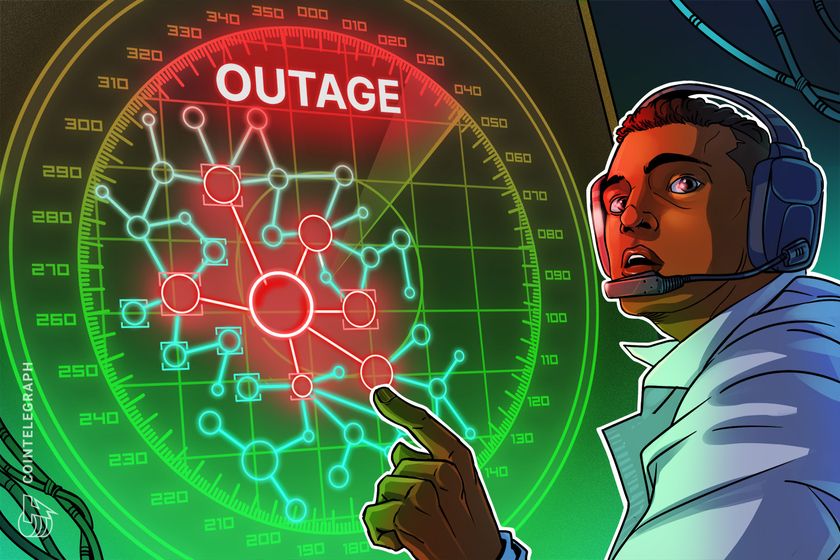 This marks the second major Amazon AWS outage since April, when “connectivity issues” created usability problems for at least eight large crypto exchanges. Update Oct. 20, 1:15 p.m. UTC: This article has been updated to include comments from Dr. Max Li, founder and CEO of OORT. Coinbase and Robinhood were among several major platforms distressed by an Amazon Web Services (AWS) data center outage on Monday, underscoring the risks of relying on centralized cloud providers for critical financial infrastructure. Coinbase, the third-largest centralized cryptocurrency exchange (CEX) by trading volume, was hit by an AWS data center outage, which reported “increased error rates and latencies” for multiple AWS Services in the Northern Virginia region. Read more