Arbitrum | Crypto
"Arbitrum" in Crypto feed
-
Cointelegraph.com - 13:00 Oct 06, 2026
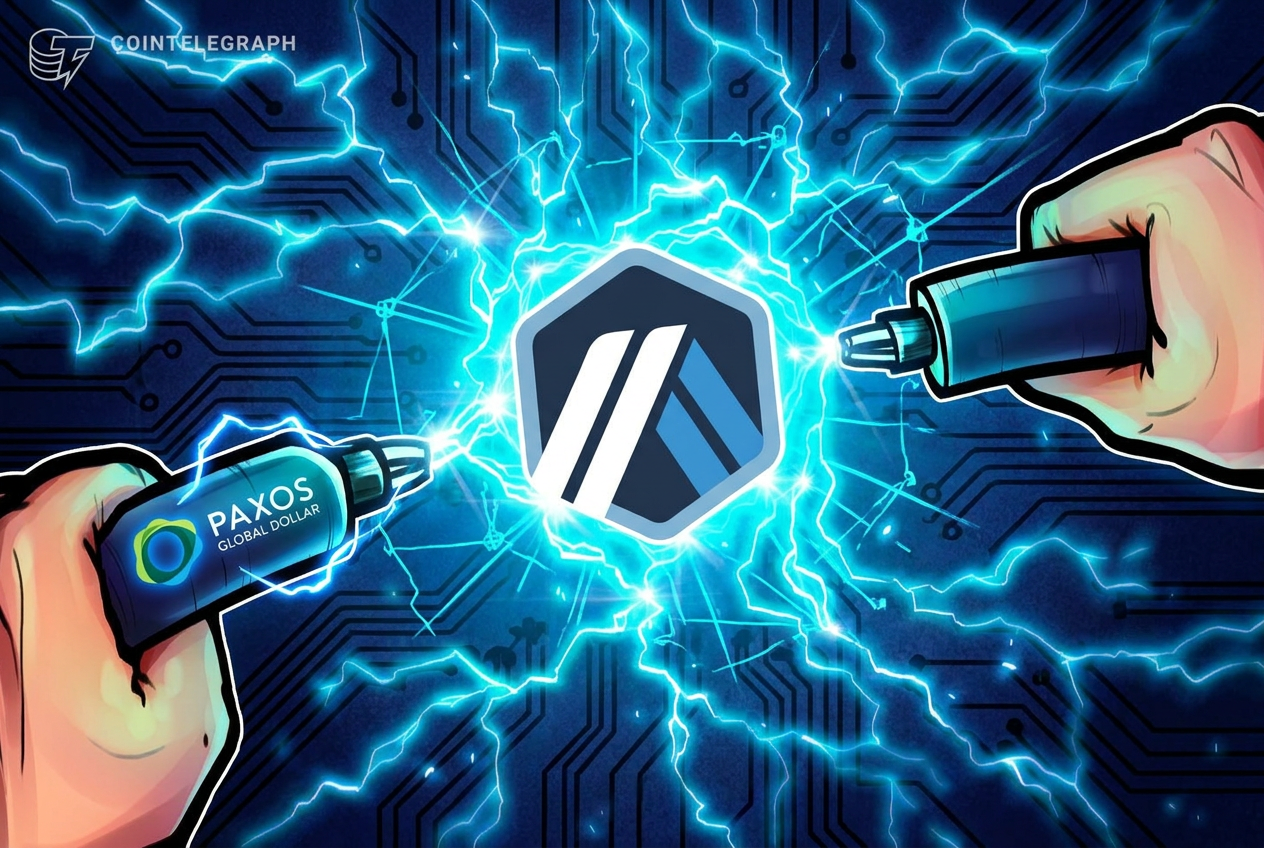 Paxos’ USDG stablecoin is now live on Arbitrum as the network proposes 100 million ARB in incentives to support adoption and liquidity. Paxos-issued stablecoin Global Dollar (USDG) has launched on Arbitrum as the blockchain joins the Global Dollar Network. According to an announcement shared with Cointelegraph, USDG is natively issued on Arbitrum One, with integrations across decentralized finance protocols including Fluid, Morpho, GMX and Maple. Kraken will support deposits and withdrawals, while Stargate will enable transfers between Arbitrum and other blockchains. A proposal submitted to the ArbitrumDAO would make USDG growth a strategic objective and add 100 million ARB to an incentive program to increase adoption. The proposal also calls for deploying Arbitrum treasury assets to support USDG liquidity, while businesses integrating the stablecoin can apply for support from the Arbitrum Foundation. Read more
 -
CryptoSlate - 09:50 Oct 03, 2026
Existing programs keep running, while a separate proof-conflict guard can delay unconfirmed withdrawals to Ethereum. The post Arbitrum pauses new Stylus activations over AI-assisted attack risks appeared first on CryptoSlate. -
Cointelegraph.com - 15:50 Sep 15, 2026
 Standard Chartered sees Robinhood Chain as an early sign that tokenization could transform Arbitrum’s economics and drive ARB sharply higher by 2030. Standard Chartered says layer-2 network Arbitrum could emerge as one of the digital asset industry’s top performers through 2030 as traditional financial firms move more assets onchain, giving the network a potentially lucrative revenue source beyond crypto-native activity. In a note shared with Cointelegraph, Geoff Kendrick, Standard Chartered’s global head of digital assets research, said Arbitrum’s economics offer considerable upside because the network receives 10% of the net protocol revenue generated by companies building on it. Robinhood Chain, developed by the online brokerage, is the first major example. According to Kendrick, Robinhood Chain has already materially changed Arbitrum’s economics. At its current run rate, Arbitrum is expected to generate $5 million in revenue in September, more than five times its level before Robinhood Chain launched in J...
 -
CryptoSlate - 21:05 Sep 06, 2026
Good Entry, Limitless and APX Finance could face separate off-chain ban votes, but the combined figure is not one repayable balance. The post Three DeFi projects face possible exclusion from future Arbitrum DAO programs appeared first on CryptoSlate. -
CoinDesk - 20:28 Jul 09, 2026
The brokerage's new blockchain is off to a fast start, with memecoin trading boosting activity and revenue flowing back to the Arbitrum ecosystem. -
Cointelegraph.com - 03:54 Jul 08, 2026
 “The security risk is the part we take most seriously,” the team said, citing old code and AI exploit risks. Privacy-focused layer-1 blockchain Secret Network is proposing to move from its longtime home on Cosmos to Ethereum layer-2 Arbitrum, citing security risks from artificial intelligence, among other reasons. Secret Network has been running privacy-preserving smart contracts on Cosmos since 2020, as the ecosystem had strong momentum back then, but the “environment has changed,” the team said Tuesday. “The security risk is the part we take most seriously,” it said. “Old code is becoming dramatically easier to analyze … With AI, the cost of attacking stale code is falling across the board.” Read more
 -
CoinDesk - 05:35 Jun 12, 2026
LG Electronics has built a blockchain-based advertising platform with the help of Arbitrum. -
Cointelegraph.com - 04:32 Jun 12, 2026
 LG is building a blockchain focused on buying and selling ads, joining a wave of companies launching their own blockchains in recent years. South Korean tech giant LG Electronics is working with the Ethereum layer-2 network Arbitrum to build a blockchain-based advertising network aimed at serving the digital ad industry. Arbitrum would give advertisers and publishers a shared database of ad inventory and track how customers interact with advertisements, with the company exploring how to bring the service to market this year, Fortune reported on Thursday. “We are evaluating whether this approach can deliver meaningful value to advertisers, publishers and audiences,” said Samuel Byungsun Park, the head of LG Electronics’ blockchain research lab. Read more
 -
Cryptonews.com - 14:24 Jun 03, 2026
Orbs V5 Launches as L3 Hybrid on Ethereum & Arbitrum The post Orbs V5 Debuts as Layer 3 Hybrid on Ethereum & Arbitrum to Cut DeFi Gas Costs appeared first on Cryptonews. -
Cointelegraph.com - 11:12 May 09, 2026
 A Manhattan judge modified a restraining notice to let Arbitrum DAO move $71 million in frozen Ether to Aave, while preserving terrorism victims’ legal claim on the funds. A Manhattan federal judge has allowed Arbitrum DAO to move $71 million in frozen Ether to Aave, clearing the path for the DeFi protocol’s recovery effort following a North Korea-linked exploit. Judge Margaret Garnett of the Southern District of New York issued the order on Friday, modifying a restraining notice that had locked the assets inside Arbitrum DAO. The modification permits an onchain governance vote to send the funds to a wallet controlled by Aave LLC, and explicitly protects anyone who participates in the transfer from being held in violation of the freeze. The order still keeps the terrorism victims’ legal claim on the funds, meaning Aave can’t use the funds freely and could be forced to hand them over if the court ultimately rules in the terrorism victims’ favor. Read more
 -
CoinDesk - 08:59 May 08, 2026
DAO delegates approved releasing exploit-frozen ETH to an Aave-led recovery effort, though Arbitrum’s governance rules delay any transfer for at least eight days -
Cointelegraph.com - 15:14 May 07, 2026
 The Snapshot vote would move the recovery effort toward a binding onchain Arbitrum governance proposal. A joint proposal to release the roughly $71 million in Ether frozen after the Kelp DAO exploit is set to pass later on Thursday, moving a cross-protocol recovery effort closer to restoring part of rsETH’s backing. Over 90.5% of the tokens were cast in favor of the motion, representing 173.9 million Arbitrum (ARB) tokens, while 9.4%, or 18.1 million tokens, abstained. Less than 1%, or 1,700 tokens, voted against the proposal before the voting period’s scheduled end at 6:54 pm UTC, according to a Snapshot at the time of writing. Co-authored by Aave Labs, Kelp DAO, LayerZero, EtherFi and Compound, the proposal seeks to unfreeze the 30,765 Ether (ETH) that was frozen by Arbitrum’s Security Council on April 21, days after an attacker drained about 116,500 restaked Ether (rsETH) from Kelp Dao, worth between $290 million and $293 million at the time. Read more
 -
CoinDesk - 11:53 May 04, 2026
Families holding decades-old judgments against North Korea are trying to seize 30,765 ETH frozen after last month’s rsETH exploit, citing alleged links between the attack and DPRK-linked hacking groups such as Lazarus, and invoking a New York restraining notice that could block Arbitrum from releasing the funds. -
Cointelegraph.com - 04:20 Apr 27, 2026
 More than $21 million in contributions has been made to the "DeFi United" relief effort so far, with another $215 million to be potentially allocated if certain governance proposals succeed. Aave Labs has proposed that the decentralized autonomous organization behind Arbitrum unfreeze $73.5 million in Ether tied to the Kelp DAO attack and to direct those funds to “DeFi United,” a fund aimed at restoring rsETH and compensating its holders. Last week, the Arbitrum Security Council moved to freeze 30,765 Ether (ETH) held in a wallet connected to the $293 million Kelp exploit. In a proposal posted Saturday on the Arbitrum governance forum, Aave Labs said directing those funds to a planned remediation effort would “restore normal conditions for Arbitrum users” and the wider ecosystem and that the Ether on Arbitrum “represents a material contribution” toward restoring the Kelp DAO restaked ETH (rsETH) token. Read more
 -
Cointelegraph.com - 11:18 Feb 04, 2026
 Base’s Jesse Pollak says L2s can’t be “Ethereum but cheaper” as builders respond to Vitalik Buterin’s call for specialization. Several layer-2 builders responded after Ethereum co-founder Vitalik Buterin said the original vision of L2s as the primary scaling engine “no longer makes sense,” calling for a shift toward specialization. In a Wednesday post, Buterin argued that many L2s have failed to fully inherit Ethereum’s security due to continued reliance on multisig bridges, while the base layer is increasingly capable of handling more throughput via gas-limit increases and future native rollups. The comments prompted responses from Ethereum layer 2s, who broadly agreed that rollups must evolve beyond being cheaper versions of Ethereum but diverged on whether scaling should remain central to their role. Read more
 -
Cointelegraph.com - 17:45 Dec 24, 2025
 Offchain Labs increases its ARB holdings, signaling long-term conviction in Arbitrum as governance token prices slump and layer-2 competition intensifies. Offchain Labs, the primary developer behind Arbitrum, has purchased additional ARB tokens, signaling long-term conviction in the network at a time when sentiment across the sector has weakened, and governance token prices have faced sustained pressure. In a post on X this week, Offchain Labs said it remains “committed to growing the Arbitrum ecosystem in a meaningful way,” adding that it has increased its direct exposure to Arbitrum (ARB) under an approved purchase plan. The development company said the move reflects its intention to continue “doubling down on the development of Arbitrum in all respects.” Read more
 -
Cointelegraph.com - 13:25 Oct 18, 2025
 Robinhood’s tokenization drive on Arbitrum now includes nearly 500 US stock and ETF tokens worth over $8.5 million, as the brokerage deepens its RWA push. Robinhood has expanded its tokenization initiative on the Arbitrum blockchain, deploying 80 new stock tokens in the past few days and bringing the total number of tokenized assets close to 500. According to data from Dune Analytics, Robinhood has tokenized 493 assets with a total value exceeding $8.5 million. Cumulative mint volume has surpassed $19.3 million, offset by around $11.5 million in burning activity, signaling a growing but actively traded market. Stocks account for nearly 70% of all deployed tokens, followed by exchange-traded funds (ETFs) at about 24%, with smaller allocations to commodities, crypto ETFs and US Treasurys. Read more
 -
CryptoSlate - 21:28 Sep 03, 2025
Arbitrum, the largest Ethereum layer-2 protocol, has launched a new initiative designed to channel liquidity into decentralized finance. The DeFi Renaissance Incentive Program (DRIP), announced on Sept. 3, will allocate up to $40 million in rewards to users performing targeted on-chain actions rather than simply generating attention. The program, structured by Entropy and powered by […] The post Arbitrum launches $40M DeFi incentive amid intensifying L2 race appeared first on CryptoSlate. -
Cryptonews.com - 18:37 Aug 13, 2025
Altcoin season has concentrated on select tokens, with OKB surging after a major burn and blockchain launch, Arbitrum sustaining scaling momentum, and Sei advancing through consistent usage growth. Broader flows remain limited but target infrastructure and tokenomic changes. The post OKB, Arbitrum, SEI: The Altcoin Season Trio That Could Make You Filthy Rich appeared first on Cryptonews. -
Cryptonews.com - 19:27 Jul 01, 2025
Arbitrum has climbed back toward $0.33 after shedding 7% from yesterday’s peak, while its $2.4 billion TVL, 1 million active wallets, and ties to Robinhood and Binance have reinforced its position as Ethereum’s busiest Layer-2, although the token remains 86% below its all-time high. The post Arbitrum ($ARB) Defies Market Slump: Can the Ethereum L2 Leader Hit $0.59 Next? appeared first on Cryptonews.