Cointelegraph.com
Source:
https://cointelegraph.com
Found 11887 news
-
Cointelegraph.com - 12:27 Feb 19, 2026
 Polymarket’s lawsuit challenges state authority and could redefine whether the CFTC controls US prediction markets or whether states set their own rules. Polymarket’s federal lawsuit against Massachusetts could determine whether prediction markets are regulated solely by the CFTC or also by states. The dispute centers on whether event contracts qualify as financial derivatives under the Commodity Exchange Act or as gambling under state laws. The lawsuit followed state-level actions against platforms like Kalshi, with Massachusetts and Nevada moving to restrict sports-related prediction contracts. Read more
 -
Cointelegraph.com - 11:55 Feb 19, 2026
 Robinhood plans a mainnet launch later this year as the testnet hosts experimental assets, including stock-style tokens. Robinhood’s Ethereum layer-2 network processed 4 million transactions in its first week of public testnet activity, according to CEO Vlad Tenev. In a Thursday post on X, Tenev said developers have begun experimenting with applications on the L2 network, which was built for tokenized real-world assets (RWAs) and blockchain-based financial services. “The next chapter of finance runs onchain,” he wrote. The trading platform launched the Robinhood Chain testnet last week as an Ethereum layer 2 built using Arbitrum technology. The launch followed about six months of private testing and is intended to serve as a high-throughput environment for financial applications. Read more
 -
Cointelegraph.com - 11:52 Feb 19, 2026
 Local media reported that the stolen 320 Bitcoin was returned to a wallet controlled by authorities, with the unknown hacker seemingly having a sudden change of heart. South Korean prosecutors say they recovered more than 320 Bitcoin that disappeared from government custody in 2025 after the cryptocurrency was returned to an official wallet this week, local media reported. The Gwangju District Prosecutors’ Office said it unexpectedly recovered 320.88 Bitcoin (BTC), worth about $21.3 million at the time of writing, local media outlet The Chosun Daily reported on Thursday. Prosecutors confirmed to the outlet that the unknown hacker returned the stolen Bitcoin to the authorities’ cryptocurrency wallet on Tuesday, and it was later transferred to a secure domestic digital exchange wallet also controlled by authorities. The Bitcoin went missing from prosecutors’ custody during an investigation in August 2025, authorities said at the time. Prosecutors later discovered the loss during a routine inspection of seized f...
 -
Cointelegraph.com - 11:16 Feb 19, 2026
 Bitmine’s top holders continued to increase exposure, showing steady institutional demand for the largest Ether treasury company from Wall Street heavyweights. The largest shareholders of Bitmine Immersion Technologies (BMNR) stock increased their investments in the leading Ethereum treasury company in the fourth quarter of 2025 despite a wider crypto market crash and poor stock price performance. Morgan Stanley, the top reported holder, increased its position by about 26% to more than 12.1 million shares, valued at $331 million at quarter end, according to its Form 13F filing with the US Securities and Exchange Commission. ARK Investment Management, the second-largest holder, increased its stake by about 27% to more than 9.4 million shares worth $256 million, its filing shows. Several other top institutional holders also increased exposure. BlackRock increased its BMNR holdings by 166%, Goldman Sachs by 588%, Vanguard by 66% and Bank of America by 1,668%. Read more
 -
Cointelegraph.com - 09:09 Feb 19, 2026
 The Bitcoin lender reportedly packaged thousands of Bitcoin-backed consumer loans into rated bonds, giving investors a new way to take crypto‑linked risk without holding BTC. Bitcoin-backed loan platform Ledn sold about $188 million of bonds tied to Bitcoin‑collateralized consumer loans into the mainstream asset‑backed securities (ABS) market, Bloomberg reported on Wednesday, citing people familiar with the matter. In a first-of-its-kind deal, one of the two tranches — the investment‑grade portion — was reportedly priced at a spread of about 335 basis points over a benchmark rate, implying that investors are demanding 3.35 percentage points in extra yield to hold crypto‑linked credit risk rather than conventional consumer ABS. The deal is structured through Ledn Issuer Trust 2026‑1, which securitizes a pool of 5,441 short‑term, fixed‑rate balloon loans extended to 2,914 US borrowers, backed by 4,078.87 Bitcoin (BTC) held as collateral, according to S&P Global Ratings’ preliminary documentation on Feb. 9. Rea...
 -
Cointelegraph.com - 08:47 Feb 19, 2026
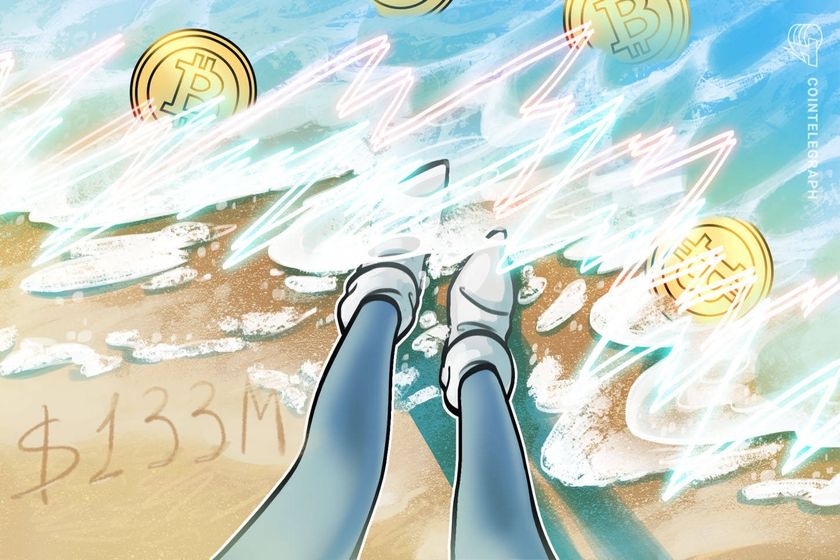 US-listed spot Bitcoin ETFs have shed $238 million this week, potentially setting up the first five-week outflow streak since March 2025. US-listed spot Bitcoin exchange-traded funds (ETFs) continued to bleed on Wednesday as market sentiment remained negative and BTC briefly dipped below $66,000. Spot Bitcoin ETFs recorded $133.3 million in net outflows on Wednesday, bringing weekly losses to $238 million, according to SoSoValue data. BlackRock’s iShares Bitcoin Trust (IBIT) led outflows, with over $84 million exiting. Trading volumes remained subdued at less than $3 billion, highlighting a persistent lack of activity even as analysts had previously noted potential inflection points amid the slowdown in outflows. Read more
 -
Cointelegraph.com - 06:55 Feb 19, 2026
 Address poisoning works by cluttering your transaction history with fake entries, tricking you into sending funds to a scammer’s address by mistake. Address poisoning exploits behavior, not private keys. Attackers manipulate transaction history and rely on users mistakenly copying a malicious lookalike address. Cases such as the 50-million-USDT loss in 2025 and the 3.5 wBTC drain in February 2026 demonstrate how simple interface deception can lead to massive financial damage. Copy buttons, visible transaction history and unfiltered dust transfers make poisoned addresses appear trustworthy within wallet interfaces. Read more
 -
Cointelegraph.com - 01:20 Feb 19, 2026
 OpenAI said it is becoming increasingly important to evaluate the performance of AI agents in “economically meaningful environments” as their adoption grows. OpenAI has launched a new benchmark that evaluates how well different AI models detect, patch, and even exploit security vulnerabilities found in crypto smart contracts. OpenAI released the “EVMbench: Evaluating AI Agents on Smart Contract Security” paper on Wednesday, in collaboration with crypto investment firm Paradigm and crypto security firm OtterSec, to evaluate how much the AI agents could theoretically exploit from 120 smart contract vulnerabilities. Anthropic’s Claude Opus 4.6 came out on top with an average “detect award” of $37,824, followed by OpenAI’s OC-GPT-5.2 and Google’s Gemini 3 Pro at $31,623 and $25,112, respectively. Read more
 -
Cointelegraph.com - 23:30 Feb 18, 2026
 A drop in Solana’s dApp revenues, along with limited institutional and retail investor interest, adds vulnerability to SOL’s $78 support. Key takeaways: SOL is struggling to hold $80 as a 75% drop in futures' open interest shows that traders are heading for the exits rather than opening new bets. Solana remains heavily dependent on retail and memecoin activity, while Ethereum maintains its lead in high-value decentralized finance. Read more
 -
Cointelegraph.com - 22:45 Feb 18, 2026
 Bitcoin’s “short-term holder stress” metric has fallen to lows not seen since 2018, suggesting the market has capitulated and possibly bottomed. A key Bitcoin (BTC) on-chain metric is flashing its most extreme capitulation signal since 2018, hinting at a potential cycle-low setup. Bitcoin’s short-term holder stress has dropped to its lowest level since the 2018 bear market bottom, according to new on-chain data from Checkonchain. The Short-Term Holder (STH) Bollinger Band metric shows the oscillator falling into its deepest oversold territory in nearly eight years. Read more
 -
Cointelegraph.com - 22:02 Feb 18, 2026
 The Base engineering team said the protocol would remain open-source and encouraged developers to continue building unique implementations. Base, a decentralized Ethereum layer-2 scaling network, said Wednesday that it is transitioning from running on L2 blockchain protocol Optimism’s tech stack to running on its own, unified software architecture. Launched in 2023 as an Optimism chain, Base is shifting to its own tech stack to reduce dependencies on external service providers and shorten the time it takes to ship new upgrades, according to an announcement from Base. The team said: The transition is also expected to simplify the Base network’s sequencer, which helps network validators to order transactions, the Base engineering team said. Read more
 -
Cointelegraph.com - 21:52 Feb 18, 2026
 The crypto exchange's parent company acquired several platforms in 2025 while confidentially filing for an initial public offering with the SEC. Payward, the parent company of cryptocurrency exchange Kraken, has acquired tokenization platform Magna, expanding the company’s infrastructure. Kraken said Wednesday the acquisition would allow Magna to operate “as a standalone platform, powered by” the crypto exchange. The company’s announcement said Kraken would use the platform for “onchain and offchain vesting, white-label token claims, custody and escrow workflows, specialized staking functionality” and other functions. “Joining Kraken gives us the resources to support existing and new clients with institutional-grade infrastructure, deeper liquidity, and global distribution,” said Magna CEO Bruno Faviero. Read more
 -
Cointelegraph.com - 21:45 Feb 18, 2026
 SOL price looks bearish on multiple chart timeframes, leading analysts to put a short-term target on $50. Will the “extreme” state of SOL’s MVRV indicator prevent another price crash? Solana’s SOL (SOL) continues to be battered by bearish headwinds since collapsing to $67 on Feb. 6. SOL is more than 72% below its all-time high of $295, and several metrics suggest that the downside may be far from over. Key takeaways: Solana’s bearish technical patterns lean toward a $50 price target. Read more
 -
Cointelegraph.com - 21:00 Feb 18, 2026
 Net selling from altcoins topped $209 billion, far outpacing the sell volumes seen during Bitcoin's five-month sell-off. Will these traders reposition into Bitcoin? Altcoins, excluding Ether (ETH), have recorded $209 billion in net selling volume since January 2025, marking one of the steepest declines in speculative demand for crypto assets this cycle. On Binance, altcoin trading volumes dropped roughly 50% since November 2025, reflecting a steady dip in activity. The decrease also coincides with an increase in Bitcoin’s volume share on the exchange. Analysts said that the contraction in altcoin demand, alongside elevated stablecoin dominance, signals that the broader market is shifting its capital toward BTC during the current downtrend. Read more
 -
Cointelegraph.com - 20:29 Feb 18, 2026
 The decentralized exchange has begun offering crypto perpetual swaps after receiving a test license from Bermuda’s regulator, operating under DAO governance and formal oversight. DerivaDEX has launched a Bermuda-licensed crypto derivatives platform, becoming what it says is the first DAO-governed decentralized exchange to operate under formal regulatory approval. According to a statement from the platform, the exchange received a T license from the Bermuda Monetary Authority and has begun offering crypto perpetual swaps trading to a limited number of advanced retail and institutional participants. The BMA’s T, or test license, is issued for a digital asset business seeking to test a proof of concept. Read more
 -
Cointelegraph.com - 20:11 Feb 18, 2026
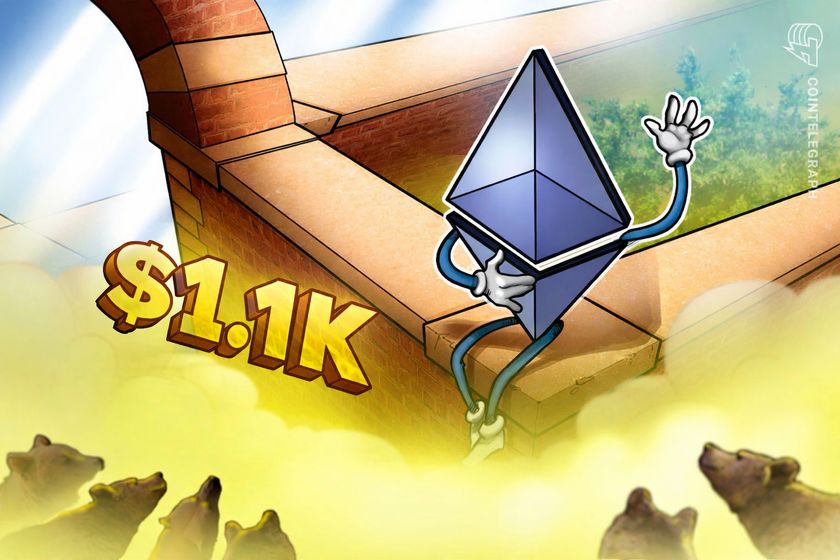 Ethereum onchain data and a bear pennant on the daily chart suggest that bears may target the $1,100 level. Would a dip to that zone represent a generational buy opportunity? Ether (ETH) price printed a bear pennant on the daily chart, a technical chart formation associated with strong downward momentum. This weakening technical setup and declining network activity may signal the continuation of ETH’s bear trend and possibly send the altcoin’s price to $1,100. A bear pennant pattern is a bearish setup that forms after the price consolidates inside an up-sloping triangle following a sharp price drop. The pennant will resolve once the price breaks below the lower trend line of the pennant at $1,950. If this happens, the ETH/USD pair could drop by as much as the previous downtrend’s height. This places the measured target for ETH price at $1,100, down 43% from the current price. Read more
 -
Cointelegraph.com - 19:52 Feb 18, 2026
 Starboard Value said that “time is of the essence,” stressing urgency in Riot getting “more material deals completed” related to AI and HPC. An activist Riot Platform shareholder is pressing the crypto mining company to accelerate its pivot to high-performance computing (HPC) and artificial intelligence. In a Wednesday letter to executives, Starboard Value, which holds about 12.7 million shares of Riot, said that the company could generate between $9 billion to $21 billion in equity value contribution from AI/HPC data centers in Texas. The shareholder said that “time is of the essence,” stressing urgency in getting “more material deals completed” as it moves deeper into AI and HPC. “With 1.4 [gigawatts] of gross capacity remaining to be monetized, Riot is in an enviable position – but it must execute with excellence and urgency,” said Starboard. “We believe Riot should be able to attract high-quality tenants for tier-3 data centers with terms similar to or better than the peer transactions announced towards t...
 -
Cointelegraph.com - 18:45 Feb 18, 2026
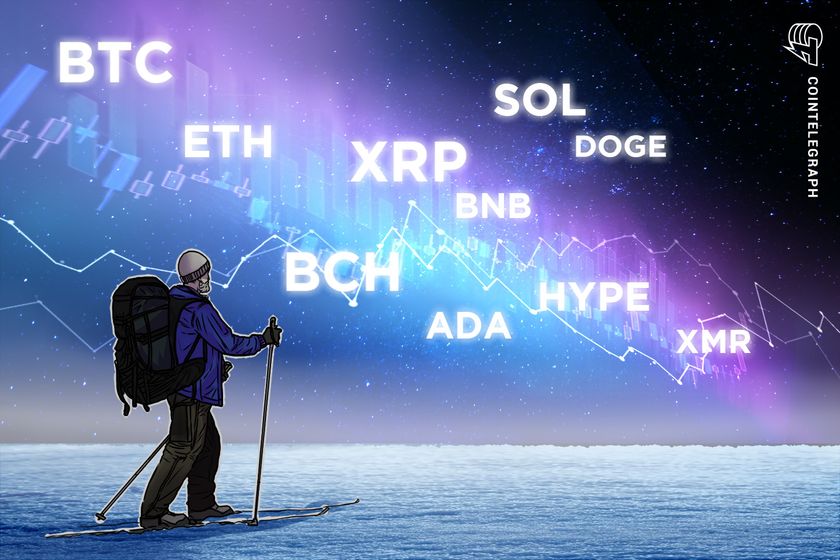 Technical charts show Bitcoin price hanging on to softening support in the $68,000 to $65,000 zone, and a breakdown below the level could usher in new lows in the $50,000 range. Key points: Bitcoin remains under pressure, and the downside might accelerate if the $65,118 level is breached. Several major altcoins are attempting a recovery, but the bears remain sellers on rallies. Read more
 -
Cointelegraph.com - 18:10 Feb 18, 2026
 New Keyrock research finds not all newly created money impacts risk assets due to how fresh liquidity flows through the economy. Treasury bill issuance is the primary liquidity metric that impacts Bitcoin’s (BTC) price and not the Federal Reserve or any other central bank’s balance sheet, according to a new report from crypto investment firm and market maker Keyrock. Every 1% change in global liquidity levels impacts BTC’s price by 7.6% the following business quarter in which new money is created. However, not all liquidity impacts risk asset prices equally, Keyrock researcher Amir Hajian said. Treasury bill issuance has about an 80% correlation with BTC prices since 2021, and this metric leads BTC prices by about eight months, according to the report. Hajian wrote: Read more
 -
Cointelegraph.com - 17:49 Feb 18, 2026
 Two-year Bitcoin hodlers "absorbed" seller pressure in recent weeks, according to new research, but most analysts still expect new macro BTC price lows. New analysis suggests that Bitcoin (BTC) is “relying” on early 2024 buyers as its price action stalls below $70,000. Key points: Bitcoin buyers from early 2024 are in focus as a giant potential safety net for BTC price. Read more
11887 items