Cointelegraph.com
Source:
https://cointelegraph.com
Found 11887 news
-
Cointelegraph.com - 18:19 Jan 22, 2026
 An actively managed fund blends Bitcoin, precious metals and mining stocks as asset managers expand crypto’s role in macro and capital-preservation strategies. Bitwise Asset Management has launched a new exchange-traded fund (ETF) designed to hedge against currency debasement, underscoring how digital assets are increasingly being incorporated into broader macro investment strategies following the success of spot Bitcoin ETFs. On Thursday, Bitwise unveiled the Bitwise Proficio Currency Debasement ETF, which trades on the NYSE under the ticker BPRO. The actively managed fund seeks to address the declining purchasing power of fiat currencies through a portfolio that includes Bitcoin (BTC), precious metals and mining equities. Unlike spot Bitcoin ETFs, BPRO allows for discretionary allocation across crypto and commodity-linked assets. The structure appears aimed at wealth managers seeking Bitcoin exposure without committing to a single-asset crypto product, particularly amid persistent inflation concerns. Read m...
 -
Cointelegraph.com - 17:30 Jan 22, 2026
 Bitcoin's price rally to $90,000 failed to hold after 16,653 BTC were sent to exchanges, but an improving spot market suggests traders see BTC’s current pricing as discounted. Crypto exchanges saw a surge in Bitcoin (BTC) flows over the past two days, emulating a pattern seen when the market topped in July and August 2025. A total 16,653 BTC was sent to exchanges, potentially a sign that the current sell-off could deepen. Bitcoin researcher Axel Adler Jr. said that the atypical BTC exchange inflow occurred Tuesday and Wednesday, including 9,867 BTC on Tuesday and 6,786 BTC onWednesday. This sharply contrasts with January’s average daily netflow range of -2,000 to +2,000 BTC. Although the netflow has since normalized (+296 BTC), the accumulated inflows create a supply overhang near current levels. As a result, the current move toward $89,000 to $90,000 is viewed as a key resistance test. Read more
 -
Cointelegraph.com - 17:30 Jan 22, 2026
 Natix and Valeo are building a decentralized, self-driving camera model to offer a transparent foundation for the safe mainstream deployment of physical AIs. Automotive technology supplier Valeo and Natix Network, a Solana-based decentralized physical infrastructure network (DePIN) provider, have partnered to build an open-source, artificial intelligence (AI) multi-camera model aimed at improving autonomous driving systems. The two companies said Thursday they are building what they call the World Foundation Model (WFM), which they say will be able to learn and predict real-world motion, while adapting to traffic situations. The multi-camera model aims to push the boundaries of AI models from text-based understanding to real-world scenarios in physical environments, according to an announcement shared with Cointelegraph. It also aims to advance research into autonomous driving. Read more
 -
Cointelegraph.com - 17:06 Jan 22, 2026
 Former Binance CEO Changpeng Zhao said at the World Economic Forum in Davos that he is advising several governments on tokenizing state assets. Changpeng “CZ” Zhao, the former CEO of cryptocurrency exchange Binance and co-founder of YZi Labs, said he is in talks with “probably a dozen governments” about tokenizing their assets. Speaking on a panel at the World Economic Forum (WEF) in Davos, Switzerland on Thursday, Zhao said he had been engaged with several unnamed countries’ governments as part of efforts related to tokenization. The former CEO said tokenization was a “huge” proven aspect of the crypto industry, along with “exchanges and stablecoins.” “I’m talking with probably a dozen governments about tokenizing some of their assets, because this way the government can actually realize the financial gains first and use that to develop those industries,” said Zhao. Read more
 -
Cointelegraph.com - 15:00 Jan 22, 2026
 The funding will support Superstate’s effort to let companies issue and trade regulated shares directly on public blockchains. Financial technology and tokenization company Superstate has raised $82.5 million in a Series B round as it pushes deeper into onchain capital markets, aiming to modernize the way companies raise money and go public using blockchain. The round was led by Bain Capital Crypto and Distributed Global, with participation from Haun Ventures, Brevan Howard Digital, Galaxy Digital, Bullish, ParaFi and several other crypto-focused investors, according to a press release shared with Cointelegraph. “This year, tokenization will catalyze the transformation of capital markets,” said Robert Leshner, CEO of Superstate. “We're grateful to our partners that allow us to grow our best-in-class team, products, and ambitions,” he added. Read more
 -
Cointelegraph.com - 14:43 Jan 22, 2026
 US President Donald Trump has decided not to invade Greenland, which gives Bitcoin some relief from the geopolitical pressures that have been weighing on its price chart. The world breathed a small, collective sigh of relief on Wednesday when US President Donald Trump said he would not use force to take over Greenland during a rambling, hour-long speech to a crowd of world leaders in Davos. Trump argued why the US should rightly own Greenland, ostensibly as a bulwark against Russian or Chinese influence in the region. However, he walked back some worrying rhetoric about military action, stating that he would not use force to take over Greenland, which itself is an autonomous region of Denmark. He scrapped plans to use tariffs to pressure allies to go along with his acquisition plans. Indeed, he walked away from Davos with a supposed “framework of a future deal.” Bitcoin (BTC) responded positively to the news, bumping up from around $87,000 to $90,000 as the evening came to a close. Read more
 -
Cointelegraph.com - 14:00 Jan 22, 2026
 Onchain asset manager Maple is taking syrupUSDC to Coinbase’s Base network, adding institutional credit rails while pursuing Aave's Base instance next. Onchain asset manager Maple is extending its yield-bearing US dollar token, syrupUSDC, to Coinbase’s Base network, plugging institutional credit directly into a fast‑growing Ethereum layer-2 ecosystem. According to a Thursday release shared with Cointelegraph, the launch will provide the company with a “direct path” to Coinbase’s broader ecosystem of users and products, while making institutional-grade yield available to a wider base of onchain users, rather than keeping it siloed on the Ethereum mainnet. An Aave governance proposal is also currently live to onboard syrupUSDC as collateral on the Aave V3 Base Instance, if the vote passes. Read more
 -
Cointelegraph.com - 13:48 Jan 22, 2026
Using AI chatbots for legal advice matters may put attorney-client privilege at risk, and the chat logs could be used against you in court. -
Cointelegraph.com - 13:48 Jan 22, 2026
Using AI chatbots for legal advice matters may put attorney-client privilege at risk, and the chat logs could be used against you in court. -
Cointelegraph.com - 13:48 Jan 22, 2026
Using AI chatbots for legal advice matters may put attorney-client privilege at risk, and the chat logs could be used against you in court. -
Cointelegraph.com - 13:15 Jan 22, 2026
 Pantera Capital predicts a year of significant consolidation for corporate crypto treasuries, with a few large players dominating digital asset demand while smaller ones get bought up. Digital asset treasury (DAT) companies are likely to face consolidation in 2026, as the largest, best-capitalized players continue to accumulate Bitcoin and Ether while smaller companies struggle to keep pace, according to Pantera Capital. DATs are set for “brutal pruning” in 2026, with only a few dominant corporate treasuries left standing, predicted asset manager Pantera Capital in a Wednesday X post. “Everyone else gets acquired or left behind except for a longer-tail token winner going along for the ride.” So far this year, the pattern has been most visible in Bitcoin (BTC) and Ether (ETH) treasuries, where the most well-funded players have dominated acquisitions. Read more
 -
Cointelegraph.com - 13:00 Jan 22, 2026
 Elliptic said the ruble-backed A7A5 token functioned as a bridge into USDT markets before sanctions and exchange controls curbed its growth. A ruble-backed stablecoin linked to sanctioned Russian financial networks processed more than $100 billion in onchain transactions in less than a year, according to a new report from blockchain analytics firm Elliptic. In a report published Thursday, Elliptic said the A7A5 stablecoin was designed to operate within a broader framework intended to reduce exposure to Western financial sanctions. The structure allowed Russian-linked businesses to move value through crypto markets while limiting the risk of asset freezes. Elliptic found that A7A5’s activity surged following its launch in early 2025, before slowing down in the second half of the year as sanctions and compliance actions taken by exchanges and token issuers started to restrict its usability. Read more
 -
Cointelegraph.com - 12:50 Jan 22, 2026
 Bitcoin long-term holders of two years or more broke records during 2024 and 2025, says a new analysis of the latest bull market. Bitcoin (BTC) is seeing record selling from old hands, but the trend began far below current prices. Key points: Bitcoin long-term holders have beaten records with their sales over the past two years. Read more
 -
Cointelegraph.com - 12:30 Jan 22, 2026
 Bitcoin’s 20-year quantum timeline collapses. 25% of the Bitcoin supply sits in vulnerable addresses requiring urgent migration. Opinion by: Youssef El Maddarsi, chief business officer of Naoris Protocol Some Bitcoin (BTC) advocates argue that the network faces no meaningful quantum threat in the immediate future, pointing to emerging NIST-approved post-quantum standards and suggesting that Bitcoin can simply upgrade long before any cryptographically relevant quantum computer appears. This confidence relies on the risky assumption that the quantum threat begins only once a machine can break keys in real time. Adam Back argued that Bitcoin has at least 20-40 years to ready itself, but the quantum threat is already active today. Bitcoin cannot rely on a leisurely multi-decade upgrade path. Read more
 -
Cointelegraph.com - 12:27 Jan 22, 2026
 At the World Economic Forum, Circle CEO Jeremy Allaire rejected claims that stablecoin yields could spark bank runs, pointing to money market funds and broader shifts in finance. Jeremy Allaire, CEO of the publicly listed stablecoin issuer Circle, said interest payments on stablecoins do not pose a threat to banks. Speaking Thursday at the World Economic Forum in Davos, Allaire described concerns that stablecoin yields could cause bank runs as “totally absurd,” citing historical precedents and existing reward-based financial services already in use. “They help with stickiness, they help with customer traction,” Allaire said, adding that interest itself is not large enough to undermine monetary policy. Read more
 -
Cointelegraph.com - 11:51 Jan 22, 2026
 Despite Ether’s latest recovery to $3,000, data suggests that ETH price may see a deeper correction to $1,850 if key support levels don’t hold. Ether (ETH) has made modest gains over the last 24 hours, briefly reclaiming the $3,000 psychological level. However, decreased ETH demand, evidenced by heavy outflows from spot Ethereum exchange-traded funds (ETFs), and a weakening technical structure could see Ether drop to levels below $2,000 over the coming weeks. Key takeaways: Decreasing Ethereum demand and negative spot Ether ETF flows signal aggressive distribution. Read more
 -
Cointelegraph.com - 11:25 Jan 22, 2026
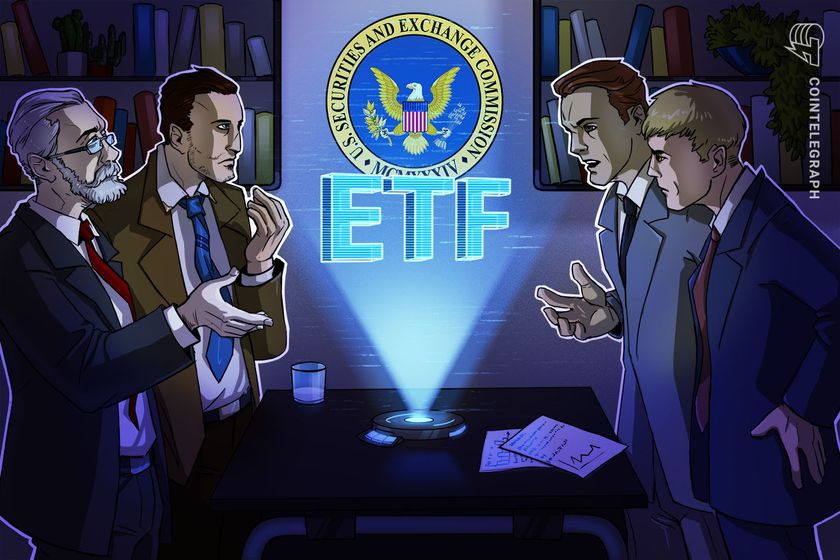 F/m Investments seeks SEC relief to record ownership of its $6 billion Treasury ETF on a permissioned blockchain as tokenization spreads on Wall Street. F/m Investments asked the United States Securities and Exchange Commission (SEC) to allow it to tokenize shares of its flagship Treasury exchange-traded fund (ETF). The $18 billion asset manager filed Wednesday for exemptive relief to let the F/m US Treasury 3 Month Bill ETF (TBIL) record ownership of its roughly $6 billion in shares on a permissioned blockchain, while remaining a standard 1940 Act exchange‑traded fund. In its press release, F/m describes the filing as the “first of its kind” from an ETF issuer seeking US regulatory relief specifically for tokenized shares of a registered investment company. Read more
 -
Cointelegraph.com - 11:14 Jan 22, 2026
 The fund targets institutional investors seeking returns beyond traditional long-only, “vanilla” Bitcoin exposure. The digital asset arm of Nomura is launching a new yield-focused Bitcoin investment product, as asset managers look to offer institutional investors returns beyond simple price exposure. Laser Digital is launching the Bitcoin Diversified Yield Fund (BDYF) to address a growing market demand for tokenized yield-driven funds over “vanilla long-only funds,” according to a Thursday announcement shared with Cointelegraph. Unlike traditional long-only Bitcoin (BTC) funds, the new product seeks to produce income by deploying diversified strategies intended to generate yield while maintaining exposure to Bitcoin, according to Laser Digital. Read more
 -
Cointelegraph.com - 09:56 Jan 22, 2026
 The licensing move operationalizes Vietnam’s crypto pilot, though regulators have yet to confirm receiving or approving any exchange applications. Vietnam began accepting applications for licenses to operate digital asset trading platforms, marking the operational start of the country’s long-planned pilot program for a regulated crypto market. The State Securities Commission of Vietnam (SSC) officially opened the licensing window on Tuesday, following the issuance of new administrative procedures under Decision No. 96 by the Ministry of Finance of Vietnam, which implements a resolution on piloting a regulated crypto asset market. “Applications for the aforementioned administrative procedures will be accepted beginning January 20, 2026,” the SSC said, framing the move as part of a broader effort to bring crypto under formal regulatory oversight. Read more
 -
Cointelegraph.com - 09:45 Jan 22, 2026
 The initiative comes as enforcement actions and pending market structure legislation raise questions about how privacy tools and open-source developers are treated. The Bitcoin Policy Institute (BPI), Fedi and Cornell University are launching a two‑year study on how Americans view financial privacy, the trade‑offs they will accept and how regulation shapes their behavior. The initiative brings together a Bitcoin (BTC) wallet company with an academic center and a policy think tank, aiming to connect how privacy tools are built, researched and ultimately governed. According to Fedi and BPI, the research will combine quantitative surveys with qualitative interviews to examine attitudes toward financial privacy and their evolution. Read more
11887 items