Chinese | Crypto
"Chinese" in Crypto feed
-
Cointelegraph.com - 11:43 Mar 12, 2026
 Chinese investors defrauded in the Zhimin Qian case are asking the UK High Court to reject a redress plan for 61,000 seized Bitcoin, saying it could deprive them of the assets’ gains. Victims of a Chinese investment fraud are challenging a United Kingdom proposal to compensate them through a Chinese redress scheme, arguing the plan could leave British authorities holding much of the upside from roughly 61,000 Bitcoin seized in a money-laundering investigation. According to the Financial Times, citing court documents, the dispute has moved into the UK High Court as groups representing victims seek to recover funds linked to the cryptocurrency seized by police in London. The Bitcoin (BTC) haul is now worth about 3.2 billion pounds ($4.3 billion) after rising sharply in value since the assets were confiscated. Law firm Candey, which represents about 5,700 victims, said the proposed compensation arrangement may not guarantee fair restitution. The fraud scheme itself reportedly affected more than 128,000 investors...
 -
Cointelegraph.com - 11:42 Mar 10, 2026
 Dominari Securities, tied to Eric Trump and Donald Trump Jr., is among the brokerages named in the congressional probe. US lawmakers have launched an investigation into several Wall Street underwriters, including Dominari Securities, whose parent company is linked to the Trump family, over their role in bringing Chinese companies to US stock markets that were later tied to stock manipulation schemes. On Monday, the House of Representatives Select Committee on China, chaired by Representative John Moolenaar with Rep. Ro Khanna as ranking member, sent letters to three US companies — D. Boral Capital, Dominari Securities and Revere Securities — seeking information about Chinese initial public offerings (IPOs) they helped underwrite. “These scam centers defraud American households through coordinated “ramp-and-dump” stock manipulation schemes involving Chinese shell companies listed on American exchanges, which your firm appears to facilitate,” the lawmakers wrote. Read more
 -
Cointelegraph.com - 19:51 Feb 27, 2026
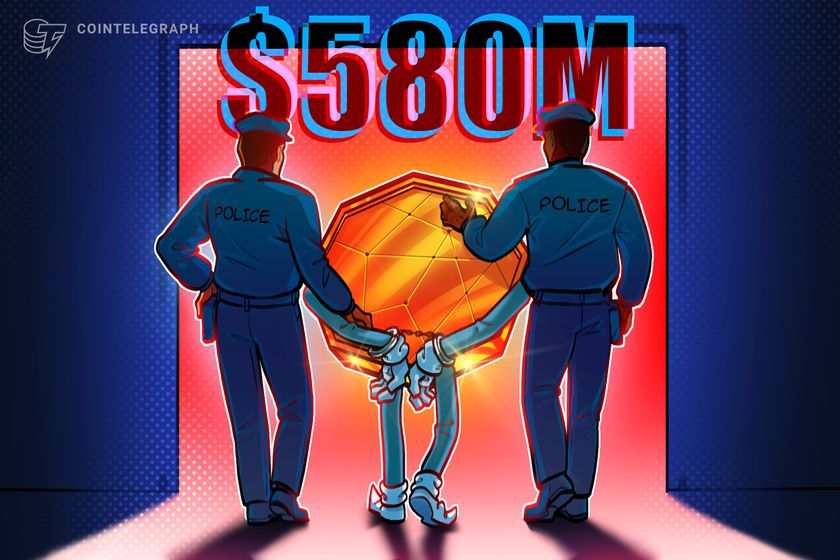 The seizures and freezing over three months were conducted by the District of Columbia’s Scam Center Strike Force, established by US Attorney Jeanine Pirro in November. Officials with the US Department of Justice reported “freezing, seizing, and forfeiting” more than $578 million worth of digital assets tied to criminal groups as part of a task force’s efforts targeting “Southeast Asian cryptocurrency-related fraud and scams.” In a Thursday notice, the Justice Department said the frozen and seized crypto had been “stolen by Chinese transnational criminal organizations” using websites and social media platforms to target US residents. The actions were taken by the District of Columbia’s Scam Center Strike Force, established by former Fox News host, now US Attorney Jeanine Pirro in November. “Seizures of cryptocurrency is one important part of the Scam Center Strike Force’s work,” said Pirro. “Through the legal process, my Office will seek to forfeit these funds and return them to victims to the maximum extent...
 -
Cointelegraph.com - 22:35 Dec 29, 2025
 Viral “U cards” are quietly onboarding Chinese users to crypto, and the digital yuan can now earn depositors interest at banks. Asia Express. Stablecoins are finding an indirect path into China via payment cards going viral on social media. Locally referred to as U cards, overseas Visa or Mastercards linked to stablecoin balances such as USDT, have surged in popularity on Chinese social platform Xiaohongshu, also known as Little Red Book. Posts explain how to obtain the cards with ease and use them for everyday overseas payments, such as subscriptions to services. Such cards allow users to spend dollar-denominated stablecoins while merchants receive fiat currency, meaning Chinese businesses never directly touch crypto. Conversion is handled by overseas banks or licensed payment institutions, placing the transaction outside Chinas domestic financial rails. Read more
 -
CryptoSlate - 14:20 Dec 09, 2025
The House’s new fiscal 2026 defense bill directs the Pentagon to develop options to impose costs on state-backed hackers who target defense-critical infrastructure in cyberspace. Section 1543 of the chamber’s amendment orders the Under Secretary of Defense for Policy and the Chairman of the Joint Chiefs of Staff, highlighted by Jason Lowery, in consultation with […] The post Has Congress quietly forced the Department of War to use Bitcoin to bankrupt Chinese hackers? appeared first on CryptoSlate. -
Cointelegraph.com - 21:35 Dec 04, 2025
 The bond was auctioned off to holders of the digital yuan, a central bank digital currency (CBDC) developed by the Chinese government. Hua Xia Bank, a publicly traded financial institution linked to China’s government, issued 4.5 billion yuan ($600 million) in tokenized bonds on Wednesday, aiming to reduce clearing friction by removing intermediaries from the auction process. According to Sina, the onchain government bonds were issued by Hua Xia Financial Leasing, a subsidiary of Hua Xia Bank, a state-controlled commercial bank in China. The bonds offered a three-year fixed yield of 1.84% to holders. The $600 million bond tranche was auctioned off exclusively to holders of China’s digital renminbi, also known as the digital yuan. Read more
 -
Decrypt - 18:00 Nov 27, 2025
The U.S. is probing how Chinese operators used AI in a cyber-espionage campaign as experts warn similar tools could hit on-chain finance. -
CryptoSlate - 09:51 Nov 17, 2025
Chinese state-sponsored hackers exploited Anthropic Claude Code AI in the world’s first largely autonomous cyber-espionage campaign, proving that machine agents can now run sprawling digital attacks with only minimal human input. Anthropic and the AI alarm bell The alarm rang in mid-September at Anthropic, but this was no ordinary network blip. As Anthropic’s threat team […] The post How Anthropic stopped AI agents working for Chinese state-sponsored spy campaign appeared first on CryptoSlate. -
Cointelegraph.com - 10:50 Oct 19, 2025
 Ant Group and JD.com have paused their stablecoin initiatives in Hong Kong after Beijing regulators raised concerns over private firms issuing digital currencies. Chinese technology giants, including Ant Group and JD.com, have reportedly suspended plans to issue stablecoins in Hong Kong after regulators in Beijing voiced concerns over privately controlled digital currencies. The companies were instructed by the People’s Bank of China (PBoC) and the Cyberspace Administration of China (CAC) to pause these initiatives, the Financial Times reported on Sunday, citing sources familiar with the matter. “The real regulatory concern is, who has the ultimate right of coinage — the central bank or any private companies on the market?” one source familiar with the discussions told the FT. Read more
 -
CryptoSlate - 15:57 Oct 14, 2025
The US government is moving to seize 127,271 Bitcoin worth about $14.2 billion, which investigators say was generated through a cross-border “pig butchering” scam operated by Chinese national Chen Zhi. If completed, the Bitcoin should be added to the U.S.’s Strategic Bitcoin Reserve according to the terms of Trump’s Executive Order issued earlier this year. […] The post US to add $14 billion BTC to Strategic Bitcoin Reserve seized from Chinese scammer appeared first on CryptoSlate. -
Cointelegraph.com - 23:04 Sep 11, 2025
 Thailand’s SEC probes a major mystery crypto hack hidden for years. Chinese property developer turns back to blockchain. Asia Express. Thailands Securities and Exchange Commission (SEC) said it is reviewing reports circulating on social media that claim a major local cryptocurrency exchange was hacked. On Sunday, Thai social media channel The Big Secret posted an image of what it described as an internal document detailing a large-scale breach. The document, which has not been verified, had its date and related blockchain addresses redacted. Following the post, several exchanges issued statements assuring customers that their assets remain safe. The exchange allegedly involved has not been publicly identified. Read more
 -
Cointelegraph.com - 23:04 Sep 11, 2025
Thailand’s SEC probes a major mystery crypto hack hidden for years. Chinese property developer turns back to blockchain. Asia Express. Thailands Securities and Exchange Commission (SEC) said it is reviewing reports circulating on social media that claim a major local cryptocurrency exchange was hacked. On Sunday, Thai social media channel The Big Secret posted an image of what it described as an internal document detailing a large-scale breach. The document, which has not been verified, had its date and related blockchain addresses redacted. Following the post, several exchanges issued statements assuring customers that their assets remain safe. The exchange allegedly involved has not been publicly identified. Read more -
Cointelegraph.com - 13:52 Sep 11, 2025
 Chinese regulators are reportedly preparing to restrict mainland state-owned enterprises and banks from pursuing stablecoin and crypto initiatives in Hong Kong. Chinese internet giants, state-owned enterprises and financial institutions operating in Hong Kong may face restrictions on stablecoin and crypto activities. According to a Thursday report by local news outlet Caixin, mainland Chinese firms operating in Hong Kong may be forced to withdraw from cryptocurrency-related activities. The Hong Kong branches of several state-owned enterprises and Chinese banks are also expected not to participate in the race to obtain a Hong Kong stablecoin license. The news follows reports that HSBC and the Industrial and Commercial Bank of China (ICBC), the world’s largest bank by total assets, plan to apply for stablecoin licenses in Hong Kong. Hong Kong’s new stablecoin regulatory framework came into effect on Aug. 1 with a six-month transition period. Regulators said 77 institutions had expressed interest in applying. Re...
 -
Cointelegraph.com - 22:40 Sep 04, 2025
 South Korean lawmaker’s bill would make ICOs legal again. Chinese state firm deletes posts about $70M worth of RWAs on Ethereum. Asia Express. A South Korean lawmaker has introduced draft legislation to create a framework for cryptocurrencies, including legalizing initial coin offerings (ICOs) and setting rules for stablecoin issuance. The proposal, announced Thursday by ruling Democratic Party lawmaker Lee Kang-il, would lift South Koreas ban on ICOs. The nation banned the fundraising method in 2017 during a speculative frenzy remembered as the ICO boom. The prohibition pushed Korean projects to launch tokens overseas. Lees bill seeks to replace the blanket prohibition with a disclosure-based regime. The draft law defines the digital asset sector as an independent industry, dividing it into nine business categories that include trading, brokerage, custody, payments and investment management. Trading and brokerage firms would require licenses, while other activities would operate under a registration system. ...
 -
Cointelegraph.com - 22:40 Sep 04, 2025
South Korean lawmaker’s bill would make ICOs legal again. Chinese state firm deletes posts about $70M worth of RWAs on Ethereum. Asia Express. A South Korean lawmaker has introduced draft legislation to create a framework for cryptocurrencies, including legalizing initial coin offerings (ICOs) and setting rules for stablecoin issuance. The proposal, announced Thursday by ruling Democratic Party lawmaker Lee Kang-il, would lift South Koreas ban enacted in 2017 during a speculative frenzy remembered as the ICO boom. The prohibition pushed Korean projects to launch tokens overseas. Lees bill seeks to replace the blanket prohibition with a disclosure-based regime. The draft law defines the digital asset sector as an independent industry, dividing it into nine business categories that include trading, brokerage, custody, payments and investment management. Trading and brokerage firms would require licenses, while other activities would operate under a registration system. Read more -
Cointelegraph.com - 12:04 Jul 21, 2025
 Chinese blockchain Conflux launched Conflux 3.0 network and unveiled a new offshore yuan-backed stablecoin targeting “Belt and Road” cross-border payments. Chinese blockchain Conflux announced a third version of its public network and introduced a new stablecoin backed by offshore Chinese yuan. According to a report from the Shanghai municipal government on Sunday, Conflux announced the developments during a three-day conference over the weekend. At the event, Conflux unveiled a partnership with fintech firm AnchorX and information technology security firm Eastcompeace to support the launch of an offshore yuan-backed stablecoin. The news follows AnchorX receiving in-principle approval for its yuan-pegged stablecoin AxCNH by Kazakhstan’s regulator, the Astana Financial Services Authority, in late February. It is unclear whether Conflux’s stablecoin is AxCNH or a separate project, and the involved companies had not responded to Cointelegraph’s inquiries by publication. Read more
 -
CryptoSlate - 19:56 Jul 10, 2025
The Beijing Internet Finance Industry Association (BIFA) issued a notice on July 9 urging retail investors to reject pitchbooks that wrap old-style pyramid sales in crypto terminology. According to local news outlets, BIFA said promoters have begun advertising “stablecoin wealth plans,” “Web 3.0 dividends,” and similar offers that promise fixed returns. The circular listed five […] The post Chinese industry group warns Web3 and DeFi high-return deals hide classic Ponzi engines appeared first on CryptoSlate. -
Cointelegraph.com - 21:55 Jul 09, 2025
 The motion to pause repayments to residents of certain countries has added a new wrinkle to the FTX saga. A Chinese creditor has filed an objection to a motion from the FTX estate that would pause payouts to residents in jurisdictions with laws or regulations restricting cryptocurrency transactions, according to a Tuesday court filing. The creditor, Weiwei Ji, stated that although they reside in Singapore, they have been classified as a Chinese creditor due to holding a Chinese passport. Ji noted that the objection was submitted on behalf of Ji and a growing group of Chinese creditors — reportedly over 300 individuals, according to the filing. The objection raises two key arguments: First, that FTX settlements are made in US dollars, which are a standard legal repayment method. Second, it notes that cryptocurrency distributions are legal in China, with digital assets constituting “personal property.” “My family holds four KYC-verified accounts with aggregate claims exceeding $15 million USD… We have fully com...
 -
Cointelegraph.com - 14:24 May 19, 2025
 Chinese printer maker Procolored reportedly spread clipboard-hijacking Bitcoin malware via its official drivers in a supply chain attack that led to over $950,000 in stolen funds. Chinese printer manufacturer Procolored distributed Bitcoin-stealing malware alongside its official drivers, according to local media reports. Chinese news outlet Landian News reported on May 19 that Shenzhen-based printer company Procolored has been distributing Bitcoin-stealing (BTC) malware alongside official drivers. The company reportedly used USB drivers to distribute malware-ridden drivers and uploaded the compromised software to cloud storage for global download. A total of 9.3 BTC worth over $953,000 have been stolen, according to the report. Crypto tracking and compliance firm Slow Mist described how the malware operates in a May 19 X post: Read more
 -
Cointelegraph.com - 22:40 May 15, 2025
Binance Wallet “killing” competition and airdrops, K-drama actress embezzles $3M, Chinese firm to issue RWAs in Hong Kong. Asia Express. Cryptocurrency exchange Binances wallet has surged out of nowhere in 2025 to become the dominant in the industry. It closed the week starting on May 5 with an 86% share of the swap market, and so far, in the week starting on May 12, its at 93%, according to Dune Analytics data. At the first full week of the year, Binance Wallet controlled a measly 3.4% while OKX led the industry with 44.6% of the market, with MetaMask and imToken each at around 18.5%. Read more