Ethereum | Crypto
"Ethereum" in Crypto feed
-
Decrypt - 17:21 Jun 25, 2025
After dropping crypto in 2023, SoFi is getting back in the game with Bitcoin and Ethereum trading, stablecoins, lending, and beyond. -
Cointelegraph.com - 15:17 Jun 25, 2025
 ETH’s two-week chart signals a bearish crossover, resembling a 2022 setup that preceded a 40% decline in the price of Ether. Key takeaways: Ethereum has printed its first two-week death cross since 2022, historically linked to a ~40% price drop. ETH faces downside risks while trading below two key trendlines. Read more
 -
Decrypt - 20:18 Jun 23, 2025
Cardano-powered privacy network Midnight will offer NIGHT tokens in an airdrop to millions of crypto users on Bitcoin, Ethereum, and beyond. -
Cointelegraph.com - 16:03 Jun 22, 2025
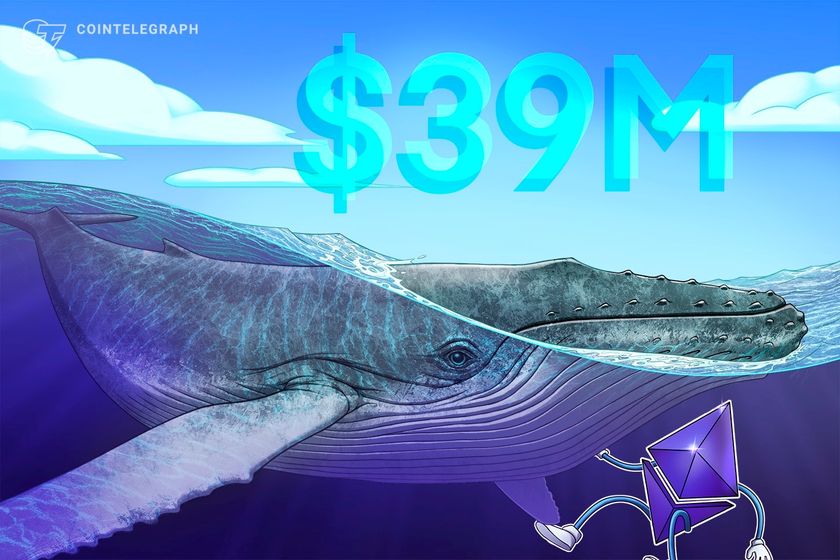 Technical patterns point to a potential 25% rebound in Ether’s price, with whales scooping $263.5 million worth of ETH during the price dip. Key takeaways: An Ethereum whale accumulated $39 million in ETH during a sharp market sell-off triggered by US airstrikes on Iran. Ethereum mega-whales added over 116,000 ETH on June 21, signaling strong buy-the-dip sentiment. Read more
 -
CryptoSlate - 13:21 Jun 19, 2025
The amount of Ethereum (ETH) held in strategic reserves is nearing a critical benchmark, with nearly 1% of the crypto’s total circulating supply now held by major organizations and institutions. Data from the Strategic ETH Reserve shows that approximately 1,167,712 ETH, valued at nearly $2.96 billion, is currently designated as a strategic holding. This figure […] The post Ethereum’s strategic reserves hit nearly 1% of supply as top holders dominate appeared first on CryptoSlate. -
Cointelegraph.com - 18:40 Jun 18, 2025
 Ethereum staking yields are falling as yield-bearing stablecoins and DeFi protocols offer more competitive returns. Can ETH regain the upper hand in the yield wars? Key takeaways Ethereum’s staking yield dropped under 3%, putting it behind many DeFi and RWA protocols. Yield-bearing stablecoins like sUSDe and SyrupUSDC now offer 4–6.5% returns and are rapidly gaining market share. Read more
 -
Cryptonews.com - 21:43 Jun 16, 2025
Trump Media & Technology Group has sought SEC approval for an ETF holding Bitcoin and Ethereum in a 75-25 split, with Crypto.com as custodian and Yorkville Digital as sponsor. The company has also unveiled a U.S.-made $499 “Trump Mobile” phone and service targeting a September rollout. The post Trump’s Truth Social Wants to Launch a Bitcoin & Ethereum ETF – Here’s What That Could Mean appeared first on Cryptonews. -
Cointelegraph.com - 17:45 Jun 16, 2025
 Ether price has significantly underperformed in 2025, but institutional demand for Ethereum staking is growing, says Lido Foundation’s Kean Gilbert. Ether has significantly underperformed Bitcoin and other digital assets this market cycle, but growing institutional interest in Ethereum staking is driving demand for custody solutions to support a wider range of investors, according to Kean Gilbert, head of institutional relations at the Lido Ecosystem Foundation. On May 27, Komainu, a regulated digital asset custody provider, began offering custody support for Lido Staked ETH (stETH), which is Ethereum’s largest staking token, accounting for 27% of all staked Ether (ETH). The custody solutions are available for institutional investors in Dubai, United Arab Emirates, and Jersey, the autonomous self-governing territory of the British Islands. Read more
 -
CryptoSlate - 16:51 Jun 16, 2025
Trump Media & Technology Group (TMTG), the company behind the Truth Social platform, has filed to launch a new exchange-traded fund (ETF) that would track Bitcoin and Ethereum. The filing, submitted to the US Securities and Exchange Commission (SEC) on June 16, marks a bold move in the firm’s shift toward digital finance. According to […] The post Trump Media files for groundbreaking Bitcoin and Ethereum ETF appeared first on CryptoSlate. -
Decrypt - 15:37 Jun 16, 2025
President Trump's company plans to launch a joint Bitcoin and Ethereum ETF under the Truth Social name, following a solo Bitcoin ETF filing. -
Cointelegraph.com - 11:26 Jun 16, 2025
 Ethereum's drivers are now different, but the ETH price is consolidating in a multimonth range, echoing its 2017 chart pattern, which resulted in a 1,000% rally. Key takeaways: Ethereum whales accumulated over 818,000 ETH ($2.5 billion) on Sunday, their biggest daily inflow since 2018. ETH price is consolidating inside a multimonth range, mirroring its 2017 breakout pattern. Read more
 -
CryptoSlate - 18:00 Jun 15, 2025
Welcome to Slate Sundays, CryptoSlate’s new weekly feature showcasing in-depth interviews, expert analysis, and thought-provoking op-eds that go beyond the headlines to explore the ideas and voices shaping the future of crypto. Alon Muroch is a man on a mission. As the founder of SSV Labs, which contributes to the second-largest Ethereum staking infra provider, SSV […] The post Ethereum at a crossroads: SSV founder Alon Muroch on the ‘dangerous’ divergence affecting crypto’s number 2 coin appeared first on CryptoSlate. -
CryptoSlate - 15:46 Jun 13, 2025
SharpLink Gaming has established a significant Ethereum reserve, acquiring more than 176,000 ETH at an average price of $2,626 per token, according to a statement released on June 13. The $463 million investment marks the company as the first Nasdaq-listed firm to implement an Ethereum-focused treasury strategy. In addition, the company is the largest public […] The post SharpLink’s record $463M Ethereum acquisition fails to prevent 67% decline in stock appeared first on CryptoSlate. -
Decrypt - 21:41 Jun 12, 2025
Long position liquidations are rapidly piling up as Bitcoin, Ethereum, Dogecoin, and Solana losses accelerate Thursday. -
CryptoSlate - 17:00 Jun 11, 2025
Ethereum has surged more than 5% in the past 24 hours, climbing above $2,860 to reach its highest price since February. The rally comes amid rising activity in the derivatives market, signaling strong market conviction behind the move. On-chain data suggests that rising futures interest is driving much of the market’s current enthusiasm. Open interest, […] The post Ethereum open interest hits all-time high as price rises to 4-month high appeared first on CryptoSlate. -
Cointelegraph.com - 16:10 Jun 11, 2025
 ETH price rising to around $2,850 drove the whale’s $11 million leveraged long into $366,000 paper profit. Key takeaways: An Ethereum whale opened a $11.15M leveraged long position just as ETH broke out of a bull flag. ETH’s price surged above $2,850, pushing the whale’s trade into a $366K unrealized profit. Read more
 -
Cointelegraph.com - 17:03 Jun 10, 2025
 Ethereum’s dominance in staking, the spot crypto ETFs, and improving investor sentiment all point toward a sustained ETH price rally. Key takeaways: ETH’s price gains are driven by an uptick in network activity and robust spot ETF inflows. Data suggests $2,800 will remain a difficult hurdle for ETH to overcome. Read more
 -
CryptoSlate - 12:38 Jun 10, 2025
Staked ETH has reached a new all-time high of 34,824,875 ETH. The total represents 28.15% of the Ethereum supply now locked in staking contracts. The validator count stands at 1,088,277, and staking activity is pushing upward after a period of consolidation and a brief decline earlier in the month. Lido remains the leading staking entity, […] The post Staked ETH hits new all-time high, capturing 28% of total Ethereum supply amid 9% price surge appeared first on CryptoSlate. -
Cointelegraph.com - 21:30 Jun 09, 2025
 Rising futures open interest, robust spot ETH ETF flows, and a bullish technical analysis indicator forecast an Ethereum price rally to $3,000. Key takeaways: Ether futures open interest has surged 40% in 30 days, while the spot ETH ETFs marked four consecutive weeks of inflows. ETH’s Gaussian channel indicator suggests a rally to $3,100 to $3,600 could occur. Read more
 -
Cointelegraph.com - 12:25 Jun 09, 2025
 A new Ethereum privacy proposal suggests modular design and privacy tech can help the network align with EU GDPR rules while preserving decentralization. As the Ethereum ecosystem and its core principles evolve to address data privacy concerns, a new proposal recommends a modular compliance strategy as a path to reconcile public blockchains with the European Union’s General Data Protection Regulation (GDPR). On Monday, a proposal drafted by Ethereum community member Eugenio Reggianini suggested the use of modular architecture for effective data management and privacy. “By pushing personal data to the edges (wallets and DApps), using offchain storage with metadata-erasure, and splitting roles cryptographically, we can focus GDPR controller duties on a small set of entities, while the wider network becomes mere processors or falls out of scope,” Reggianini said. Read more