Qubic | Crypto
"Qubic" in Crypto feed
-
Cointelegraph.com - 23:26 Oct 20, 2026
 The network’s validators approved a recovery plan and opened claims until May 1, 2027. Layer-1 blockchain Qubic has restarted its network and launched a recovery process after a wallet seed vulnerability allowed an attacker to drain roughly $1.4 million in QU tokens from 1,404 accounts, according to the project’s latest update. Qubic’s blockchain explorer shows the network resumed processing ticks 8:00 pm on Oct. 19, advancing beyond tick 85,371,949, where it was halted on Sunday. Qubic said its network validators, known as Computors, had approved a recovery plan and that the project had launched a claims platform for affected wallet holders. Read more
-
Cointelegraph.com - 01:03 Oct 19, 2026
 Qubic says 87.1% of the stolen funds remain onchain and the rest were frozen at crypto exchange MEXC, as network validators prepare to vote on a recovery plan. Layer-1 blockchain network Qubic halted operations Sunday after an attacker reportedly exploited weakly generated wallet seeds to drain approximately $1.4 million from more than 1,400 accounts, according to the project. In a statement on X, Qubic said the network was halted at tick 85,371,949, where it remains paused at the time of writing. Qubic said the vulnerability affected wallet seeds generated using any browser on an iPhone or iPad, Safari on a Mac until Oct. 18, 2026, or the Qubic iOS app before July 2025, leading to 2.94 trillion Qubit (QU) stolen. “87.1% of the drained funds never left the Qubic network and remain frozen in place,” said Qubic. “The remaining 12.9% was sent to MEXC, whose team froze the receiving account within about an hour.” Read more
-
Cointelegraph.com - 21:48 Aug 17, 2025
 The community for Qubic, an AI-focused blockchain project, voted to target the Dogecoin network over Zcash and Kaspa by a wide margin. The community for Qubic, the AI-focused blockchain project that executed a 51% attack on Monero this week and gained majority control of the network’s computing power, has voted to target Dogecoin (DOGE) next. Sergey Ivancheglo, the founder of the Qubic network, asked the Qubic community which application-specific integrated circuit (ASIC)-enabled, proof-of-work blockchain the group should target with its next 51% attack, including DOGE, Kaspa (KAS), and Zcash (ZEC). “The Qubic community has chosen Dogecoin,” Ivancheglo, who goes by the online handle Come-from-Beyond, wrote in a Sunday X post announcing the results of the vote. Read more
-
Cointelegraph.com - 12:19 Aug 12, 2025
 Qubic claims it has achieved 51% control of Monero’s hashrate, prompting debate over whether the resulting six-block reorganization was a successful attack. Update (Aug. 12, 2025, at 1:30 pm UTC): This article has been updated to add a Qubic announcement. Layer-1 blockchain Qubic said it has “completed its attempt to dominate the Monero network,” claiming a month-long push culminated Monday with 51% control of Monero’s hashrate. According to a Monday blog post, the “month-long, high-stakes technical confrontation” concluded with Qubic reaching 51% of Monero’s hashrate. The effort coincided with a six-block-deep chain reorganization that discarded 60 previously valid blocks, according to the Monero Consensus Status dashboard. Read more
-
CryptoSlate - 12:07 Aug 12, 2025
The privacy-focused Monero blockchain has suffered a 51% attack, meaning the network is not controlled by a single entity. XMR dropped just shy of 9% after developers flagged the event. On Aug. 12, Sergey Ivancheglo, known in the crypto community as “Come-from-Beyond” (CFB), claimed on X that Qubic had surpassed 51% of Monero’s network hash […] The post Monero hit by critical 51% attack as Qubic gains control of network appeared first on CryptoSlate. -
Cointelegraph.com - 12:26 Aug 04, 2025
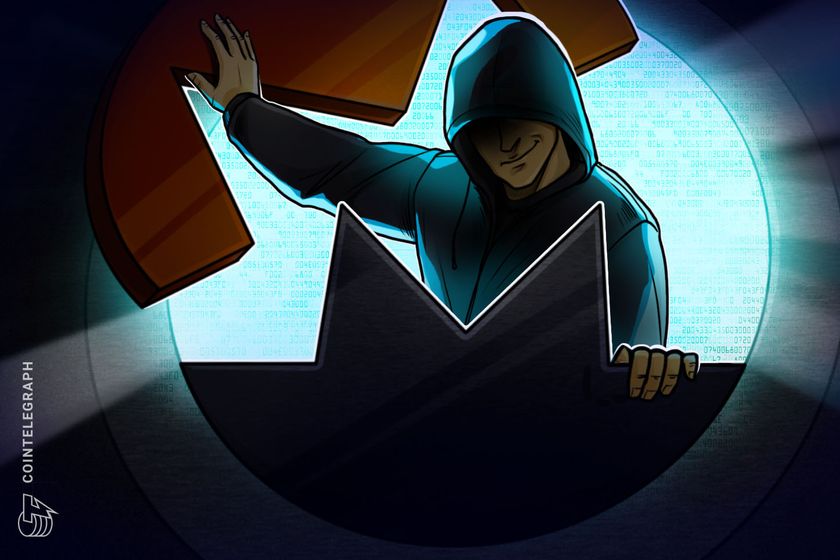 The Qubic mining pool, which is attempting a 51% takeover of Monero, is allegedly being hit by a distributed denial-of-service attack linked to the Monero community. Update (Aug. 4, 2025, at 1:50 pm UTC): This article has been updated to add commentary by XMRig developer Sergei Chernykh. A mining pool behind an attempted 51% takeover of Monero is reportedly under a distributed denial-of-service (DDoS) attack, disrupting the effectiveness of its attempt. In a Sunday X post, Sergey Ivancheglo, who claims responsibility for the takeover attempt, said the Qubic mining pool he controls is under a DDoS attack. He added that the attack resulted in the mining pool’s hashrate falling from 2.6 gigahashes per second down to 0.8 GH/s. Read more
-
CryptoSlate - 21:43 Jul 28, 2025
A fast‑moving fight over mining power consumed Monero’s weekend after Sergey Ivancheglo used X to promote an “economic” campaign to dominate the network’s hashrate, which was met by community resistance. The fight escalated after Ivancheglo, the figure behind Qubic and better known as Come‑from‑Beyond (CFB), confirmed the takeover intentions with an incentive-driven 51% attack. As […] The post Monero community pushes back as Qubic’s 51% hash rate bid falters appeared first on CryptoSlate.