Crypto
-
Cointelegraph.com - 13:30 Sep 15, 2025
 Second-generation stablecoins separate yield from principal, enabling holders to earn returns while keeping liquidity and turning static dollars into productive assets. Opinion by: Reeve Collins, co-founder of Tether and chairman of STBL Stablecoins have become the universal backbone of digital markets. Every month, trillions of dollars flow through them. Globally, they clear trades, settle remittances and provide a safe harbor for cash onchain. Yet despite their broad adoption, the original design has barely changed since 2014. The first generation of stablecoins solved one problem: how to put a reliable digital dollar on the blockchain. Tether USDt (USDT), and later USDC (USDC), delivered precisely that. Simple, fully reserved and redeemable, they gave crypto the stability it needed to grow. But they were also static, like dollars locked in a vault. Holders earned nothing while issuers captured all the yield. That structure fit the market 10 years ago. In 2025, it is no longer enough. Read more
 -
Cointelegraph.com - 13:19 Sep 15, 2025
 Helius said it will explore staking and lending opportunities to further leverage its SOL treasury, which it plans to build over the next 24 months. Nasdaq-listed Helius Medical Technologies is launching a $500 million corporate treasury reserve built around Solana, making it one of the largest Solana-focused treasury initiatives to date. The company announced Monday that it priced an oversubscribed private investment in public equity (PIPE) offering of common stock at $6.88 per share, along with stapled warrants exercisable at $10.12 for three years. The deal includes $500 million in equity and up to $750 million in warrants, assuming full exercise. Helius said it will use the net proceeds of the offering to establish a crypto treasury strategy with the Solana (SOL) token as its main reserve asset. The company said it will “significantly scale holdings over the next 12-24 months via best-in-class capital markets program incorporating ATM sales and other proven strategies.” Read more
 -
CoinDesk - 13:16 Sep 15, 2025
Uniswap (UNI) fell 9.9% and Chainlink (LINK) declined 7%, leading index lower from Friday. -
CoinDesk - 13:07 Sep 15, 2025
The firm aims to accumulate Solana's SOL, competing with recently launched Forward Industries that has bought over $1.5 billion in SOL in a week. -
Decrypt - 13:01 Sep 15, 2025
The team, led by Davide Crapis, will collaborate with Silicon Valley titans and crypto developers on making Ethereum the foundational layer of the AI ecosystem. -
CoinDesk - 13:00 Sep 15, 2025
The milestone builds on the network’s incentivized testnet, which went live in July and stress-tested Boundless’ architecture under real-world conditions. -
CoinDesk - 13:00 Sep 15, 2025
The digital passport stamps form part of Amex’s new travel app, designed to record and commemorate the travel experience. -
Cointelegraph.com - 12:44 Sep 15, 2025
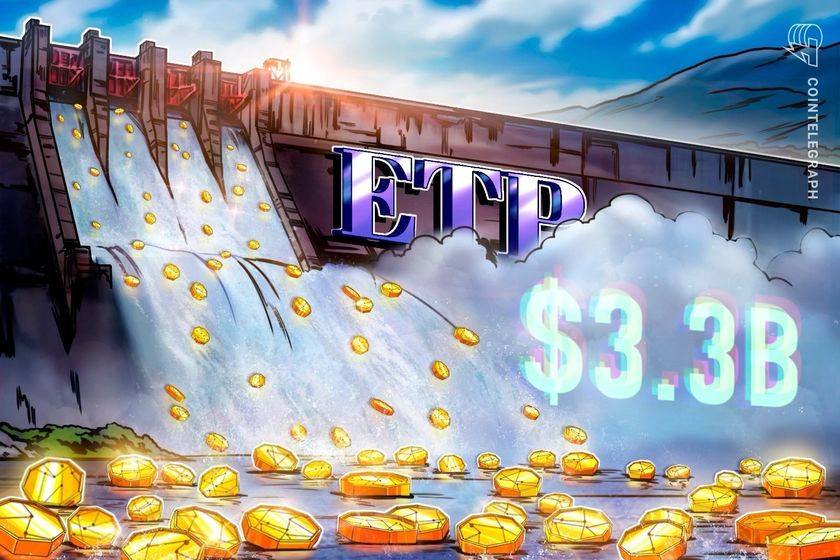 Crypto ETPs recovered last week, recording $3.3 billion in inflows and lifting the overall assets under management to $239 billion. Crypto investment products reversed their recent outflow trends last week, with Bitcoin, Ether and Solana exchange-traded products (ETPs) recording significant inflows. Global crypto ETPs saw $3.3 billion in inflows last week, lifting overall assets under management (AUM) to $239 million, near the record high in August. Last month, crypto ETPs saw an all-time high AUM of $244 billion. The inflows came as underlying assets showed modest gains over the week. Bitcoin (BTC), which traded at $111,900 on Sept. 8, rose 3.3% to $115,600 on Friday. Ether (ETH) went from $4,300 to $4,500 last week, a 4.6% gain in five days. Read more
 -
CoinDesk - 12:38 Sep 15, 2025
The news could explain the weakness in bitcoin, which declined more than 1.5% over the past two hours to the current $114,900. -
Cointelegraph.com - 12:30 Sep 15, 2025
 France’s securities regulator is considering attempting to ban European license “passporting” over concerns related to MiCA regulation enforcement gaps in other EU countries. France warned it may try to block cryptocurrency companies operating locally under licenses obtained in other European countries, raising enforcement gap concerns regarding the European Union’s crypto regulatory framework. France’s securities regulator, the Autorité des Marchés Financiers (AMF), told Reuters Monday that it is concerned about potential regulatory enforcement gaps related to Europe’s Markets in Crypto-Assets Regulation (MiCA), the world’s first comprehensive crypto regulatory framework. Concerned that some crypto companies may seek licenses in more lenient EU jurisdictions, the AMF is considering a ban on operating in France under MiCA licenses obtained in other member states. Read more
 -
CoinDesk - 12:19 Sep 15, 2025
The reorganization was pinned on Qubic, which has acquired over half of Monero's mining power last month and uses XMR rewards to buy and burn its own token. -
Decrypt - 12:15 Sep 15, 2025
New creators poured into Pump.fun over the weekend, generating millions of dollars in fees and driving the PUMP token price up. -
Decrypt - 12:09 Sep 15, 2025
V Global was in operation between July 2020 and April 2021, with the three convicts participating in multi-level marketing. -
Cointelegraph.com - 11:06 Sep 15, 2025
 Polkadot said that under the old tokenomics model, the total supply of DOT could have swelled to more than 3.4 billion tokens by 2040. Polkadot’s decentralized autonomous organization (DAO) passed a referendum approving a hard cap on the network’s native token for the first time. The decision set the maximum supply at 2.1 billion Polkadot (DOT) tokens, a significant pivot from the previous tokenomics model, under which new tokens were indefinitely issued yearly. Under the old inflationary model, Polkadot minted about 120 million DOT tokens annually, with no limit on the token’s total supply. The project said the supply could have swelled to more than 3.4 billion tokens by 2040 under the old model. The new framework introduces a gradual issuance reduction every two years. At the time of writing, Polkadot had a total supply of about 1.5 billion tokens. Read more
 -
Cointelegraph.com - 11:05 Sep 15, 2025
 Bitcoin braced for further gains toward $120,000 after finishing the week in the green above $115,000, new price analysis concluded. Key takeaways: Bitcoin’s weekly close above $115,000 signals bullish strength. BTC’s bull flag breakout could trigger a rally to $120,000. Read more
 -
Cointelegraph.com - 10:42 Sep 15, 2025
 UK crypto and payments groups urged the Bank of England to drop plans to cap individual stablecoin holdings, claiming the move would be costly and hard to enforce. United Kingdom-based cryptocurrency industry advocacy groups called on the Bank of England not to proceed with plans to limit individual stablecoin holdings. In a November 2023 discussion paper, the bank floated setting individual caps on digital pounds between 10,000 British pounds ($13,558) and 20,000 pounds and asked for feedback on a possible lower limit of 5,000 pounds. According to a Monday Financial Times report, industry groups criticized the plan, saying it would be difficult and expensive to implement and could leave the UK lagging behind other jurisdictions. Read more
 -
Cointelegraph.com - 10:08 Sep 15, 2025
 Atkins signaled a departure from the enforcement-first approach of the SEC during Gensler’s leadership, including preliminary notices prior to enforcement actions. The US Securities and Exchange Commission (SEC) chair continued steering the regulatory agency in a different direction than its previous enforcement-first policy toward the crypto industry. In an interview with the Financial Times published Monday, SEC Chair Paul Atkins said the agency is departing from the aggressive enforcement actions common during the administration of former President Joe Biden and former SEC Chair Gary Gensler. US cryptocurrency businesses can now expect preliminary notices of technical violations before any agency enforcement actions, Atkins told the FT. Read more
 -
Cointelegraph.com - 09:51 Sep 15, 2025
 Bitcoin headed into the Fed interest-rate cut with analysis bullish on the macro outlook, but traders split over new BTC price highs. Bitcoin (BTC) traders geared up for volatility as crypto heads into the US Federal Reserve interest-rate decision. Bitcoin bulls have a clear resistance level to overcome at $117,000 as the week gets underway. All eyes are on the Fed as markets unanimously expect the first interest-rate cut of 2025 to come on Wednesday. Read more
 -
Cointelegraph.com - 09:26 Sep 15, 2025
 Yield-bearing stablecoins promise steady income onchain, but regulation, taxes and risks make them more complex than cash. Here’s what you need to know in 2025. Yield-bearing stablecoins include treasury-backed, DeFi and synthetic models. US and EU law ban issuer-paid interest; access is often restricted. Rebases and rewards are taxed as income when received. Read more
 -
Cointelegraph.com - 09:25 Sep 15, 2025
 Shiba Inu’s DeFi team offered a $23,000 bounty to the Shibarium bridge attacker after a $2.4 million exploit, urging the return of stolen funds. Shiba Inu’s decentralized finance platform on its Shibarium layer-2 network offered a 5 Ether ($23,000) bounty to the attacker behind a recent bridge exploit, urging the return of stolen assets. On Monday, the DeFi platform sent an onchain message to the attacker saying that the bounty offer will remain open for 30 days. The protocol added a deadline and a condition that the bounty will begin decreasing in seven days. “Settlement is atomic when we call recoverKnine(). If you call accept() we cannot cancel the deal. Code is law,” K9 Finance wrote. “Bounty is live. Please, act fast.” Read more