Crypto
-
CoinDesk - 14:06 Jun 24, 2025
Peter Thiel’s Founders Fund leads the round, and the $200 million includes $50 million in previously unannounced funding. -
CoinDesk - 14:00 Jun 24, 2025
The partnership is part of Mastercard's expanding efforts in the cryptocurrency space, following recent collaborations with Moonpay and Kraken. -
Cointelegraph.com - 13:53 Jun 24, 2025
 If Bitcoin continues to tumble this season, it will mark its fourth consecutive summer in the red, while TradFi aims to extend its winning streak to three. Bitcoin is facing a potential fourth straight summer loss if it ends the 2025 stretch in the red, while the S&P 500 will log its third straight seasonal rally if its winning streak continues. From 2020 to 2024, the S&P 500 logged eight positive July and August performances, while Bitcoin (BTC) had six. So, while their summer trends aren’t entirely decoupled, the divergence has become clear in June. Since 2020, Bitcoin has posted just one positive June, while the S&P 500 has seen only two negative ones over the same span. A closer look at the past few years shows that Bitcoin’s summer slumps have less to do with seasonal patterns and more to do with crypto-native shocks and economic trends, such as China’s mining ban, halving cycles and post-COVID inflation. Read more
 -
CoinDesk - 13:48 Jun 24, 2025
Michael Saylor has pointed to high volatility as a reason for owning MSTR, so without it, the stock could suffer. -
CryptoPotato - 13:48 Jun 24, 2025
Analyst Axel Adler Jr. says the surge in Realized Cap shows massive profit taking but new buyers kept BTC from plunging deeper. -
Cryptonews.com - 13:47 Jun 24, 2025
Ledger has revealed the Recovery Key, a physical ‘spare key’ that lets users recover their crypto wallet by tapping the device and entering a PIN. The post Ledger Reveals Recovery Key for Flex and Stax Wallets appeared first on Cryptonews. -
Cryptonews.com - 13:45 Jun 24, 2025
Bitcoin rebounds to $105K after Trump’s ceasefire deal. Traders eye $120K as technicals and Fed policy align. Can BTC sustain this bullish breakout? The post Bitcoin Price Prediction As Trump Ceasefire Announcement Sparks Bullish Momentum: Is $120K Next? appeared first on Cryptonews. -
Cryptonews.com - 13:42 Jun 24, 2025
The SEI price has ballooned by 40% in the past 24 hours, but do its indicators signal a further rally, or a big correction? The post SEI Price Prediction: Will the SEI Pump Continue to $0.50? appeared first on Cryptonews. -
Cointelegraph.com - 13:17 Jun 24, 2025
 Hype moves fast, but real crypto innovation is quieter. Use GitHub, Discord and X to spot legitimate projects before they moon or rug. Real crypto projects show consistent GitHub activity, open development and active contributors, not abandoned repos or marketing fluff. Discord can reveal a project’s true momentum through developer interaction, roadmap updates and community-led feedback. X offers direct access to protocol founders and devs; follow conversations, not influencers, to catch real signals early. Read more
 -
CoinDesk - 13:12 Jun 24, 2025
NEAR Protocol (NEAR) was also a top performer, rising 8.2% from Monday. -
Decrypt - 13:08 Jun 24, 2025
The exchange's crypto operations are reportedly moving to Panama as part of its restructuring, ahead of Singapore’s June 30 deadline. -
Decrypt - 13:01 Jun 24, 2025
Network operators controlling at least 14% of Ethereum’s stake are testing a new data propagation system promising 10x speed improvements. -
CryptoPotato - 13:00 Jun 24, 2025
Grayscale just announced its latest product - the Space and Time (SXT) trust. -
CoinDesk - 13:00 Jun 24, 2025
The Space and Time Foundations says the network is built to solve the "one critical need" around which AI and blockchain are converging: verifiable data -
Cointelegraph.com - 12:53 Jun 24, 2025
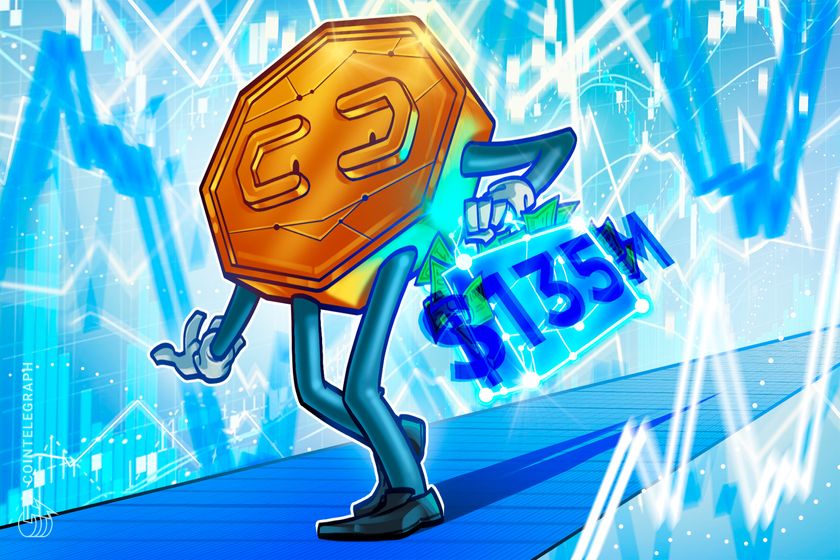 Digital Asset raised $135 million from Goldman Sachs, Citadel and others to scale its Canton Network and drive tokenization of real-world assets in finance. Institutional blockchain infrastructure provider Digital Asset raised $135 million from investors including Goldman Sachs and Citadel. According to a Tuesday announcement, Digital Asset raised $135 million in a strategic funding round led by DRW Venture Capital and Tradeweb Markets, with participation from financial heavyweights including Goldman Sachs, Citadel Securities, BNP Paribas and the Depository Trust & Clearing Corporation. Crypto-focused backers included Paxos, Polychain Capital and Circle Ventures. Digital Asset said the funding is intended to accelerate the adoption of institutional and decentralized finance on its Canton Network. Read more
 -
Cointelegraph.com - 12:28 Jun 24, 2025
 Trump may issue an executive order to protect crypto firms from banking discrimination, ending what some call Operation Chokepoint 2.0, according to The Wall Street Journal. US President Donald Trump’s administration is reportedly considering an executive order aimed at preventing banks from cutting off services to politically unfavorable industries, including cryptocurrency firms, according to a Tuesday report from The Wall Street Journal, citing unnamed sources. The move would come in response to allegations that some banks have denied services to tech and crypto entrepreneurs as part of a coordinated debanking campaign critics have dubbed “Operation Chokepoint 2.0.” At least 30 technology and cryptocurrency founders were reportedly denied access to banking services during the administration of former President Joe Biden. Read more
 -
Decrypt - 12:25 Jun 24, 2025
Analysts told Decrypt that Sei's strong on-chain growth over the preceding months could help support its recent price gains. -
Cointelegraph.com - 12:10 Jun 24, 2025
 Bitcoin bullish catalysts are multiplying amid a Middle East ceasefire and new hopes of an earlier-than-expected Fed rate cut. Key points: Bitcoin holds Middle East ceasefire gains as $103,000 becomes the new area of interest for “buying the dip.” Institutional BTC inflows hold firm despite geopolitical uncertainty. Read more
 -
Cointelegraph.com - 11:54 Jun 24, 2025
 Japan’s FSA proposed classifying crypto as financial products, potentially allowing ETFs and a flat 20% capital gains tax. Japan’s Financial Services Agency (FSA) proposed a sweeping reclassification of cryptocurrencies that would clear a path for the launch of crypto exchange-traded funds (ETFs) and introduce a flat 20% tax on digital asset income. The proposal, introduced on Tuesday, suggests recognizing crypto as “financial products” under the scope of the Financial Instruments and Exchange Act (FIEA), the same regulatory framework that governs securities and traditional financial products. The proposed reclassification could also shift Japan’s current progressive tax system, which taxes crypto gains at rates up to 55%, to a uniform 20%, mirroring the treatment of stocks. That change could make crypto investing more attractive to both retail and institutional players. Read more
 -
CryptoPotato - 11:35 Jun 24, 2025
[PRESS RELEASE – Abu Dhabi, United Arab Emirates, June 24th, 2025] In coordination with the Integrated Transport Center (ITC) of the Department of Municipalities and Transport, Tawasul Transport, in collaboration with Al Maryah Community Bank (Mbank), launched a groundbreaking initiative enabling passengers to pay electronically via the AEC Wallet app using the stable digital currency […]