Crypto
-
Cryptonews.com - 17:18 Jun 19, 2025
Units.Network, a Layer-1 blockchain leveraging Waves Protocol, has secured $10M from Nimbus Capital as it advances AI-blockchain convergence. Funds will boost validator capacity, extend cross-chain liquidity, and fast-track an AI Launchpad and Liquidity Manager. The post Waves Protocol’s Units.Network Raises $10M as AI-Blockchain Market Heats Up appeared first on Cryptonews. -
CryptoPotato - 17:13 Jun 19, 2025
While USDT and USDC continue to dominate the space, more than 10 stablecoins now have over $100 million in circulation. -
Cointelegraph.com - 17:13 Jun 19, 2025
 Yellow Card plans to roll out stablecoin payments with Visa in at least one African country this year amid a trend driven partly by limited access to US dollars. Credit card giant Visa has partnered with Yellow Card Financial, an African stablecoin payments provider, to accelerate the adoption of digital dollars across the continent, underscoring the growing synergy between traditional payment networks and cryptocurrency solutions. The two companies have signed an agreement to promote stablecoin use for cross-border payments in emerging markets where Yellow Card operates, Bloomberg reported Thursday. Yellow Card will launch stablecoin transactions with Visa in at least one African country this year, with additional rollouts expected in 2026. Chris Maurice, co-founder and CEO of Yellow Card, said the collaboration will focus on enhancing treasury operations, improving liquidity management and enabling more cost-effective money transfers. Read more
 -
Decrypt - 16:48 Jun 19, 2025
Publicly-traded health sciences company Prenetics joins a growing list of companies adopting a Bitcoin treasury strategy. -
Cryptonews.com - 16:40 Jun 19, 2025
The Cardano price has edged lower this morning, but could the altcoin collapse if founder Charles Hoskinson retires? The post Cardano Price Prediction: Hoskinson Threatens to Retire If $1 Billion Treasury Overhaul Fails appeared first on Cryptonews. -
Cryptonews.com - 16:38 Jun 19, 2025
KuCoin Taps BitGo Singapore through the Go Network, a step that has advanced its $2 B Trust Project, giving institutions off-exchange settlement across spot, options and futures. Trades occur without pre-funding as assets stay in regulated custody with $250 M cover, cutting counterparty risk. The post KuCoin Taps BitGo in $2B ‘Trust Project’ to Shield Clients With Off-Exchange Custody appeared first on Cryptonews. -
Cryptonews.com - 16:35 Jun 19, 2025
The Solana price has fallen to $145 today, but do oversold indicators mean that the altcoin is about to bounce back strongly? The post Solana Price Prediction: Stuck in the $140s — What’s Holding SOL Back from Breaking Out? appeared first on Cryptonews. -
Cointelegraph.com - 16:30 Jun 19, 2025
 The Telegram founder will once again be allowed to travel to Dubai for a short period before returning to France, where his case is ongoing. Telegram founder Pavel Durov gained court approval to leave France for up to 14 days to travel to Dubai, United Arab Emirates, where the company is headquartered. Durov will be allowed to leave France on July 10 after having a travel request denied by French officials in May, according to French news outlet Le Monde. The executive had requested permission to travel to Oslo, Norway, to deliver a keynote address at the Human Rights Foundation’s Oslo Freedom Forum, which was presented remotely after French officials rejected his travel application. Read more
 -
Cryptonews.com - 16:19 Jun 19, 2025
While the two platforms operate independently, speculators view a Binance.us spot listing as early validation that could pave the way for a listing on the global Binance exchange. The post SPX6900 Price Prediction: Binance Lists SPX in the US – Is a Global Listing Imminent? appeared first on Cryptonews. -
Decrypt - 16:12 Jun 19, 2025
Project 11 is working on protecting the leading crypto network against the potential threat. -
CoinDesk - 16:08 Jun 19, 2025
Despite market uncertainty, NEAR finds strong support at $2.11 level while testing key resistance. -
Decrypt - 16:01 Jun 19, 2025
Musk’s X Money will soon roll out the feature, according to an FT report, but no sign yet of crypto integration, including Dogecoin. -
Decrypt - 15:49 Jun 19, 2025
Plasma is aiming to create “stablecoin chain number one” after securing $1 billion in deposits for its upcoming XPL token pre-sale. -
CoinDesk - 15:45 Jun 19, 2025
Price ranges between $2.13 and $2.18 with declining volatility and a symmetrical triangle pattern emerging. -
Cointelegraph.com - 15:45 Jun 19, 2025
 Shrinking liquid supply, persistent ETF demand, and strong technical factors could push ETH price above $4,000. Key takeaways: Spot ETH ETF net inflows totalled $861.3 million over the last two weeks. Total ETH staked and accumulated are at all-time highs. Read more
 -
CoinDesk - 15:43 Jun 19, 2025
SOL fell below $144 despite bullish institutional headlines, as Sol Strategies filed to list on Nasdaq while holding over $61 million worth of SOL tokens. -
CoinDesk - 15:34 Jun 19, 2025
"Soon you're going to be able to live your whole financial life on the platform," CEO Linda Yaccarino said -
Decrypt - 15:16 Jun 19, 2025
CIRCLE STOCKS PUMPS, TRUMP WAITING ON IRAN ACTION, FED TO WAIT & SEE. FOMO HOUR LIVE ON DEGENZ. Degenz Live is the only content you need for crypto, macro, trading, gambling and risk-taking. Powered by MYRIAD MARKETS, REKT BRANDS and YEET CASINO. Crypto volatile as Israel-Iran strikes continue. Circle stock pumps on GENIUS Act passing. Crypto is future, and we’ll own it: Trump. Trump urges House to pass GENIUS Act. Ohio exempts BTC payments under $200 from taxes. Stablecoin market cap exceeds $250bn. CryptoCom, Deribit to accept BUIDL as collateral. Coinbase to allow USDC to be used as collateral. ‘Coinbase Payments’ launched, stock pops. SOL Strategies to go public in the US. Lion Group raises $600m for HYPE treasury. Jump Trading plans reentry into crypto. Brokerage FalconX in talks for IPO. Crypto lenders now hold $60b in assets. First spot XRP ETF launches in Canada. 00:00 - Intro to the show 02:20 - Tylers top news stories 06:05 - Mando appears 08:00 - FOMC recap 10:30 - Macro and ongoing conflicts 15:00... -
Cointelegraph.com - 15:15 Jun 19, 2025
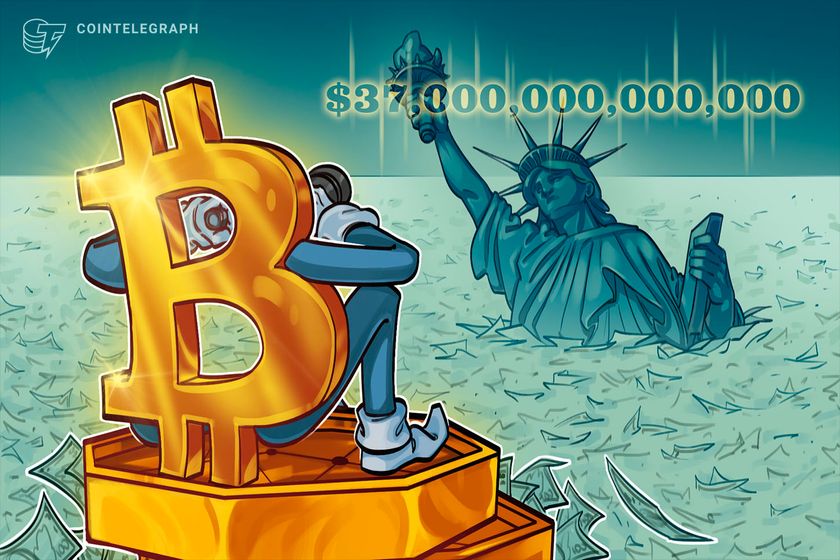 As Washington printed trillions, Bitcoin evolved into a global asset class, trusted by nations and corporations, amid growing US debt concerns. While Washington, DC printed trillions, Bitcoin mined block by block, quietly evolving from digital experiment to global asset class. As policymakers increased government spending and implemented stimulus measures, the US national debt surged to over $37 trillion, sparking worries about inflation, currency devaluation and long-term fiscal stability. Read more
 -
CryptoPotato - 15:06 Jun 19, 2025
[PRESS RELEASE – Miami, FL, June 19th, 2025] Everstake, a leading global non-custodial staking provider serving institutional and retail clients, has partnered with Zodia Custody, a leading institutional digital asset custodian backed by Standard Chartered, SBI Holdings, Northern Trust, and National Australia Bank. Through this collaboration, Everstake will support institutional staking for Zodia Custody clients […]