Cointelegraph.com
Source:
https://cointelegraph.com
Found 11887 news
-
Cointelegraph.com - 17:29 Jan 29, 2026
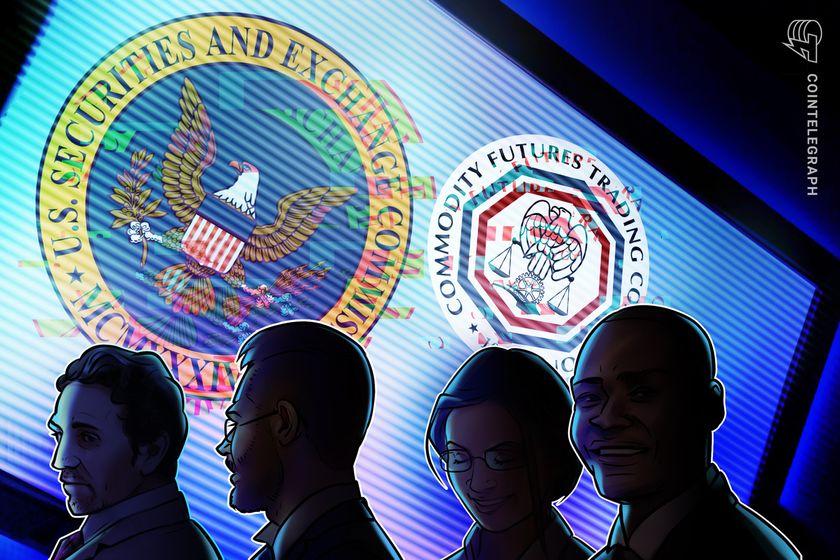 SEC Chair Paul Atkins and CFTC Chair Mike Selig spoke on CNBC on Thursday as debate continues over stablecoin yield in the CLARITY Act. US Securities and Exchange Commission Chair Paul Atkins and Commodity Futures Trading Commission Chair Mike Selig appeared on CNBC’s Squawk Box on Thursday to discuss the crypto market structure bill and a White House–hosted meeting scheduled for Monday. The bill was recently held up in the Senate, where it is undergoing committee review after being passed in the House of Representatives, with lawmakers working through unresolved issues on the Agriculture and Banking Committees. One of the central sticking points in the legislation is how stablecoin yield should be treated, an issue that has divided traditional banks and crypto companies. Coinbase recently withdrew support for the bill, citing concerns over several provisions, including those related to yield. Read more
 -
Cointelegraph.com - 15:35 Jan 29, 2026
 Lawmakers begin debating amendments to a sweeping digital asset market structure proposal as Congress looks to clarify oversight of crypto markets. US lawmakers began a key markup session Thursday morning on a long-awaited crypto market structure bill, marking a pivotal step in Congress’ effort to establish clearer rules for digital asset markets. The bill has been months in the making and follows sustained pressure from the crypto industry and some lawmakers to move beyond enforcement-led regulation. Lawmakers voted on three amendments to the market structure bill, all of which failed along party lines. Read more
 -
Cointelegraph.com - 14:44 Jan 29, 2026
 DePIN’s “death” narrative hides a market that’s quietly compounding revenues, as Messari’s new report pegs the sector at $10 billion with growing real‑world usage and cash flow. Decentralized physical infrastructure networks (DePINs) have been written off as dead by many investors, but a new “State of DePIN 2025” report from Messari and Escape Velocity argues the sector has steadily grown into a $10 billion market generating $72 million in onchain revenue last year alone. According to the report, the “class of 2018-2022” DePIN tokens are down a massive 94%-99% from all‑time highs. Yet, leading projects now post verifiable recurring revenue and trade at 10 to 25 times revenue multiples, levels Messari characterizes as undervalued relative to growth. Messari said the shift marks a transition from subsidy-driven growth toward networks that generate revenue through real-world usage, particularly in areas such as bandwidth, compute, energy and sensor data. Read more
 -
Cointelegraph.com - 14:20 Jan 29, 2026
Viral AI assistant Clawdbot/Moltbot learned to speak on its own, and can trade on Polymarket. But it’s a cybersecurity nightmare. AI Eye. -
Cointelegraph.com - 14:20 Jan 29, 2026
Viral AI assistant Clawdbot/Moltbot learned to speak on its own, and can trade on Polymarket. But it’s a cybersecurity nightmare. AI Eye. -
Cointelegraph.com - 14:20 Jan 29, 2026
Viral AI assistant Clawdbot/Moltbot learned to speak on its own, and can trade on Polymarket. But it’s a cybersecurity nightmare. AI Eye. -
Cointelegraph.com - 14:14 Jan 29, 2026
 The platform enables enterprises to use programmable stablecoins for payments and treasury while outsourcing custody, compliance and settlement. Financial technology company Dakota launched a stablecoin infrastructure platform as more enterprises look to adopt digital dollars without taking on the operational and regulatory burden of custody and compliance. Dakota will handle custody, compliance and settlement on behalf of its clients. CEO Ryan Bozarth told Cointelegraph that the company operates in the US as a registered Money Services Business, while working with licensed banking and regulated payments partners in other regions. It is also pursuing Electronic Money Institution and Crypto-Asset Service Provider licenses in Europe. This arrangement, according to Bozarth, enables Dakota to offer cross-border money movement without customers becoming regulated financial institutions themselves. Read more
 -
Cointelegraph.com - 14:12 Jan 29, 2026
 The parliamentary inquiry comes as regulators warn that stablecoins could drain bank deposits and reshape payments. The House of Lords Financial Services Regulation Committee has opened an inquiry into proposed stablecoin rules in the United Kingdom, seeking public input on plans put forward by the Bank of England (BoE) and the Financial Conduct Authority (FCA). The inquiry will examine how stablecoins could affect traditional financial services such as banking and payments, as well as the opportunities and risks created by their growing use in the UK, the committee said in a Thursday statement. Lawmakers said the review will assess whether the regulatory frameworks proposed by the BoE and the FCA provide “measured and proportionate responses” to developments in the stablecoin market, according to Baroness Noakes, chair of the committee. Read more
 -
Cointelegraph.com - 13:59 Jan 29, 2026
 Bitcoin order-book analysis said that BTC price action was being held back by just one trading entity, while risking a trip to "Bearadise." Bitcoin (BTC) lingered beneath $88,000 into Thursday’s Wall Street open as attention switched to order-book manipulation. Key points: Bitcoin is facing fresh attempts to manipulate short-term price action, says analysis. Read more
 -
Cointelegraph.com - 13:13 Jan 29, 2026
 Citrea’s Bitcoin rollup has become a live experiment in whether BTC can support a full DeFi and stablecoin stack, and how much complexity Bitcoin should anchor at the base layer. Founders Fund and Galaxy Ventures-backed Bitcoin zero-knowledge rollup (ZK-rollup) Citrea launched its mainnet on Tuesday with BTC collateral lending, BTC-structured products and a new US dollar stablecoin, ctUSD. The launch is aimed at turning what Citrea calls “economically idle” Bitcoin (BTC) into base collateral for decentralized finance (DeFi) and payments, while anchoring more of that activity to Bitcoin’s base layer. The team expects active DeFi liquidity to reach $50 million in the first few weeks, with BTC lending, BTC-structured products, and decentralized trading already live from day one. Read more
 -
Cointelegraph.com - 12:30 Jan 29, 2026
 Current blockchain infrastructure has inadequate throughput and systematic front-running. Real-world finance demands sub-second finality and fair transaction ordering. Opinion by: Joshua Sum, head of product at Solayer Labs Consider a single, borderless financial market operating around the clock, where a farmer in Nebraska can instantly hedge wheat futures. At the same time, a pension fund in Tokyo trades Tesla shares seamlessly, all without permission, intermediaries or geographic constraints. This isn’t science fiction. Read more
 -
Cointelegraph.com - 12:13 Jan 29, 2026
 Bitcoin has been called "digital gold," and some of its key properties may help BTC rally more than the precious metal in percentage terms. Bitcoin (BTC) has vastly underperformed gold (XAU) in the past year, dropping by 13.25% compared with the precious metal’s almost 100% rally. Can BTC catch up to gold’s gains? Key takeaways: Bitcoin’s supply is capped at 21 million, with about 1 million left to be mined. Read more
 -
Cointelegraph.com - 11:34 Jan 29, 2026
 Heavy outflows from Bitcoin ETFs have diminished, putting BTC price in a better position to overcome the next hurdle at $93,000. Bitcoin’s (BTC) pre-FOMC rally on Wednesday stalled at $90,000 amid stiff overhead resistance and weak ETF demand. Still, several data points suggested that upward momentum may increase once the BTC/USD pair breaks above $93,000. Key takeaways: BTC bulls must flip the $90,000-$93,000 range into new support. Read more
 -
Cointelegraph.com - 11:24 Jan 29, 2026
 Hong Kong-listed OSL Group plans acquisitions and global expansion after securing fresh capital to scale its stablecoin and digital payments business. OSL Group has raised $200 million in equity financing as it steps up plans to expand its stablecoin trading and payment businesses globally. The Hong Kong–listed digital asset company said the capital injection will strengthen its balance sheet and support growth across regulated digital payment and settlement services, according to a Thursday announcement. “The market has strongly validated OSL Group’s strategic positioning within the stablecoin and payment space,” chief financial officer Ivan Wong said. “This financing round will allow us to welcome more like-minded strategic and long-term investors,” he added. Read more
 -
Cointelegraph.com - 11:12 Jan 29, 2026
 Solana’s validator count has dropped 68% since 2023 as rising costs and zero-fee competition push smaller node operators offline. Solana’s validator count has fallen dramatically over the past three years, raising concerns about the blockchain network’s decentralization as the economics of running a node squeezes out smaller operators. The number of Solana validators fell 68% to 795 as of Wednesday, from a peak of 2,560 validator nodes in March 2023, according to Solanacompass data. Validators are responsible for adding new blocks and verifying transactions in proposed blocks, playing a vital role in the operations of the decentralized ledger. Read more
 -
Cointelegraph.com - 10:45 Jan 29, 2026
 Metaplanet said proceeds will be used for Bitcoin purchases, its Bitcoin income business and partial debt repayment as it executes its capital strategy. Tokyo-listed Bitcoin-focused company Metaplanet approved an overseas capital raise of as much as $137 million, combining new common shares and stock acquisition rights as it looks to expand its Bitcoin holdings and reduce debt. In a Thursday filing, Metaplanet said it plans to issue 24.5 million common shares at 499 Japanese yen per share, raising about 12.24 billion yen ($78 million) upfront. It also approved the issuance of 159,440 stock acquisition rights, representing up to 15.9 million additional shares, which could raise about $56 million if exercised. The warrants give investors the option to buy shares later at a fixed price above the current market level, but only over the next year. Both the shares and warrants will be sold privately to overseas investors, subject to routine closing conditions, according to the filing. Read more
 -
Cointelegraph.com - 10:03 Jan 29, 2026
 Regulators gain wider discretion to vet shareholders, finances and controls as South Korea tightens crypto market access. South Korea’s National Assembly has approved an overhaul of the country’s crypto licensing regime, tightening entry requirements for virtual asset service providers (VASPs) and expanding scrutiny to include controlling shareholders. On Thursday, lawmakers passed an amendment to the Act on Reporting and Using Specified Financial Transaction Information, a cornerstone of Korea’s Anti-Money Laundering (AML) framework for digital assets. The committee substitute bill was approved at a plenary session and is expected to take effect six months after the law is enacted. The new rules widen background checks for crypto firms applying to operate in South Korea. Regulators will now vet not just company executives but also major shareholders. The list of red flags has expanded beyond financial crimes to include offenses such as drug trafficking, tax evasion, fair-trade violations, serious economic cr...
 -
Cointelegraph.com - 09:14 Jan 29, 2026
 Crypto exchange Bybit said its new “My Bank” accounts will give users personal IBANs, instant fiat access, multi-currency transfers and crypto trading under their own name. Bybit, one of the world’s biggest crypto exchanges by trading volume, plans to launch retail banking services on its platform starting in February, the company said Thursday. Bybit unveiled the product, “My Bank powered by Bybit,” during a live online keynote on Thursday. Bybit CEO Ben Zhou said the service will offer users a personal IBAN (international bank account number), allowing them to send and receive funds across banks in multiple currencies, with US dollar transfers supported at launch. Read more
 -
Cointelegraph.com - 08:15 Jan 29, 2026
 Hang Seng plans to offer tokenized gold fund units recorded on public blockchains, though the product remains subject to regulatory approval and will not trade on secondary markets. Hang Seng Investment Management has launched a new physically backed gold exchange-traded fund (ETF) in Hong Kong, with an option for future tokenized access to the asset. The Hang Seng Gold ETF, which began trading on the Hong Kong Stock Exchange on Thursday under stock code 3170, is designed to track the LBMA Gold Price AM, the widely used morning benchmark set in London. The fund is structured as a passive ETF and holds physical gold bars that meet London Bullion Market Association good delivery standards, according to product details. Gold held by the ETF is stored in vaults in Hong Kong, with HSBC acting as gold custodian. The structure allows for both in-cash and, in certain cases, in-gold creation and redemption by participating dealers, though retail investors trade units on the secondary market like ordinary shares. Read ...
 -
Cointelegraph.com - 08:15 Jan 29, 2026
 ETH price charts confirmed a triangle breakdown, shifting the near-term bias lower and putting $2,250 in focus if sellers stay in control. Ether (ETH) is now more than 14% below its local peak near $3,400, underscoring the sellers’ tenacity above $3,000. A bearish technical setup suggests the pressure may extend into February. Key takeaways: ETH fell back below $3,000, confirming a triangle breakdown that targets $2,250. Read more
11887 items