Dawn
Source:
https://www.dawn.com
Found 12682 news
-
Dawn - 13:30 Jul 22, 2026
The owner of a South Korean Michelin-starred restaurant is facing one year in jail for garnishing a palate-cleansing sorbet with black ants “to add a sour taste”, local media said. Seoul prosecutors requested the prison term for the anonymous owner of the unnamed eatery at a Monday court hearing for violating food safety regulations, the reports said. Under South Korean law, only 10 insect species are approved for human consumption, including grasshoppers and brown mealworm larvae. But the restaurant, which holds two prized Michelin stars, is accused of serving the forbidden insects imported from Thailand and the US, a food safety ministry statement said. Local media said the ants were served atop a sorbet. Authorities launched their probe last year, according to a food ministry statement, claiming the chef topped the icy desserts with “three to five” ants “to add a sour taste”. He made around 12,000 sales worth 120 million won ($81,000) over nearly four years until January 2025, the statement said. One evide... -
Dawn - 13:20 Jul 22, 2026
A French modelling scout with close ties to convicted US sex offender Jeffrey Epstein has been found dead at his home outside Paris, prosecutors and his lawyer said on Wednesday. Under investigation in France, Daniel Siad, 69, was one of several French men accused of aiding the convicted sex offender to traffic and abuse women. Siad had not yet been questioned by investigators, but had denied the allegations, saying he wanted to be heard and give his version of events. “An investigation to determine the cause of death was opened on Monday evening following the discovery”, the prosecutor’s office in the Paris suburb of Nanterre said. An autopsy will be carried out as part of the probe. French investigators had been investigating Siad over allegations including rape and human trafficking. Siad’s lawyer Menya Arab-Tigrine said her client had requested to give his side of the story before he died. “He is dead and he was innocent,” she told AFP. “If he died of a heart attack, the unbearable waiting, the pressure a... -
Dawn - 13:02 Jul 22, 2026
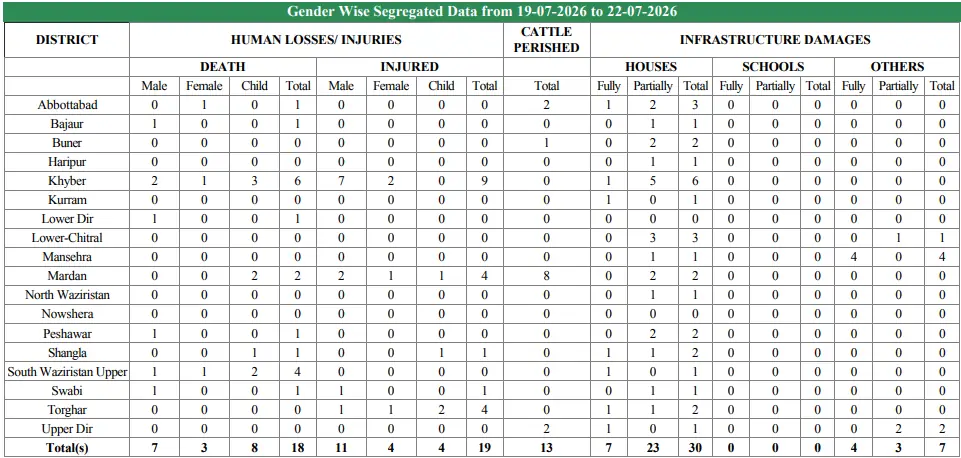 LOWER SOUTH WAZIRISTAN/ MIRANSHAH: The death toll from rain-related incidents during the ongoing monsoon spell and flash floods in Khyber Pakhtunkhwa has risen to 20. According to the Pakistan Meteorological Department (PMD), the current rain spell, which began on July 19, is expected to last till July 23 in KP. The latest rain-related fatalities in the province were reported from North Waziristan, where two men drowned after being swept away by a flash flood in the Tochi River, Rescue 1122 spokesperson Noor Islam said in a statement. He said the drowned men’s bodies were recovered from the river after hours-long efforts. The spokesperson warned that the rains had resulted in “exceptionally” high water levels in the Tochi River, where flood-like conditions persisted. He urged area residents to stay at a distance from rivers, seasonal streams and water channels, stressing that water levels could rise within minutes due to flash floods. “Rescue 1122 emergency teams remain on high alert and are deployed at vario...
 -
Dawn - 12:25 Jul 22, 2026
Prime Minister Shehbaz Sharif on Wednesday noted that Pakistan’s military advancements in indigenous defence capabilities were an “integral part” of its national defence. He made the remarks at the two-day Indus Robotics and Autonomous Systems (RAS) Expo 2026 that opened today at the Pak-China Friendship Centre in Islamabad. Addressing the event, PM Shehbaz noted that Pakistan has “made remarkable progress in developing indigenous autonomous capabilities in the field of defence and security under the dynamic leadership” of Chief of Defence Forces (CDF) and Chief of the Army Staff Field Marshal Syed Asim Munir. He recalled that during the conflict with India in May 2025, the “valiant armed forces resolutely guarded our physical and cyber frontiers through the highly effective use of advanced autonomous systems” led by the CDF and supported by the air and naval chiefs. PM Shehbaz declared that “these remarkable military advancements are an integral part of our national defence”. He said they would “strengthen o... -
Dawn - 11:58 Jul 22, 2026
PPP Chairman Bilawal Bhutto Zardari on Wednesday said the upcoming election in Azad Jammu and Kashmir (AJK) was perhaps the “most significant” in the region’s history, saying its future was tied to the outcome. He was addressing a public rally in Mirpur, AJK. More to follow -
Dawn - 11:55 Jul 22, 2026
Pakistan on Wednesday “unequivocally” condemned the recent threats issued by Houthis against Saudi Arabia and commercial shipping in the Red Sea, the Foreign Office said. Islamabad’s statement comes after Yemen’s Houthi rebels, aligned with Iran, announced an immediate maritime embargo on Saudi Arabia, opening a new front in the Middle East conflict. The naval blockade, if enforced, could cut off access to Saudi Arabia’s Red Sea ports, which have been vital for oil exports as renewed US-Iran fighting limits passage through the Strait of Hormuz. It remains unclear how the Houthis would enforce such a blockade. “Threats against commercial shipping and trading with the Kingdom of Saudi Arabia are unacceptable and violate established principles of international law,” the FO said in a statement on Wednesday, noting the “continued threats” by Houthis. Islamabad said it was “particularly concerned by reports of threats directed against vessels engaged in lawful commercial trade” with Saudi Arabia. “Such actions thre... -
Dawn - 11:54 Jul 22, 2026
GILGIT: Gilgit-Baltistan’s newly sworn-in Chief Minister Amjad Hussain has selected 12 members to join his cabinet as ministers, it emerged on Wednesday, following the issuance of a notification for the cabinet members’ appointment. According to the notification, seen by Dawn, 12 individuals from Hussain’s own party, the PPP, and four from the Istehkam-i-Pakistan Party (IPP) have been named as members of the new cabinet. The notification, issued by the Services and General Administration Department and Cabinet Department, stated that on the advice of the chief minister, the GB governor “has been pleased to appoint the following members of the Gilgit-Baltistan Assembly as ministers to the government of Gilgit-Baltistan”. The notification then lists the members, who include: Zulfiqar Ali Murad (PPP) Syed Jalal Shah (PPP) Muhammad Ali Akhtar (PPP) Naiknam Karim (PPP) Iqbal Hassan (PPP) Raja Nasir Khan (PPP) Muhammad Naseem (PPP) Syed Tauqeer Mehdi (PPP) Aman Ali (IPP) Asad Shafiq (IPP) Anwar Ali (IPP) Muhammad D... -
Dawn - 11:52 Jul 22, 2026
S&P Global Ratings on Wednesday upgraded Pakistan’s long-term sovereign credit rating to ‘B’ from ‘B-’, citing an improving external position and gradual macroeconomic stabilisation, while assigning a stable outlook. The agency also affirmed the country’s short-term sovereign credit rating at ‘B’ and raised its transfer and convertibility assessment to ‘B’ from ‘B-’. In a statement, the credit rating agency said the change in rating was based on its belief that the country had strengthened its institutional capacity, allowing it to implement reforms of the International Monetary Fund (IMF). “Our upgrade on Pakistan is predicated on improved institutional stability that has helped to implement critical IMF programme reforms,” it said. “These reforms have quickened fiscal consolidation and rebuilt external buffers.” It noted that the institutional settings of Pakistan had strengthened over the last two years, in particular highlighting the passage of the IMF’s Extended Fund Facility (EFF) $7 billion programme i... -
Dawn - 11:10 Jul 22, 2026
Prime Minister Shehbaz Sharif on Wednesday said that Pakistan has made “remarkable progress” in developing indigenous defence capabilities. He made the remarks at the Indus Robotics and Autonomous Systems (RAS) Expo 2026 being held today and tomorrow at the Pak-China Friendship Centre in Islamabad. Addressing the event, PM Shehbaz noted that Pakistan has “made remarkable progress in developing indigenous autonomous capabilities in the field of defence and security under the dynamic leadership” of Chief of Defence Forces (CDF) and Chief of the Army Staff Field Marshal Syed Asim Munir. “Our armed forces have adopted cutting-edge technologies, some of which I just witnessed on display outside this hall. Remarkable achievement,” the premier said. He added that he also took a look at simulators which were “100 per cent manufactured and assembled in Pakistan”. He noted that drones had achieved 60pc indigenisation and “many other important machines” have been made in Pakistan. The prime minister recalled that the “v... -
Dawn - 10:08 Jul 22, 2026
Security forces have killed 10 terrorists and apprehended two female suicide bombers, along with their facilitator, during operations carried out in Balochistan’s Surab and Mastung districts over the past 48 hours, the military’s media affairs wing said in a statement released on Wednesday afternoon. According to the Inter-Services Public Relations (ISPR), seven terrorists were killed in Surab while three in Mastung, where the two suicide bombers and their facilitator were also apprehended. The ISPR statement said that the operations in these two districts were in continuation of actions against the “terrorist nexus of India-sponsored Fitna-al-Hindustan and Fitna-al-Khawarij” in Balochistan to “weed out remnants of terrorists and their facilitators”. The state uses the term Fitna-al-Khawarij for the banned Tehreek-i-Taliban Pakistan (TTP) and has designated Balochistan-based groups as Fitna-al-Hindustan to highlight India’s alleged role in terrorism and destabilisation across Pakistan. The ISPR said that as p... -
Dawn - 10:01 Jul 22, 2026
BAHAWALPUR: A young shepherd who was gang-raped by 12 men in Cholistan desert in jurisdictions of the Marot Police Station of Bahawalnagar succumbed to his injuries at the Bahawal Victoria Hospital (BVH) on Tuesday. A police spokesperson told Dawn, the shepherd was abducted by a suspect on his motorcycle on July 1 from Toba Jinnawala near Chak 289/HR where he had his over 40 sheep for grazing. After eight days on July 9, the youth’s brother, Mohsin, went to meet him at Toba Jinnawala and found him in a serious condition. The victim informed his brother that 12 men, seven of them identified in the FIR, administered him some intoxicant drink, raped him and stole his 40 sheep. Mohsin shifted his serious brother to the Bahawal Victoria Hospital (BVH) and informed Marot police on 15 about the incident. Marot police registered a case against twelve suspects. The Marot police arranged a post-mortem at the BVH. The police spokesperson claimed that five of the suspects had been arrested by Marot police. In Vehari, a b... -
Dawn - 09:29 Jul 22, 2026
LOWER SOUTH WAZIRISTAN: The death toll from rain-related incidents during the ongoing monsoon spell and flash floods in Khyber Pakhtunkhwa has risen to 18, the Provincial Disaster Management Authority (PDMA) said on Wednesday. According to the Pakistan Meteorological Department (PMD), the current rain spell, which began on July 19, is expected to last till July 23 in KP. The latest rain-related fatalities in the province were reported from Upper South Waziristan, where four people were killed in a roof collapse incident, Additional Deputy Commissioner Fazal Wadood told Dawn. He said the incident occurred in the Bangiwala village on the outskirts of Sararogha tehsil during heavy rainfall. The victims belonged to the same family, including a couple and their son and daughter, he added. A report released by the PDMA this morning said that 18 people had died and 19 had been injured in rain-related incidents across the province since July 19. The authority’s report said 23 houses had been partially damaged in rain... -
Dawn - 08:58 Jul 22, 2026
US Secretary of State Marco Rubio met Chinese Foreign Minister Wang Yi for talks on Wednesday during a regional gathering led by the Association of Southeast Asian Nations (Asean), where top diplomats voiced concern about renewed Middle East hostilities and tension in the South China Sea. The two were expected to discuss a possible US summit between their leaders flagged for the end of September by President Donald Trump, with Rubio saying on Sunday it was still anticipated. Rubio and Wang did not speak to the media as they entered the room. The meeting comes amid a fragile truce between the world’s biggest economies that could be complicated by Trump’s accusations of Chinese meddling in US elections, which Beijing has denied. The broader Asean meeting in Manila comes amid a flare-up in the conflict between the United States and Iran, while tension simmers between Beijing and close US ally the Philippines over an incident in the South China Sea that led each to summon the other’s ambassador. Meeting with fore... -
Dawn - 08:28 Jul 22, 2026
The Federal Investigation Agency (FIA) said on Wednesday that four suspects, including officials of the National Database and Registration Authority (Nadra), had been arrested in Karachi for their alleged involvement in making false documents for Afghan nationals. In a press release, a spokesperson for the agency identified the suspects as Nadra Assistant Director Imamul Haq, Nadra Deputy Assistant Director Fayyaz Ahmed, Junaid Ahmed, a watchman working for the authority, and a private agent Muhammad Umar Shah. He added that law enforcement agencies had seized important records and other evidence as part of the operation, adding that the scope of the investigation had been expanded. “Further significant revelations and arrests are expected during the investigation, and all facilitators and key figures linked to this network will be brought to justice,” he said. The spokesperson said that preliminary investigations showed that the suspects were involved in facilitating the issuance of fake identity documents f... -
Dawn - 08:17 Jul 22, 2026
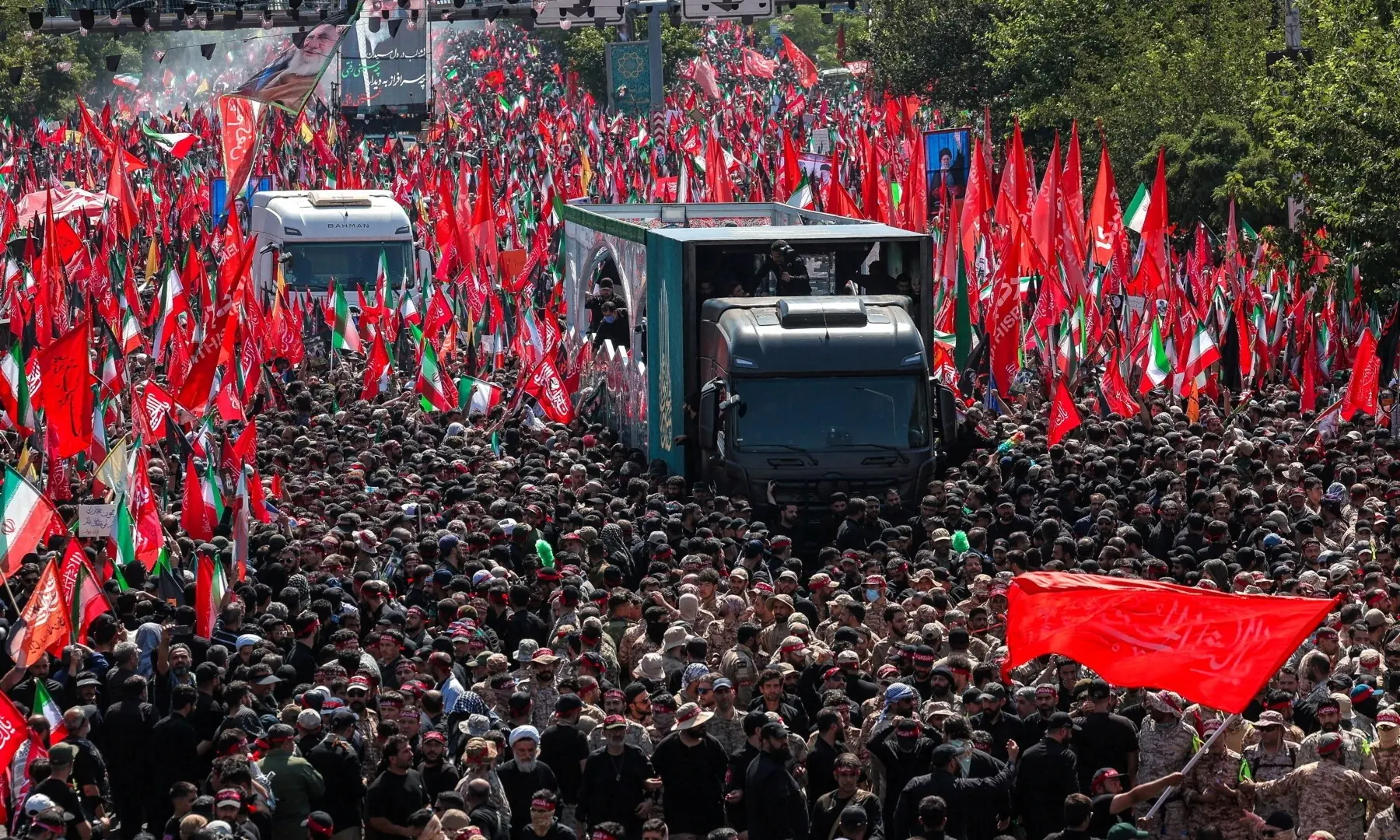 Tehran is red and black when I arrive. Millions of people in black mourning attire carried red flags, the stark emblem of blood and martyrdom, seeking revenge for their leader, Ayatollah Ali Khamenei, who was assassinated on February 28. “We Must Rise,” declare the banners. War songs ricochet off the walls in streets punctuated by elegies on the martyrdom of Imam Husayn and his Companions at Karbala. This is collective grief channelled as state resilience. An elderly supporter I meet, Akbar Ali Jafari, puts it like this: “The war has given the Revolution a new lease on life.” The founding purpose is resurrected and its leadership cast as embattled defenders of the nation rather than an ageing, contested regime. A vehicle carrying coffins of Iran’s late Supreme Leader Ayatollah Ali Khamenei and his family members, makes its way as people attend a funeral procession for Khamenei. — Reuters In early July, a towering fist was constructed a few days before the funeral proceedings of the slain leader. The Islamic R...
 -
Dawn - 08:01 Jul 22, 2026
India’s education minister said that Prime Minister Narendra Modi’s administration was committed to addressing the concerns of protesting youth and exam reforms, in the latest sign that the government was beginning to respond to growing protests. The comments by Dharmendra Pradhan are his first since the youth-led “cockroach” movement launched a protest in New Delhi last month seeking his resignation over the leak of medical school test papers that affected some two million students and was linked to several student suicides. The protests by the self-named Cockroach Janta Party (CJP) — which began as an online satire — involved a few hundred young people when they were first launched. This week, the movement has grown into the biggest youth challenge to Modi in his third term as the prime minister as tens of thousands of protesters took to the streets of Delhi on Monday, clashing with police who used tear gas and batons to push them back. The protests gained further momentum on Tuesday when the main oppositio... -
Dawn - 06:53 Jul 22, 2026
Exam paper leak, protests and Gandhi siblings' arrest — India's 'cockroach' youth movement explained
Thousands of supporters of India’s youth-led “cockroach” movement have been camping in the capital, New Delhi, to demand the resignation of Education Minister Dharmendra Pradhan, in the biggest public challenge to Prime Minister Narendra Modi in his third term. Here is a look at what sparked the protests and the situation now. Why do protesters want Pradhan to quit? The immediate trigger for the demonstrations was the cancellation of the National Eligibility cum Entrance Test (NEET), India’s undergraduate medical school entrance exam, after its question papers were found to have been leaked. About two million students across India took the exam on May 3, but it was later scrapped, with about a dozen student suicides linked to its cancellation. A re-test was held in June. Why is NEET important? The exam is the sole gateway to undergraduate medical courses across India, and millions of aspirants sit for it every year, competing for fewer than 150,000 seats, making it one of India’s toughest entrance exams. The ... -
Dawn - 06:03 Jul 22, 2026
New York City Mayor Zohran Mamdani said on Tuesday his office does not have the authority to carry out the International Criminal Court’s (ICC) arrest warrant for Israeli Prime Minister Benjamin Netanyahu, and called on US federal officials to step in. “Benjamin Netanyahu is a war criminal, the architect of a horrific genocide against the Palestinian people,” Mamdani said in a brief video message posted to social media. “My administration has reviewed every avenue available under applicable law to determine whether New York City could execute the ICC’s arrest warrant if Benjamin Netanyahu came here,” he said. “It is clear that we do not have the independent legal authority to enforce this warrant. The federal government, however, does, and I call on them to join the ICC and execute this warrant.” The Hague-based International Criminal Court said in 2024 that it had reasonable grounds to believe Netanyahu was responsible for alleged war crimes and crimes against humanity related to Israel’s offensive in Gaza f... -
Dawn - 05:47 Jul 22, 2026
Fresh US strikes triggered air defences in Tehran on Wednesday after President Donald Trump warned he was “not finished” with a war on Iran that has already cost his nation $37.5 billion. After the foes’ fighting over the strategic Strait of Hormuz led to the collapse of a preliminary deal, the Middle East war has expanded to include the region’s other key chokepoint for global oil supplies. The US military said its latest attacks hit targets such as “military logistics infrastructure” while Iranian state media reported strikes around the country, including Bushehr, which hosts a nuclear power plant. “News sources reported minutes ago that air defence activity was heard in the west, east and northeast of Tehran,” state TV posted on Telegram. As the war nears the five-month mark and November legislative elections approach, Trump has faced intense political pressure to end the conflict, which is unpopular even with segments of his base. Critics have pointed to the cost of the war that Pentagon Chief Pete Hegset... -
Dawn - 05:42 Jul 22, 2026
Interior Minister Mohsin Naqvi said that Pakistan was ready to extend cooperation with Iran in all fields. He made the remarks as he met with Iranian Interior Minister Eskandar Momeni, who is currently in Pakistan on an official visit. A smartly turned-out contingent of the Federal Constabulary presented a guard of honour to the visiting minister upon his arrival, according to a statement issued by the interior ministry. It said that the two ministers held one-on-one talks, followed by delegation-level discussions. It said that the two ministers reviewed bilateral relations, trade, regional developments and avenues for cooperation. According to the interior ministry, both sides agreed to enhance cooperation in counter-terrorism, counter-narcotics, prevention of illegal immigration and efforts against human trafficking. The two ministers also emphasised the need for joint efforts to curb drug smuggling and terrorism “originating from the Afghan border”, while agreeing to improve coordination between the releva...
12682 items