Dawn
Source:
https://www.dawn.com
Found 12682 news
-
Dawn - 14:02 Jul 21, 2026
Prime Minister Shehbaz Sharif on Tuesday launched a new artificial intelligence (AI)-based digitisation platform for the Prime Minister’s Office (PMO), designed to replace paper-based working in governance. According to a statement by the PMO on social media, the premier described the Prime Minister Office System (PMOS) as a transformative digital platform that would “modernise governance” by “recording, communicating, monitoring and tracking every directive issued by the prime minister from issuance through implementation, verified completion and post-completion monitoring”. During the launch ceremony of the system at the PMO — attended by Minister for Economic Affairs Ahad Khan Cheema, Minister for IT and Telecom Shaza Fatima Khawaja, and other senior officials — the prime minister was given a comprehensive briefing on the AI-powered platform and its objectives. Addressing the ceremony, the prime minister directed all relevant authorities to ensure the immediate and full implementation of the new digital sy... -
Dawn - 13:52 Jul 21, 2026
The PML-N on Tuesday formally kicked off its election campaign in Azad Jammu and Kashmir (AJK), with party supremo Nawaz Sharif addressing supporters in the regional capital. Elections in AJK, previously set for July 27, are now to be held in three division-wise stages, beginning on July 27 and concluding on August 10. Flanked by Punjab Chief Minister Maryam Nawaz, the ex-premier began his address by noting that he was among the people of Muzaffarabad after several years. He expressed his affection for the people of Kashmir and highlighted the absence of a motorway between Kohala and Muzaffarabad. “A most beautiful motorway should be constructed along the Jhelum River from Mansehra to Muzaffarabad, and from Muzaffarabad to Mirpur,” the PML-N supremo said. He recalled that he had approved a plan for the region’s development when his party’s Raja Farooq Haider was the AJK PM in his last tenure. Nawaz said that he had never differentiated between AJK and the provinces of Pakistan. “AJK is as dear to me as Punjab... -
Dawn - 13:30 Jul 21, 2026
LAHORE: Jamaat-i-Islami Pakistan (JI) emir Hafiz Naeemur Rehman on Tuesday announced a nationwide highway blockade and sit-ins on Aug 7 as part of the second phase of the party’s anti-petroleum levy and anti-inflation campaign. The government had announced a petroleum and carbon levy on June 14, 2025, under an iron-clad commitment with the International Monetary Fund (IMF). The JI campaign demands the immediate abolition of the petroleum levy, cancellation of costly agreements with independent power producers (IPPs), and measures to curb inflation and power outages. Addressing a press conference at Mansoorah, Rehman said that JI workers and supporters would stage sit-ins on roads connecting all districts across the country, adding that only ambulances would be allowed to pass. To mobilise public support ahead of the protest, the JI would hold 20,000 nationwide corner meetings before Aug 7, he announced. The JI emir warned the government against using undemocratic tactics to suppress the protest movement, sayi... -
Dawn - 13:28 Jul 21, 2026
A Singapore court sentenced an Indian tourist to more than two years in jail over a failed bid to steal a diamond by hiding it in his accomplice’s mouth. Mangroliya Manojkumar Kurjibhai, 41, and his accomplice visited a jewellery store in Singapore’s Chinatown on June 19 with their eyes on a 4.95-carat diamond worth $154,000, according to court documents seen by AFP on Tuesday. Mangroliya distracted the shop manager while his partner, 30-year-old Serasiya Milan Ramnikbhai, allegedly swapped the diamond with a fake hidden in his mouth, local media reported. The two men then left the store without buying anything, with Serasiya now carrying the real stone in his mouth. The theft was caught on surveillance camera, and the pair were arrested at the airport later that day – with the stolen gem recovered from one of their bags. Mangroliya was sentenced to two years, two months and two weeks in jail after pleading guilty last week, court papers said. Serasiya is in remand and scheduled for a hearing on Friday. The p... -
Dawn - 12:56 Jul 21, 2026
The Pakistan Stock Exchange’s (PSX) benchmark index on Tuesday made marginal gains as investor sentiment remained cautious over uncertainty surrounding global energy markets. The KSE-100 index opened in the green, soaring by 2,442.72 points to reach an intraday high of 178,370.45 at 10:09am. However, the market dipped sharply from 12pm onwards, dropping below the 177,000-point level at 1:56pm. It then finally closed at 176,133.56 points, up by mere 205.83 points (0.12 per cent) from the previous close. Topline Securities Ltd noted that the “strong start proved short-lived, as participants opted to lock in gains at elevated levels, triggering broad-based profit-taking during the latter half of the session”. “The subdued close reflected cautious investor sentiment amid lingering geopolitical tensions and persistent uncertainty surrounding global energy markets, prompting market participants to remain selective despite the early optimism,” it added. Topline further observed that refinery stocks bore the brunt of... -
Dawn - 12:34 Jul 21, 2026
LAHORE: A sessions court on Tuesday granted post-arrest bail to podcast host Rehan Tariq in a case registered under the blasphemy laws and the Prevention of Electronic Crimes Act, 2016 (Peca). The National Cyber Crime Investigation Agency (NCCIA) had registered the case and arrested the YouTuber at Lahore’s international airport upon his arrival from abroad. Advocate Mian Dawood, representing the petitioner, argued that the prosecution had failed to produce any evidence linking his client to the alleged social media uploads. He argued that conducting an interview and asking questions on historical or religious matters was a constitutionally protected journalistic function. The counsel further said the FIR did not specify which questions were allegedly objectionable. He also submitted that opinions obtained from prominent religious scholars stated that the questions did not amount to disrespecting any revered Islamic personality. The counsel argued that the petitioner was entitled to bail because the prosecuti... -
Dawn - 11:25 Jul 21, 2026
The Azad Jammu and Kashmir (AJK) Election Commission on Tuesday announced that elections in the region, which were originally slated for July 27, would now be held in three phases ending on August 10. AJK Election Commissioner retired Justice Ghulam Mustafa Mughal made the announcement at a press conference, citing the unavailability of security forces due to ongoing operations in the provinces. He said that polls will be held in three phases: July 27: 13 constituencies of Mirpur division August 2: nine constituencies of Muzaffarabad division and all 12 refugee constituencies August 10: 11 constituencies of Poonch division Addressing the media, Mughal said the changes in the election schedule were made keeping in view the ongoing situation in AJK. He explained that the decision was made so that contingents of the army could be “available in all divisions in sufficient numbers” to ensure peaceful polling. “You know the conditions in Balochistan, KP and other places where incidents take place, and where our arm... -
Dawn - 11:19 Jul 21, 2026
KARACHI: The family of a missing National Database and Registration Authority (Nadra) official approached police on Tuesday with an application for his recovery. The application, seen by Dawn, addressed Sindh Inspector General of Police (IG) Javed Alam Odho and stated that applicant Sohail Sangi’s younger son, Fayyaz Ahmed Janjhi, who is an assistant director at Nadra, had been missing since 6:30pm on July 20. The application further stated that the missing official’s family had tried to contact him continuously, but his phone was switched off. The family also contacted his colleagues, who said he had left his office at Ayesha Manzil at around 6pm on Monday. “But he did not reach home,” the application said. Urging authorities to register a complaint of him going missing and locate him, the applicant said his son or the rest of the family had no enmity with anyone. Janjhi’s elder brother, Riaz Sohail, told Dawn that the family had approached the Sindh IG with the application, and the provincial police chief h... -
Dawn - 11:10 Jul 21, 2026
The Saudi Ministry of Haj and Umrah has launched a multiple-entry Umrah visa with one-year validity from the date of issuance, through which pilgrims will be able to enter the kingdom multiple times, with a cumulative stay of up to 90 days each year, state-run Saudi Press Agency (SPA) reported on Monday. As per the conditions of the visa, each visit would require the purchase of a service package from an approved provider on the Nusuk platform — a digital platform that lists several Umrah packages for various economic tiers. The report added that the packages’ durations should not exceed the “remaining days available on the visa”. “Entry is also contingent on issuing an Umrah permit via the Nusuk application prior to arrival,” the report added. It further detailed that the visa would be deactivated after each departure and reactivated upon meeting regulatory requirements for the next visit. However, the report said, the visa cannot be availed during the Haj season, from the first of Ziqad to the 13th of Zilha... -
Dawn - 11:05 Jul 21, 2026
ISLAMABAD: As the Supreme Court (SC) on Tuesday adjourned the hearing in the controversial social media posts case against Imaan Zainab Mazari-Hazir and her husband Hadi Ali Chattha, senior lawyers and well-wishers celebrated incarcerated Imaan’s birthday outside court premises. On January 24, rights lawyers Imaan and Hadi were sentenced by an Islamabad sessions court to a total of 17 years in jail on multiple charges under the Prevention of Electronic Crimes Act (Peca). Imaan and Hadi last month sought an early hearing of their challenge to a February 19 Islamabad High Court (IHC) decision in the social media posts case. In that order, the court had denied their plea for the suspension of their sentences while issuing notices on it. After the SC on July 6 issued notices on the couple’s pleas for an early hearing, a three-judge SC bench led by Justice Muhammad Ali Mazhar took up the applications on Tuesday. The SC postponed further hearing of the petitions since IHC had fixed Imaan and Hadi’s case on July 24.... -
Dawn - 10:35 Jul 21, 2026
One claim that resurfaces periodically in public debate over Balochistan’s accession to Pakistan is that the Instrument of Accession of the Khanate of Kalat is evidence of Balochistan’s accession as a whole. This conflates a single princely state with the entire province, and it is worth examining why that conflation matters. The central claim advanced is that Khan Ahmed Yar Khan’s signature on March 27, 1948 proves Balochistan existed as a fully sovereign, independent state from Partition in August 1947 until that date — a span of nearly seven months. This narrative forms a foundational pillar of separatist ideology and, for that reason alone, demands careful scholarly and constitutional scrutiny. The mosaic structure Few historical accounts have suffered greater distortion than the assertion that Balochistan constituted a single, indivisible political entity that acceded to Pakistan as a unified province in 1948. Propagated by adversarial foreign elements and terrorist outfits such as the Balochistan Libera... -
Dawn - 10:31 Jul 21, 2026
The ongoing torrential rainfall in Khyber Pakhtunkhwa has killed 12 people in three days, while 18 people have been injured, the Provincial Disaster Management Authority (PDMA) said on Tuesday. Power supply has been disrupted in several regions of the province due to the weather conditions, Peshawar Electric Supply Company (Pesco) said. Furthermore, the National Disaster Management Authority (NDMA) issued a nationwide alert warning of flash floods, urban flooding and landslides from July 21 to 24. The PDMA report, detailing losses and damages for the Sunday to Tuesday period, showed that five men, two women and five children had been killed by the heavy rains. Half of the deaths were reported from Khyber district, where a vehicle carrying Afghan families was swept away in a flash flood on Monday. Two children lost their lives in Mardan and a man died in Peshawar over the past three days. Furthermore, 10 men, four women and as many children were injured during the same period. Khyber accounted for half of thos... -
Dawn - 09:40 Jul 21, 2026
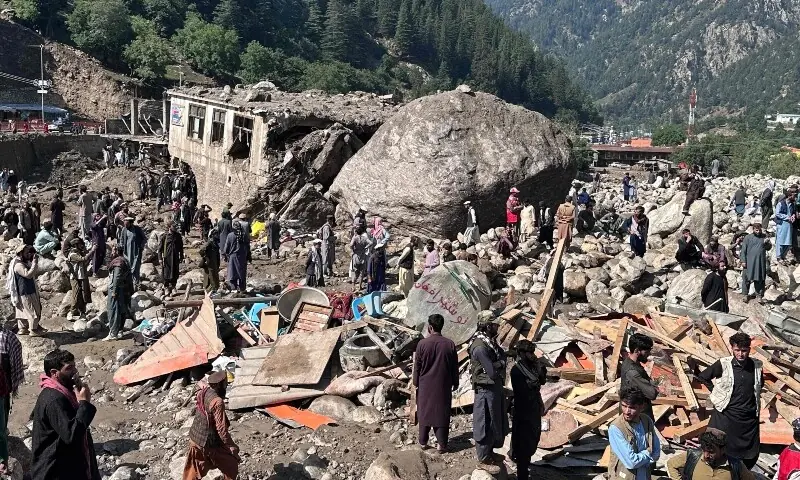 Rescuers were struggling to reach residents trapped under mud and boulders in eastern Afghanistan on Tuesday, after a major flood smashed through one province, killing at least 23 people. Around 100 people are unaccounted for, the national disaster agency and the provincial governor’s office said, also updating the death toll from Monday’s deluge. An AFP journalist saw dozens of people gathered in remote Parun, the capital of Nuristan province, using wooden poles and their bare hands to search for the missing. Afghan men stand amidst destroyed shops after flash floods hit Parun town in Afghanistan’s Nuristan province on July 21, 2026. — AFP Farid Gul Zaheer, a 34-year-old pharmacist, said he had “never witnessed such a dangerous flood”. “It felt like there was an earthquake, and I heard children and people screaming,” he told AFP, after getting injured while trying to flee up the mountain. On Tuesday, a bulldozer was of limited use in clearing some debris in Parun, where the flood had buried multiple shops an...
-
Dawn - 09:26 Jul 21, 2026
SINCE Brexit, political instability in the UK appears to be unending. Over the past decade, the country has had six prime ministers, yet the majority of the public remains despondent and views Britain as fractured. Now, Andy Burnham, the former mayor of Greater Manchester, has been appointed as the prime minister to help steer the country out of its current political turmoil with a complete reset of policies and governance. His pitch for the premiership is “good growth in every postcode and hope in every heart”. Andy Burnham humorously earned the nickname the ‘King of the North’, inspired by Game of Thrones, for his efforts to defend Manchester communities during the Covid pandemic. He took steps to bring the city’s transport under local control and championed the devolution of power from Westminster and Whitehall to regional authorities. This strategy is often referred to as ‘Manchesterism’, and ‘Burnhamism’. While Manchester’s economy has been the UK’s fastest growing in recent years, some argue that this s... -
Dawn - 09:13 Jul 21, 2026
QUETTA: Three excise officials have been abducted at gunpoint following an attack on their department’s checkpost on the Dalbandin–Taftan Highway in Balochistan’s Chagai district, police sources told Dawn on Tuesday. According to the sources, the attack was carried out by unidentified men on Monday evening. They said around 30 armed men surrounded the checkpost that was set up temporarily for routine checking, held the officials on duty at gunpoint and later abducted them. The sources added that the attackers also took away two official vehicles and weapons. Police and other law enforcement personnel rushed to the site after being informed of the incident and cordoned off the area, the sources said, adding that a search operation has been launched to trace the attackers and ensure the safe recovery of the abducted officials. They said an investigation was under way to ascertain the identity of the assailants and determine the route they used to flee. The incident takes place as Balochistan continues to face s... -
Dawn - 08:42 Jul 21, 2026
Prime Minister Shehbaz Sharif on Tuesday met newly appointed Gilgit-Baltistan (GB) Chief Minister Advocate Amjad Hussain and assured him that the federal government was committed to working closely with his government for the welfare of the region’s people. According to the Prime Minister’s Office (PMO), the premier told Hussain that the Centre is committed to working with his government for “the welfare and well-being of the people of Gilgit-Baltistan”. The statement said that he also congratulated Hussain on assuming office. PM Shehbaz also said that the federal government was undertaking development initiatives in renewable energy, tourism, infrastructure, health, education and other sectors for the region’s progress. “Among the federal government’s projects, the top priorities include a 100-megawatt solar energy initiative and the establishment of knowledge schools,” the statement quoted the premier as saying. He added that the federal government was also planning to establish a Pakistan Asaan Khidmat Cen... -
Dawn - 08:25 Jul 21, 2026
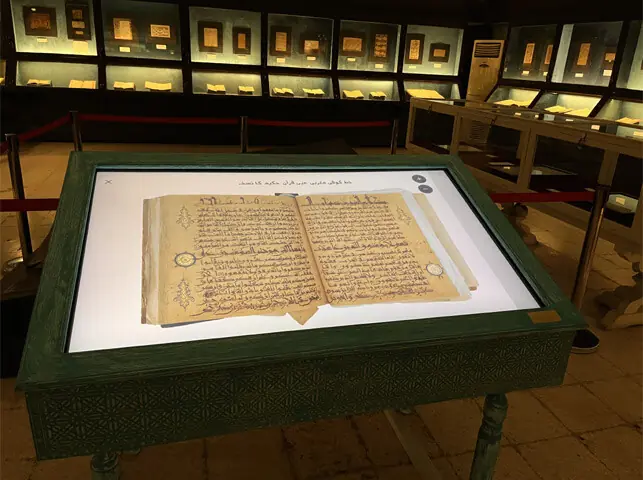 Digitising a museum collection is often framed as a technical challenge. Procure high-resolution cameras and scanners, hire trained photographers and scanning technicians, build databases and upload images to the cloud. In Pakistan, however, museum, archive and heritage digitisation is as much about navigating governance structures, institutional histories and professional anxieties as it is about the technology being used. For more than two decades, the Lahore Museum has not been led by a museum professional. For the past 16 years, the Taxila Museum has lacked authority over the majority of its reserve collection. During those same periods, specialised expertise in collections management, conservation and museum documentation have steadily eroded across much of the country’s cultural sector. The result is that projects that should primarily be about technology have become exercises in navigating institutional uncertainty. The recent digitisation of the Lahore and Taxila Museums demonstrates how the success o...
-
Dawn - 07:56 Jul 21, 2026
Dr Asif Mahmood, a physician of Pakistani origin, has been elected as the chair of the United States Commission on International Religious Freedom (USCIRF). The commission is a bipartisan body of the US federal government that monitors religious freedom around the world and makes policy recommendations to the president, the secretary of state and the US Congress. In a statement on Monday, USCIRF announced the unanimous election of Mahmood as the panel’s chair and of CeCe Heil as the vice chair for the 2026-27 term. Mahmood is a practising pulmonologist, human rights advocate, and philanthropist, according to USCIRF. “His global advocacy work and humanitarian interventions have helped save lives in crisis-stricken regions around the world, including Kashmir, Tigray, and other conflict zones,” the commission’s website states. “As a two-term member of the Medical Board of California, Dr Mahmood fiercely advocates for patients’ rights and works to secure greater access to medical coverage for all communities,” ... -
Dawn - 07:55 Jul 21, 2026
The Pakistan Stock Exchange’s (PSX) benchmark index gained nearly 1,200 points during intraday trade on Tuesday. The KSE-100 index opened in the green, soaring by 2,442.72 points to reach an intraday high of 178,370.45 at 10:09am. However, it then dipped sharply after 12pm, declining to 177,120.04 points at 12:44pm, up by 1,192.31 (0.68 per cent) from the previous close. The development came as global oil prices softened on Tuesday, with markets weighing reports of mediation efforts between the US and Iran against an exchange of fresh attacks between the two and threats of a naval blockade of Saudi Arabia by Yemen’s Houthis. Brent crude futures eased 78 cents, or 0.9pc, to $88.44 per barrel by 0415 GMT. US West Texas Intermediate crude was down 73 cents, or 0.9pc, to $82.50 per barrel, while the more active contract for September delivery slipped 41 cents, or 0.5pc, to $82.07 a barrel. Awais Ashraf, director of research at AKD Securities, said the market extended the previous session’s late recovery as “oil p... -
Dawn - 07:26 Jul 21, 2026
 The curtain has fallen on the 2026 FIFA World Cup, the grandest and most expansive edition yet, hosted across the United States, Canada and Mexico. Spain emerged triumphant in a tense final against Argentina, etching their name on the trophy in a display of technical brilliance. Yet as the echoes of the stadiums fade, the tournament departs with more than memories of footballing excellence. It leaves behind a trail of controversies and unanswered questions that may linger long after the final whistle. Sport, like politics, often mirrors the contradictions of its time. The 2026 World Cup was no different. Here are five questions that football must now confront. Did political interference undermine the integrity of the game? The most glaring shadow over the tournament was the alleged involvement of political figures in sporting matters, most notably US President Donald Trump’s intervention following the red card awarded to American forward Folarin Balogun. After receiving a red card that should have triggered a...
12682 items