Dawn
Source:
https://www.dawn.com
Found 12682 news
-
Dawn - 17:22 Jul 10, 2026
Balochistan Chief Minister Sarfraz Bugti on Friday stated that a total of 75 terrorists had been killed since July 5 in various intelligence-based operations in the province. In a post on social media platform X, CM Bugti said: “Operation Shaban is progressing successfully following the terrorist attack on Mangi Dam Police Station.” He elaborated that 39 terrorists had been killed in Operation Shaban as a result of joint ground and air operations by the Pakistan Army, Frontier Corps and Balochistan Police in rugged mountainous areas, while a total of 75 terrorists had been killed in various intelligence-based operations since July 5. Bugti further said that a terrorist attack on Zehri Police Station in the Kachhar area of Balochistan had also been foiled today. “The writ of the state will be maintained in Balochistan at any cost; terrorists cannot escape their fate,” he declared. A day earlier, Prime Minister Shehbaz Sharif said the country’s civil and military leadership had taken a “mutual and singular deci... -
Dawn - 16:49 Jul 10, 2026
KP govt decides to withdraw controversial clauses from law granting expanded privileges to lawmakers
PESHAWAR: The Khyber Pakhtunkhwa government on Friday decided to withdraw the controversial clauses from recently enacted legislation that expanded lawmakers’ powers and privileges after widespread backlash. In April, the provincial assembly passed the KP Provincial Assembly (Powers, Immunities and Privileges) Act, 2026, granting blue passports to members and their spouses, arms licenses, blanket immunity from preventive detention and making the speaker’s permission necessary before arresting members on criminal charges. The law faced harsh criticism from the media and general public, prompting KP Chief Minister Sohail Afridi to order a review of the legislation on Wednesday. In a video message shared on X, KP Information Minister Shafi Jan said: “On the directives of Chief Minister Sohail Afridi, the provincial government has decided to withdraw all controversial provisions incorporated into the KP Provincial Assembly (Powers, Immunities and Privileges) Act, 2026.” He said that cabinet members met with the c... -
Dawn - 15:45 Jul 10, 2026
A pledge by President Donald Trump to allow Kyiv to produce US Patriot air defence missiles is a victory for Ukrainian President Volodymyr Zelensky but it could take at least a year to start producing them, defence experts say. With its chronic shortage of interceptor missiles likely to continue until then, Kyiv faces tough choices over which targets are a priority to defend as Russia keeps pounding its cities and energy infrastructure. Trump’s promise on Wednesday, when he met Zelensky during a Nato summit in Ankara, was a significant gesture of support that marked a huge improvement in their relationship since they clashed at the White House in February 2025. Patriot interceptor missiles are vital for Ukraine’s defence at a time when Zelensky says Russia, whose battlefield advances have stalled, is trying to leverage its advantage in ballistic missiles by hitting Ukraine hard. The Patriot is the only weapon in Kyiv’s arsenal capable of stopping Russian ballistic missiles. Ukraine has brought down only four ... -
Dawn - 14:54 Jul 10, 2026
If FIFA President Gianni Infantino imagined his embrace of technology might finally put an end to disputes over refereeing decisions, the World Cup would have disabused him of the notion. The use of technology has been at the heart of every major controversy at the tournament, including the saga around the red card for Folarin Balogun that drew in United States President Donald Trump. Criticism of technology has ranged from charges of over-reach and inconsistency of application, to full-blown conspiracy theories that VAR was being used to determine the outcome of matches in favour of certain teams or players. Egypt coach Hossam Hassan gave voice to all three on Tuesday after his team had a goal scratched off by VAR because of a foul at the other end of the pitch, and a penalty shout that went unchecked, before losing 3-2 to Argentina in the last 16. “What’s happening isn’t fair,” he said. FIFA referees’ chief Pierluigi Collina said in an interview on Wednesday that he was happy with how things were going and ... -
Dawn - 14:28 Jul 10, 2026
ISLAMABAD: The Privatisation Commission Board on Friday approved the signing of a transaction advisory services agreement (TASA) with the Asian Development Bank (ADB) for the outsourcing of operations of Islamabad International Airport. In February, the board formed a negotiation committee to engage with the ADB and discuss terms for a financial advisory services agreement. This committee would undertake negotiations and submit recommendations to the board for approval. The meeting, presided over by Adviser to the Prime Minister on Privatisation and Privatisation Commission Chairman Muhammad Ali, reviewed the terms of the agreement negotiated with the ADB and approved it. The board expressed confidence that the ADB, with its expertise and experience, would be able to successfully complete this important transaction swiftly while ensuring maximum competition and transparency. Islamabad International Airport will be outsourced to a qualified private sector operator under a long-term concession framework through... -
Dawn - 13:47 Jul 10, 2026
China on Friday successfully tested an experimental rocket retrieval system using a net attached to a sea platform, state media reported, in the hope of breaking US dominance in reusable rockets. The Long March 10B rocket lifted off from the Hainan commercial space launch site in southern China at 12:15pm (9:15am PKT) and, about six minutes after separation of its booster and upper stage, the booster returned vertically and was recovered on an offshore platform, state broadcaster CCTV reported. The test marks China’s first successful retrieval of an orbital-class rocket, putting the country closer to developing reusable rockets. The rocket had sent a satellite into preset orbit on Friday, state media said. Shares in Chinese aerospace firms jumped on the news, with China Spacesat and China Satellite Communications hitting daily limits. The Long March 10B has been compared to the Falcon 9, SpaceX’s widely used medium-lift rocket. It was developed for commercial aerospace by the country’s main state rocket devel... -
Dawn - 13:15 Jul 10, 2026
Renowned Islamic scholar Mufti Taqi Usmani has declared purchasing goods with cryptocurrency “impermissible”, citing research conducted by experts so far which found that cryptocurrency does not qualify as “wealth”, it emerged on Friday. The fatwa was originally issued by Darul Ifta, Jamia Darul Uloom, Karachi, and dated 24 Zilhaj 1447 AH (June 10, 2026). Apart from Mufti Usmani, a former judge of the Federal Shariat Court, five other prominent scholars are its signatories. Responding to a question about purchasing books with cryptocurrency, the fatwa said: “It is not permissible for you to purchase the books in question using cryptocurrency.” “According to research and opinion of experts so far, cryptocurrency is not considered ‘maal’ (wealth) in Sharia. Instead, it is merely the recording of fictitious numbers in an account, whether in the form of USDT or other crypto tokens,” it stated. As cryptocurrency was not recognised as wealth, the fatwa maintained that the buyer did not technically become the owner ... -
Dawn - 12:35 Jul 10, 2026
The Sindh government on Friday ordered a private school in Karachi to reverse fee hikes imposed during the summer holidays. In a letter addressed to the principal and administrator of Veritas Learning Circle (Primary), dated July 10 (Friday), Sindh’s Directorate of Inspection and Registration of Private Institutions — part of the provincial government’s School Education and Literacy Department — referred to a hearing held the previous day regarding complaints about the school’s “illegal and extraordinary” fee hike. A copy of the letter is available with Dawn. “During the course of the hearing, it was determined that your school, including all of its campuses, had enhanced tuition fees without the approval of the registration authority, in violation of the Rule 7(6) of the Sindh Private Educational Institutions (Regulation and Control) Rules 2005,” the letter said. The rule states that “any complaint regarding the tuition fees in violation of the rules or charging of any fee other than tuition fees shall be li... -
Dawn - 12:13 Jul 10, 2026
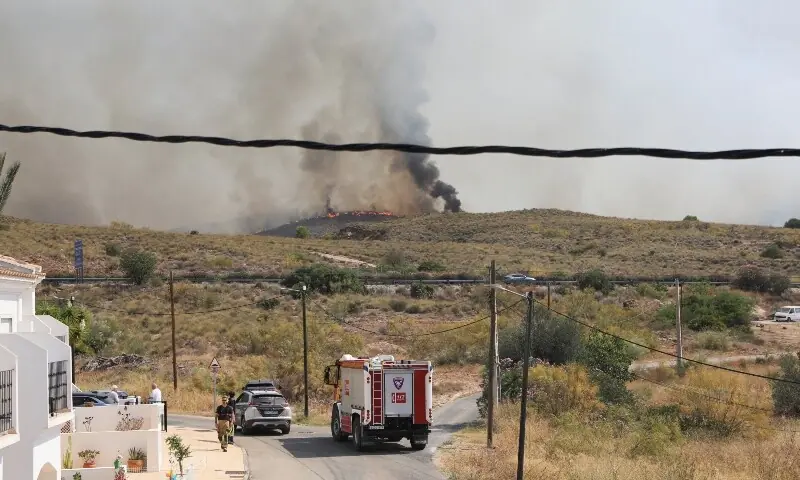 As flames approached their homes and the smoke-filled air became choking, panicked residents in rural Andalusian villages around Los Gallardos in southern Spain chose to flee, a decision some paid for with their lives. Firefighters on Friday were still trying to contain one of Spain’s deadliest wildfires, with a total of 11 people confirmed dead, while 19 more are missing. A firefighting vehicle stands next to a Spanish Civil Guard vehicle as residents get ready to leave their homes while smoke and flames rise during a wildfire in Los Gallardos, Almeria, Spain on July 10, 2026. —Reuters Authorities told some residents of areas in the mountains above Los Gallardos to evacuate via a recommended route, while residents of the forested hamlet of Bedar were told to shelter in place. However, as the flames rapidly approached, Antonio Rubio, a handyman living in Bedar, said the smoke had made it impossible to shelter in place. “We left the house yesterday (Thursday) afternoon at 5 o’clock. The fire didn’t reach my ho...
 -
Dawn - 11:57 Jul 10, 2026
The Pakistan Aviation Authority (PAA) said on Friday that the search for the crew of a cargo plane that crashed into the Arabian Sea was ongoing, adding that additional wreckage had been located. In a statement, the authority said the search and rescue missions by the Pakistan Navy and Pakistan Maritime Security Agency in the deep sea were still in progress. “The search for the crew members is continuing with full vigour through the coordinated employment of aerial and sea-borne assets,” it said. “Additional parts and debris of the ill-fated aircraft have been located and retrieved for subsequent analysis by the investigation team,” it said, adding that updates would be shared as the search and rescue operations continued. On Tuesday night, a K2 Airways Boeing 737-400 cargo aircraft en route from Sharjah to Karachi had disappeared from radar over the Arabian Sea, about 300 kilometres west of Karachi, while approaching Pakistani airspace. The pilot had reported a navigation problem during the flight and reques... -
Dawn - 10:31 Jul 10, 2026
The Pakistan Meteorological Department (PMD) on Friday predicted rain, windstorm and thundershowers in the upper parts of the country over the weekend. The department said that moist currents from the Arabian Sea were continuously penetrating the upper parts of the country, increasing in strength on Saturday (July 11) evening. “Meanwhile, a westerly wave is also likely to approach the upper parts on Saturday,” it said. Rain, windstorm and thundershower with isolated heavy rainfall have been predicted in Neelum valley, Muzaffarabad, Rawalakot, Poonch, Hattian, Bagh, Haveli, Sudhanoti, Kotli, Bhimber and Mirpur from Friday night (July 10) to Monday (July 13). Similar weather conditions are expected in Dir, Chitral, Swat, Kohistan, Malakand, Nowshera, Charsadda, Karak, Tank, Lakki Marwat, Swabi, Shangla, Battagram, Buner, Kohat, Kurram, Dera Ismail Khan, Bannu, Waziristan, Bajaur, Mohmand, Khyber, Orakzai, Mansehra, Abbottabad, Haripur, Peshawar, Mardan and Hangu on Saturday and Sunday (July 12). Meanwhile, scat... -
Dawn - 09:57 Jul 10, 2026
Four terrorists were killed in a joint intelligence-based operation in the Khattak Dam area near the border between Khyber Pakhtunkhwa’s Karak and Kohat districts, according to police. In a statement, Karak police said that credible information was received regarding the presence of terrorists in the area at around 5am. It said that an operation was carried out in tandem with the Kohat police. “During the operation, terrorists opened fire on the police party, prompting an effective retaliatory response from the police,” it said. Following an “intense exchange of fire”, four terrorists from the ‘Commander Zahid Group’ were killed, it added. The statement said the terrorist group had reportedly been involved in the killing of several police officers and personnel. The statement said police had launched a search operation and cordoned off the area as they gathered further details on the identities and criminal records of the killed terrorists. In its statement, Karak police reiterated its commitment to eradicati... -
Dawn - 09:14 Jul 10, 2026
Prime Minister Shehbaz Sharif on Friday said that effective communication between the Centre and the leadership of Gilgit-Baltistan (GB) was indispensable, directing that a committee be formed to review suggestions from PML-N lawmakers from the region for its welfare. He made the remarks while meeting with PML-N members of the GB Assembly in Islamabad, according to the Prime Minister’s Office (PMO). The meeting was also attended by Deputy Prime Minister and Foreign Minister Ishaq Dar, Information Minister Attaullah Tarar, Minister for GB and Kashmir Affairs Amir Muqam, and PM’s Adviser on Political Affairs Rana Sanaullah. “The development and progress of GB is among the federal government’s top priorities,” the statement quoted PM Shehbaz as saying. He added that the government gained “direct insight” into people’s expectations, issues and priorities via the members of the assembly, as their elected representatives. “Regardless of our affiliation with any political party, our sole objective is to serve the pe... -
Dawn - 08:41 Jul 10, 2026
Khyber Pakhtunkhwa Governor Faisal Karim Kundi on Friday urged the National Assembly speaker and the Senate chairman to convene a meeting for deciding on a single bill for lawmakers’ privileges. His remarks come after the KP Assembly passed the KP Provincial Assembly (Powers, Immunities and Privileges) Act, 2026 on April 30. The law expanded provincial assembly members’ powers and immunities, including the issuance of lifetime official passports to them and their spouses. Kundi had assented to the law, alongside others, on May 6. However, following backlash, KP Chief Minister Sohail Afridi this week ordered a review of the new law’s provisions. In a post on the social media platform X, Kundi called on National Assembly Speaker Ayaz Sadiq and Senate Chairman Yousuf Raza Gilani to “immediately convene a meeting of the speakers of all four provincial assemblies and agree on a single, harmonised bill governing the salaries, privileges and entitlements of legislators across Pakistan”. “No province should legislat... -
Dawn - 06:54 Jul 10, 2026
The World Bank’s (WB) Board of Executive Directors has approved $375.9 million in financing for Pakistan’s Grid Stability Enhancement Project to strengthen the country’s national power transmission network. According to a press release issued by the WB, the project is being implemented under the Boosting Energy Security through Transmission in Pakistan (BEST-PAK) Multiphase Programmatic Approach (MPA). It said the project is the first phase of a 10-year programme aimed at helping Pakistan modernise its “electricity transmission network, reduce power outages and bring more clean energy to homes, businesses and industries”. “Pakistan’s energy challenges are deeply interconnected with its broader economic stability,” WB Country Director Bolormaa Amgaabazar was quoted as saying. “By investing in advanced technologies for more resilient transmission infrastructure, this project will contribute to reducing electricity costs, bring more renewable energy onto the grid, and lay the groundwork for a power sector that w... -
Dawn - 06:42 Jul 10, 2026
Interior Minister Mohsin Naqvi and his Bangladeshi counterpart Salahuddin Ahmed have agreed to extend cooperation in curbing cybercrime and online fraud, the interior ministry said on Friday. The two ministers held a meeting in New York. In a statement on the social media platform X, the ministry said that the ministers also agreed to expand cooperation in areas of mutual interest. During the meeting, they discussed training and exchange programmes for police officers, it said. It further said that they held a detailed discussion on the US-Iran conflict and the current situation in the Middle East. According to the statement, Ahmed lauded Pakistan’s “constructive role” in establishing peace. Meanwhile, Naqvi was quoted as saying that Prime Minister Shehbaz Sharif and Chief of Defence Forces and Chief of Army Staff Field Marshal Asim Munir played a vital role in maintaining peace. “We must seize new opportunities to further strengthen our mutual relations,” he said. Naqvi is currently in the US, where he repre... -
Dawn - 06:13 Jul 10, 2026
India’s Prime Minister Narendra Modi lands in New Zealand on Friday touting a free trade deal that has sparked a backlash despite promises it will unlock jobs and economic riches. On the agenda are trade, tourism and sport — but recent undercurrents of anti-migrant sentiment risk tarnishing his trip to a nation long proud of its tolerance. New Zealand Prime Minister Christopher Luxon celebrated the signing in April of the free trade deal with the world’s most populous nation, touting an export boom that would deliver jobs and investment in spades. The pact is widely expected to be approved by New Zealand’s parliament. But not everyone is happy at the prospect. Lawmakers in the populist New Zealand First Party, part of Luxon’s governing coalition, railed against parts of the agreement covering migration and visas. “I don’t care how much criticism we get, I am just never going to agree with a butter chicken tsunami coming to New Zealand,” government minister Shane Jones told a local radio show. An Indian commun... -
Dawn - 05:31 Jul 10, 2026
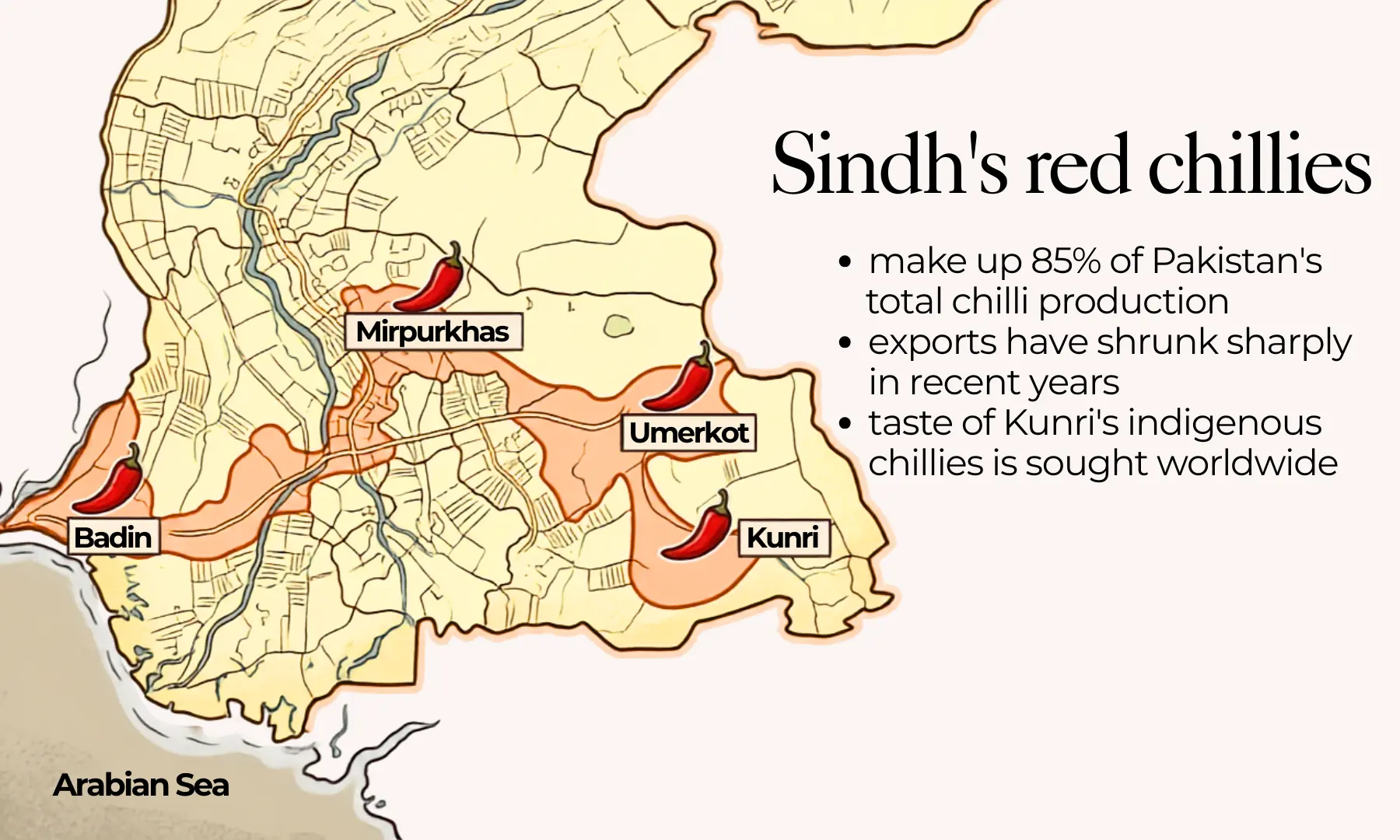 Name: Kunri, Umerkot Pop.: 26,600 Area: 585 km² The farmers say the origin story goes something like this. In the sixties, a handful of chilli seeds travelled south from Radha Ram in Punjab to Kunri in Sindh. Harvest after hot harvest proved so successful that within two decades the town shot to fame as the red chilli capital of Asia. The farmers put their fortune down to divine largesse but the scientific explanation is far more mundane: Kunri simply had exactly the right climate for a brief window of time—partially humid and partially dry—for its soils to produce one variety of chilli that cannot be grown anywhere else in the world. That chilli is Dundicut or Longi, which when plucked comes off without the stem, hence the name dandi-cut. It grows in the crumbed soil of sun-cooked fields, which infuse the air with pepper mist. Rows of the dwarf plant are punctuated by figures at work in armfuls of ivory bangles and neon green cholis. This little fighter registers between 30,000 and 35,000 Scoville heat units...
 -
Dawn - 05:08 Jul 10, 2026
From remote-controlled trucks delivering life-saving aid in dangerous settings to mobile phone data analysis flagging mass displacement, humanitarians are eyeing ways in which artificial intelligence (AI) can speed up and improve their operations. There have been plenty of warnings about the dangers of AI for aid agencies, who face growing challenges of securing often extremely sensitive data and swelling misinformation about their operations and beneficiaries. But at the ‘AI for Good’ summit in Geneva this week, a handful of humanitarian-focused displays emphasised the technology’s positive potential. Parked in one corner of a vast hall at the Palexpo conference centre was a giant white Sherp vehicle, resembling a hulking Martian rover, decked out with cameras and sensors and a drone landing-pad on the roof. Made in Ukraine, Sherps are amphibious vehicles that can float on water, drive through swamps and flooded rivers with their giant wheels, and climb over obstacles up to one metre high. The UN’s World Foo... -
Dawn - 03:44 Jul 10, 2026
LAHORE: Human rights defenders and activists gathered at the Human Rights Commission of Pakistan on Thursday to discuss the Punjab Control of Habitual Offenders and Anti-Social Behaviour Bill, 2026, raising concerns that, if implemented, the proposed law would turn the whole Punjab into an open jail. “The objective of the Bill is to stop any statements against the security forces, followed by a hierarchy of sensitivity. Azma Bokhari and Marriyum Aurangzeb had complaints written to the NCCIA, they went to high court, directions were issued to the NCCIA but they were not satisfied. The objectives they wanted to achieve against those who had made their memes or defamed them were not achieved,” says lawyer Asad Jamal. Those people, he said, were not punished by the NCCIA because it had its own limitations and objectives. “Now they want to establish a parallel institution in Punjab and they are moving towards it,” Jamal declared. Secondly, he added, the Crime Control Department (CCD) had brought a bad name to the ...
12682 items