Iran | Pakistan
"Iran" in Pakistan feed
-
The Nation - National - 18:04 Aug 05, 2026
Prime Minister Muhammad Shehbaz Sharif, on Wednesday, reaffirmed that Pakistan highly valued its close and brotherly ties with the Islamic Republic of Iran. -
Dawn - 16:30 Aug 05, 2026
Pakistan and Iran on Wednesday agreed to further expand trade ties by keeping border crossings open round the clock, improving logistics and harmonising customs procedures. The development came during a meeting between Prime Minister Shehbaz Sharif and a six-member Iranian delegation, led by Iran’s Minister for Industry, Mine and Trade Mohammad Atabak, in Islamabad, according to a statement issued by the Prime Minister’s Office (PMO). During the meeting, the prime minister said that Pakistan highly valued its relations with its close, brotherly neighbour Iran, the PMO said. “Pakistan will continue its sincere efforts for peace in the region,” PM Shehbaz was quoted as saying. He added that he had recently held a productive discussion with Iranian President Dr Masoud Pezeshkian on establishing lasting peace in the region and further enhancing Pakistan-Iran bilateral relations, particularly in trade, the statement said. During the meeting, the prime minister expressed hope that sustained efforts would enable bot... -
The Express Tribune - 09:45 Aug 05, 2026
PM Shehbaz says sustained efforts can help Pakistan and Iran achieve their $10b bilateral trade target -
Dawn - 05:32 Aug 05, 2026
United States President Donald Trump said a deal to reopen the Strait of Hormuz could come as soon as Wednesday but warned Iran it would get “hit very hard” if negotiations fell through. Transit of the waterway, a key conduit for global oil and gas supplies, has been a sticking point in talks and led to renewed fighting following an April ceasefire. Iran has tightened its grip on Hormuz and wants to control the strait and charge tolls — powers it did not exercise before the war began on February 28. Trump said on Tuesday a deal with Iran to reopen Hormuz could happen “tomorrow or the next day,” telling reporters in California that negotiators “had a very good day”. Earlier, he struck a more threatening tone. “The strait is going to be open very soon, or they’re going to get hit very hard — and then the strait’s going to be open,” Trump said in an interview with Fox News. “All you can do is fight your way out.” US Treasury Secretary Scott Bessent told CNBC earlier “there is a chance we may have a deal” by Wedn... -
Dawn - 08:59 Aug 04, 2026
ISLAMABAD: Pakistan and Iran on Tuesday reiterated their resolve to expand bilateral trade to $10 billion, with Commerce Minister Jam calling for transforming “historic brotherly relations” with Iran into a robust economic partnership. Since March this year, both countries have rolled out a series of measures to facilitate border trade, including easing customs procedures, formalising Taftan as a customs station, and notifying new transit routes, against the backdrop of the ongoing US-Iran conflict in the Middle East that has strained economies in the region and beyond. Their latest engagement took place at the 10th session of the Pak–Iran Joint Trade Committee (JTC), which is being held in Islamabad from August 3-5. The meeting was co‑chaired by Iranian Industry, Mine and Trade Minister Mohammad Atabak and Pakistan’s Commerce Minister Jam Kamal Khan. On the occasion, Khan also underscored the urgency to finalise the Pak–Iran Free Trade Agreement, a statement issued by his ministry said. He called for the rem... -
Dawn - 09:24 Aug 03, 2026
Iran said on Monday that no negotiations with the United States were currently being held despite US President Donald Trump announcing earlier that the two sides were set to begin parleys later today. “Iran is not currently holding talks with the United States and is now in discussions with Oman over a temporary safe route through the Strait of Hormuz,” Iranian foreign ministry spokesperson Esmaeil Baqaei said in a televised press conference. On Sunday, Trump said that new negotiations with Iran would begin on Monday after he decided to hold off on striking the country to pursue a deal to end the war entering its sixth month. Trump told reporters that the talks would cover the Strait of Hormuz and ultimately, the denuclearisation of Iran. Oil prices fell on Monday at the opening of Asian trade after Trump announced the new negotiations, with West Texas Intermediate dropping 4.7 per cent to $80.72 per barrel. Following a return to strikes last month, fears had mounted that the fighting could escalate once agai... -
Dawn - 06:32 Aug 03, 2026
Oil prices tumbled more than $4 a barrel on Monday after US President Donald Trump held off on a fresh attack on Iran, seeking to reach a quick deal that would reopen the Strait of Hormuz. Brent crude futures slid $4.49, or 5.11 per cent, to $83.44 by 0408 GMT while US West Texas Intermediate crude was at $79.77 a barrel, down $4.90, or 5.79pc. Both contracts jumped more than 20pc last month after fighting between the US and Iran resumed and as attacks on several tankers around Oman heightened security concerns, deterring shippers from entering the Gulf to load oil. In a sign of de-escalation, Trump said late on Saturday on his Truth Social platform that Iran and other Middle Eastern countries had asked for time to complete a deal that would lead to “the Immediate, Complete and Total” reopening of the vital strait and “an end to Iran’s nuclear threat”. IG market analyst Tony Sycamore says, “The bigger focus is whether this week turns into a rinse and repeat of last week with hopes of a deal collapsing as Iran... -
Dawn - 05:16 Aug 03, 2026
US President Donald Trump said that new negotiations with Iran will begin on Monday after he decided to hold off on striking the country to pursue a deal to end the war entering its sixth month. Trump told reporters on Sunday that the talks would cover the Strait of Hormuz — a route for global energy supplies that has become a key sticking point in the conflict —and ultimately, the denuclearisation of Iran. For its part, Iran said it was nearing a deal with Oman over a new route through the strait, where a tanker reported an explosion nearby on Sunday, underscoring the continued volatility of the strategic waterway. Oil prices fell on Monday at the opening of Asian trade after Trump announced the new negotiations, with West Texas Intermediate dropping 4.7 per cent to $80.72 per barrel. Washington and Tehran have been at war since February 28, when the US and Israel launched surprise strikes against Iran, though months of on-off diplomacy have led to periods of relative calm. Following a return to strikes last... -
The Express Tribune - 00:06 Aug 03, 2026
Trump repeatedly issued threats to escalate war on Iran in late February, only to allow more time for talks -
Dawn - 17:36 Aug 02, 2026
Donald Trump has made some of the most aggressive public threats about military action of any modern US president. He has walked back many of them too. The 80-year-old Republican’s comments about the US war against Iran have shifted, sometimes dramatically and quickly, since the conflict erupted on February 28. He has repeatedly declared victory, claiming Iran’s military capabilities were utterly defeated, only to later tweak the war timeline or threaten Tehran with more strikes. He praised Iran’s new leaders on June 17 as “very smart” and “far less radicalized” than their predecessors killed in US and Israeli strikes. By July 8, a frustrated Trump changed his tune. “I don’t want to deal with them anymore, they’re scum,” he said. Here are some of the main examples of Trump’s threats against Iran, and how he has dialed them back. March 21 “If Iran doesn’t FULLY OPEN, WITHOUT THREAT, the Strait of Hormuz, within 48 HOURS from this exact point in time, the United States of America will hit and obliterate their v... -
Dawn - 03:43 Aug 02, 2026
United States President Donald Trump said late on Saturday he would hold off on a fresh attack on Iran as long as a deal could be reached quickly to halt Iran’s nuclear ambitions and reopen the Strait of Hormuz. Iran and “other Middle Eastern Countries” asked for a time to complete a deal that would lead to “the Immediate, Complete and Total” reopening of the Strait and “an end to Iran’s nuclear threat,” Trump wrote on his Truth Social platform. “Based on this request, I have agreed, for the future benefit of the WORLD and, likewise, the survival of a successful and prosperous Iran, to cancel the attack, subject to being able to rapidly make a DEAL.” Israel “joins me in this commitment,” Trump wrote. Israel did not immediately make a public statement on the issue. Iran warned the US this weekend against any adventurous action and said it would retaliate decisively if American forces followed through on Trump’s threats of fresh attacks on Iranian targets. Iranian Foreign Minister Abbas Araqchis comments in sep... -
Dawn - 02:51 Aug 02, 2026
• Top American commander warns navy is stretched too thin; US has used nearly half of its THAAD interceptors • Pentagon may face choice between US interests and Israel • Missile defences consumed faster than they can be replaced; war tests Washington’s ability to fight on multiple fronts WASHINGTON: A warning from one of America’s top military commanders has exposed a growing dilemma for Washington: The United States may no longer have enough naval forces to simultaneously defend Israel against Iranian missile attacks and protect its own interests across the Middle East. General Alexus Grynkewich, commander of US European Command, has privately informed Pentagon officials that American naval assets are becoming stretched too thin as the conflict with Iran continues, according to reports by The Washington Post and other news outlets. The general reportedly warned that without another US Navy destroyer assigned to the region, commanders could eventually face a difficult choice between protecting American forces... -
The Express Tribune - 14:32 Jul 30, 2026
US Senate blocked a bid to curb military action on Iran, leaving the president's authority unchanged -
The Express Tribune - 09:28 Jul 30, 2026
Iran set to receive up to 400 Chinese-made air-defence missile systems within weeks amid efforts to rebuild forces -
Dawn - 08:23 Jul 30, 2026
The Foreign Office (FO) said on Thursday that Pakistan was doing its “utmost” to bring the United States and Iran back to the negotiating table under the Islamabad memorandum of understanding (MoU) signed last month. Addressing a weekly press briefing, FO spokesperson Tahir Andrabi said Pakistan noted with concern that the security situation in the Middle East “remains precarious despite the relative calm of the past few days, which had rekindled hopes that this positive development, this calm, would consolidate into a durable and fully respected ceasefire and pave the way for dialogue”. Andrabi reiterated Pakistan’s support for dialogue and diplomacy, maintaining that it remained the “only viable path forward”. “We welcome all efforts aimed at sustaining cessation of hostilities and resumption of dialogue between Iran and the US,” he said, adding that Pakistan remained engaged and will continue to do so. “Let me add that the negotiations between parties are ongoing to normalise the situation, particularly th... -
Dawn - 05:51 Jul 30, 2026
The US military completed a “heavy wave of strikes” against Iran on Thursday in retaliation for Tehran targeting American bases in Jordan, as fighting intensified in the Middle East war after a nearly week-long pause. The reignited hostilities appear to have dashed hopes of a quick return to negotiations between the foes. US President Donald Trump had vowed to hit Iran “hard” after Tehran launched missiles at Jordan, its first regional strike in days. American forces “successfully completed a heavy wave of strikes against Iran”, and struck dozens of Islamic Revolutionary Guard targets including military command centres, US Central Command (Centocom) said. “The strikes aimed to further diminish threats posed by Iran and its proxies to American forces, commercial shipping, and neighboring Gulf countries,” it said. Iran’s state news agency IRNA reported hits on several cities in the southwestern Khuzestan province, as well as on Qeshm island in the Gulf. Areas around the cities of Abadan, Shadegan, Arvandkenar a... -
Dawn - 17:40 Jul 28, 2026
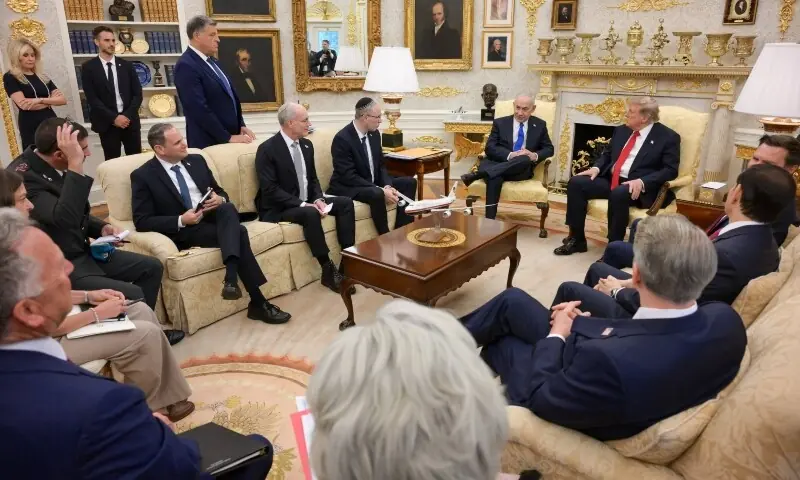 Israeli Prime Minister Benjamin Netanyahu visited the White House on Tuesday for his first in-person talks with President Donald Trump since the Iran war began, as the leaders sought to patch over public disagreements on the conflict. The meeting, which took place behind closed doors, was expected to be dominated by the war, which began with US and Israeli strikes on Iran in late February but has seen a recent pause in the fighting as Washington says it wants to give negotiations a chance. Israel has not taken part in the latest round of hostilities between the United States and Iran, which flared earlier this month as an April ceasefire collapsed. The talks — which the White House described as “positive and productive” — lasted for about an hour and a half. The meeting is the eighth between the leaders since Trump’s return to office in early 2025 and comes ahead of key electoral tests later this year for both Netanyahu and the US president: national elections in Israel and midterm polls in the United States....
 -
The Express Tribune - 10:12 Jul 28, 2026
Iran has yet to respond to Oman proposals aimed at ending Strait trade disruption from US-Israeli war -
Dawn - 03:26 Jul 28, 2026
AT least 624 US military service members have been wounded since President Donald Trump ordered strikes against Iran in February, according to the Pentagon’s most recent update on 25 July, BBC News reported. Among those wounded, 417 are attributed to Operation Epic Fury, while 207 are attributed to “Overseas Operations”. The US and Iran agreed to a ceasefire in April and signed a Memorandum of Understanding in June, but attacks by both sides have continued throughout. Revised casualty figures, unexplained changes to official records draw criticism over transparency Last week, the Pentagon revised its figures on those injured and killed in the war, removing the names of four personnel who died in Operation Epic Fury and adding them to the death toll for Overseas Operations. On the Pentagon’s Defence Analysis Casualty System, the death toll for Operation Epic Fury — the name given to the initial attack — was listed at 18 as late as Tuesday, along with 482 wounded, according to BBC News. At some point, four of ... -
The Express Tribune - 01:47 Jul 28, 2026
Relations with Zelenskiy warm while White House frustration mounts over stalled progress in Iran conflict