Galaxy | Crypto
"Galaxy" in Crypto feed
-
Cointelegraph.com - 08:24 Oct 08, 2026
 Eligible US Galaxy will be able to send USDC to crypto wallets and transfer funds to bank accounts in more than 60 countries. Samsung plans to introduce USDC transfers to the Samsung Wallet payment app for eligible US Galaxy users in the last week of October. The company announced that the feature will let users send USDC to compatible crypto wallets internationally and transfer money to eligible bank accounts in more than 60 countries, where recipients can receive funds in their local currency. Samsung said the feature will be available on 82 million compatible Galaxy devices in the US, but users must complete identity verification to access the service. Read more
 -
CryptoSlate - 04:30 Sep 24, 2026
Clients can pledge the savings token, though the companies disclosed no sUSDS-backed client loan volume. The post Galaxy adds $100M Sky token and institutional adoption is tested appeared first on CryptoSlate. -
CryptoSlate - 03:30 Aug 29, 2026
Abstentions created the smaller public margin, while on-chain finalization remained pending at the latest check. The post Kraken and Galaxy flipped late as Solana approved a major supply cut appeared first on CryptoSlate. -
Cointelegraph.com - 08:46 Aug 25, 2026
 Galaxy Research’s latest tally shows that more than half of 221 Coldcard hack victim reports involved individual losses exceeding 1 Bitcoin. The vast majority of Bitcoin stolen in the Coldcard hack remains unmoved, according to researchers tracking one of the largest hardware wallet exploits. Galaxy Research has attributed the theft of 1,789.28 Bitcoin from 8,865 addresses to the Coldcard hack, according to a Monday X post by Alex Thorn, Galaxy’s head of research. The funds were worth $114.7 million at the time of theft. Thorn said attackers have not spent 1,561 Bitcoin, or 87.3% of the attributed losses. The funds remain in attacker-controlled collection or holding addresses, including all Bitcoin stolen during the first three attack waves. Read more
 -
Cointelegraph.com - 08:40 Aug 15, 2026
 Galaxy cited unresolved ethics, stablecoin yield and developer protection issues, along with a narrow Senate window when lawmakers return in September. Galaxy Digital has lowered its estimate of the Digital Asset Market Clarity (CLARITY) Act’s chances of passing in 2026 to 10%. It warned that multiple political issues remain unresolved and the Senate will have only about two to three weeks to pass it when it reconvenes on Sept. 14. Unless an initial motion to proceed vote occurs immediately upon lawmakers’ return to Washington, there would be enough time for the CLARITY Act to pass the Senate only if it “dominates basically the entire working session,” wrote Galaxy’s head of firmwide research, Alex Thorn, in a Friday X post. Read more
 -
Cointelegraph.com - 15:41 Aug 14, 2026
 Bank Leumi customers will be able to buy, hold and sell three major cryptocurrencies directly through the bank’s investment app beginning in early 2027. Israel’s Bank Leumi has partnered with Galaxy Digital to let customers trade Bitcoin (BTC), Ether (ETH), and Solana (SOL) through the bank’s investment platform, with the service expected to launch in early 2027. The companies said Friday that customers of Leumi and Pepper, its mobile banking arm, will be able to buy, hold and sell the three cryptocurrencies through a dedicated section of the Leumi Trade app. Leumi and Galaxy said the rollout would make Leumi the first Israeli bank to offer digital asset trading services to customers. Leumi will use GalaxyOne Institutional for trading and related services, while Galaxy’s custody infrastructure platform, formerly known as GK8, will support the bank’s digital asset infrastructure. Read more
 -
Cointelegraph.com - 13:20 Aug 05, 2026
 Galaxy Digital reported an $85 million net loss driven by falling digital asset prices and $8.7 billion in revenue that missed Wall Street estimates. Galaxy Digital reported an $85 million net loss for the second quarter of 2026 as cryptocurrency valuations declined in the period. That resulted in a $0.09 loss per share posted on Wednesday which Galaxy attributed to the depreciation of digital asset prices during the quarter. Revenue at $8.7 billion was down 15% from $10.2 billion in the first quarter of 2026. Analysts had forecast a consensus of $12.7 billion, according to estimates compiled by Yahoo Finance. Read more
 -
Cointelegraph.com - 17:10 Aug 04, 2026
 The custody giant is expanding beyond safekeeping by adding staking services, allowing eligible institutional clients to earn yield on proof-of-stake assets. BNY and Galaxy have partnered to integrate institutional crypto staking into BNY’s digital asset custody platform, allowing eligible clients to earn staking rewards without moving assets out of custody. Under the arrangement, which was unveiled on Tuesday, institutional clients will be able to stake supported proof-of-stake assets while keeping them within BNY’s custody framework. Galaxy will provide the staking infrastructure and serve as a design partner for BNY’s broader digital asset platform. The companies did not specify which digital assets will be supported. The partnership also aims to combine custody, staking, reporting and tax services into a single offering for institutional clients, a move the companies said could simplify digital asset operations. Read more
 -
Cointelegraph.com - 14:38 Aug 04, 2026
 Galaxy said that at least 15 different attackers have exploited the Coldcard vulnerability, which may have been avoided with just $2 worth of AI hardening, according to Dragonfly’s managing partner. At least 15 different attackers have exploited the Coldcard vulnerability, according to Galaxy Digital’s head of research, Alex Thorn, citing new victim reports received since the incident. Thorn said Tuesday that the victim reports helped the company label new attackers that would have gone undiscovered, as the nature of the exploit was different from a hack on a centralized exchange. “Due to one single victim’s report of less than 1 BTC stolen, we identified a new attack with 12 BTC siphoned from 126 addresses,” Thorn wrote in a Tuesday X post. Read more
 -
Cointelegraph.com - 04:47 Aug 04, 2026
 Galaxy Research said 90% of the stolen Bitcoin remains unmoved as investigators examine a suspected fourth wave that could lift losses to $130 million. Confirmed losses from the Coldcard wallet incident have exceeded $100 million, with 1,596 Bitcoin (BTC) stolen from about 7,300 addresses across three separate major attack waves and 14 smaller incidents, according to a new update from Galaxy Research. On Monday, Galaxy Digital’s research arm said 73 victims had contacted its researchers, and victim reports confirmed the first three major attacks, helping investigators identify smaller “footprints” that Galaxy said could represent opportunistic attackers exploiting the vulnerability. Galaxy Research also identified a suspected fourth wave that could bring total losses to 2,055 BTC, worth about $130 million. However, Galaxy said it excluded the event from its confirmed estimate because it had not yet received confirmation from victims believed to be part of that wave. The research group said with “medium-high”...
 -
Cointelegraph.com - 01:57 Aug 03, 2026
 Galaxy research head Alex Thorn warned that unconfirmed transactions may give some Coldcard users a narrow opportunity to save their funds. Update (Aug. 3 at 4:19 am UTC): This article has been updated with the latest estimated number of affected addresses and Bitcoin from Galaxy’s Alex Thorn. Coldcard users are being warned of a new wave of coordinated thefts targeting their Bitcoin hardware wallets, coming just days after the first wave of attacks on Thursday. In an X post on Monday, Galaxy research head Alex Thorn flagged hundreds of transactions impacting 709 potential victim addresses, moving around 448.7 Bitcoin (BTC). Read more
 -
Cointelegraph.com - 09:23 Aug 01, 2026
 Galaxy Research identified 1,196 addresses that lost 1,082.65 Bitcoin in a 41-minute window, expanding the estimated scope of the Coldcard wallet incident. Galaxy Research, the research arm of crypto investment company Galaxy Digital, identified 1,196 addresses linked to the Coldcard wallet incident that lost 1,082.65 Bitcoin, worth about $70.2 million at the time of the transactions. Galaxy Research traced the Bitcoin movements between 1:10 AM and 1:51 AM UTC on July 30 across blocks 960,183 to 960,191, about 30 hours before Coldcard published its first security advisory, according to an X post on Friday. Earlier preliminary analysis of the Coldcard incident by AnchorWatch CEO and co-founder Rob Hamilton estimated that 594.48 Bitcoin, worth around $38 million, moved across 500 transactions within a three-block window. Read more
 -
Cointelegraph.com - 18:08 Jul 28, 2026
 The crypto-focused companies announced separate acquisitions as demand for power-intensive AI and digital infrastructure continues to grow. Crypto companies continued to expand their physical footprint in Texas, with Galaxy Digital and MARA Holdings announcing separate land acquisitions tied to AI, high-performance computing (HPC) and Bitcoin mining infrastructure. On Tuesday, Galaxy Digital, a crypto financial services and infrastructure company, said it acquired a 500-acre site in McGregor, Texas, where it plans to build its second AI and high-performance computing (HPC) data center campus in the state. The project is expected to launch with 74 megawatts of power capacity before expanding in later phases. MARA Holdings, a Bitcoin miner and digital infrastructure company, separately announced an agreement to acquire a 1,200-acre powered site in Matagorda County with access to up to 2 gigawatts of power capacity. The company said it intends to develop the site for AI and HPC workloads as well as bitcoin minin...
 -
CryptoSlate - 18:45 Jul 26, 2026
Phase II handovers are expected to begin in 2027 as the project company takes on fixed cash costs. The post The brutal $346M math behind Galaxy’s high-stakes race to build CoreWeave’s Texas AI mega-center appeared first on CryptoSlate. -
Cointelegraph.com - 13:06 Jul 26, 2026
 Dormant BTC activity fell to its lowest level since Q3 2022, suggesting long-term holders have slowed distribution after heavy profit-taking. Dormant Bitcoin movement in the second quarter fell to its lowest level since the third quarter of 2022, according to data shared by Alex Thorn, Galaxy’s head of firmwide research. Coin days destroyed, a metric that gives greater weight to older coins, showed a similar decline. Thorn said the earlier spikes were driven by “OGs taking profit,” similar to the pattern seen during Bitcoin’s 2017 bull market, suggesting long-term holders have slowed selling after elevated distribution in 2024 and 2025. Read more
 -
CryptoSlate - 18:55 Jul 22, 2026
Bitcoin is safe today, but signatures, software, custodians and users would need years to coordinate a defense. The post Galaxy puts $5 million behind Bitcoin’s race to migrate before quantum risk arrives appeared first on CryptoSlate. -
Cointelegraph.com - 09:30 Jul 22, 2026
 Galaxy pledged up to $5 million in grants for developers working on Bitcoin’s quantum security and elected a council of quantum-advisory experts to research quantum-resistant migration solutions. Galaxy Digital has pledged up to $5 million in grants to open-source developers building post-quantum cryptography for Bitcoin. The company also formed a quantum advisory council under its Bitcoin Quantum Readiness Initiative, which it announced Tuesday. The council includes Barry Sanders, professor and scientific director of Quantum City at the University of Calgary; Damien Bérubé, an MIT Sea Grant Knauss fellow; and Eran Tromer, professor of computer science at Boston University. The grants will fund quantum-resistant upgrade proposals, post-quantum cryptography, Bitcoin signature schemes, wallet and custodian migration tooling and formal security audits. Read more
 -
Cointelegraph.com - 20:03 Jul 17, 2026
 Galaxy Digital will rename Texas Tech’s football stadium under a 15-year agreement, expanding its West Texas presence as the state attracts growing crypto investment. Digital asset and AI infrastructure company Galaxy Digital has signed a 15-year naming rights agreement with Texas Tech, renaming the university’s football stadium Galaxy Stadium beginning with the 2026 season. The partnership also makes Galaxy the official data center and digital assets partner of Texas Tech Athletics, with the companies planning to collaborate on student-athlete name, image and likeness opportunities, artificial intelligence initiatives and workforce development programs. According to Friday’s announcement, the stadium will debut under its new name on Sept. 5, when Texas Tech opens its season against Abilene Christian. Financial terms of the agreement were not disclosed. Read more
 -
Cointelegraph.com - 08:16 Jun 29, 2026
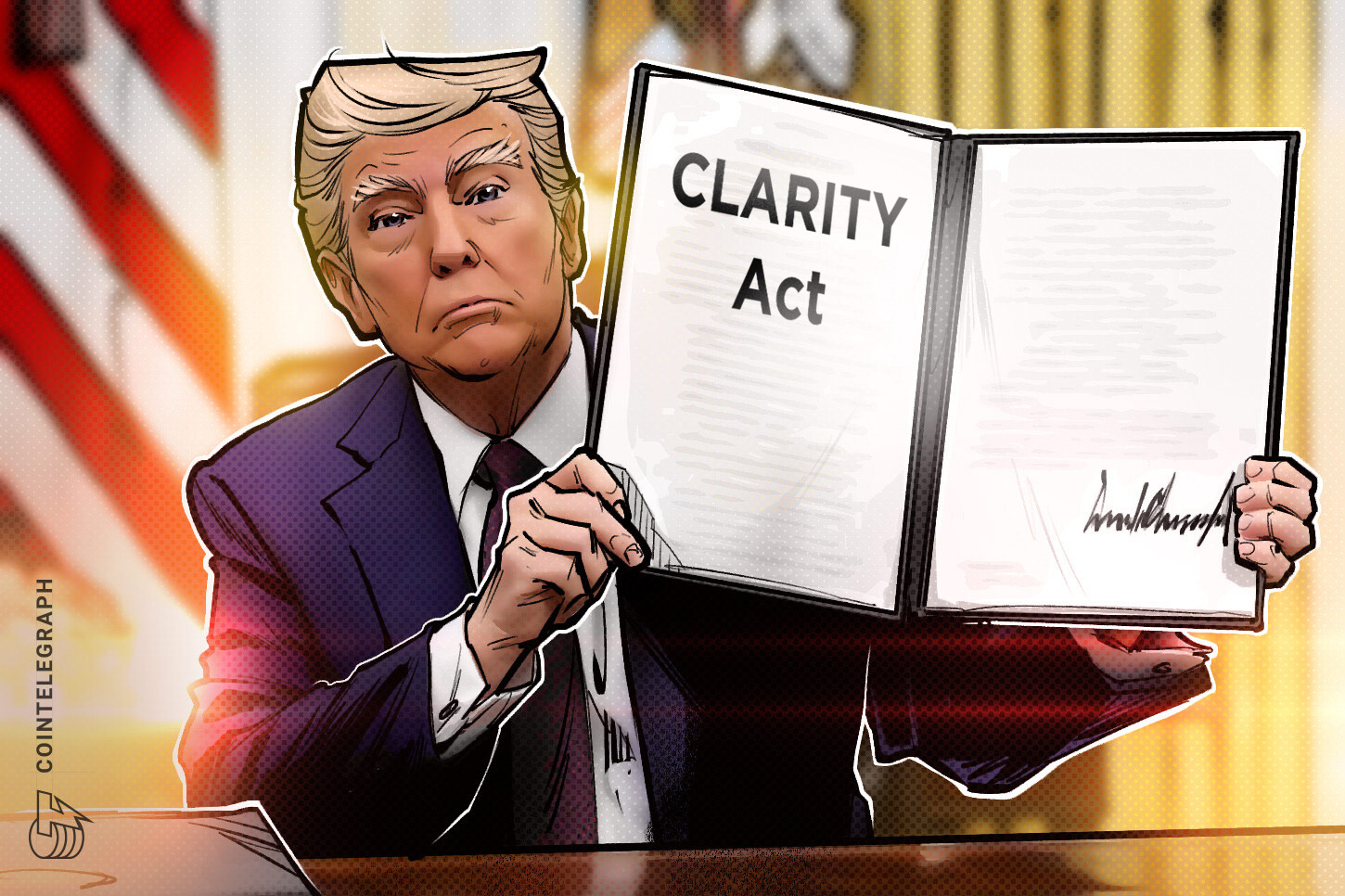 Galaxy cut its 2026 CLARITY Act odds to 50%, warning that Senate floor time is running out before the August recess. Galaxy Digital has cut its odds of the CLARITY Act becoming law in 2026 to 50%, warning that the US Senate is running out of time to move the crypto market structure bill before its August recess. “We are reducing our odds of CLARITY Act passage in 2026 to 50-50,” wrote Galaxy's head of firmwide research, Alex Thorn, citing the lack of a unified Senate Banking-Agriculture text, no firm floor schedule and a narrowing legislative window before lawmakers leave Washington. Thorn said the downgrade was about the bill's timing, not substance and added that the congressional competition for floor time “intensified” after US President Donald Trump abruptly canceled the signing of the bipartisan housing bill and said he would not sign it until Congress passed the SAVE Act, to introduce a proof-of-citizenship elections bill. Read more
 -
Cointelegraph.com - 06:44 Jun 12, 2026
 Galaxy’s Alex Thorn says a plan to scrap rules on stock orders and quotes would remove a major barrier to tokenized stocks trading on decentralized platforms. The US Securities and Exchange Commission proposal to rescind rules around order protections and price quotes could remove a major legal barrier for tokenized US stocks. The SEC on Thursday proposed to scrap two rules in its national market system regulations. Rule 611 that bans “trade-throughs,” where a stock order on one exchange can’t be for a worse price than on another, and Rule 610(e) banning exchanges from displaying a bid at the same or higher price than what is available elsewhere. Galaxy head of research Alex Thorn said the proposal is “one of the biggest unlocks yet for tokenized stocks” as it would remove “one of the biggest structural barriers to tokenized US equities trading in DeFi.” Read more