Ethereum | Crypto
"Ethereum" in Crypto feed
-
Cryptonews.com - 22:30 Feb 04, 2026
Google's Gemini AI predicts XRP, Ethereum and Solana could hit new highs in 2026-27 if a long bull cycle and clearer U.S. rules draw more institutional and ETF flows. Gemini cites oversold RSI readings for XRP and SOL and key resistance near $5,000 for ETH as traders watch for a break later in 2026 The post Google’s Gemini AI Predicts the Price of XRP, Ethereum and Solana By the End of 2026 appeared first on Cryptonews. -
CoinDesk - 16:48 Feb 04, 2026
Leaders across the layer-2 space don't see this moment as an existential threat, but rather that Ethereum’s progress is forcing them to clarify their purpose. -
CryptoSlate - 13:45 Feb 04, 2026
Ethereum was cheaper than expected in 2020, and rollup decentralization was slower than promised in 2021. Those two realities are forced the ecosystem to rewrite what “a layer-2” is for. Vitalik Buterin's recent post on Ethereum Research bluntly frames the shift: the original vision of layer-2 (L2) blockchains as “branded shards” of Ethereum is no […] The post Ethereum fees are plummeting so fast that Vitalik Buterin says most Layer 2 chains now lack purpose appeared first on CryptoSlate. -
Cointelegraph.com - 10:40 Feb 04, 2026
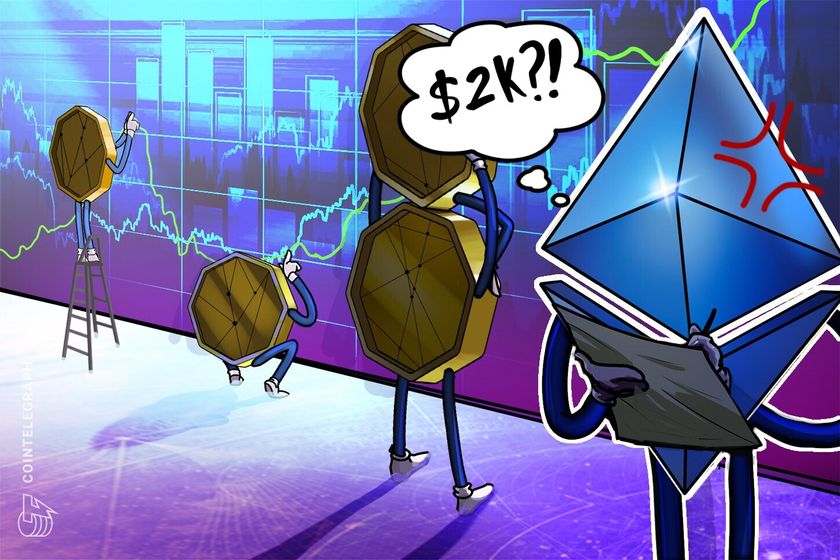 Ether risks declining toward the $1,665-$1,725 range in February, according to a confluence of bearish technical and on-chain indicators. The price of Ethereum’s native token, Ether (ETH), risks sliding below $2,000 in February as a classic bearish setup plays out. Key takeaways: ETH breakdown keeps $1,665 downside target in focus. Read more
 -
Cryptonews.com - 22:23 Feb 03, 2026
Vitalik Buterin has weighed in as Ethereum core devs have advanced Frame Transactions (EIP-8141) as a Hegota headliner candidate, describing how the new transaction type can inherit ERC-4337-style paymaster mempool acceptance rules and gas sponsorship, with ETH around $2,305 after the development The post Vitalik Buterin Weighs In as Devs Add Frame Transactions to Ethereum’s Next Upgrade Debate appeared first on Cryptonews. -
Cryptonews.com - 22:35 Feb 02, 2026
Best Crypto to Buy Now after weekend panic selling has pushed Bitcoin below $80K and dragged major assets lower. XRP, Solana and Ethereum have been watched as U.S. crypto law has moved forward and Bitcoin market share has slipped, keeping altcoins tied to BTC’s direction. The post Best Crypto to Buy Now February 2 – XRP, Solana, Ethereum appeared first on Cryptonews. -
Cryptonews.com - 22:30 Feb 02, 2026
We hacked Perplexity AI to predict XRP near $8 and Bitcoin toward $200,000–$250,000 while Ethereum targets $7,500 in a bullish case. The model has linked its estimates to U.S. regulation, ETF flows, and post-halving supply, projecting paths for 2026 and 2027. It has also noted swings after selloffs. The post We Hacked Perplexity AI to Predict the Price of XRP, Bitcoin and Ethereum By the End of 2026 appeared first on Cryptonews. -
Decrypt - 16:24 Feb 02, 2026
Publicly traded Ethereum treasury BitMine Immersion Technologies is still buying as ETH plunges, despite the firm's growing losses. -
CryptoSlate - 18:05 Feb 01, 2026
By the end of 2025, a corner of the market most Ethereum traders rarely watch had built a position large enough to matter for everyone else. Everstake’s annual Ethereum staking report estimates that public companies’ “digital asset treasuries” collectively held roughly 6.5–7.0 million ETH by December, which is more than 5.5% of the circulating supply. […] The post A sudden shift in Ethereum staking is draining billions from exchanges toward a new corporate elite appeared first on CryptoSlate. -
CryptoSlate - 15:30 Jan 30, 2026
Ethereum's most infamous experiment is back. Not as a venture fund, but as something the ecosystem arguably needs more: a permanent security budget. On Jan. 29, a group of Ethereum veterans announced plans to convert roughly 75,000 ETH in decade-old recovery funds into a staked endowment whose yield will finance smart contract security work across […] The post TheDAO’s leftover rescue money sat for a decade now it’s becoming Ethereum’s permanent $220M security budget appeared first on CryptoSlate. -
Cointelegraph.com - 13:13 Jan 30, 2026
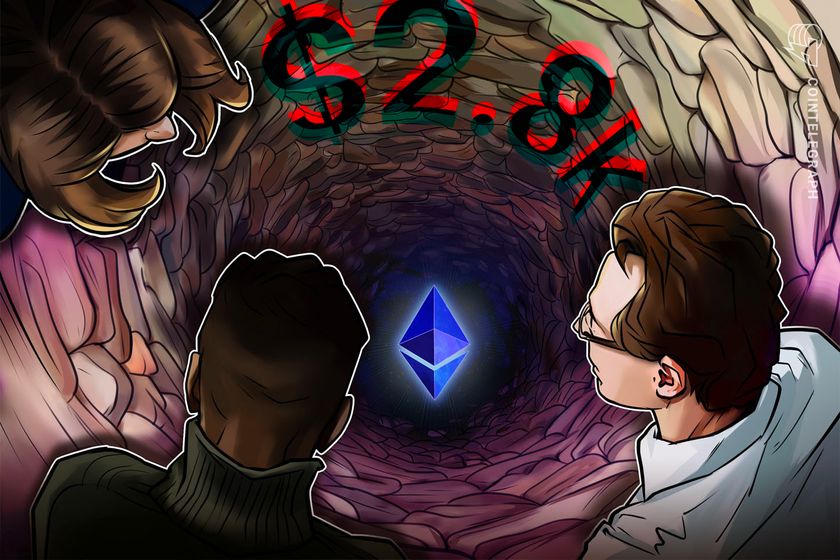 Ethereum slipped under $2,800 as charts and onchain data suggested downside risk remains elevated, with a potential move toward $2,100. Ether (ETH) could see another sharp drop after losing the support level at $2,800, with technical charts and onchain data suggesting the downtrend will continue. Key takeaways: Ether’s descending and symmetrical triangle setups converge at $2,100. Read more
 -
CoinDesk - 09:48 Jan 30, 2026
Ethereum’s co-founder said the $43 million withdrawal will support a broader “full-stack openness and verifiability” vision as the foundation tightens spending. -
Cryptonews.com - 22:50 Jan 29, 2026
Crypto price prediction today: Bitcoin has fallen to about $89,500 after 7 straight spot ETF outflow days and a rising-wedge breakdown with the low $80,000s in view if it stays under the mid $90,000s. Ethereum has tested $2,750–$2,850, while XRP has retested $1.80 support. ETH eyes $2,500;XRP $1.60. The post Crypto Price Prediction Today 29 January – XRP, Bitcoin, Ethereum appeared first on Cryptonews. -
CryptoPotato - 22:17 Jan 29, 2026
Ethereum trades near $2,950 as charts mirror 2024 patterns, with analysts watching a possible move to $4K and a longer-term $10K target. -
CryptoSlate - 18:05 Jan 29, 2026
Ethereum (ETH) announced ERC-8004 is heading to mainnet, positioning the network as a neutral infrastructure for a problem the AI industry can't yet solve: how agents prove they're trustworthy when no single platform controls the reputation layer. The timing reveals the underlying tension, as AI agents are moving from demos into production systems that trigger […] The post Ethereum aims to stop rogue AI agents from stealing trust with new ERC-8004 – but will it? appeared first on CryptoSlate. -
CryptoSlate - 12:55 Jan 29, 2026
Fidelity announced the launch of a stablecoin on the Ethereum mainnet, positioning the token as a compliance-wrapped settlement dollar distributed through the firm's brokerage, custody, and wealth management channels. The move lands amid what looks like a stablecoin sprawl, as estimates suggest 59 new major stablecoins launched in 2025 alone, per third-party tracker Stablewatch. This […] The post Banks may lose up to $500B after Fidelity’s official token launches on Ethereum with freeze powers appeared first on CryptoSlate. -
Cointelegraph.com - 08:15 Jan 29, 2026
 ETH price charts confirmed a triangle breakdown, shifting the near-term bias lower and putting $2,250 in focus if sellers stay in control. Ether (ETH) is now more than 14% below its local peak near $3,400, underscoring the sellers’ tenacity above $3,000. A bearish technical setup suggests the pressure may extend into February. Key takeaways: ETH fell back below $3,000, confirming a triangle breakdown that targets $2,250. Read more
 -
CryptoPotato - 04:29 Jan 29, 2026
Ethereum trades above $3,000 as analysts compare its current structure to the 2017 rally, with rising open interest, record wallets, and key levels in focus. -
Cryptonews.com - 22:40 Jan 27, 2026
Crypto price prediction today tracks Bitcoin near $87,500 and sets 2026 levels for ETH, XRP and DOGE after a rough 2025. Ethereum has tried to reclaim value from L2 fees; XRP has held $1.80 support; Dogecoin has bounced near $0.12. A Bitcoin Hyper L2 pitch cites a $31M presale and staking up to 38%. The post Crypto Price Prediction Today 27 January – XRP, Ethereum, Dogecoin appeared first on Cryptonews. -
Cryptonews.com - 22:30 Jan 27, 2026
We hacked China's Alibaba AI and KIMI has sketched price paths for XRP, Bitcoin and Ethereum, with a bull market and clearer U.S. regulation as key drivers. Its model has put XRP at $8, Bitcoin, near $250,000 and Ethereum in the $7,500–$25,000 range. It has cited patterns and US spot XRP ETF demand. The post We Hacked China’s Alibaba AI to Predict the Price of XRP, Bitcoin and Ethereum By the End of 2026 appeared first on Cryptonews.