Polymarket | Crypto
"Polymarket" in Crypto feed
-
CryptoSlate - 13:30 Oct 07, 2026
App users follow approval prompts, while integrations must keep CTF support and add V2 identifiers and permissions. The post Polymarket’s upgrade won’t automatically move existing bets to new contracts appeared first on CryptoSlate. -
Cointelegraph.com - 12:29 Oct 07, 2026
 Some traders are looking for more predictable prediction market opportunities, rather than playing “hot potato” with the next 100x gem, according to Polymarket’s Shayne Coplan. Cryptocurrency trading is becoming a game of “irrational exuberance” as traders race to be among the earliest investors to find the next 100x token, according to Shayne Coplan, the CEO of prediction market platform Polymarket. “People think they’re buying something, it’s worthless, but they’re buying it. If it can go to 100X, they want to sell it before it goes back to zero,” said Coplan during a fireside chat at Token2049 Singapore on Wednesday. Coplan said that some traders can generate significant wealth through this strategy, but added that it is a “game of irrational exuberance and hot potato” where asset prices that rise must eventually come down. Read more
 -
Cointelegraph.com - 12:54 Oct 06, 2026
 Polymarket begins its Protocol V2 rollout ahead of a planned November transition for new prediction markets, while existing positions remain on the current system. Prediction market platform Polymarket is rebuilding its smart contract infrastructure, laying the groundwork for new market features and potential expansion beyond Polygon. Polymarket began rolling out Protocol V2 on Monday, introducing a new smart contract system designed to support different market types through a single exchange, according to an X post by Rajath Alex, the company’s head of protocol. The platform is testing the system on a limited number of live markets through Oct. 30, with a tentative Nov. 2 target for switching new markets to V2. Read more
 -
CryptoSlate - 22:50 Sep 24, 2026
New York has sued Polymarket, alleging its US prediction market is an unlicensed gambling business operating across the state. On Sept. 24, Attorney General Letitia James asked a New York state court to stop QCX LLC, which operates as Polymarket US, from offering event contracts without a state gaming license and to order restitution, disgorgement, […] The post New York sues Polymarket, seeks triple gains and $100,000 penalties over prediction markets appeared first on CryptoSlate. -
CoinDesk - 22:41 Sep 24, 2026
The state wants to block Polymarket from operating without a gambling license and recover allegedly illegal gains. -
Cointelegraph.com - 15:27 Sep 24, 2026
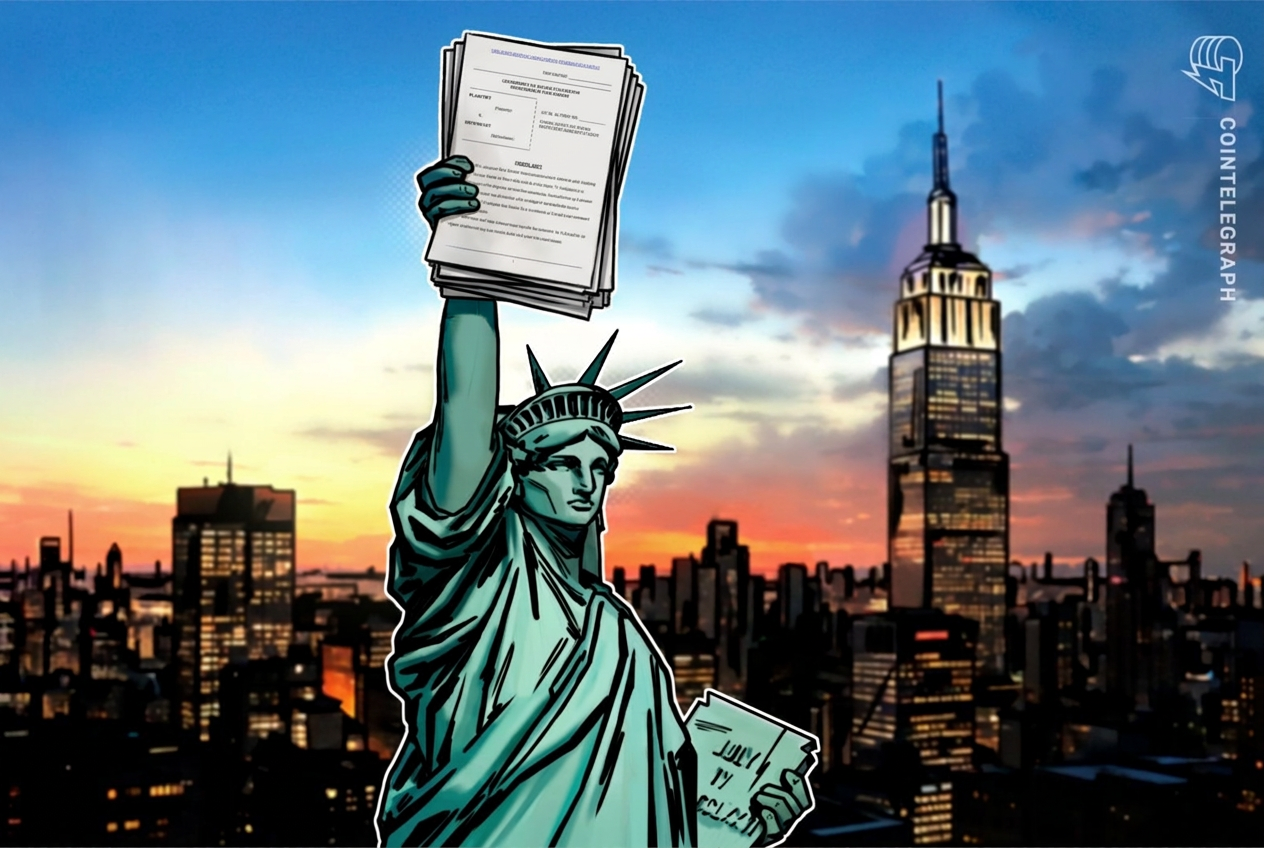 The action filed by state lawmakers followed a similar lawsuit against prediction markets company Kalshi in July that alleged the platform was running an illegal gambling operation. New York Attorney General Letitia James is suing prediction markets platform Polymarket for offering contracts related to sporting events. On Thursday, New York state officials filed a lawsuit against Polymarket, alleging that the company’s prediction market event contracts violated state gambling laws. The lawsuit followed a similar action against Kalshi in July and litigation against prediction market platforms run by Coinbase and Gemini in April. Thursday’s filing cited Polymarket’s sporting event contracts on its mobile app launched in December 2025, including its advertising practices to New Yorkers. According to the filing, state officials could also seek to block the platform to residents. Read more
 -
Cryptonews.com - 11:26 Sep 23, 2026
The Polymarket NATO contract covers a 2025 military-clash window, while fresh warnings concern possible future tests of the alliance. The post Polymarket’s NATO–Russia Clash Alarm Explodes as Spy Chief Warns: ‘Months, Not Years’ appeared first on Cryptonews. -
Cointelegraph.com - 09:37 Sep 17, 2026
 South Korean police reportedly referred 18 Polymarket users to prosecutors in a gambling probe involving 26 people and $12.7 million in bets. South Korean police have reportedly referred 18 Polymarket users to prosecutors in an illegal gambling investigation involving 26 people who collectively wagered about 17.6 billion won (worth $12.7 million). According to Asia Economy, data submitted by the National Police Agency to the office of Democratic Party lawmaker Yoon Kun-young showed that the Gangwon Provincial Police Agency had placed 26 people under investigation as of Tuesday and sent 18 of them to prosecutors. The report said the largest amount wagered by a single user was about 5.7 billion won ($4.1 million). Police identified users by analyzing publicly available blockchain transactions, the report said. Polymarket lets users buy and sell contracts tied to the outcomes of real-world events and operates on a noncustodial, peer-to-peer structure with automated settlement. It does not maintain a conventiona...
 -
CoinDesk - 10:41 Sep 15, 2026
Bitcoin fell 1.7% since midnight UTC to $76,862, unwinding a late Monday rally as Polymarket odds on the Clarity Act becoming law this year halved overnight. -
CoinDesk - 16:10 Sep 10, 2026
Jenson becomes the prediction market’s first CFO as Polymarket builds its regulated U.S. exchange and global platform. -
Cointelegraph.com - 07:47 Sep 01, 2026
 Donald Trump Jr.-linked 1789 Capital will reportedly lead a $1 billion investment round into Polymarket, which would value the platform at $21 billion, just below Kalshi’s $22 billion valuation. Donald Trump Jr.-linked investment firm 1789 Capital is reportedly investing about $300 million in Polymarket, a blockchain-based prediction market. 1789 Capital, where Donald Trump Jr. is a partner, will make the $300 million investment as part of a $1 billion round that would value Polymarket at $21 billion, people familiar with the matter told the Wall Street Journal on Monday. The investment would bring 1789 Capital’s total investment in Polymarket to about $500 million and make it one of the platform’s largest backers. Read more
 -
Cointelegraph.com - 21:33 Aug 24, 2026
 A judge stayed the CFTC’s civil case against a soldier who allegedly used nonpublic information for a Polymarket bet, but the regulator is trying to weigh in on the criminal case. Gannon Ken Van Dyke, a soldier who allegedly made more than $400,000 using nonpublic information to trade event contracts on prediction market platform Polymarket, is pushing back against attempts by the US Commodity Futures Trading Commission (CFTC) to weigh in on his criminal case. In a Monday filing in the US District Court for the Southern District of New York, Van Dyke’s lawyers opposed the CFTC’s efforts to file an amicus brief relating to claims in his case. The letter referred to the commodities regulator’s counsel filing a notice requesting permission from the court to provide its views on many of Van Dyke’s defense claims, including that event contracts on platforms like Polymarket were not “swaps” under the purview of the CFTC. “The CFTC is no sheep ‘friend of the Court’ here,” said defense attorneys. “It is a regulatory ...
 -
CryptoSlate - 12:15 Aug 22, 2026
The Nov. 3 midterm election is less than 11 weeks away, and its betting market had already surpassed the full 2024 congressional cycle in the latest comparable data. Traders had placed at least $133 million across markets tied to House and Senate races by Aug. 10, compared with $92.4 million during all of 2024. The […] The post Just 1% of wallets control $133M in midterm odds on Polymarket, creating a dangerous illusion of mass public consensus appeared first on CryptoSlate. -
CryptoSlate - 09:40 Aug 18, 2026
An anonymous trader on Polymarket holds a No position on the CLARITY Act worth about $414,895, roughly 2.6 times larger than the $160,200 in liquidity currently available on the market where it sits. CryptoSlate's live market data puts CLARITY Act odds near 20% Yes, a number now widely read as Washington's probability estimate for the […] The post Polymarket’s 20% CLARITY Act odds sit on a market one $100K trade could radically reprice appeared first on CryptoSlate. -
Cointelegraph.com - 08:39 Aug 18, 2026
 The Korea Media and Communications Commission said Polymarket’s structure and operations amount to illegal gambling despite its noncustodial design and smart contracts. South Korean authorities have ordered access to Polymarket to be blocked after determining that the crypto prediction market provides an illegal gambling environment to users in the country. The country’s media and communications review commission said Tuesday that Polymarket falls under information that facilitates gambling or the opening of a gambling venue under the Criminal Act, as well as prohibited analogous betting activity under the National Sports Promotion Act. The regulator said Polymarket’s winner-takes-all structure, where users can gain or lose money based on outcomes including politics, sports and weather, encourages speculative gambling behavior. It also cited Polymarket’s role in operating markets, setting trading rules, providing crypto deposit, withdrawal and settlement systems and collecting transaction fees. Read more
 -
Cointelegraph.com - 08:53 Aug 14, 2026
 JPMorgan Chase reportedly cut banking ties with Polymarket in October 2025 over regulatory concerns but remains open to an underwriting role if the platform goes public. JPMorgan Chase ended a banking relationship with Polymarket over regulatory concerns, according to the Financial Times. JPMorgan notified the prediction market platform in October 2025 that it needed to find a new bank, the Financial Times reported Friday, citing people familiar with the matter. Polymarket now works with an unidentified lender. Still, JPMorgan has maintained other ties with Polymarket. The bank is allegedly keen on a potential underwriting role should Polymarket attempt to go public. Polymarket reportedly said that it continues to have a “close, active relationship” with JPMorgan. Read more
 -
CoinDesk - 05:04 Aug 14, 2026
According to Financial Times, JPMorgan ended its banking relationship with Polymarket in late 2025 over regulatory concerns. -
CryptoSlate - 15:50 Jul 28, 2026
KalshiEX and Polymarket US can keep serving Minnesota users while the merits and contract boundary remain unsettled. The post Federal court shields Kalshi and Polymarket from Minnesota’s felony crackdown days before deadline appeared first on CryptoSlate. -
CryptoSlate - 11:10 Jul 22, 2026
On July 28 and 29, the Federal Reserve meets to set its next rate decision, and traders will try to price the outcome through bonds, currencies, crypto and contracts that settle directly on what the central bank announces. Reuters polled 104 economists on July 21 and found every one of them expected the Fed to […] The post Easy money on Polymarket and Kalshi is disappearing as prop firms deploy AI agents appeared first on CryptoSlate. -
CryptoSlate - 14:30 Jul 21, 2026
Spain’s second World Cup title settled the largest sports-related winner markets yet on Polymarket and Kalshi, closing a tournament that brought prediction trading closer to the center of the global sports-betting business. Available data from the two leading platforms show that they recorded about $5.57 billion in cumulative volume on contracts tied to the tournament […] The post Most world cup traders won less than $5 on Polymarket while FIVE wallets walked away with millions appeared first on CryptoSlate.