Senate | Crypto
"Senate" in Crypto feed
-
CryptoSlate - 11:45 Apr 10, 2026
The Trump administration and the broader crypto industry have initiated an unprecedented, multi-agency pressure campaign aimed at forcing the Senate to pass the Digital Asset Market Clarity Act, signaling a decisive final push to overhaul the regulatory framework of the $2.4 trillion cryptocurrency market before the 2026 midterm elections. In a highly synchronized effort this […] The post CLARITY Act faces White House blitz as Treasury and SEC flood Senate with coordinated pressure this week appeared first on CryptoSlate. -
Cryptonews.com - 11:45 Apr 07, 2026
XRP Price Outlook: Senate Clarity Act Timeline April The post Senate Has 3 Weeks to Pass the CLARITY Act: Most Important Month in Ripple XRP History? appeared first on Cryptonews. -
CryptoSlate - 12:20 Mar 24, 2026
This month, Kentucky lawmakers advanced another bill that critics say could make self-custody impossible for hardware wallet manufacturers to deliver without building a backdoor into their products. It comes after passing a bill last year protecting residents' right to use crypto wallets. The vehicle is HB 380, a consumer-protection measure aimed at cryptocurrency kiosks. Its core […] The post Crypto wallets to offer a backdoor recovery if buried amendment to state bill passes Senate appeared first on CryptoSlate. -
Cointelegraph.com - 14:12 Mar 23, 2026
 A bipartisan Senate bill would reportedly ban sports betting and casino-style contracts on prediction markets. US Senators Adam Schiff and John Curtis are expected to introduce a bipartisan bill on Monday that would bar sports betting and “casino-style” contracts from prediction markets regulated by the Commodity Futures Trading Commission (CFTC), according to a Monday Wall Street Journal report. “Too many young people in Utah are getting exposed to addictive sports betting and casino-style gaming contracts that belong under state control, not under federal regulators,” Senator Curtis, one of the bill’s co-sponsors, told the WSJ. If introduced as reported, the measure would add to a widening Washington push against certain prediction market contracts. The report adds to the growing regulatory scrutiny over prediction markets, following renewed insider trading concerns sparked by the US-Israeli war with Iran. Read more
 -
Cointelegraph.com - 22:06 Mar 12, 2026
 Senator John Thune reportedly said that the chamber would prioritize the SAVE America Act before addressing a vote on bipartisan bills like crypto market structure. US Senator Majority Leader John Thune reportedly said he doesn’t expect the chamber to move forward with legislation to establish digital asset market structure before April. According to a Thursday Punchbowl News report, Thune said that the Senate planned to prioritize voting on the SAVE America Act, a bill that would require voters to provide proof of US citizenship in person to register. The majority leader addressed reporters on Thursday saying that the bill would go to the chamber next week, adding that lawmakers would focus on the crypto market structure bill and other bipartisan bills after the SAVE America Act vote. Read more
 -
Cointelegraph.com - 20:23 Mar 12, 2026
 The provision banning the Federal Reserve from issuing a central bank digital currency was included in housing affordability legislation. The United States Senate voted on Thursday to include an amendment in the 21st Century Road to Housing Act that would prohibit the Federal Reserve from issuing a central bank digital currency (CBDC). The CBDC prohibition will remain in effect until Dec. 31, 2030, according to the amendment in the bill. The legislation, which passed 89-10, stated: However, the bill does not prohibit any dollar-denominated digital currency that is “open, permissionless, and private,” such as stablecoins. Read more
 -
CoinDesk - 16:21 Mar 12, 2026
A bipartisan housing bill was approved in the Senate, carrying an unrelated ban on U.S. central bank digital currencies, but its future remains uncertain. -
Cointelegraph.com - 13:07 Mar 11, 2026
 Democratic Senator Adam Schiff introduced a bill to ban prediction markets related to war, death and terrorism amid escalating insider trading concerns related to military operations. US Democratic Party Senator Adam Schiff introduced legislation Tuesday that would explicitly bar federally regulated prediction-market platforms from listing contracts tied to war, terrorism, assassination and individual deaths. The bill, called the DEATH BETS Act, would amend the Commodity Exchange Act to make those contracts prohibited for entities overseen by the US Commodity Futures Trading Commission (CFTC). In a statement announcing the bill, Schiff said markets that let traders profit from violent events create incentives for the misuse of classified information, threaten national security and encourage violence. He said prediction markets had become a “Wild West” and called for Congress and the CFTC to make clear that such “death bets” are not allowed. Read more
 -
Cointelegraph.com - 17:07 Mar 06, 2026
 The crypto exchange responded to a Senate inquiry over sanctions by claiming that “no Binance account transacted directly with an Iran-based entity.“ Cryptocurrency exchange Binance has officially responded to a February inquiry launched by a group of 11 US senators, largely denying facilitating transactions to Iranian entities and the narrative around employees’ terminations. In a Friday letter to US Senators Richard Blumenthal and Ron Johnson of the Permanent Subcommittee on Investigations, Binance said that an inquiry launched in February into the exchange’s activities was based on reports that were “demonstrably false, unsupported by credible evidence, and defamatory in several material respects.” The exchange referred to reporting from the Wall Street Journal, New York Times and Fortune, which said that Binance fired employees that reported the company had facilitated more than $1 billion in crypto transactions to entities connected to Iran, called Hexa Whale and Blessed Trust. According to Binance, the...
 -
Cointelegraph.com - 14:18 Mar 06, 2026
 The US Federal Reserve has issued a limited-use master account to Kraken, marking a major pro-crypto shift in policy. Recent events at the US Federal Reserve signal acceptance of digital assets at the highest levels of the country’s monetary system. Kraken recently became the first crypto exchange to receive a master account at the Federal Reserve. The Fed could also see a new crypto-friendly chair. US President Donald Trump on Wednesday submitted a pro-Bitcoin candidate for the Senate’s consideration. Read more
 -
Cointelegraph.com - 21:13 Mar 04, 2026
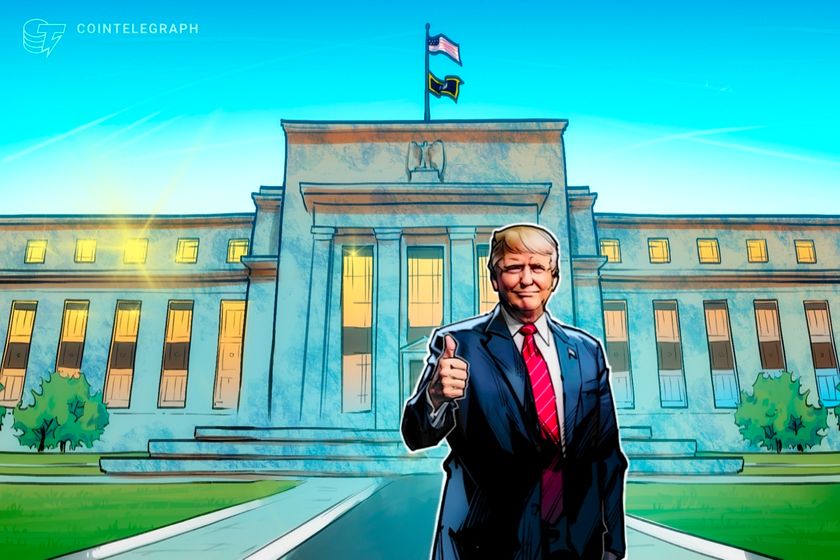 The US President makes it official after previously announcing his pick of Kevin Warsh to replace Fed chair Jerome Powell in a Jan. 30 social media post. The US Senate will soon vote on Donald Trump’s nominee to head the US Federal Reserve after the president picked Kevin Warsh, who has previously expressed pro-Bitcoin views, to replace Fed chair Jerome Powell. In a Wednesday notice, the White House said that Trump had sent Warsh’s nomination to the Senate to be chair of the Board of Governors of the Federal Reserve for a term of four years, and as a Fed governor for 14 years. The president had previously taken to social media to announce Warsh was his pick to replace Powell, whose term as chair ends in May but may stay on as a Fed governor until 2028. Warsh served as a Fed governor under former US Presidents George W. Bush and Barack Obama from 2006 to 2011. He went on to become a Shepard Family Distinguished Visiting Fellow in Economics at the Hoover Institution of Stanford University. Read more
 -
Cointelegraph.com - 13:08 Feb 16, 2026
 The CLARITY Act moved quickly through the House of Representatives since it was introduced in June 2025 but has been plagued with delays in the Senate. The crypto industry and investors are awaiting the completion of the US CLARITY Act, which has been delayed amid partisan politics and industry concerns. The bill would rewrite the rules of the road for the crypto industry, from which agency oversees it to regulations for decentralized finance (DeFi). Currently, lawmakers in the US Senate are hammering out the details, with significant points of contention. Democrats want a bipartisan bill with ethics provisions and a bailout prohibition that Republicans roundly rejected. Read more
 -
Decrypt - 18:14 Feb 14, 2026
Mark Moran is using a meme coin on Solana to elevate his U.S. Senate bid, rallying degens against a pro-crypto Democrat in Virginia. -
CryptoSlate - 14:05 Jan 30, 2026
On Jan. 29, the Senate Agriculture Committee advanced the crypto market-structure bill, giving the legislation known as the “CLARITY Act” its first concrete win in the Senate. The Agriculture panel’s action moves the bill closer to a full Senate fight over which regulator sets the rules for spot crypto markets. However, the bigger near-term problem […] The post US Senate advances new crypto law yet CLARITY gridlock might kill the bill for good appeared first on CryptoSlate. -
Cointelegraph.com - 06:19 Jan 19, 2026
 The Republican and Democratic Senate Judiciary leaders have called for changes to the market structure bill, arguing it would “weaken” the ability to police money transmitters. US Senate Judiciary Committee leaders are seeking to remove crypto developer protections from the Senate’s crypto market structure bill, arguing the provisions would weaken unlicensed money transmitting laws. Senate Judiciary chair Charles Grassley and the committee’s top Democrat, Richard Durbin, told Senate Banking Committee chair Tim Scott and top Democrat Elizabeth Warren on Wednesday that the crypto bill as drafted would “create a significant enforcement gap for decentralized digital asset platforms.” “Such a gap risks attracting illicit actors — like cartels and other sophisticated criminal organizations — to decentralized platforms,” Grassley and Durbin said in a letter Politico first reported on Friday. Read more
 -
Cointelegraph.com - 17:52 Jan 13, 2026
 With the CLARITY Act scheduled for a markup on Thursday, some lawmakers could still be at odds over decentralized finance, stablecoins and ethical concerns. As US senators prepare to mark up a major crypto market structure bill this week, industry leaders are weighing in on proposed changes that could shape whether stablecoin holders can earn interest and rewards. According to an amended draft of the Digital Asset Market Clarity Act released on Monday, the bill states that “a digital asset service provider may not pay any form of interest or yield [...] solely in connection with the holding of a payment stablecoin,” effectively barring passive, deposit-like returns on stablecoin balances. The draft leaves room for structured reward mechanisms, as stablecoin rewards would not be prohibited under certain circumstances, including “providing liquidity or collateral” or “governance, validation, staking, or other ecosystem participation.” Read more
 -
CryptoSlate - 14:25 Jan 13, 2026
The US Senate could wipe out $6 billion in crypto rewards this week by closing one specific loophole
The GENIUS Act banned issuer-paid yield, but the Senate markup fight is whether exchanges can keep routing rewards around that restriction, and the answer could decide who controls $6 billion in annual incentives. Senate Banking is scheduled to consider the CLARITY Act on Jan. 15, and the legislative fight has narrowed to a single question […] The post The US Senate could wipe out $6 billion in crypto rewards this week by closing one specific loophole appeared first on CryptoSlate. -
CryptoSlate - 06:30 Jan 08, 2026
Crypto firms like Ripple are betting on a Senate deal that is rapidly unraveling behind closed doors
The US crypto industry has launched a unified push for Congress to pass federal market-structure legislation, known as the “Digital Asset Market Clarity Act of 2025” (H.R. 3633). The legislation is viewed by industry proponents as the necessary “missing layer” of federal law to allow the industry to thrive. While the “GENIUS Act” established baseline […] The post Crypto firms like Ripple are betting on a Senate deal that is rapidly unraveling behind closed doors appeared first on CryptoSlate. -
Cointelegraph.com - 09:00 Dec 23, 2025
 Harriet Hageman’s “Soon” teaser on X sharpens talk of a 2026 Senate bid to replace crypto ally Cynthia Lummis, raising the stakes for Wyoming’s pro‑crypto brand. Wyoming Representative Harriet Hageman fueled speculation about a 2026 Senate run after posting a cryptic video days after Senator Cynthia Lummis announced she will not seek reelection. The five-second clip shows the congresswoman alongside a single-word caption: “Soon.” It breaks a months‑long lull on her account and bolsters speculation that she is eyeing Lummis’ open seat. Wyoming’s Senate seat has been a reliable voice in advancing regulatory clarity for the crypto industry, from market structure bills and stablecoin regulation to banking access. Whoever replaces Lummis will help decide whether crypto keeps a dedicated champion in the Senate. Read more
 -
CryptoSlate - 09:10 Dec 22, 2025
Cardano founder Charles Hoskinson recently argued that the launch of TRUMP three days before President Donald Trump's inauguration derailed what would have been a 70-vote Senate majority for the CLARITY Act and turned a unified crypto-policy push into a partisan battle. In an interview, Hoskinson said that in December 2024, “we were expecting about 70 […] The post Charles Hoskinson argues the TRUMP token cost crypto a 70-vote Senate win and sparked the Bitcoin-only crisis appeared first on CryptoSlate.