Crypto
-
CryptoSlate - 18:30 Aug 13, 2026
The company retired $3.5 million of principal for $2.3 million while issuing about 478,000 shares to fund operating costs. The post Solana treasury company shutters its SOL accelerator as a $27 million quarterly reversal forces deep cuts appeared first on CryptoSlate. -
CoinDesk - 18:26 Aug 13, 2026
KPMG U.S. examined Tether's books and even counted its gold bars as the $180 billion USDT issuer said it completed its long-promised financial audit. -
Decrypt - 18:26 Aug 13, 2026
President Donald Trump signed a memorandum Tuesday that lets vetted U.S. companies carry out offensive cyber operations against foreign criminal networks. Here's what the program actually authorizes. -
CryptoPotato - 18:22 Aug 13, 2026
While Riot, Hut 8, and Core Scientific printed strong gains, Bitdeer, Argo, and Canaan are down 20%, 24%, and 71% YTD. -
Cointelegraph.com - 18:18 Aug 13, 2026
 The CFTC will hold a meeting for its Innovation Advisory Committee on Aug. 20 to address regulation related to crypto assets, artificial intelligence and prediction markets. The US Commodity Futures Trading Commission (CFTC) announced a committee meeting to advise the agency on policy issues, including a potential exploration of how to address cryptocurrency regulation in the absence of congressional action. In a notice issued Thursday, the CFTC said it would hold a meeting for its Innovation Advisory Committee on Aug. 20 to address regulation related to crypto assets, AI and prediction markets. Among the potential topics to be discussed on crypto were “areas where regulatory action can complement future congressional legislation,” likely referring to the US Senate failing to advance the Digital Asset Market Clarity (CLARITY) Act before breaking for an August recess last week. The CFTC announcement followed a similar notice of a meeting to be held by the US Securities and Exchange Commission (SEC) on Friday. ...
 -
Decrypt - 17:47 Aug 13, 2026
The Blockchain Association is urging the Supreme Court to take up Custodia’s case, saying that broad Fed power over “master accounts” could be used to push crypto firms out of the banking system. -
CoinDesk - 17:43 Aug 13, 2026
The thesis is that high yields on long-term U.S. Treasuries make non-yielding assets like bitcoin less attractive. -
Cointelegraph.com - 17:36 Aug 13, 2026
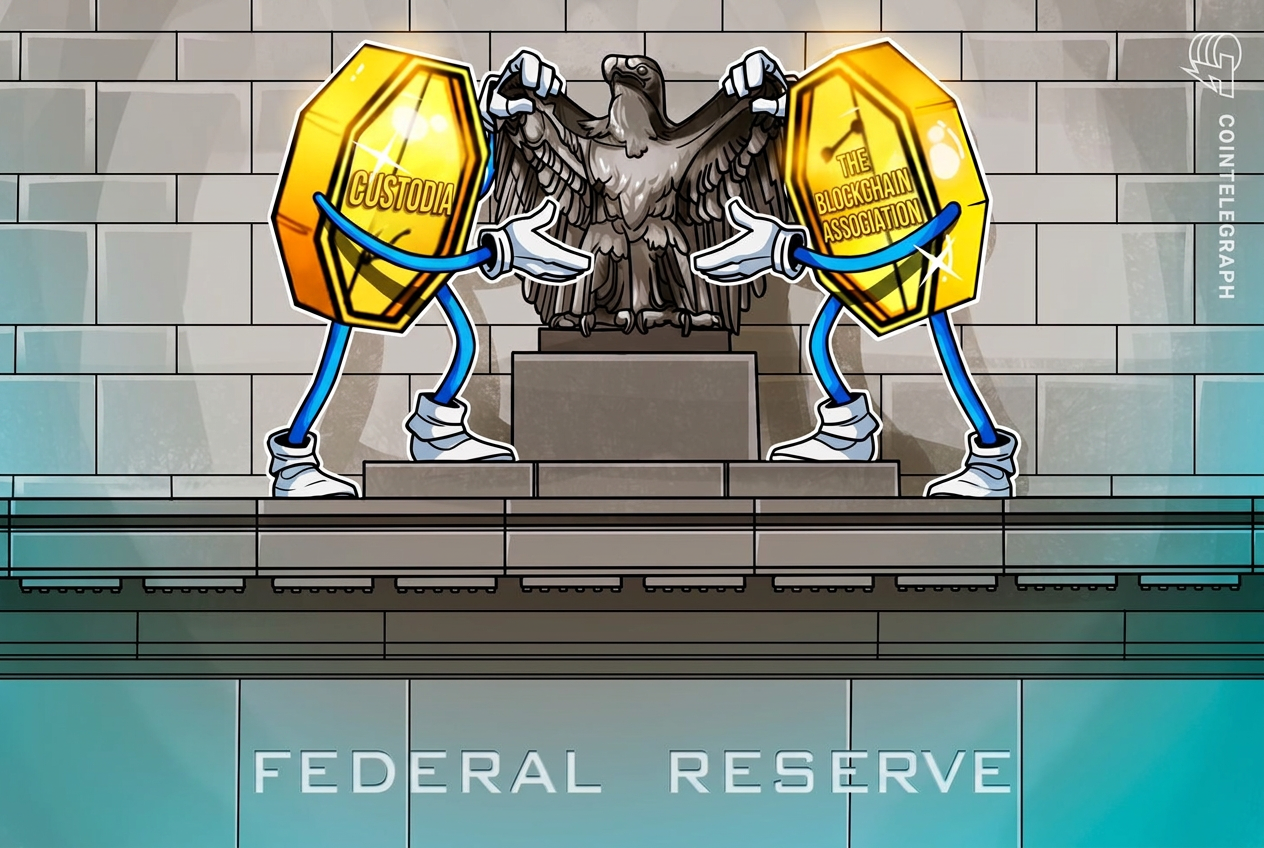 The Blockchain Association argues the Fed should not have broad discretion to deny eligible state-chartered banks direct access to its payment system. The Blockchain Association urged the US Supreme Court to hear Custodia Bank’s challenge to the Federal Reserve’s denial of its application for a master account, which would give the crypto-focused bank direct access to the Fed’s payment system. In an amicus brief filed Wednesday, the industry group argued that federal law requires the central bank to make its payment services available to eligible nonmember banks and that the Fed should not have broad discretion to deny access. The association said the appeals court’s decision effectively gives the Fed veto power over state-chartered banks by allowing it to withhold services needed to operate independently. It also linked Custodia’s case to alleged crypto debanking under “Operation Choke Point 2.0,” arguing that federal regulators discouraged banks from serving the digital asset industry. Read more
 -
CryptoSlate - 17:30 Aug 13, 2026
Direct costs absorbed 99.83% of segment revenue while adjusted EBITDA stayed negative and management targeted $15 million in savings. The post BitGo made $4.3 billion in revenue last quarter, but direct costs swallowed 99.8% of it appeared first on CryptoSlate. -
Cointelegraph.com - 17:28 Aug 13, 2026
 Standard Chartered said Robinhood’s Uniswap integration could solve a key challenge for new blockchains while accelerating UNI token burns. Robinhood’s partnership with Uniswap is helping the brokerage rapidly build liquidity on its new blockchain, potentially removing a key obstacle to attracting users and assets, according to Standard Chartered. In a recent note, Standard Chartered analyst Geoffrey Kendrick said Robinhood Chain has grown to nearly $1 billion in total value locked (TVL), which he described as the fastest growth of any blockchain by that measure. Virtually all of Robinhood Chain’s liquidity needs are being met through Uniswap V2, V3 and V4, Kendrick said. The arrangement gives Robinhood access to established decentralized finance infrastructure as it scales its blockchain, potentially strengthening its ability to attract users without having to build liquidity from scratch. Read more
 -
Decrypt - 17:11 Aug 13, 2026
More than 40 bitcoin and crypto firms asked the biggest AI labs this week to let independent security researchers use their strongest models before public release. -
CoinDesk - 17:10 Aug 13, 2026
The incident marks the first time Trezor customers' shipping addresses were exposed. -
CryptoPotato - 17:05 Aug 13, 2026
"Everybody is waiting for that ultimate confirmation, but that never comes," Michael van de Poppe stated. -
CryptoPotato - 16:47 Aug 13, 2026
Trezor disclosed today that a data breach at ShipMonk, the logistics partner that stores its products and ships orders to customers, exposed order data belonging to 13,689 buyers across seven countries. -
Decrypt - 16:40 Aug 13, 2026
The company's CEO said a 5,014 BTC transfer was a custody move, not a sale, as the Tokyo-listed Bitcoin treasury company rolls out a fixed-rate debt program. -
CryptoSlate - 16:15 Aug 13, 2026
Its Aug. 12 filing confirms complete liquidation, a separate $41.167 million ETH-loss line and no crypto at quarter-end. The post FG Nexus dumped all its Ethereum at a $45 million loss to buy mobile home parks—after earning just $144,000 in staking rewards appeared first on CryptoSlate. -
Decrypt - 16:05 Aug 13, 2026
Lawmakers targeted the deposits that scammers rely on, with the machines still able to sell crypto for dollars or swap one coin for another. -
Cointelegraph.com - 16:00 Aug 13, 2026
 AI and HPC are reshaping mining economics as operators repurpose power and data centers, while a smaller group of miners continues to expand Bitcoin capacity. Publicly traded Bitcoin miners are cutting mining capacity faster than the Bitcoin network overall, suggesting that more operators are redirecting electricity and infrastructure toward data centers and high-performance computing (HPC), in another sign of the sector’s evolution beyond creating more crypto. In the latest Miner Weekly newsletter, BlocksBridge Consulting reported that realized hashrate among a cohort of public Bitcoin miners fell from 368.3 exahashes per second (EH/s) in the fourth quarter of 2025 to 319 EH/s in the second quarter of 2026, a 13.4% decline. The contraction was even sharper when excluding Bitdeer, which continued to expand its mining operations. Without Bitdeer, the cohort’s realized hashrate fell 21.2% over the six-month period, from 324.6 EH/s to 255.9 EH/s. Bitdeer’s realized hashrate, meanwhile, increased 44% to 63 EH/s. ...
 -
Cointelegraph.com - 15:36 Aug 13, 2026
 The crypto exchange operator’s shares gained around 10% as adjusted EBITDA more than tripled and subscription and services revenue hit a record high. Bullish shares jumped around 13% in early trading Thursday after the institutional-focused crypto exchange and CoinDesk owner reported a 62% year-over-year increase in second-quarter adjusted revenue and more than tripled its adjusted EBITDA. Bullish reported $92.6 million in adjusted revenue for the quarter, up from $57 million a year earlier, while adjusted EBITDA rose to $29.5 million from $8.1 million. Adjusted net income reached $14.3 million, reversing a $6 million loss in the year-ago quarter. Subscription, services and other revenue hit a record $62.7 million, helping offset weaker exchange activity. The company recorded $179.6 billion in quarterly trading volume, down from $197.4 billion a year earlier, while average daily volume fell to $2 billion from $2.2 billion. Read more