Cointelegraph.com
Source:
https://cointelegraph.com
Found 11878 news
-
Cointelegraph.com - 15:48 Apr 16, 2026
 The CEO of the troubled Zonda exchange has disclosed a Bitcoin wallet holding around 4,500 BTC, but said the private keys were never transferred during a company handover. Crypto exchange Zonda said a cold wallet holding around 4,500 Bitcoin is currently inaccessible as the platform faces concerns over delayed withdrawals. Zonda CEO Przemysław Kral posted a video statement on Thursday disclosing the exchange’s wallet address, saying the private keys to the wallet were never handed over. In the statement, Kral denied accusations of misappropriating funds, saying the private keys were intended to be handed over by Zonda founder and former CEO Sylwester Suszek, who has been missing since 2022. Read more
 -
Cointelegraph.com - 15:20 Apr 16, 2026
 The Drift Protocol will use the $150 million to relaunch and restore user funds following a $280 million exploit earlier in April. Stablecoin issuer Tether, the company behind USDt (USDT), said Thursday it will back a $150 million recovery program for the Drift Protocol decentralized exchange (DEX) following an exploit of the platform in April. The recovery plan for the $280 million Drift Protocol exploit includes $127.5 million from Tether, with the rest coming from undisclosed partners, according to Tether’s announcement. Tether said: The Drift Protocol platform will “contribute directly” to the ongoing recovery of user funds as the platform resumes normal trading activity. Read more
 -
Cointelegraph.com - 13:59 Apr 16, 2026
 UAE investors are buying the AI and tech dip, keeping exposure to software, chips and crypto as the Iran conflict stress-tests the Gulf’s bid to be a global tech hub. United Arab Emirates investors are leaning into the artificial intelligence sell-off rather than running from it, despite the regional conflict testing the Gulf’s ambitions to become a global hub for AI and digital assets. New eToro data shared with Cointelegraph on Wednesday show users in the UAE boosted holdings of software and AI infrastructure names whose share prices fell sharply in the first quarter, suggesting they used the downturn to “buy the dip” rather than broadly de-risk. The pattern suggests UAE investors are staying exposed to long-term AI and digital-infrastructure themes even as the conflict raises fresh risks for data centers, logistics and cross-border technology build-outs in the Gulf. An April 13 report from Deutsche Bank said the shock is more likely to sharpen rather than derail demand for AI, cybersecurity and sovereign ...
 -
Cointelegraph.com - 13:28 Apr 16, 2026
 Investors in the cryptocurrency Ponzi scheme OneCoin may finally get some relief through a Department of Justice program, some 12 years after the project launched. In the United States, victims of the $4 billion crypto Ponzi scam OneCoin are finally receiving compensation. On April 13, the US Department of Justice said that $40 million in assets are available to anyone who purchased OneCoin between 2014 and 2019 and experienced a net loss. This program marks a milestone for OneCoin victims, most of whom had no recourse to get back what they lost, until now. Victims in the UK attempted a class action suit in 2024, but it fell apart when litigation funding was terminated. Read more
 -
Cointelegraph.com - 13:26 Apr 16, 2026
 Australia’s A$24B digital asset opportunity hinges on regulation. Clear rules could drive tokenized markets, faster payments and institutional investment. Australia could generate A$24 billion, or about $17 billion, annually from digital assets and tokenized finance. But that opportunity depends on whether policymakers establish clear and supportive regulatory frameworks. Tokenization could transform financial markets by improving liquidity, automating settlement processes and expanding investor access to assets such as foreign exchange, equities, government debt and investment funds. Tokenized money, including CBDCs and stablecoins, could significantly reduce the cost and time of cross-border payments by minimizing reliance on traditional banking networks. Read more
 -
Cointelegraph.com - 13:25 Apr 16, 2026
 The corrected filing details timeline, caveats and conditions tied to a potential Naver Financial IPO after the Dunamu share swap deal. South Korean tech company Naver and Upbit operator Dunamu said in a corrected filing that their planned share swap includes forming an initial public offering (IPO) committee for Naver Financial within one year of closing, outlining a path toward a future listing. The disclosure, outlined in the corrected filing on Wednesday, said the companies would pursue a listing within five years, with a possible two-year extension. Naver said it plans to secure voting rights in Naver Financial so the fintech unit remains a consolidated subsidiary after the deal. The filing suggests the deal goes beyond a simple ownership change, outlining a structure that could eventually bring Upbit’s parent under a listed fintech group. The move indicates Naver and Dunamu are positioning any future South Korea listing at the fintech-parent level rather than through a standalone listing of Upbit’s par...
 -
Cointelegraph.com - 13:20 Apr 16, 2026
DeFi fared pretty well under the House’s version of the CLARITY Act — but the Senate’s revised draft could throw a spanner in the works. -
Cointelegraph.com - 13:00 Apr 16, 2026
 Ukrainian authorities detained a suspect linked to a $100 million cybercrime network targeting the US and Europe, seizing $11 million in assets, of which $3 million was in cryptocurrency. Ukrainian authorities have arrested a member of an international cybercrime network wanted by the FBI over allegations of fraud and money laundering tied to losses exceeding $100 million across the United States and Europe. The suspect was arrested in the Transcarpathia region during a joint operation involving the National Police of Ukraine and other internal security units, Ukraine police said on Thursday. Officials said the man had been wanted internationally for some time and was eventually found in Uzhhorod, where he was living under a fake identity using forged documents. “He issued fictitious documents about his own death and continued to live in Ukraine as a “new” person, using false documents,” prosecutors said, adding that he laundered illicit proceeds through property acquisitions, often using relatives as interme...
 -
Cointelegraph.com - 12:47 Apr 16, 2026
 AllUnity says it is expanding EURAU stablecoin liquidity pools across major DEXs such as Uniswap and Raydium, with trading pairs against USDT and USDT0. AllUnity, a regulated European stablecoin issuer, is expanding its euro-pegged stablecoin, EURAU, across major decentralized exchanges (DEXs). The company announced Thursday that its EURAU stablecoin is entering liquidity pools across major DEXs, including Uniswap, currently the largest decentralized exchange by trading volumes. The rollout includes two EURAU trading pairs, one against Tether USDt (USDT) on Ethereum, and another against USDT0 — an omnichain version of USDT — on the Tempo blockchain. It also includes the EURAU/USDT pair on Solana via the Raydium DEX. Read more
 -
Cointelegraph.com - 12:23 Apr 16, 2026
 Back said at Paris Blockchain Week that Bitcoin’s post-quantum shift may reveal the true size of the stash held by Satoshi Nakamoto, estimated at between 500,000 and 1 million BTC. Blockstream CEO Adam Back said Thursday that a future post-quantum migration of Bitcoin could help clarify how many coins linked to Satoshi Nakamoto remain accessible, because any owner wanting to protect vulnerable holdings would need to move them to a new address format. Speaking at Paris Blockchain Week, Back said such a migration would likely give users ample time to move funds and argued that coins left unmoved after that process could reasonably be treated as lost. “This migration to post-quantum address format may tell us how many of those coins [Satoshi] still has,” said Back, adding that the pseudonymous creator has an estimated 500,000 to 1 million Bitcoin (BTC). Read more
 -
Cointelegraph.com - 11:55 Apr 16, 2026
 Executives at Paris Blockchain Week said European firms interested in Bitcoin treasury strategies are working around shallower capital markets and tighter constraints than in the US. European companies exploring Bitcoin treasury strategies are unlikely to replicate the playbook pioneered by Michael Saylor’s Strategy, according to industry executives, who pointed to structural differences between US and European capital markets. Speaking at Paris Blockchain Week 2026, Thomas Vogel, a partner in the Paris and Frankfurt offices of Latham & Watkins, said the constraints on issuing financial instruments in Europe differ significantly from those in the US, making a direct replication of the model difficult. “If you issue convertibles in the US, the constraints are not the same as when you issue them out of a French balance sheet or a balance sheet in Europe,” Vogel said, pointing to differences in market depth, regulation and investor behavior. Read more
 -
Cointelegraph.com - 11:22 Apr 16, 2026
 Circle’s Jeremy Allaire sees “tremendous” room for a yuan stablecoin, despite China banning most private yuan tokens and pushing its CBDC to challenge US dollar stablecoins. Circle CEO Jeremy Allaire says there is “tremendous opportunity” for a yuan-backed stablecoin, despite Beijing’s formal moves against most private renminbi-linked stablecoins and commitment to its own digital yuan. Speaking to Reuters in Hong Kong on Thursday, Allaire framed stablecoins as a way for China to “export” its currency by making global payments easier, as digital money becomes more tightly woven into trade and finance, and said the country could roll out a yuan-backed stablecoin within three to five years. Geopolitical rivalry over money is increasingly being waged in code as much as in central bank policy, and Allaire’s comments sharpen a deeper question: Can governments that clamp down on private digital currencies afford to shun them if they want to compete globally? Read more
 -
Cointelegraph.com - 10:53 Apr 16, 2026
 Jean-Didier Berger said at Paris Blockchain Week that France is preparing new steps to protect crypto holders as wrench attacks and kidnappings keep mounting. Jean-Didier Berger, minister delegate to the interior minister of France, said authorities are taking measures to protect cryptocurrency investors from the growing threat of crypto kidnappings and wrench attacks in the country. Speaking at Paris Blockchain Week, Berger said his office has taken “preventative measures” against crypto wrench attacks, including launching a prevention platform that has drawn thousands of sign-ups. He added that he was working with Interior Minister Laurent Nuñez on what he described as a more serious plan in the coming weeks. His comments come days after another reported crypto-linked abduction in France this week, where a mother and her 11-year-old child were reportedly kidnapped in Burgundy on Monday by four suspects who demanded a 400,000 euro ($471,000) ransom from the father, a crypto entrepreneur. Authorities caught t...
 -
Cointelegraph.com - 09:58 Apr 16, 2026
 A review of over 150 crypto protocols finds fewer than 1% disclose market-making arrangements, revealing a major transparency gap in token trading structures. A review of more than 150 major crypto protocols shows that disclosure of market-making arrangements is almost nonexistent, despite their central role in token trading. The research, conducted by crypto advisory company Novora, found that fewer than 1% of protocols disclose any terms related to market makers. Across the full dataset, only one protocol, decentralized liquidity platform Meteora, was found to have publicly disclosed details of its market-making arrangements, citing the project’s 2025 Annual Token Holder Report. The study covered leading sectors, including decentralized exchanges, lending platforms, perpetual futures, layer-1 and layer-2 networks, bridges and centralized exchange tokens, with protocols ranging in size from roughly $40 million to $45 billion in fully diluted valuation. Read more
 -
Cointelegraph.com - 08:50 Apr 16, 2026
 The sandbox will test preset spending limits, timing controls and category restrictions for public sector expense payments. South Korea’s Ministry of Economy and Finance (MOEF) is preparing to test blockchain-based payments for certain government expenses under a regulatory sandbox exploring distributed ledger technology (DLT)-based financial infrastructure. The ministry said on Thursday that it selected a pilot project that will use tokenized deposits to execute government operational spending, with a full rollout targeting the fourth quarter of 2026. The program will initially launch in Sejong City and will test predefined spending conditions, including limits on timing and usage categories. Tokenized deposits are digital representations of traditional bank deposits on blockchain or other DLT infrastructure. Unlike many stablecoins, they remain bank liabilities and are designed to operate within the existing financial system. Read more
 -
Cointelegraph.com - 06:30 Apr 16, 2026
 Crypto users in the US are required to pay capital gains taxes on cryptocurrencies, stifling their usefulness as a currency, argued a Washington DC-based think tank. Cato Institute, a US-based think tank, argued that the government should remove capital gains taxes on Bitcoin and other cryptocurrencies to open the door for more currency competition. The capital gains tax (CGT) is discouraging the use of alternative currencies like Bitcoin (BTC) as it incentivizes long-term holding and adds extra burdens to reporting requirements, Nicholas Anthony, a policy scholar and research fellow at the Cato Institute, said in a report on Wednesday. He said the simplest option is to end capital gains taxes completely; however, another option could be removing them on crypto and foreign currency use to “take the government’s thumb off the scale and let competition be the true decider of the best money.” Read more
 -
Cointelegraph.com - 06:04 Apr 16, 2026
 Major World Liberty Financial investor Justin Sun called a plan to lock tokens for up to four years “the most absurd governance scams I have ever seen.” The Trump family’s crypto platform, World Liberty Financial, is facing backlash over a new proposal to lock up tokens purchased by early investors for up to four years, or in some cases, indefinitely. World Liberty posted the proposal to its governance forum on Wednesday, which outlined that early investors would have their World Liberty Financial (WLFI) tokens locked for a further two years before their tokens would be released in batches over the following two years. According to the proposal, tokenholders who do not accept the new unlock schedule would “continue to have their tokens locked indefinitely.” Read more
 -
Cointelegraph.com - 06:02 Apr 16, 2026
 The Morgan Stanley Bitcoin Trust is also within striking distance of overtaking three other US spot Bitcoin ETFs that launched in January 2024. Morgan Stanley’s new spot Bitcoin exchange-traded fund has just surpassed the WisdomTree Bitcoin Fund (WBTC) in total net inflows, despite launching just over a week ago. The Morgan Stanley Bitcoin Trust (MSBT) added $19.3 million of investor inflows on Wednesday, bringing its total net inflow to $103 million. The figure has now passed WisdomTree Bitcoin Fund’s (WBTC) total net inflow of $86 million, which it had been accumulating since launching in January 2024, Farside Investors data shows. Read more
 -
Cointelegraph.com - 01:14 Apr 16, 2026
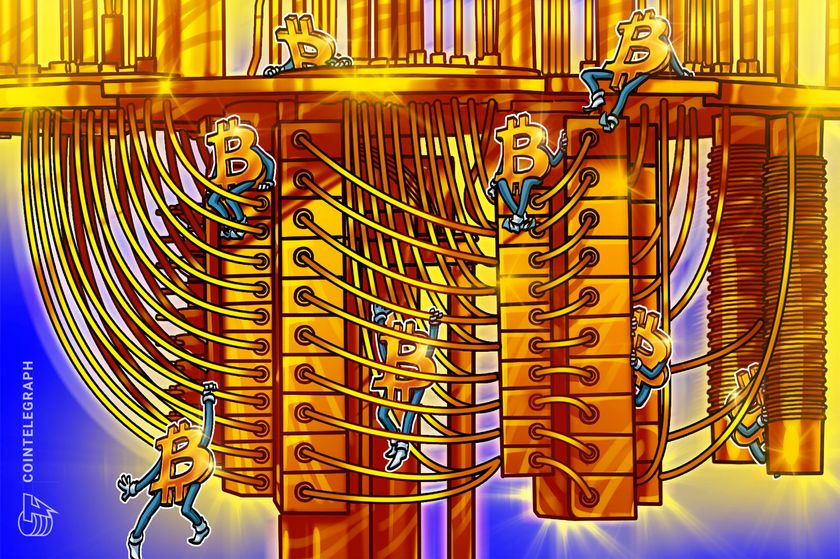 Back said the safest approach is to build optional upgrades that would allow Bitcoin to migrate to quantum-resistant cryptography once it's needed. Blockstream CEO Adam Back, an early pioneer of the crypto movement, said Bitcoiners should be looking at building quantum-resistant solutions now, even if the threat is still decades away. “Quantum computing still has a lot to prove. Current systems are essentially lab experiments. I’ve followed the field for over 25 years, and progress has been incremental,” Back said at Paris Blockchain Week on Tuesday. “That said, Bitcoin should prepare,” Back said, adding that the “safest approach” is to build optional upgrades that allow migration to quantum-resistant cryptography if needed. Read more
 -
Cointelegraph.com - 22:15 Apr 15, 2026
 Institutional investors are buying Ether again, but a handful of factors could slow market momentum and negatively impact ETH’s rally. Key takeaways: Institutional ETH accumulation remains robust as Ether ETFs and Bitmine Immersion lead a healthy, spot-driven recovery. Lackluster DApp revenue and negative ETH funding rates suggest that traders are skeptical of the rally. Read more
11878 items