July | Crypto
"July" in Crypto feed
-
Cointelegraph.com - 14:22 Oct 15, 2026
 Russia plans to ban direct P2P crypto trades from July 1, 2027, while separate rules already prohibit transfers from digital accounts to self-custody wallets. Russia will ban direct peer-to-peer (P2P) cryptocurrency transactions between individuals starting next year, requiring individuals to use authorized intermediaries for such trades. The restriction will end individuals’ ability to exchange crypto assets directly without intermediaries, the Bank of Russia, the country’s central bank, explained in guidance updated Monday. The regulator confirmed that such transactions will remain permitted only until July 1, 2027. The regulator also clarified that individuals are not allowed to transfer crypto assets from their digital accounts to their own non-custodial, or self-custodial, wallets. Read more
-
Cointelegraph.com - 03:29 Oct 15, 2026
 TeraWulf, Core Scientific, Cipher Mining and IREN each lost more than 12% as hotter inflation hit AI infrastructure companies. US stocks suffered their sharpest selloff since July on Wednesday as hotter-than-expected inflation data weighed on technology and AI infrastructure companies, with Bitcoin miners among those hit. The S&P 500 fell 1.1%, its biggest one-day decline since July 29; the Nasdaq Composite fell 1.9%, its biggest one-day drop since July 23, while the Dow Jones Industrial Average fell 0.1% over the day. Leading decliners among major tech companies included data center operator CoreWeave, which fell 16%, AI infrastructure provider Nebius, which fell 11%, and Oracle, which fell 9%. Read more
-
CryptoSlate - 11:10 Oct 05, 2026
Softer hiring and slower wages weaken the labor case for another Fed hike, while inflation and household employment complicate the outlook. The post US jobs revision turns July’s 21,000 gain into a 10,000 loss appeared first on CryptoSlate. -
Cointelegraph.com - 10:53 Sep 11, 2026
 Bitcoin HODL waves data revealed an unusually muted reaction to Bitcoin’s drop below $58,000, raising questions over its status as a bear-market floor. Bitcoin (BTC) buyers avoided “buying the dip” as BTC price fell to $57,800 in July, analysis reports. Key points: Read more
-
CryptoSlate - 04:00 Aug 19, 2026
The company placed 4.96 EH/s in its operating column while a footnote said Ethiopia mining was paused. The post Canaan counted paused Ethiopia mining as nearly 35% of its July operating hashrate total appeared first on CryptoSlate. -
Cointelegraph.com - 16:29 Aug 17, 2026
 The stablecoin bill signed into law last year is scheduled to go into effect in January 2027, potentially without finalized regulations from US government agencies. The US Department of the Treasury issued a notice of proposed rulemaking related to the implementation of the Guiding and Establishing National Innovation for US Stablecoins (GENIUS) Act, a bill to establish a framework for payment stablecoins signed into law last year. In a Monday notice, the Treasury Department said that it was opening a proposed rule up to public comment ahead of the January 2027 implementation of the GENIUS Act. Under the terms of the bill, the stablecoin law had been scheduled to go into effect 120 days after agencies finalize rules, or 18 months after it was passed in July 2025, making its effective date Jan. 18, 2027. Treasury Secretary Scott Bessent said that the department “welcomes input from stakeholders as [it works] to provide the regulatory certainty businesses need to innovate and grow in America.” Read more
-
CryptoPotato - 17:39 Aug 16, 2026
Binance remained the largest venue in the market, accounting for 76% of total equity perpetual futures volume in July. -
Cointelegraph.com - 07:59 Aug 07, 2026
 The Coldcard exploit, which caused more than $100 million in losses, helped push July crypto thefts to $247 million, making it the second-worst month of 2026. July emerged as the second-worst month of 2026 for cryptocurrency thefts, largely due to the recent Coldcard exploit. Hackers stole $247.4 million in crypto in July, the most this year after the $644 million stolen in April, according to DefiLlama data. The total was more than triple the $75 million stolen in June and the $60 million stolen in May. The Coldcard exploit was the month’s biggest exploit, with at least $100 million in Bitcoin (BTC) stolen from 7,300 wallets across three confirmed attack waves, according to Galaxy Digital. The company also identified a suspected fourth wave that could bring total losses to about $130 million. DefiLlama’s hack tracker estimates losses tied to the Coldcard exploit at $115 million. Read more
-
CryptoPotato - 18:45 Aug 01, 2026
History repeated in July with a notable increase: will it happen again in August but this time in the opposite direction? -
CoinDesk - 16:51 Aug 01, 2026
Without that QQQ token, QQQB, July volume for tokenized equities would be roughly $2.03 billion, about 30% below June’s total. -
Cointelegraph.com - 07:23 Aug 01, 2026
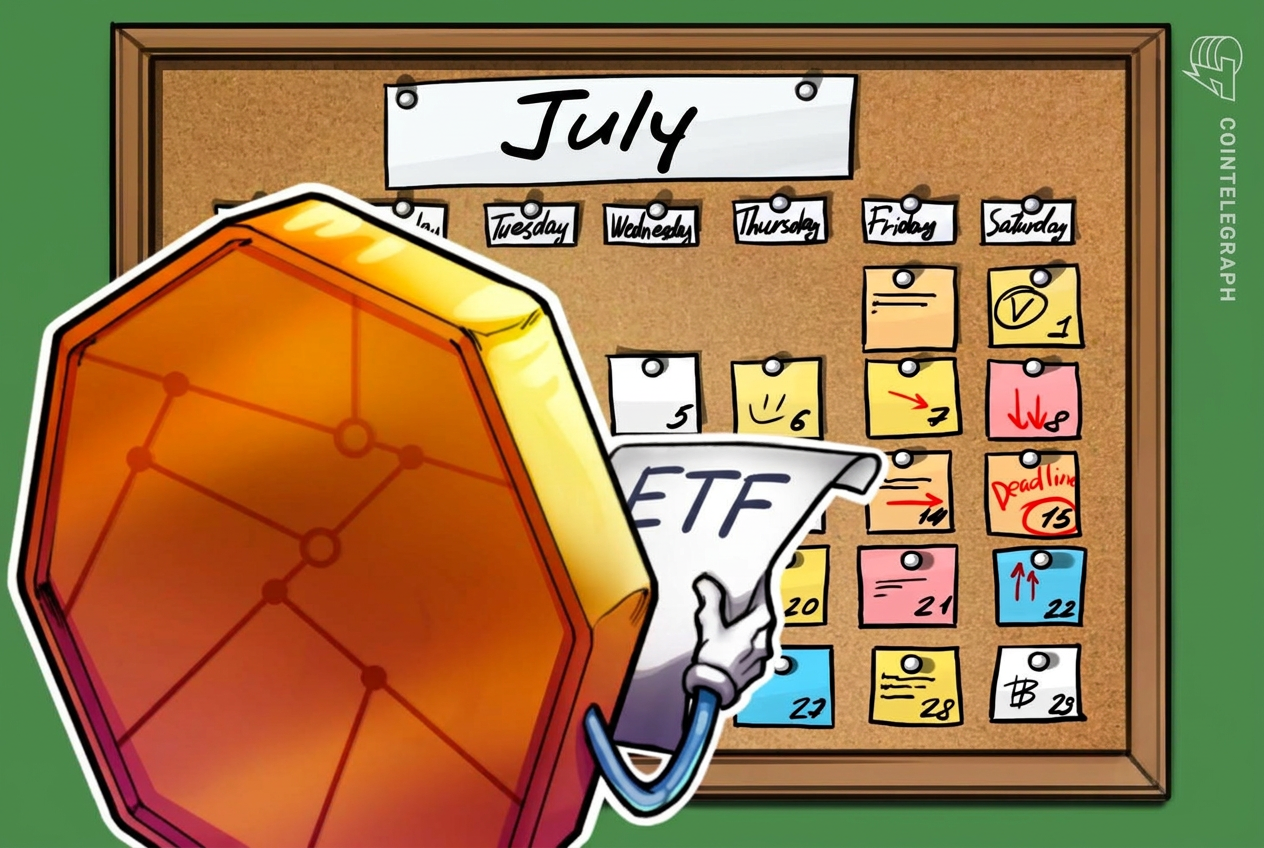 Spot Bitcoin ETFs attracted $172.4 million in July inflows but remained $5.3 billion negative year to date after heavy withdrawals in May and June. US-listed spot Bitcoin exchange-traded funds (ETFs) finished July in the green despite a late-month wave of selling and BTC price volatility. Bitcoin ETFs attracted a modest $172.4 million in net inflows in July, reversing two consecutive months of outflows, according to SoSoValue data. The monthly inflows came despite a volatile end to July, as the funds logged a $265.4 million net outflow on Friday, marking their largest daily withdrawal since July 13. Read more
-
Cryptonews.com - 08:34 Jul 31, 2026
The Kospi ended July with a powerful rebound, while the Bitcoin price stayed remarkably steady despite several major headlines. We watched the Kospi recover sharply as the Bitcoin hovered near $64,300, showing little interest in politics, stock market swings, or a major crypto security breach.July closed with markets moving in different directions. South Korean equities […] The post Crypto News, July 31: July Round Up, Kospi Coming Back, Bitcoin Price Ignores Political Noise as Market Splits appeared first on Cryptonews. -
Cryptonews.com - 08:02 Jul 30, 2026
FOMC paused rates, Bitcoin shrugged off volatility, while Ethereum traded sideways as markets digested the decision. The post Crypto News, July 30: FOMC Holds Rates, Bitcoin ETFs Flip Green, Ethereum Dominance Falls appeared first on Cryptonews. -
Cointelegraph.com - 04:13 Jul 30, 2026
 Luno and Gnosis joined a widening round of crypto restructurings in July, when at least 12 companies reported job cuts. Crypto exchange Luno is reportedly cutting about 20% of its global workforce as it restructures operations and shifts more resources toward institutional clients, financial infrastructure and business-to-business services. According to a Bloomberg report on Tuesday, Luno CEO James Lanigan said the company had invested in automation and broader operational improvements that changed the resources needed to run the business. Luno will also trim costs in line with market conditions while investing in compliance, core infrastructure and retail products. Luno has previously made larger workforce reductions. In January 2023, the exchange cut 35% of its staff, affecting nearly 330 employees, as turbulence across the technology and crypto sectors weighed on its growth and revenue. Read more
-
Cryptonews.com - 09:01 Jul 29, 2026
Is crypto about to change forever? Morgan Stanley makes its move, the Clarity Act advances, and Bitcoin plus Ethereum price react. The post Crypto News, July 29: Morgan Stanley Launches Ethereum and Solana ETPs, Paul Atkins Pushes Clarity Act, Bitcoin Price Bounces appeared first on Cryptonews. -
CryptoSlate - 14:45 Jul 28, 2026
The five-year trigger is clear, but the first applicable report cycle and transition treatment are not. The post Crypto holders face a July 29 Maine deadline as state manual conflicts on when abandoned funds trigger seizure appeared first on CryptoSlate. -
Cryptonews.com - 09:21 Jul 28, 2026
Bitcoin price tumbles as the Clarity Act stalls in Congress. Is crypto heading for a deeper correction or just another shakeout? The post Crypto News, July 28: CLARITY Act Shelved, Bitcoin Drops in Asian Market Rout appeared first on Cryptonews. -
Cryptonews.com - 08:58 Jul 27, 2026
Crypto has started the week with a completely different mood. Just days ago, traders were preparing for another round of geopolitical escalation. Instead, the United States and Iran have now held fire for a second consecutive day, oil prices have dropped by 5%, and risk appetite has returned. If you’re wondering why crypto is up […] The post Crypto News, July 27: Why Crypto Up? ETH BTC Ratio Just Flashed a Massive Alt Season Signal appeared first on Cryptonews. -
Cointelegraph.com - 00:03 Jul 27, 2026
 Despite support from Goldman Sachs, Fidelity and law enforcement bodies, the Clarity Act’s chances dim. BitMEX to close as crypto consolidates into five big players. Despite wealthy memecoin entrepreneur President Donald Trump agreeing to an ethics deal, the Clarity Act (CLARITY) is floundering as the August recess deadline looms. Senate Majority Leader John Thune said he doesn’t believe the act has the votes to pass just yet, but may bring it to a vote anyway to “get Clarity started. We’ll see where the votes are.” The ethics deal would prohibit all US officials from issuing or sponsoring digital assets, but contains some “get out of jail free” provisions for the President that the Democrats are unhappy with, including the fact the rules expire the day he is scheduled to leave office in 2029. Read more
-
Cointelegraph.com - 11:59 Jul 24, 2026
 Odos Protocol will shut down on July 30, giving users one week to withdraw assets. The team did not provide a reason for the decision. Decentralized exchange (DEX) aggregator Odos Protocol announced plans to shut down operations, giving users until July 30 to withdraw their assets. The team said in a Thursday X post that the Odos DAO is separate from the operating company and will announce its own plans, while the ODOS token will continue to exist onchain. It didn’t provide a rationale for the decision. Odos Protocol’s DEX aggregator volume has been declining over the past two years, falling to $169 million in July 2026 from a peak of $7.8 billion in December 2024. The protocol generated $2.72 million in annualized revenue, according to DefiLlama data. Read more