South Korea | Crypto
"South Korea" in Crypto feed
-
Cointelegraph.com - 05:53 Oct 02, 2026
 South Korean crypto exchange operating profits fell 78% in the first half of 2026 as trading volumes, market capitalization and customer deposits declined. South Korean crypto exchanges saw operating profits fall 78% in the first half of 2026 as trading activity, market valuations and customer deposits declined, according to new government data. On Thursday, the Korea Financial Intelligence Unit (KoFIU) said average daily trading volume at domestic virtual asset exchanges fell 44% from the previous six months, while market capitalization dropped 33% and won-denominated deposits fell 35%. Exchange sales declined 41% over the same period, even as the number of accounts eligible to trade rose slightly by 0.4%. KoFIU’s survey covered 26 registered virtual asset service providers, including 17 exchange operators and nine custody and wallet providers, and covered activity from Jan. 1 through June 30. Read more
 -
Cointelegraph.com - 05:08 Oct 02, 2026
 South Korea’s financial regulator proposed detailed rules for tokenized securities, including capital requirements, OTC trading licenses and retail investment limits. South Korea’s Financial Services Commission has proposed detailed regulations for issuing and trading tokenized securities as the country’s regulatory framework is set to take effect in February 2027. The changes would allow stocks, bonds, funds and certain fractional investment securities to be issued and circulated in tokenized form. The proposal also introduces requirements for companies issuing and managing tokenized securities. Under the proposed changes, companies issuing tokenized securities while directly managing customer accounts would need at least 4 billion Korean won ($2.8 million) in equity capital and dedicated compliance and technology staff. Read more
 -
Cointelegraph.com - 05:42 Sep 28, 2026
 Crypto market making is effectively restricted under South Korea’s manipulation rules, but regulators are reconsidering the approach after a JPYC spiked on Upbit this month. South Korea’s Financial Services Commission said it is considering a market-making system for digital assets, after a stablecoin linked to the value of the Japanese yen traded for as much as four times its peg on a major South Korean crypto exchange earlier this month. Crypto exchange Upbit opened trading of JPYC, a yen-backed stablecoin, on Sept. 17, with the market opening at 12 Korean won per JPYC before reaching a high of 37.6 Korean won just an hour later, more than four times its market value. The spike was attributed to limited liquidity on Upbit. “We will also review the need to introduce systems such as market-making activities to increase the efficiency and stability of the digital asset landscape,” Yoo Young-joon, director of digital finance policy at the FSC, said at a conference in Seoul on Monday, Digital Asset reported. “...
 -
CoinDesk - 08:49 Sep 21, 2026
South Korea's second-largest bank’s $100 million foreign-currency bond blockchain issuance shortened settlement time to the same day from three to five business days. -
Cointelegraph.com - 09:37 Sep 17, 2026
 South Korean police reportedly referred 18 Polymarket users to prosecutors in a gambling probe involving 26 people and $12.7 million in bets. South Korean police have reportedly referred 18 Polymarket users to prosecutors in an illegal gambling investigation involving 26 people who collectively wagered about 17.6 billion won (worth $12.7 million). According to Asia Economy, data submitted by the National Police Agency to the office of Democratic Party lawmaker Yoon Kun-young showed that the Gangwon Provincial Police Agency had placed 26 people under investigation as of Tuesday and sent 18 of them to prosecutors. The report said the largest amount wagered by a single user was about 5.7 billion won ($4.1 million). Police identified users by analyzing publicly available blockchain transactions, the report said. Polymarket lets users buy and sell contracts tied to the outcomes of real-world events and operates on a noncustodial, peer-to-peer structure with automated settlement. It does not maintain a conventiona...
 -
Cryptonews.com - 19:01 Sep 02, 2026
XRP briefly outpaced Bitcoin on South Korean exchanges with a 273% volume surge. Here's the price analysis, key levels, and what it means for traders. The post XRP Price Prediction: Ripple Edges Bitcoin In South Korea appeared first on Cryptonews. -
CoinDesk - 10:21 Aug 28, 2026
Following a deal with Shinhan Financial, the global payments giant is widening its footprint in Asia’s major crypto hub through South Korea's largest exchange. -
Cointelegraph.com - 08:39 Aug 18, 2026
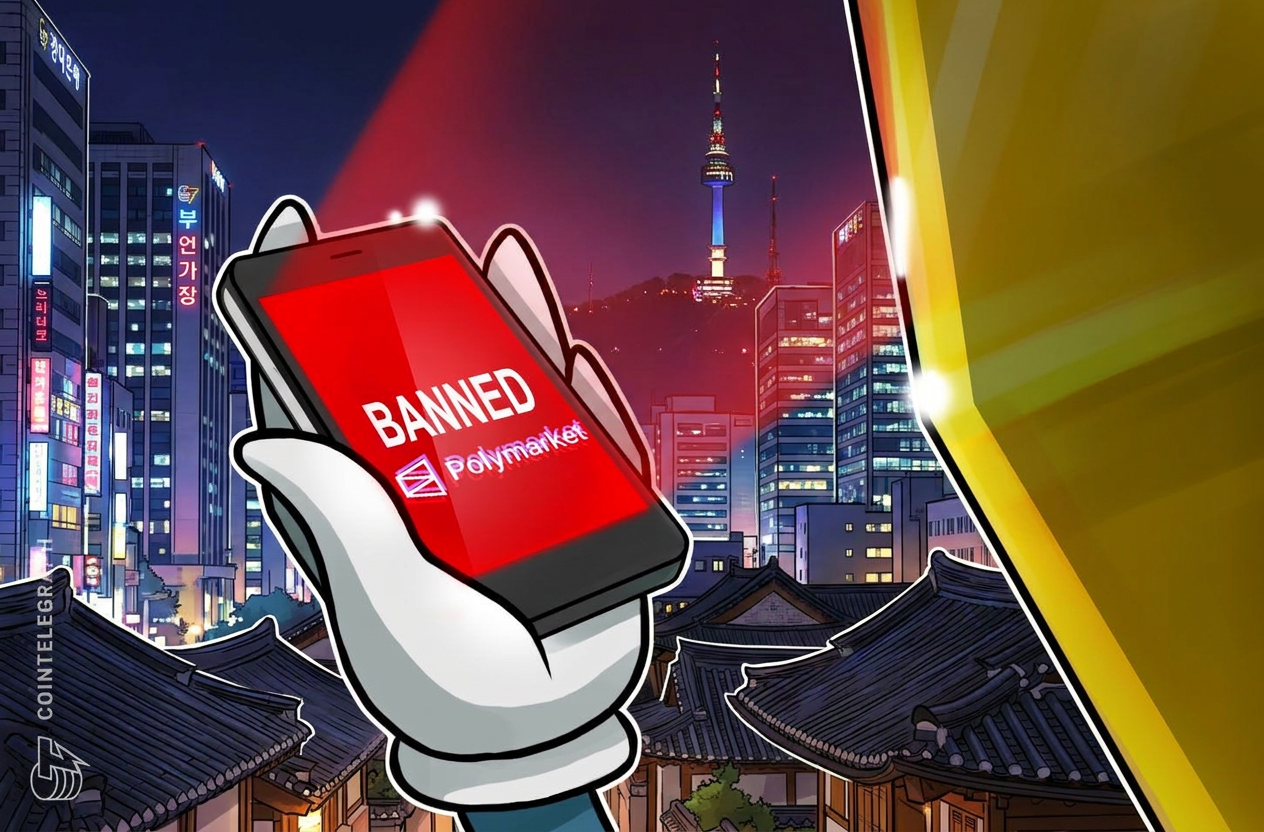
 The Korea Media and Communications Commission said Polymarket’s structure and operations amount to illegal gambling despite its noncustodial design and smart contracts. South Korean authorities have ordered access to Polymarket to be blocked after determining that the crypto prediction market provides an illegal gambling environment to users in the country. The country’s media and communications review commission said Tuesday that Polymarket falls under information that facilitates gambling or the opening of a gambling venue under the Criminal Act, as well as prohibited analogous betting activity under the National Sports Promotion Act. The regulator said Polymarket’s winner-takes-all structure, where users can gain or lose money based on outcomes including politics, sports and weather, encourages speculative gambling behavior. It also cited Polymarket’s role in operating markets, setting trading rules, providing crypto deposit, withdrawal and settlement systems and collecting transaction fees. Read more
 -
Cointelegraph.com - 04:11 Aug 18, 2026
 Ripple is bringing its cross-border payments platform to Jeonbuk Bank, but key details including its launch status and settlement asset remain undisclosed. South Korea’s Jeonbuk Bank has partnered with blockchain payments company Ripple to deploy its cross-border payment system for business customers. On Tuesday, Ripple said its Ripple Payments platform would let the bank’s customers settle overseas transfers in seconds to minutes, with operations around the clock. The service targets businesses including import-export companies, technology startups and online content creators. Ripple said its system would provide the bank with faster, less expensive remittance capabilities than conventional transfers routed through intermediary banks via the SWIFT messaging network, which can take several days. Read more
 -
Cointelegraph.com - 19:21 Aug 13, 2026
 More than a year after being indicted on fraud charges related to his activities at crypto company Delio, Jeong Sang-ho faces prison time in South Korea. A judge in South Korea reportedly sentenced Delio CEO Jeong Sang-ho to 15 years in prison after he was found guilty of defrauding users out of about $50 million in crypto. According to a Thursday report from South Korean news outlet Newsis, the 11th Criminal Division of the Seoul Southern District Court sentenced Jeong after his conviction on charges related to embezzlement and the use of a false trading license, but the CEO received no detention for defrauding users of $175 million. “While operating Delio, [Jeong] falsely obtained a virtual asset trading license and defrauded victims of approximately 70 billion won [$49.3 million] in virtual assets,” said the court, adding: Read more
 -
Cointelegraph.com - 06:28 Aug 11, 2026
 South Korea will remove its 1 million won Travel Rule threshold and apply information-sharing requirements to all transfers between registered crypto service providers. South Korea will expand its crypto Travel Rule to all transfers between registered virtual asset service providers (VASPs), removing the current 1 million won (about $700) threshold. The country’s Cabinet approved amendments to the Enforcement Decree of the Act on Reporting and Using Specified Financial Transaction Information on Tuesday. Under the changes, the Travel Rule will apply to all transfers between registered crypto service providers regardless of value. Receiving platforms will also be required to obtain sender and recipient information and may request missing information or reject transactions when required data is unavailable. Read more
 -
CryptoSlate - 22:30 Aug 10, 2026
Civil creditors could compel custodians to freeze, disclose, transfer, swap and sell debtors’ assets if the rules advance. The post South Korea puts crypto exchanges on a seven-day clock under new seizure rules appeared first on CryptoSlate. -
Cointelegraph.com - 05:33 Jul 30, 2026
 Policy report recommends interim licensing guidance, greater flexibility for stablecoin issuers and rules ahead of the Digital Asset Basic Act. South Korea should allow greater flexibility for stablecoin issuers, provide interim licensing guidance and phase in stablecoin regulation before completing its Digital Asset Basic Act, according to a policy report published Wednesday by Hashed Open Research and the Solana Policy Institute. The report summarizes a June 23 symposium attended by lawmakers, legal experts and industry participants. The Digital Asset Basic Act would establish South Korea’s first comprehensive digital asset framework, covering stablecoins, issuance, disclosures and market rules. However, lawmakers have yet to reconcile multiple bills, with disagreements over stablecoin issuance delaying the legislation. Read more
 -
Cointelegraph.com - 03:43 Jul 29, 2026
 The FSC reportedly plans a government-backed digital asset bill covering stablecoins and exchanges, while opposition lawmakers seek to scrap a 22% crypto tax due in 2027. South Korea’s Financial Services Commission (FSC) reportedly plans to draft a consolidated Digital Asset Basic Act with the ruling Democratic Party, giving lawmakers a government-backed proposal covering stablecoins and the broader cryptocurrency market after months of delays. According to an Edaily report published Wednesday, the FSC told the National Assembly ahead of a policy briefing that it intends to introduce a consolidated bill. The proposal would reportedly cover stablecoin issuance and circulation, digital asset business rules, exchange entry requirements, disclosures, internal controls and system-resilience standards. A consolidated government-ruling party proposal could provide a central framework for negotiations. At the moment, 10 separate digital asset and stablecoin bills are already pending in Parliament, while disagreements...
 -
Cryptonews.com - 09:47 Jul 28, 2026
Bitcoin dropped to $63,582 on July 28 as $100M in leveraged positions were wiped in 60 minutes — the third flush at $64K this week. Here's the technical picture and what's next. The post South Korea’s Stock Market Triggered 8th Circuit Breaker of 2026: Bitcoin Liquidated 3 Times Near $64,000 appeared first on Cryptonews. -
Cointelegraph.com - 10:21 Jul 26, 2026
 South Korea’s largest lender will use JPMorgan’s blockchain platform to support US dollar cross-border payments for import and export businesses across 10 countries. South Korea’s KB Kookmin Bank will launch a blockchain-based cross-border payment service for import and export businesses in August using JPMorgan’s Kinexys network, according to multiple local media reports. Kinexys, formerly known as Onyx, is JPMorgan’s blockchain platform for institutional payments, tokenization and digital assets. The service will initially support US dollar transfers across 10 countries, including the US, Singapore, Saudi Arabia and the United Arab Emirates. Read more
 -
Cointelegraph.com - 08:51 Jul 24, 2026
 Mirae Asset reportedly plans to use the South Korean crypto exchange as a hub for tokenized assets, stablecoins and digital finance. South Korean crypto exchange Korbit will reportedly rebrand as Digital X after becoming part of Mirae Asset Group. Mirae Asset founder and global strategy officer Park Hyeon-joo announced the new name in an internal email to employees on Thursday, according to a Herald Business report. Park reportedly described Digital X as central to the group’s “Mirae Asset 3.0” strategy, which aims to combine digital assets with traditional finance. The company plans to expand into real-world asset (RWA) tokenization, security token offerings, stablecoins and traditional asset products. Park said the exchange would prioritize anti-money laundering controls, customer verification, information security and fraud detection as South Korea develops its crypto and tokenized securities rules. Read more
 -
CoinDesk - 07:05 Jul 23, 2026
Korbit, South Korea's first cryptocurrency exchange, has joined the Mirae Asset Group family, marking the first time a traditional Korean financial group's affiliate has taken a controlling stake in a domestic crypto exchange. -
Cointelegraph.com - 10:47 Jul 22, 2026
 Trading activity on South Korea’s five major crypto exchanges fell sharply as the KOSPI surged, signaling a shift in retail investors toward equities. South Korea’s major crypto exchanges have seen their trading activity fall sharply over the past year as the country’s stock market surged, suggesting retail speculative interest may be shifting toward equities, Cointelegraph analysis shows. The Korea Composite Stock Price Index (KOSPI) benchmark more than doubled over the period, while volumes across the country’s largest won-based crypto platforms contracted. Cointelegraph reviewed CoinGecko’s historical 24-hour volume readings for Upbit, Bithumb, Coinone, Korbit and Gopax, comparing seven-day periods in July 2025 and July 2026. Read more
 -
Cointelegraph.com - 07:18 Jul 20, 2026
 The Bank of Korea’s CBDC pilot will add two regional banks, new payment features and tests of government subsidy payments using tokenized bank deposits The Bank of Korea may launch the second phase of Project Hangang, its wholesale central bank digital currency (CBDC) pilot, as early as September, according to Yonhap News. The next stage expands participation to nine banks from seven, introduces new payment features and tests government subsidy disbursements through tokenized bank deposits. Regional lenders Kyongnam Bank and iM Bank will join the existing group of participants. Project Hangang uses a blockchain-based wholesale CBDC issued by the central bank as the settlement asset for deposit tokens issued by commercial banks. Consumers can then use the bank-issued tokens for everyday payments. Read more