Tether | Crypto
"Tether" in Crypto feed
-
Cointelegraph.com - 13:07 Aug 01, 2025
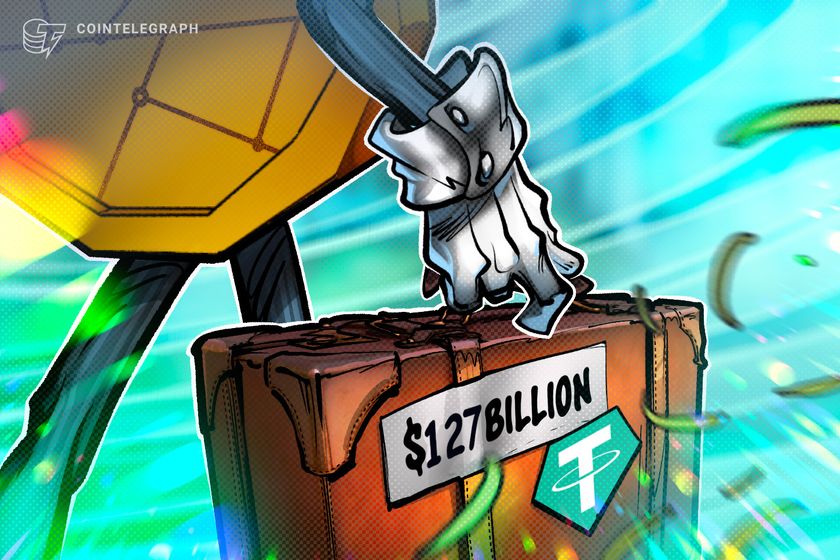 Tether’s USDT supply has increased by $26 billion in 2025, pushing its market cap to $163.6 billion as global demand for stablecoin grows. Stablecoin-issuer Tether has become the 18th-largest holder of United States Treasurys globally, surpassing the holdings of South Korea, according to a recent attestation report. On Thursday, Tether said in its attestation report for the second quarter of 2025 that it holds $127 billion in US Treasury bills. The company said it has $105.5 billion in direct US Treasury exposure and $21.3 billion held indirectly. Tether’s current holdings show a $7 billion increase from the first quarter. On May 19, the stablecoin issuer reported having $120 billion in T-bills, overtaking Germany’s holdings to take the 19th spot. Read more
 -
Cointelegraph.com - 19:40 Jul 31, 2025
 In the first six months of 2025, Tether has had a profit of $5.7 billion, a rise of 9.6% compared to the same period in 2024. Tether disclosed another strong quarter as stablecoins continue to gain traction amid growing regulatory clarity in the United States. The company said it posted $4.9 billion in profit for the second quarter of 2025, a 277% increase compared with the same period a year ago. Tether is the creator of USDt (USDT), a stablecoin pegged to the US dollar and backed by US Treasurys and cash equivalents. According to DefiLlama, USDt continues to dominate the stablecoin market, accounting for 61.7% of all stablecoin value, with a market capitalization of $164.5 billion at this writing. According to Tether, it had $162.6 billion in assets and $157.1 billion in liabilities as of June 30, with most of the liabilities relating to token issuance. Read more
 -
CryptoSlate - 15:54 Jul 31, 2025
Tether has minted over $20 billion worth of USDT since the start of 2025, pushing the stablecoin’s total circulation beyond $157 billion, according to its quarterly attestation report released on July 31. The company noted that over $13.4 billion in USDT was issued during the second quarter alone, reflecting strong demand for the dollar-pegged token […] The post Tether reports $5.7 billion profit amid record $127 billion US Treasury investments appeared first on CryptoSlate. -
Cointelegraph.com - 17:39 Jul 21, 2025
 Following its latest freeze of nearly $86K in stolen USDt, Tether’s enforcement capabilities are again in the spotlight — raising questions about centralized control in stablecoin ecosystems. Tether, issuer of the world’s largest stablecoin, said on Sunday it had frozen $85,877 in USDt (USDT) tied to stolen funds, acting in “collaboration with law enforcement.” The move has reignited debate over the role of centralized stablecoin issuers in enforcing crypto compliance. The freeze, while relatively minor compared to other such actions by Tether, adds to the company’s growing record of intervention. Tether says it has frozen over $2.5 billion in USDt linked to illicit activity and has blocked more than 2,090 wallets in cooperation with global authorities. Related: Embedding human rights into crypto isn’t optional, it’s foundational Read more
 -
Cointelegraph.com - 14:22 Jul 17, 2025
 Tether’s USDt stablecoin has surpassed $160 billion market cap, confirming its place as the digital dollar, as Tron leads in blockchain supply. The market cap of Tether’s USDt, the world’s largest stablecoin, has surpassed $160 billion for the first time, a “new mind-blowing milestone,” according to Tether CEO Paolo Ardoino. In a Thursday post on X, Ardoino called the achievement a testament to USDt’s growing role as the digital dollar for “billions of people living in emerging markets and developing countries.” USDt crossed $150 billion in May. Ardoino has said that USDt (USDT) is used by more than 400 million people worldwide, expanding by 35 million wallets each quarter, especially in emerging markets where it serves as a reliable dollar substitute. Read more
 -
CryptoSlate - 15:20 Jul 16, 2025
Tether, the world’s largest stablecoin issuer, minted an additional $2 billion USDT on July 16 on the Ethereum blockchain. Tether CEO Paolo Ardoino confirmed the mint via a post on X, clarifying that the new mints were an “inventory replenish” on Ethereum. This means the funds serve as inventory for future issuance and blockchain swaps, […] The post Tether mints $2 billion in USDT as supply reaches a record-breaking $160 billion appeared first on CryptoSlate. -
Cointelegraph.com - 13:57 Jul 16, 2025
 Iurii Gugnin allegedly used fake documents to bypass sanctions and launder $530 million for Russian clients. In the process, he deceived US banks. Iurii Gugnin allegedly used his crypto firm to move $530 million through US banks and crypto exchanges using Tether (USDT), facilitating payments for Russian clients tied to sanctioned banks. Gugnin allegedly failed to implement AML regulations and didn’t file suspicious activity reports (SARs), violating the Bank Secrecy Act and misleading financial institutions. Gugnin also reportedly accessed websites that provided information on indicators of criminal investigation and methods for detecting law enforcement surveillance. Read more
 -
CryptoPotato - 20:16 Jul 12, 2025
These blockchains played a foundational role in Tether’s growth; however, their USDT volume has significantly declined in the last two years. -
CryptoSlate - 23:15 Jul 11, 2025
Tether announced it will discontinue support for its USDT stablecoin on five “legacy” blockchains, including Omni Layer, Bitcoin Cash SLP, Kusama, EOS, and Algorand. According to the July 11 announcement, the move will become effective Sept. 1, ending redemptions and freezing remaining tokens on those networks. The decision comes as part of what the company […] The post Tether to sunset USDT redemptions on 5 ‘legacy’ networks including Bitcoin Cash, Algorand appeared first on CryptoSlate. -
Decrypt - 21:31 Jul 11, 2025
Stablecoin issuer Tether is ending support for USDT on five "legacy" blockchains after previously halting minting on those networks. -
Cointelegraph.com - 19:31 Jul 11, 2025
 The discontinuance of USDt on these blockchains has been in the works for years, as Tether looks to pivot its strategy to other protocols. Tether is discontinuing redemptions for USDt (USDT) on five legacy blockchains starting Sept. 1, the company announced on Friday. The move affects users of Omni Layer, Bitcoin Cash SLP, Kusama, EOS (now Vaulta), and Algorand. “Sunsetting support for these legacy chains allows us to focus on platforms that offer greater scalability, developer activity, and community engagement,” Paolo Ardoino, CEO of Tether, said in a statement. Tether’s sunsetting of support for these particular blockchains has been in the works for some time. In August 2023, the company announced it would no longer be issuing USDt on the Omni Layer, Kusama, and Bitcoin Cash SLP. In June 2024, Tether halted minting on EOS and Algorand. Read more
 -
CryptoSlate - 18:11 Jul 08, 2025
Tether CEO Paolo Ardoino revealed that the firm holds roughly $8 billion in gold in a Swiss vault during an interview with Bloomberg News on July 7. Ardoino called the site “the most secure vault in the world” and said the company owns almost the entire 80-ton stockpile outright, placing the El Salvador-based issuer among […] The post Tether holds $8 billion worth of gold in Swiss vault, matching UBS exposure appeared first on CryptoSlate. -
Cryptonews.com - 17:24 Jul 08, 2025
The founder of Cardano (ADA), Charles Hoskinson once again confirmed that the project’s Foundation has engaged in conversations with the founding entities behind Circle and Tether – the issuers of the top stablecoins USDC and USDT.To the Cardano community, bringing these two stable assets to the blockchain’s ecosystem would favor a bullish Cardano price prediction.In […] The post Cardano Price Prediction: Hoskinson Confirms Talks With Circle and Tether – Massive Stablecoin Partnership Coming? appeared first on Cryptonews. -
CryptoSlate - 18:41 Jul 03, 2025
Stablecoin issuer Tether has signed a Memorandum of Understanding (MoU) with Adecoagro S.A. to explore a strategic collaboration centered on renewable-powered Bitcoin mining, according to a July 3 statement. Adecoagro, one of South America’s leading producers of sustainable agricultural goods and energy, is evaluating how its more than 230 MW of renewable energy capacity can […] The post Tether and Adecoagro join forces on renewable-powered Bitcoin mining venture appeared first on CryptoSlate. -
Cointelegraph.com - 15:55 Jul 02, 2025
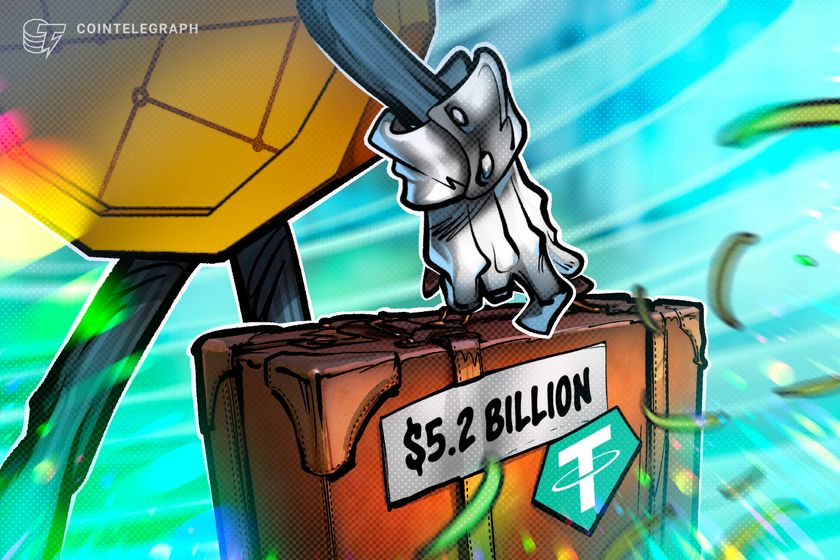 With rising rates and over $100 billion in reserves, Tether turned monetary policy into profit, and it’s not alone. In the first half of 2024, Tether quietly posted one of the biggest profit hauls in crypto history, pulling in a staggering $5.2 billion across just two quarters. That’s not a typo: $4.52 billion in Q1, followed by another $1.3 billion in Q2. Read more
 -
CryptoSlate - 19:33 Jun 18, 2025
PancakeSwap has emerged as the highest revenue-generating platform in the crypto industry over the last 24 hours, outpacing even major players like Tether. According to DeFiLlama data, PancakeSwap generated $24.6 million in fees on July 17, eclipsing Tether’s $19.9 million during the same period. This marks the DEX platform’s second-largest single-day fee haul, just behind […] The post PancakeSwap surpasses Tether with $24.6M daily revenue, driven by record $10B trading surge appeared first on CryptoSlate. -
Cointelegraph.com - 15:11 Jun 12, 2025
 Tether’s investment in Canada’s Elemental Altus Royalties follows the company’s strategy to “integrate long-term, stable assets such as gold and Bitcoin in its ecosystem.” Tether, the issuer of the world’s largest stablecoin by market capitalization, continues its buying spree with its 32% stake acquisition in Canada’s public gold royalty firm Elemental Altus Royalties. Tether Investments on Thursday announced the acquisition of 78,421,780 common shares of Elemental (ELE) from La Mancha Investments, representing 31.9% of Elemental’s issued and outstanding shares. The transaction, completed Tuesday, was made at a price of $1.55 Canadian dollars ($1.14) per share, according to an announcement by Elemental, costing Tether approximately $89.4 million. Read more
 -
Cryptonews.com - 20:37 Jun 09, 2025
Tether has indicated that it will release its Mining Operating System via Open-source mining. MOS runs on devices from Raspberry Pi to container farms and supports varied cooling and power setups. The release may narrow the software edge that public miners hold over smaller peers. The post Tether’s Open-Source Mining OS Could Shatter Barriers – Will Public Miners Lose Their Edge? appeared first on Cryptonews. -
CryptoSlate - 17:57 Jun 09, 2025
Tether is building a gateway for new players to enter Bitcoin mining by releasing its Bitcoin Mining OS (MOS) as open-source software by the end of 2025, according to CEO Paolo Ardoino. In a June 9 post on X, Ardoino explained that the move will lower barriers for small and independent miners. Tether expects to […] The post Tether to democratize Bitcoin mining with open-source software debut appeared first on CryptoSlate. -
Cointelegraph.com - 15:38 Jun 09, 2025
 The USDt issuer plans to launch its open-source project by the fourth quarter of 2025, according to CEO Paolo Ardoino. Stablecoin issuer Tether plans to open-source its Bitcoin mining software, a move the company said would allow new miners to enter the market without relying on expensive third-party vendors. By open-sourcing its Bitcoin Mining OS (MOS), “A horde of new Bitcoin mining companies will be able to enter the game and compete to keep the network safe,” Tether CEO Paolo Ardoino said in a Monday X post. Ardoino described MOS as scalable and modular, “built with a peer-to-peer [Internet of Things] architecture at its core.” Read more