Crypto
-
Cointelegraph.com - 19:00 Nov 11, 2025
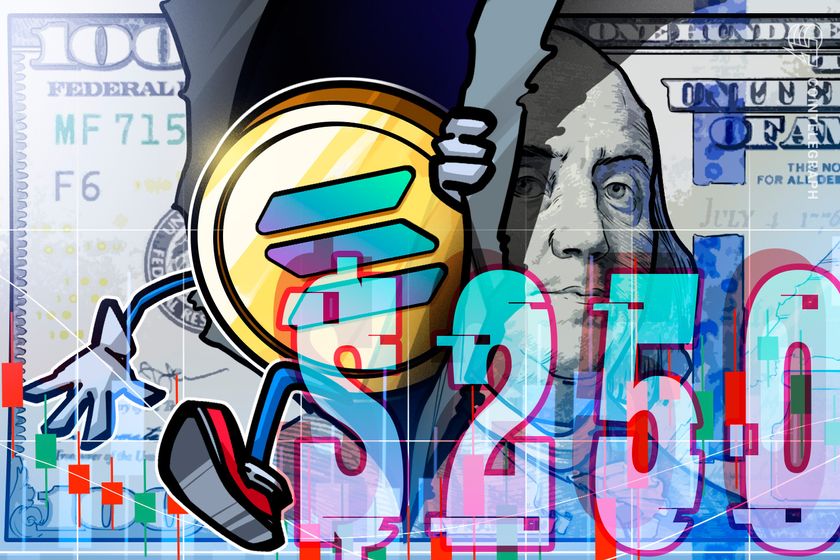 Solana’s fundamentals remain strong, but its recovery toward $250 will depend on easing geopolitical risks and renewed confidence in tech markets. Key takeaways: Solana’s strong onchain metrics and DApps revenue dominance hint at long-term strength despite recent selling pressure from major holders. Solana ETF inflows and diversified onchain activity support SOL, yet macro risks in AI and trade remain key obstacles to a $250 recovery. Read more
 -
Decrypt - 18:47 Nov 11, 2025
Financial services firm SoFi is rolling out access to crypto trading, allowing users to buy and sell Bitcoin, Ethereum, and other assets. -
Decrypt - 18:34 Nov 11, 2025
Crypto majors are trading in the red after an overnight dip, with Bitcoin (BTC) down 1% at $104,800, Ethereum (ETH) down 1% at $3,550, Binance Coin (BNB) down 2% at $978, and Solana (SOL) down 3% at $163. Among top movers, Uniswap (UNI) surged 20% and Aerodrome (AERO) gained 16%, while Zcash (ZEC) tumbled 25% to $474 but remains up 16% on the week. The US Treasury and IRS issued new guidance making it easier for ETFs to stake crypto tokens and distribute rewards to investors. Uniswap also announced a major governance proposal to activate its fee switch, conduct an initial 100 million UNI token burn, and introduce several other changes, helping boost UNI by 20%. Meanwhile, the US Senate released its first draft of a crypto market structure bill, marking a significant step toward advancing regulatory clarity. In corporate news, Jack Dorsey’s Square revealed support for Bitcoin payments across its 4 million merchants, while Gemini’s stock dropped 12% after reporting a $159.5 million net loss for Q3. -
CoinDesk - 18:33 Nov 11, 2025
Price action retreats from resistance as institutional selling emerges at key levels. -
Cointelegraph.com - 18:28 Nov 11, 2025
 The Nasdaq-listed company will acquire $100 million in OOB tokens and oversee the digital treasury of OOBIT, a crypto payments company backed by Tether and Solana’s co-founder. Malaysia-based VCI Global (Nasdaq: VCIG) has announced plans to acquire $100 million in OOB tokens and oversee the digital treasury of OOBIT, a Singapore-based crypto payments platform launched in 2017. According to a Tuesday announcement, Tether will become the largest shareholder in VCI Global through its stake in OOBIT. Solana co-founder Anatoly Yakovenko, CMCC Global and 468 Capital are also investors. VCI Global acquired $50 million in OOB tokens from the OOB Foundation at a $200 million market capitalization, or $0.20 per token, by issuing company shares as payment. The company plans to purchase an additional $50 million worth of OOB tokens on the open market after its official launch. Read more
 -
CryptoPotato - 18:21 Nov 11, 2025
XWIN Research Japan says bullish headlines can’t offset LTH selloffs and fading conviction in the current cycle. -
Decrypt - 18:07 Nov 11, 2025
CleanSpark is raising over $1 billion with plans to buy back stock, though its share price is falling for the second straight day. -
Cryptonews.com - 18:06 Nov 11, 2025
ADA has overcome the resistance trendline that guided its October crash – Cardano price predictions now eye renewed bullish push. The post Cardano Price Prediction: 30-Day Downtrend Is Over – Here’s Why Traders Are Suddenly Watching ADA Again appeared first on Cryptonews. -
Cryptonews.com - 18:05 Nov 11, 2025
Transak has secured six new U.S. MTLs, bringing its total to 10 and supporting stablecoin transactions and fiat-to-crypto conversions. With 19 applications pending, it has set a target of full 50-state coverage within 12–18 months and has prepared to roll out ACH after adding wires in August 2025. The post Transak Expands Stablecoin Payments with 6 New US State Licenses Amid Fragmented Rules appeared first on Cryptonews. -
Cryptonews.com - 17:49 Nov 11, 2025
Altcoin season has concentrated in DeFi tokens where structure and utility have evolved. Uniswap has advanced a governance plan with fee sharing and a burn; Aerodrome has adjusted emissions; SOON has added listings and 10sSOON activity. Traders have clustered around liquidity and steady turnover. The post Uniswap Governance Shift Leads Today’s DeFi Altcoin Season Moves appeared first on Cryptonews. -
Cointelegraph.com - 17:47 Nov 11, 2025
 Ethereum’s $200 billion tokenized economy, falling exchange supply and traditional finance footprint are fundamental factors that suggest ETH is undervalued. Key takeaways: Ethereum currently hosts $201 billion in tokenized assets, which is nearly two-thirds of the global total of $314 billion. Institutional growth led by BlackRock and Fidelity has driven a 2,000% surge in onchain fund AUM since 2024. Read more
 -
CryptoSlate - 17:34 Nov 11, 2025
Regardless of what Crypto Twitter says, DTCC pages show operational prep, not permission. Under the SEC’s new generic-listing regime, the real tells are an effective S-1 and an exchange listing notice, and that is when the clock to launch actually starts. DTCC pages listing XRP ETFs are not approvals. The entry means the clearing and […] The post Here’s the real XRP ETF launch timeline as DTCC is misread again appeared first on CryptoSlate. -
CryptoPotato - 17:26 Nov 11, 2025
XRP trades at $2.46 after a 9% weekly rise. Analysts watch $2.70 resistance, moving averages, and ETF developments for next direction. -
Cryptonews.com - 17:25 Nov 11, 2025
Coinbase enters UK retail banking with a 3.75% savings account backed by FSCS protection, positioning itself against traditional banks while offering integrated access to crypto assets. The post Coinbase Launches Savings Account to Rival UK Banks, Offers 3.75% Interest appeared first on Cryptonews. -
Cointelegraph.com - 17:22 Nov 11, 2025
 Some agencies, such as the SEC, are expected to reopen the day after a funding bill becomes law, more than 40 days after reducing their operations and staff. The US government is moving closer to reopening after more than 40 days of being shut down, following several Democratic lawmakers in the Senate siding with Republicans to pass a funding bill. On Monday, the US Senate held a late-night vote for a bill “continuing appropriations and extensions for fiscal year 2026,” which passed 60 to 40 in the chamber. The bill is expected to fund the government through Jan. 31, 2026, provided it passes in the House of Representatives and is signed into law by President Donald Trump. As Tuesday is a US federal holiday, the House is not expected to reconvene to vote on the bill until Wednesday at the earliest. Prediction platform Polymarket has already adjusted its expectation that the US government will return to normal operations on Friday, likely following the passage of the House bill. Read more
 -
Cointelegraph.com - 17:15 Nov 11, 2025
 PrizePicks has teamed up with Polymarket to let users wager on real-world outcomes, expanding beyond fantasy sports into the growing prediction-market space. PrizePicks, one of North America’s largest daily fantasy sports operators, has partnered with Polymarket to expand into the prediction-markets space — a move that could open new revenue streams beyond its core fantasy sports business. The partnership will integrate Polymarket’s event contracts directly into the PrizePicks app, allowing users to make predictions on outcomes spanning sports, entertainment and cultural events, the companies disclosed Tuesday. Polymarket founder and CEO Shayne Coplan said the collaboration could attract millions of PrizePicks users to the emerging prediction-markets ecosystem. Read more
 -
CoinDesk - 17:12 Nov 11, 2025
Crypto traders are taking profits on the bounce in prices, a Wintermute strategist said in a note. -
Decrypt - 17:01 Nov 11, 2025
To onboard millions of followers from TikTok, X and Instagram to its NOBODY token, the character brand is “making crypto invisible.” -
Cointelegraph.com - 17:01 Nov 11, 2025
 Speaking with Cointelegraph, 10T Holdings founder Dan Tapiero explains why Bitcoin’s fundamentals remain strong even as a 70% downturn looms in the next bear phase. Macro investor Dan Tapiero remains convinced that Bitcoin (BTC) is on track to reach $180,000 as part of its current bull cycle, but warns that a major correction could follow once the rally peaks. Despite recent risk-off sentiment and heavy selling from long-term “OG whales,” Tapiero insists the bull market remains intact. “I think the macro backdrop is still positive,” he said in an interview with Cointelegraph. According to Tapiero, the latest all-time high didn’t fully reflect the “fundamental improvements” in Bitcoin’s ecosystem or the increasingly favorable macro environment supporting digital assets. Read more
 -
CryptoPotato - 16:42 Nov 11, 2025
[PRESS RELEASE – Singapore, Singapore, November 11th, 2025] BSX Labs, backed by Blockchain Capital and Coinbase Ventures, brings expertise from supporting over $15B in orderbook trading volume. The team will help RISE develop EVM-based synchronously composable orderbook primitives that will bridge traditional financial markets. RISE today announced its acquisition of BSX Labs, the team behind […]