Crypto
-
Cointelegraph.com - 13:30 Aug 16, 2025
 Without localized risk detection and public–private cooperation, illicit capital will continue to flow unchecked, and trust in the system will collapse. Opinion by: Slava Demchuk, co-founder and CEO of AMLBot Asia’s cryptoverse has lost more than 1.5 billion in the first half of 2025 — more than during 2024, including Bybit and pig butchering scams in Southeast Asia. Most engines are built around typologies of Western money laundering. They miss custom laundering channels tailored to each region, which are popping up across Asia. Blockchain analytics firms must build customized regional risk libraries and collaborate with local law enforcement to combat the level and caliber of cryptocurrency-enabled crime in Asia. Failure to address this means criminal funds will still be able to lurk in plain sight and subvert the very integrity of global compliance systems. Read more
 -
Cryptonews.com - 13:16 Aug 16, 2025
BitMine purchases 106,485 ETH worth $470.51M bringing total holdings to 1.297M ETH while mystery whale withdraws $412M from Kraken as retail traders panic sell during pullbacks. The post BitMine and Mystery Whale Buy $882M in Ethereum While Retail Panic Sell appeared first on Cryptonews. -
Cointelegraph.com - 13:06 Aug 16, 2025
 S&P Dow Jones Indices is exploring partnerships with major exchanges, custodians and DeFi protocols to launch tokenized versions of its benchmarks. S&P Dow Jones Indices (S&P DJI) is in discussions with major exchanges, custodians and DeFi protocols to license and list tokenized versions of its benchmarks, according to Stephanie Rowton, the firm’s director of US equities. Rowton told Cointelegraph that the index provider is taking a “strategic approach” to ensure tokenized S&P products are launched only on platforms that meet high standards for transparency, security and regulatory compliance. “By establishing these types of relationships, we hope we can work together to participate in a robust infrastructure that supports the trading and accessibility of tokenized versions of our indexes, ultimately enhancing the investor experience,” she said. Read more
 -
Decrypt - 13:00 Aug 16, 2025
Ethereum stakers are lining up to withdraw their ETH, but the record queue could spell bad news for the coin's recent price surge. -
CryptoPotato - 12:29 Aug 16, 2025
Improved liquidity, deeper order books, higher trading volumes, and reduced slippage are making altcoins easier to trade. -
Cryptonews.com - 11:11 Aug 16, 2025
Ethereum slips 2% to $4,457 after SharpLink reports $103M loss despite holding 728,804 ETH. Can staking rewards and technical support at $4,350 spark a rebound? The post Ethereum Price Prediction: Will SharpLink’s Massive ETH Holdings Offset Revenue Decline? appeared first on Cryptonews. -
CoinDesk - 11:00 Aug 16, 2025
The distributor is rolling out an XRPL-powered system for 6,500 pharmacies to speed up payments, cut costs, and expand blockchain use in healthcare finance. -
Cryptonews.com - 10:31 Aug 16, 2025
XRP price prediction: Institutional buyers drove August’s rally with $3.8B in whale accumulation. Can technical support at $3.02 fuel a rebound toward $3.66? The post XRP Price Prediction: Institutional Buyers Drove August Rally – Will Accumulation Continue? appeared first on Cryptonews. -
Cointelegraph.com - 10:15 Aug 16, 2025
 BitMine and an unknown whale have acquired nearly $882 million in Ether through major OTC desks and exchange withdrawals in a show of growing institutional demand. Institutional appetite for Ether shows no sign of slowing, with blockchain data revealing nearly $882 million in ETH purchases by two entities as of late. Public Bitcoin mining firm BitMine Immersion Technology led the charge, scooping up 106,485 Ether (ETH) worth roughly $470.5 million over the past 10 hours. The miner’s latest haul brings its total holdings to 1,297,093 ETH, valued at about $5.75 billion, according to transactions tracked by Lookonchain. The transactions reveal that BitMine acquired much of the ETH through large over-the-counter (OTC) deals and direct transfers from well-known institutional intermediaries, including Galaxy Digital, FalconX and BitGo. Read more
 -
Cryptonews.com - 09:57 Aug 16, 2025
Gemini has filed an S-1 with the US Securities and Exchange Commission, aiming to go public on the Nasdaq Global Select Market under the ticker GEMI. The post Gemini Seeks Public Listing on Nasdaq Despite $282M in Losses So Far in 2025 appeared first on Cryptonews. -
Cryptonews.com - 09:44 Aug 16, 2025
American Bitcoin, a US cryptocurrency miner backed by Donald Trump Jr. and Eric Trump, is seeking acquisitions in Asia to expand its Bitcoin holdings. The post Trump-Backed American Bitcoin Targets Japan, Hong Kong Acquisitions to Boost BTC Reserves appeared first on Cryptonews. -
Cryptonews.com - 09:23 Aug 16, 2025
Bitcoin could be entering a supercycle, with ChatGPT projecting a $200K target. Read the latest analysis on ETF inflows, macro trends, and BTC’s technical outlook. The post Bitcoin Price Analysis: ChatGPT Predicts BTC Supercycle – Is $200K Now in Play? appeared first on Cryptonews. -
Cointelegraph.com - 07:49 Aug 16, 2025
 Gemini, the Winklevoss-founded crypto exchange and custodian, has filed to list on Nasdaq under ticker GEMI, revealing steepening losses ahead of its IPO. Gemini Space Station, the crypto exchange and custodian founded by Cameron and Tyler Winklevoss, has filed with the US Securities and Exchange Commission to list its Class A common stock on the Nasdaq Global Select Market under the ticker GEMI. Founded in 2014, Gemini operates a regulated crypto exchange, custody service, and a range of blockchain-based products, including the US dollar-backed Gemini Dollar (GUSD) stablecoin and a crypto-rewards credit card, the platform said in the filing submitted on Friday. According to its filing, the IPO will mark the first time its shares are publicly traded, with pricing expected between an undisclosed range. The offering will be led by a syndicate of major banks, including Goldman Sachs, Morgan Stanley, Citigroup and others. Read more
 -
Cointelegraph.com - 07:25 Aug 16, 2025
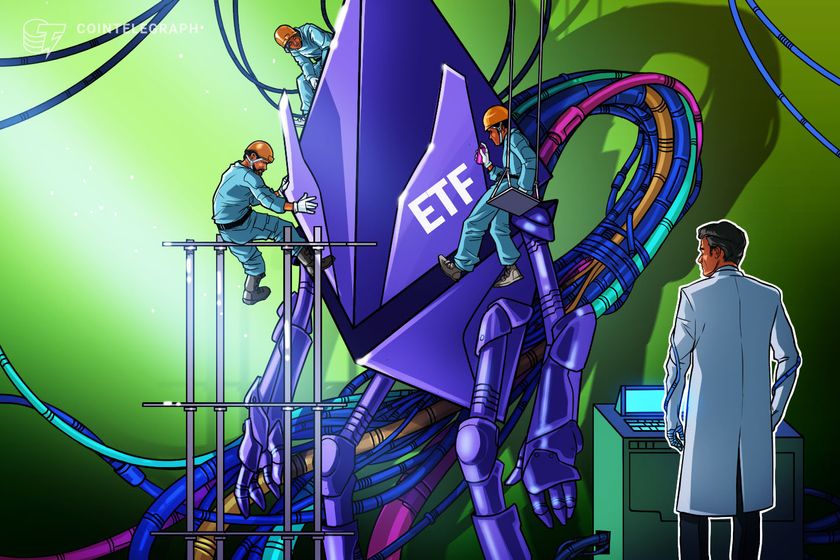 The outflow day for spot Ether ETFs comes just after Ether narrowly missed reclaiming its 2021 all-time high. Spot Ether exchange-traded funds (ETFs) closed the week with outflows after a nearly two-week streak of significant inflows. On Friday, US-spot Ether (ETH) ETFs saw $59.3 million in outflows, bringing an end to their eight-day inflow streak that added approximately $3.7 billion to the products, according to Farside data. It comes as Ether fell just 1.94% short of reclaiming its 2021 all-time high of $4,878 on Thursday, before retracing down to $4,448 at the time of publication, according to CoinMarketCap. Read more
 -
Cointelegraph.com - 05:29 Aug 16, 2025
 Crypto traders’ “lack of interest” in dip buying Ether compared to Bitcoin could be the catalyst that sees Ether's price go higher, says Santiment. Ether holds a slight edge over Bitcoin in the short-term as social media chatter around the cryptocurrency is less overheated, says sentiment platform Santiment. “The $ETH crowd hasn’t shown nearly as much bullishness despite significantly better performance over the past 3 months,” Santiment said in an X post on Friday amid the ETH/BTC ratio, which measures Ether’s (ETH) relative strength against Bitcoin (BTC) being up 32.90% over the past 30 days, according to TradingView. “The current outlook shows a slightly more bullish path for Ethereum due to the lack of interest in dip buying compared to Bitcoin,” Santiment said. Read more